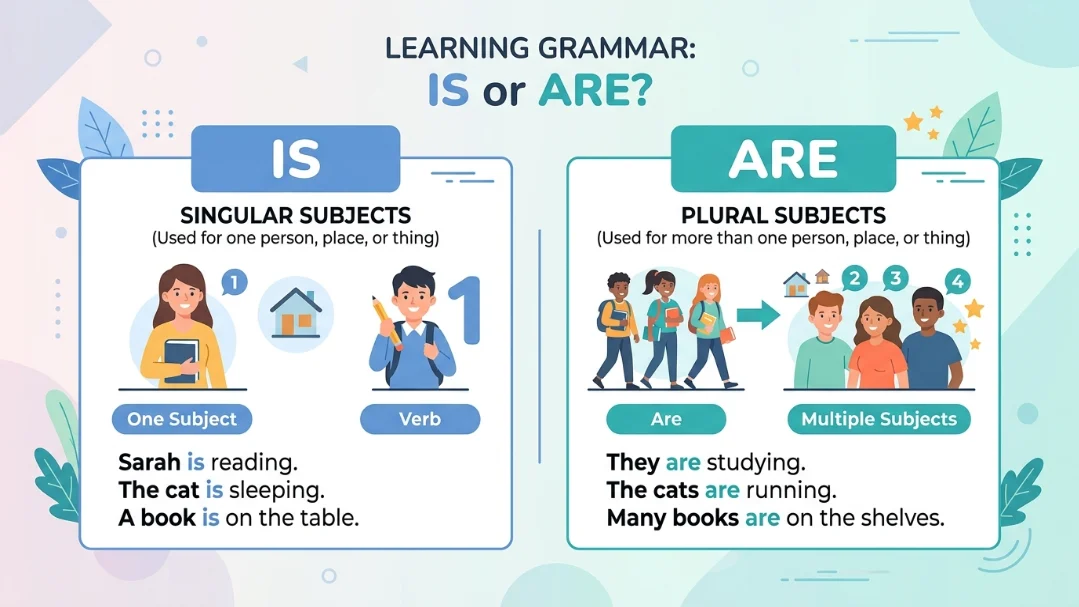
Feature Snippet: The difference between is and are is simple. Is is a singular verb used with singular subjects like “he,” “she,” “it,” or singular nouns. Are is a plural verb used with plural subjects like “we,” “they,” or plural nouns. Choose is for one person or thing and are for more than one.
Have you ever written a sentence and paused, unsure whether to use is or are? This small choice confuses writers of all levels. The two words look completely different, but choosing between them requires understanding subject-verb agreement. Getting it wrong can make your writing sound awkward and unprofessional.
This confusion matters more than you might think. English speakers use these verbs constantly. You will need them in emails, reports, essays, and everyday conversations. Using the correct form shows attention to detail and respect for your readers. It also helps you communicate clearly without causing confusion.
The challenge comes from several sources. Some subjects are tricky because they are collective nouns. Others are tricky because they are indefinite pronouns. Many people also struggle with subjects that come after the verb or with compound subjects. These situations make the choice between is and are less obvious.
This article clears up the confusion once and for all. You will learn the definitions, see real examples, and discover easy rules to choose correctly every time. By the end, you will never second-guess this choice again. Good writing depends on mastering subject-verb agreement.
The main takeaway is that is is singular and are is plural. Use is with singular subjects and are with plural subjects. The subject of your sentence determines the verb choice. This rule applies to all present tense sentences. Remember that is pairs with one person or thing, while are pairs with more than one. This simple rule works in almost every situation.
Definitions and Explanations
What Does “Is” Mean?
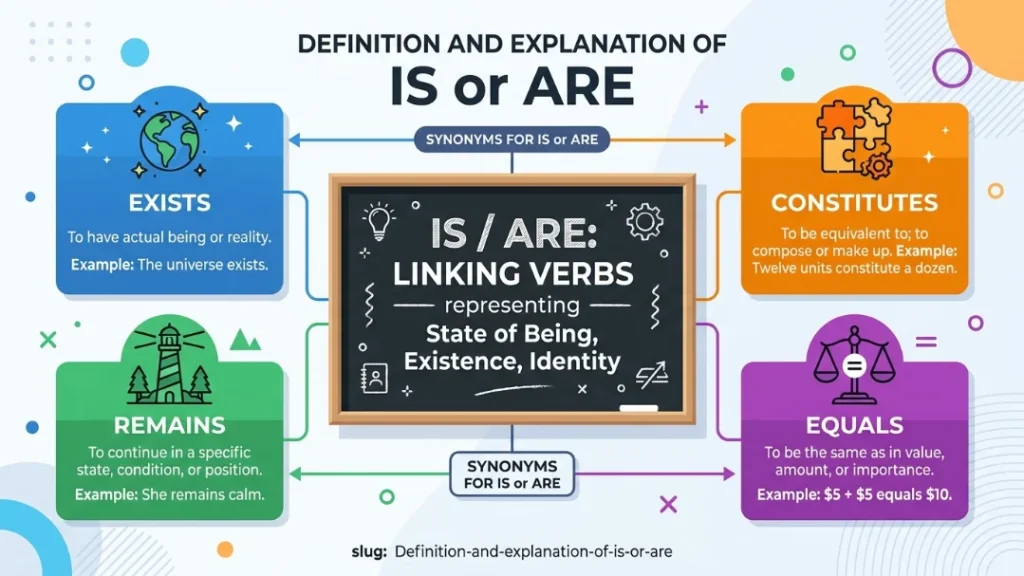
Is is a form of the verb to be. It is the third-person singular present tense form. You use is when the subject of your sentence is singular. This means the subject refers to one person, one thing, or one idea.
Is appears with singular pronouns like “he,” “she,” and “it.” It also appears with singular nouns like “the cat,” “the teacher,” or “the book.” For example, “She is happy” uses is because “she” is singular. “The dog is barking” uses is because “the dog” is singular.
The verb is describes a state of being. It connects the subject to information about the subject. It can describe identity, condition, location, or existence. For example, “He is a doctor” describes identity. “The coffee is hot” describes condition. “The book is on the table” describes location.
What Does “Are” Mean?
Are is also a form of the verb to be. However, it is the plural present tense form. You use are when the subject of your sentence is plural. This means the subject refers to more than one person, thing, or idea.
Are appears with plural pronouns like “we,” “they,” and “you.” It also appears with plural nouns like “the cats,” “the teachers,” or “the books.” For example, “They are happy” uses are because “they” is plural. “The dogs are barking” uses are because “the dogs” is plural.
Like is, the verb are describes a state of being. It connects the subject to information about the subject. It can describe identity, condition, location, or existence for plural subjects. For example, “They are doctors” describes identity. “The coffees are hot” describes condition. “The books are on the table” describes location.
The Core Difference Explained
The difference between is and are is all about number agreement. The verb must agree with the subject in number. This means singular subjects take singular verbs (is), and plural subjects take plural verbs (are).
| Subject | Number | Correct Verb | Example |
| He | Singular | Is | He is here. |
| She | Singular | Is | She is coming. |
| It | Singular | Is | It is raining. |
| The cat | Singular | Is | The cat is sleeping. |
| We | Plural | Are | We are ready. |
| They | Plural | Are | They are leaving. |
| The cats | Plural | Are | The cats are playing. |
| You | Singular or Plural | Are | You are correct. |
Understanding the Verb “To Be”
The verb to be is the most important verb in English. It connects subjects to information about them. It is also an irregular verb, meaning its forms do not follow standard patterns.
Here are the present tense forms of to be:
| Subject | Verb Form |
| I | Am |
| You | Are |
| He/She/It | Is |
| We | Are |
| They | Are |
Is appears only with third-person singular subjects (he, she, it). Are appears with first-person plural (we), second-person (you), and third-person plural (they). This table shows the complete pattern.
Advantages and Disadvantages
Using the correct form offers clear advantages. Getting it wrong can create problems. This section explores both sides.
Advantages of Using the Correct Form
- Clarity: Your readers will understand exactly what you mean. There is no confusion about whether you are describing one person or many.
- Professionalism: Correct grammar builds trust with your readers. It shows that you care about your writing and respect your audience.
- Credibility: Mistakes can make you look less educated or careless. Using the correct form helps you maintain your credibility.
- Smooth reading: When subjects and verbs agree, sentences flow smoothly. Readers will not stumble over awkward constructions.
- Confidence: Knowing the rule gives you confidence in your writing. You will not have to pause and second-guess yourself.
Disadvantages of Using the Wrong Form
- Confusion: Your reader might not know what you mean. For example, “The team is winning” and “The team are winning” could mean different things.
- Unprofessionalism: Simple grammar errors can make you appear careless. This can harm your reputation in professional settings.
- Misunderstanding: In some cases, the wrong verb might change your sentence’s meaning. “The data is clear” and “The data are clear” are both used in different contexts.
- Embarrassment: Making this mistake in public can be embarrassing and undermine your confidence.
Real-World Examples
Seeing these words used correctly helps solidify the difference.
Examples of “Is” in Action
- “The teacher is in the classroom.” This describes a singular person.
- “My car is parked outside.” This describes a singular thing.
- “She is a talented musician.” This describes a single person.
- “The water is cold.” This describes a singular substance.
- “The meeting is at 3 PM.” This describes a single event.
- “His answer is correct.” This describes a single item.
Examples of “Are” in Action
- “The teachers are in the classroom.” This describes multiple people.
- “Our cars are parked outside.” This describes multiple things.
- “They are talented musicians.” This describes multiple people.
- “The waters are cold.” This describes multiple bodies of water.
- “The meetings are at 3 PM.” This describes multiple events.
- “Their answers are correct.” This describes multiple items.
Contrasting Examples
| Singular (Is) | Plural (Are) |
| “The child is playing.” | “The children are playing.” |
| “The book is on the shelf.” | “The books are on the shelf.” |
| “My friend is coming.” | “My friends are coming.” |
| “The house is big.” | “The houses are big.” |
Common Mistakes
This section highlights the most frequent errors people make. Learning about them will help you avoid them.
Mistake 1: Confusing Collective Nouns
Collective nouns are words that refer to a group of people or things. Examples include “team,” “family,” “committee,” and “government.” These words cause confusion because they are singular in form but refer to multiple people.
Correction: In American English, collective nouns usually take singular verbs (is). For example, “The team is winning.” In British English, they can take plural verbs (are). For example, “The team are winning.” Choose one style and be consistent.
Mistake 2: Confusing Indefinite Pronouns
Indefinite pronouns like “everyone,” “someone,” “anyone,” and “no one” are singular. They take singular verbs (is). However, many people mistakenly use plural verbs with them.
Correction: Always use is with these pronouns. For example, “Everyone is here” is correct. “Everyone are here” is incorrect.
Mistake 3: Misplacing the Subject
When the subject comes after the verb, people often choose the wrong verb. This happens in questions and in sentences that begin with “there.”
Correction: Find the subject first. The verb must agree with the subject, not with the word nearest to it. For example, “There is a book on the table” (subject: book, singular). “There are books on the table” (subject: books, plural).
Mistake 4: Confusing Compound Subjects
Compound subjects joined by “and” are usually plural. They take plural verbs (are). However, compound subjects joined by “or” or “nor” take verbs that agree with the nearest subject.
Correction: Use are with “and” compounds. For example, “The cat and the dog are playing.” Use the nearest subject for “or” or “nor.” For example, “Neither the cat nor the dogs are here.”
Regional and Global Usage
The rules for is and are are largely consistent across English-speaking regions. However, there are some interesting differences.
American vs. British English
American English typically treats collective nouns as singular. For example, “The team is winning.” British English often treats collective nouns as plural. For example, “The team are winning.” Both are correct in their respective regions.
| Collective Noun | American English | British English |
| The team | The team is… | The team are… |
| The government | The government is… | The government are… |
| The committee | The committee is… | The committee are… |
| The family | The family is… | The family are… |
Data: Is or Are?
The word “data” causes special confusion. In Latin, “data” is plural. In English, it can be singular or plural.
- Formal: “The data are conclusive” (plural)
- Common: “The data is conclusive” (singular)
Both forms are acceptable in modern English. However, some style guides prefer the plural form. Be consistent in your usage.
Global Consistency
Apart from collective nouns, the rules for is and are are the same worldwide. Singular subjects take is. Plural subjects take are. This consistency makes the rule easy to learn and apply globally.
Related Concepts and Comparisons
Understanding how these words relate to other concepts helps build a complete picture.
Is vs. Am vs. Are
These are all forms of the verb to be. The choice depends on the subject:
- I am
- You are
- He/She/It is
- We are
- They are
| Subject | Verb Form |
| I | Am |
| You | Are |
| He, She, It | Is |
| We | Are |
| They | Are |
Is vs. Was
These are present and past tense forms of to be.
- Is: present tense, singular
- Was: past tense, singular
| Tense | Singular | Plural |
| Present | Is | Are |
| Past | Was | Were |
Is vs. Has
These are different verbs with different functions.
- Is: form of to be, describes state
- Has: form of to have, shows possession
| Verb | Function | Example |
| Is | Describes state | “She is happy.” |
| Has | Shows possession | “She has a car.” |
Exercises
Test your knowledge with these exercises.
Exercise 1: Fill in the Blank
Choose is or are to complete each sentence.
- The dog _________ barking loudly.
- The dogs _________ barking loudly.
- She _________ a talented artist.
- They _________ talented artists.
- The book _________ on the table.
- The books _________ on the table.
- Everyone _________ invited to the party.
- The team _________ practicing for the game.
- There _________ a problem with the computer.
- There _________ problems with the computer.
Exercise 2: Identify the Error
Each sentence has a mistake. Identify the incorrect word and correct it.
- “The children is playing in the park.”
- “My friends is coming to dinner.”
- “Everyone are excited about the trip.”
- “The committee are meeting tomorrow.” (American English)
- “There is many reasons to celebrate.”
Exercise 3: Choose the Correct Form
Select the correct form to complete each sentence.
- “The cake _________ delicious.” (is/are)
- “The cakes _________ delicious.” (is/are)
- “Neither the teacher nor the students _________ here.” (is/are)
- “The police _________ investigating the case.” (is/are)
Answer Key
Answers of Exercise 1:
- Is (singular subject: dog)
- Are (plural subject: dogs)
- Is (singular subject: she)
- Are (plural subject: they)
- Is (singular subject: book)
- Are (plural subject: books)
- Is (singular indefinite pronoun)
- Is (singular collective noun in American English)
- Is (singular subject: problem)
- Are (plural subject: problems)
Exercise 2 Corrections:
- “The children are playing in the park.” (Plural subject)
- “My friends are coming to dinner.” (Plural subject)
- “Everyone is excited about the trip.” (Singular indefinite pronoun)
- “The committee is meeting tomorrow.” (American English)
- “There are many reasons to celebrate.” (Plural subject)
Exercise 3 Answers:
- Is (singular)
- Are (plural)
- Are (nearest subject: students)
- Are (plural collective noun in American English)
FAQs
What is the difference between is and are?
The difference is simple. Is is singular and used with one person or thing. Are is plural and used with more than one person or thing. Choose is for singular subjects and are for plural subjects.
When should I use is?
Use is when the subject is singular. This includes singular pronouns like “he,” “she,” and “it.” It also includes singular nouns like “the cat” or “the book.” For example, “The cat is sleeping.”
When should I use are?
Use are when the subject is plural. This includes plural pronouns like “we” and “they.” It also includes plural nouns like “the cats” or “the books.” For example, “The cats are sleeping.”
Is it “there is” or “there are”?
It depends on the subject. Use “there is” with singular subjects. For example, “There is a book on the table.” Use “there are” with plural subjects. For example, “There are books on the table.”
Is it “the team is” or “the team are”?
Both can be correct. In American English, use “the team is” (singular). In British English, use “the team are” (plural). Choose one style and be consistent.
Is it “everyone is” or “everyone are”?
Always use “everyone is.” “Everyone” is a singular indefinite pronoun. It takes a singular verb. “Everyone are” is incorrect.
Is it “data is” or “data are”?
Both can be correct. In formal or technical writing, use “data are” (plural). In everyday usage, “data is” (singular) is widely accepted. Be consistent in your writing.
Is it “the police is” or “the police are”?
Use “the police are.” “Police” is a plural collective noun. It refers to multiple individuals. “The police is” is generally incorrect.
What is subject-verb agreement?
Subject-verb agreement means the subject and verb must match in number. Singular subjects take singular verbs (is). Plural subjects take plural verbs (are). This rule applies to all present tense sentences.
How do I know if a noun is singular or plural?
A singular noun refers to one person or thing. A plural noun refers to more than one. Plural nouns usually end in “s” or “es.” For example, “book” (singular) and “books” (plural). Some plurals are irregular, like “child” and “children.”
Is “none” singular or plural?
“None” can be singular or plural. Traditionally, “none” is singular (not one). However, “none” is also widely used as a plural. For example, “None of the food is left” (singular) and “None of the books are here” (plural).
Conclusion
This guide has clarified the simple but important difference between is and are. Is is singular and used with singular subjects. Are is plural and used with plural subjects. The verb must agree with the subject in number. This rule applies to all present tense sentences.
The best practical advice is to identify your subject first. Find the main noun or pronoun in your sentence. Decide if it is singular or plural. Then choose the verb that matches. This simple process works in almost every situation. Remember that collective nouns, indefinite pronouns, and compound subjects have special rules.
Good writing depends on mastering subject-verb agreement. Getting it right shows attention to detail and professionalism. Now you have the knowledge to choose the correct verb every time. Use this guide as a reference whenever you are unsure. Over time, the correct usage will become second nature to you.