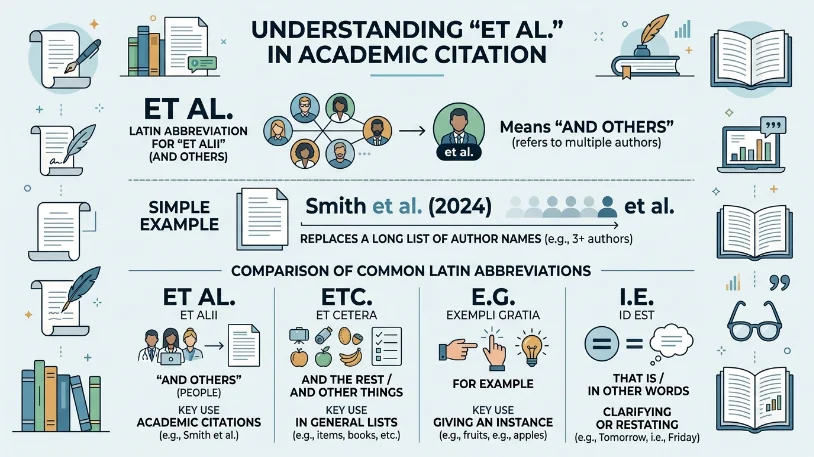
Et al. is a Latin abbreviation meaning “and others.” Writers use it after a person’s surname when a source has multiple authors. It commonly appears in academic citations, research papers, books, legal writing, and scholarly references.
what does et al mean is a common question for students, researchers, readers, and anyone who encounters academic citations. The short answer is simple: et al. means “and others.” It comes from the Latin phrase et alii, et aliae, or et alia, depending on the grammatical context.
However, the abbreviation does not usually appear in casual texting or social media slang. Instead, it belongs mainly to formal and academic writing. You may see it in research papers, journal articles, books, dissertations, essays, and reference lists.
For example, a citation might say Smith et al. (2024). This means Smith and the other authors who contributed to that source.
The exact rules vary by citation style. APA, MLA, Chicago, and other systems handle multiple authors differently. Therefore, you should always check the style guide required for your assignment or publication.
The most important point is this: et al. saves space while still identifying a source with several contributors.
Quick Answer Box
| Meaning | Context | Primary Platforms | Example | Tone |
| And others | Academic and scholarly writing | Research papers, journals, books, citations | Smith et al. (2024) | Formal |
| Latin abbreviation | Author citations | APA, Chicago, scientific writing | Jones et al. | Professional |
| Multiple contributors | Source attribution | Academic databases and publications | Brown et al. | Neutral |
What Does et al Mean? Full Semantic Definition and Origin
The phrase et al. comes from Latin. The word et means “and.” The word al. is an abbreviation related to Latin words meaning “others.”
Consequently, the expression communicates the idea of “and others.”
The abbreviation does not identify a specific number of people by itself. Instead, it tells the reader that additional authors exist beyond the person named in the citation.
For example:
Johnson et al. found that sleep patterns changed significantly among participants.
This sentence refers to Johnson and the other authors of the study.
Why Does the Abbreviation Have a Period?
The period matters because al. is an abbreviation. The period signals that the word has been shortened.
By contrast, et normally does not receive a period because it is already a complete Latin word.
Therefore, the conventional form is:
et al.
Not:
et. al.
And generally not:
et al
when the chosen citation style requires the abbreviation punctuation.
What Does “Et” Mean?
In Latin, et means “and.”
It appears in many familiar Latin expressions. In et cetera, for example, et also means “and.”
However, et by itself does not mean “and others.” The complete abbreviation et al. carries that meaning.
What Does “Al.” Mean?
The abbreviation al. represents a Latin term connected with “others.”
The complete Latin expression can vary according to grammatical gender and context:
| Latin Form | General Meaning |
| et alii | and other men or masculine plural |
| et aliae | and other women or feminine plural |
| et alia | and other things |
| et al. | General abbreviated form used in citations |
Modern academic writing usually uses et al. as the standard citation abbreviation. Writers do not normally switch between these full Latin forms in ordinary references.
Is Et Al. English?
No. Et al. is Latin, although English academic writing uses it extensively.
English has adopted many Latin expressions. For example, academic and professional writing also uses terms such as i.e., e.g., etc., and vice versa.
Therefore, seeing et al. in an English paper does not mean the paper has switched languages. It simply uses a traditional Latin abbreviation.
Contextual Dynamics and Nuances of the Term
The meaning remains stable, but its function depends heavily on context.
Most importantly, et al. normally refers to people associated with a cited work. In academic writing, those people are usually authors.
For example:
Garcia et al. examined the relationship between exercise and concentration.
Here, Garcia is one author. The other contributors are represented by et al.
It Does Not Mean “Etc.”
A common misunderstanding involves confusing et al. with etc.
They have different meanings.
| Expression | Meaning | Typical Use |
| et al. | and others | People or authors |
| etc. | and so on | Things, examples, items |
| e.g. | for example | Introducing examples |
| i.e. | that is | Clarifying a statement |
Consider the difference:
Garcia et al. conducted the study.
This refers to Garcia and other authors.
Now consider:
The study examined age, education, income, etc.
Here, etc. means other similar items.
Using etc. when referring to authors would therefore create confusion.
It Usually Refers to Authors
In scholarly citations, et al. most often appears after an author’s surname.
For example:
Miller et al. (2023)
The reader understands that Miller is the named author and additional authors contributed to the cited work.
The reference list may provide the full author information, depending on the citation style.
It Can Appear in Narrative and Parenthetical Citations
Academic citation systems commonly use two broad citation formats.
A narrative citation integrates the author into the sentence:
Miller et al. (2023) reported similar findings.
A parenthetical citation places the reference information inside parentheses:
Similar findings were reported (Miller et al., 2023).
The exact punctuation and author rules depend on the citation system.
The Number of Authors Matters
Different citation styles establish different thresholds for using the abbreviation.
For example, current APA Style rules generally use et al. for works with three or more authors in in text citations. Other styles have different rules.
Therefore, you should not assume that every academic style uses the same author cutoff.
That distinction matters because a paper can be grammatically correct yet still violate the required citation style.
Real Life Conversation Examples Using et al.
Although the expression mainly belongs to formal writing, people sometimes mention it during conversations about school, research, or publishing.
Example 1: Student Asking About a Citation
Student: I keep seeing “Taylor et al.” in my textbook. What does that mean?
Teacher: It means Taylor and the other authors of the source.
Student: So it does not mean Taylor is the only author?
Teacher: Correct. It tells you that additional authors contributed to the work.
Example 2: Research Discussion
Researcher A: Who wrote the study we discussed yesterday?
Researcher B: Lee et al. published it in 2022.
Researcher A: Got it. Lee was one of several authors.
Researcher B: Exactly.
Example 3: Citation Style Question
Student: Can I use et al. in my paper?
Professor: Yes, if your required citation style calls for it.
Student: Should I use it everywhere?
Professor: Not necessarily. Follow the specific rules for your style and source type.
Example 4: Reading a Journal Article
Reader: Why does this article say “Garcia et al.” instead of listing everyone?
Editor: The citation style allows the authors to be shortened in the text.
Reader: Where can I find the complete author list?
Editor: Usually in the reference section or source information.
Example 5: Casual Explanation
Friend A: I saw “Brown et al.” in your assignment.
Friend B: Yeah, it is a research citation.
Friend A: So et al. means other people?
Friend B: Exactly. It means “and others.”
Platform Specific Breakdown
The expression behaves very differently across online platforms. It is important not to treat it like modern internet slang.
How It Is Used on Snapchat
Snapchat is primarily a casual communication platform. Therefore, et al. is uncommon in ordinary Snapchat conversations.
Someone might still use it when discussing schoolwork, research, medicine, science, or another academic subject.
For example:
“Our professor wants us to read Johnson et al. before Friday.”
Here, the abbreviation retains its formal citation meaning.
However, a person is unlikely to use et al. as ordinary slang. It does not generally mean “friends,” “everyone,” or “the group” in casual Snapchat language.
The Role of et al. on TikTok
TikTok content sometimes discusses academic subjects, science, history, books, medicine, and research. Therefore, users may encounter the abbreviation in captions, educational videos, or comments.
For example:
“Researchers found this effect in a study by Wilson et al.”
In this setting, the phrase works as a citation reference.
However, TikTok does not give the abbreviation a special platform specific meaning. Its core definition remains “and others.”
Therefore, context is critical.
If someone uses the expression while discussing a research paper, it probably has its traditional academic meaning. If someone uses it in a joke, the creator may be deliberately playing with formal academic language.
Instagram and Texting Dynamics
Instagram captions can sometimes contain academic citations, especially in educational posts. However, ordinary personal messages rarely use et al.
For example:
“According to Patel et al., the results were significant.”
That sentence uses the abbreviation normally.
By contrast:
“Me and my friends et al.”
would not be standard usage.
The second example incorrectly treats et al. as a casual substitute for “and friends.”
Academic Databases and Search Results
You may also encounter the abbreviation when browsing academic databases or research websites.
Search results often display shortened author information because long author lists can make titles and citations difficult to scan.
Consequently, recognizing et al. helps readers understand that a source has multiple contributors.
Books and Printed Publications
Books may use the abbreviation in citations, footnotes, bibliographies, and scholarly discussions.
Its appearance depends on the publisher’s editorial style. Therefore, the same source can look slightly different across publications.
Alternative Meanings and NLP Variations of the Phrase
The core meaning does not change much. However, natural language processing systems and search engines may associate the term with several related phrases.
Common semantic variations include:
| Variation | Meaning |
| and others | Direct English meaning |
| authors and others | Academic interpretation |
| multiple authors | Citation context |
| coauthors | People who contributed to a work |
| scholarly citation | Common usage environment |
| author abbreviation | Functional description |
| Latin abbreviation | Linguistic classification |
| academic citation term | Search intent variation |
Searchers may phrase the same question in different ways.
For example:
“what does et al mean”
“What does et al. stand for?”
“What does et al. mean in citations?”
“What does et al. mean in research?”
“What does et al. mean after a name?”
“All authors or et al?”
These queries generally point toward the same underlying concept.
Et Al. Versus And Others
The simplest translation is “and others.”
However, the phrase does not function exactly like those two English words in every sentence.
It operates as a conventional citation abbreviation.
That means you should not automatically replace every instance of “and others” with et al. Formal citation rules determine when the abbreviation is appropriate.
Et Al. Versus Coauthors
The word coauthors describes the people who wrote a work alongside the named author.
Et al., by contrast, abbreviates the citation itself.
Therefore:
Smith et al.
means Smith and the other authors.
But:
Smith’s coauthors
directly describes those additional authors.
The two expressions overlap in meaning, but they serve different grammatical purposes.
Misinterpretations: When NOT to Use et al.
Understanding when not to use the abbreviation is just as important as understanding its meaning.
Do Not Use It as a General Synonym for Friends
You should not write:
“I went out with Sarah et al.”
unless you are intentionally using academic style as a joke.
In ordinary English, write:
“I went out with Sarah and some friends.”
Do Not Use It for Objects
Et al. refers to people in its conventional citation use.
Therefore, this is inappropriate:
“I bought apples et al.”
Use etc. or another suitable phrase instead.
Do Not Replace “Etc.” With Et Al.
These abbreviations serve different purposes.
Use et al. for people or authors.
Use etc. for additional things or examples.
Do Not Add an Extra Period After Et
The standard form is:
et al.
Not:
et. al.
The period belongs after al.
Do Not Assume Every Citation Style Uses It the Same Way
Citation systems differ.
APA has specific rules. MLA has its own approach. Chicago also has distinct conventions.
Therefore, always check your required style guide.
Do Not Use It Without Understanding the Source
If you cite “Smith et al.,” make sure the source actually contains multiple authors.
You should also make sure Smith is an appropriate author name to use under your citation style.
Accuracy matters more than shortening a citation.
How to Respond in Chat Comfortably
If someone asks you what the abbreviation means, you can answer simply.
A natural response is:
“It means ‘and others.’ It usually appears in academic citations when a source has multiple authors.”
You can also make the answer shorter:
“Et al. means ‘and others,’ usually referring to other authors.”
For a casual conversation, there is no need to give a long Latin explanation unless the person asks for more detail.
If Someone Asks “What Does Et Al Mean in a Paper?”
You could say:
“It means the named author plus the other authors of the source.”
If Someone Asks “Why Does My Professor Use It?”
You could respond:
“It shortens citations when a work has multiple authors. The exact rules depend on the citation style.”
If Someone Uses It Incorrectly
You can correct them politely:
“Et al. usually refers to other people, especially authors. For things, ‘etc.’ is usually the better abbreviation.”
If You Need a One Sentence Definition
Use:
“Et al. is a Latin abbreviation meaning ‘and others,’ commonly used when citing a work with multiple authors.”
FAQs
What does et al mean in a citation?
It means “and others.” In citations, it usually represents additional authors who contributed to the cited work.
What does et al. stand for?
It is an abbreviation derived from Latin expressions meaning “and others.” Academic writers commonly use it to shorten citations containing multiple authors.
Is et al. Latin or English?
It is Latin. However, English academic writing uses it frequently, especially in scholarly citations.
Does et al. mean more than one author?
Usually, yes. In academic citations, it indicates that additional authors exist beyond the author whose surname appears before the abbreviation.
What is the difference between et al. and etc.?
Et al. means “and others” and generally refers to people. Etc. means “and so on” and generally refers to additional things or examples.
Should et al. be italicized?
Citation style determines formatting. In many modern academic styles, et al. is not italicized simply because it originated in Latin. Always follow the style guide required for your work.
Does et al. include the first author?
No. The named author appears separately. The abbreviation represents the additional authors.
For example:
Smith et al.
means Smith and the other authors.
Can I use et al. in an essay?
Yes, when your citation style permits it. It is especially common in academic essays that cite scholarly sources.
However, do not insert it simply to sound formal. Use it according to the required citation rules.
Is et al. used in APA style?
Yes. APA Style uses et al. in in text citations for works with three or more authors. However, reference list rules differ, so do not automatically apply the same abbreviation everywhere.
Can I use et al. in casual texting?
You can, but it is unusual. Most people use the abbreviation in academic, professional, or scholarly contexts rather than ordinary texting.
Conclusion
Although people sometimes discover the term while browsing social platforms, et al. is not primarily internet slang. It is a traditional Latin abbreviation that remains useful in modern academic and professional writing.
The central idea is straightforward: et al. means “and others.”
Most commonly, those “others” are additional authors of a cited source.
The abbreviation helps writers avoid repeating long lists of names throughout an academic paper. Consequently, readers can scan citations more efficiently while still identifying the primary author.
However, correct usage depends on context. You should distinguish et al. from etc., which means “and so on.” You should also remember that citation styles have different rules for author names, punctuation, and formatting.
For students, the easiest rule is simple. When you see a citation such as Smith et al., read it as Smith and the other authors.
That interpretation will usually give you the correct meaning immediately.
Ultimately, understanding this small abbreviation makes academic writing easier to read. It also helps students recognize citations, research sources, and scholarly references without confusion.

Jack Murphy is a language writer with a passion for word meanings, synonyms, and effective communication. He creates informative and easy to understand content to help readers enhance their vocabulary and language skills.




26 thoughts on “What Does et al Mean | The Ultimate Guide and Meaning For 2026”