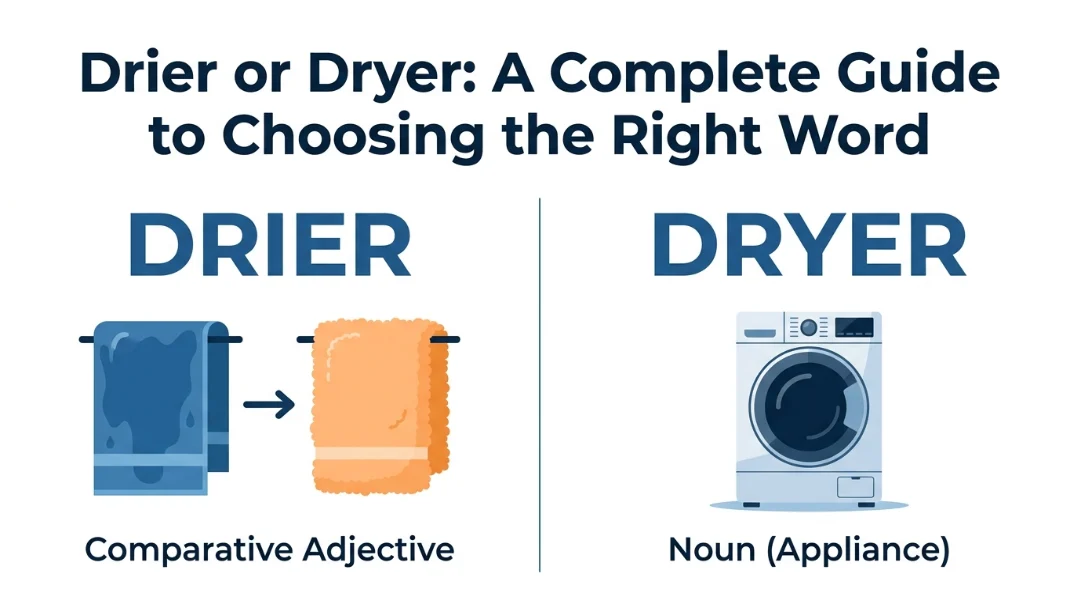
The difference between drier and dryer is simple. Drier is a comparative adjective that means more dry. Dryer is a noun that refers to an appliance or machine used for drying things. Remember that drier describes a condition, while dryer names a device.
Have you ever stared at a sentence and wondered whether to write drier or dryer? This small spelling difference causes confusion for many writers. The two words sound identical when spoken, yet they serve entirely different purposes in writing. One describes a condition, and the other names a machine.
This confusion matters more than you might think. Using the wrong word can make your writing look unprofessional and unclear. Imagine telling someone that your clothes are getting dryer when you actually mean drier. Your reader might picture a machine instead of understanding that your laundry is almost dry.
The challenge comes from the fact that English has many words with the same pronunciation but different spellings and meanings. These are called homophones. Drier and dryer are perfect examples of this confusing pattern. Many people simply do not know which one to use because they have never learned the rule.
This article clears up the confusion once and for all. You will learn the definitions, see real examples, and discover easy memory tricks to choose correctly every time. By the end, you will never second-guess this choice again. Good writing depends on these small but important distinctions.
The main takeaway is that drier is always a comparative adjective meaning more dry. Dryer is always a noun meaning a machine or device that removes moisture. You can remember the difference by thinking of the “er” in drier as meaning “more” and the “er” in dryer as meaning “a thing that does.” This guide will help you master both words and never confuse them again.
Definitions and Explanations
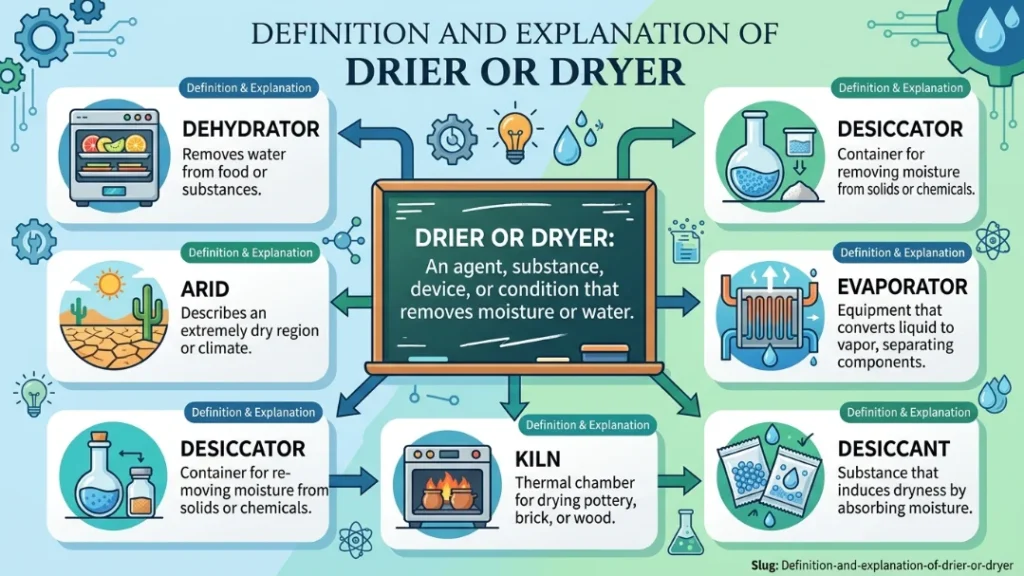
What Does “Drier” Mean?
Drier is a comparative adjective. It describes something that has less moisture than something else. It is the comparative form of the adjective dry. For example, “This towel is drier than that one” means the first towel has less water. “The desert climate is drier than the rainforest” compares the moisture levels of two regions.
Drier follows the standard rule for forming comparative adjectives. For most short adjectives with one syllable, you add “-er” to the end. For example, dry becomes drier. High becomes higher. Wet becomes wetter. This pattern is consistent and easy to follow.
Drier can also be an adjective used to describe a period of weather. For instance, “We are expecting a drier week ahead” means the upcoming days will have less rain. It can describe soil, air, skin, or any other thing that can have moisture removed.
What Does “Dryer” Mean?
Dryer is a noun. It refers to a machine or device that removes moisture from things. The most common dryer is the clothes dryer in your laundry room. This appliance spins clothes and blows hot air to make them dry. Another type is the hair dryer, which blows hot air onto wet hair to speed up drying.
Dryer follows the pattern of many English nouns that end in “-er.” In this case, the “-er” suffix means “one that does” or “a thing that does.” A dryer is a thing that dries. This pattern also appears in other words like washer (a thing that washes) and cleaner (a thing that cleans).
Dryer can also refer to other drying devices in industrial settings. For example, a grain dryer removes moisture from harvested crops. A paint dryer speeds up the drying process for painted surfaces. In all cases, a dryer is a tool, not a description.
The Pronunciation
Both words are pronounced exactly the same way. They sound like “DRY-er.” The first syllable rhymes with “try” and “sky.” The second syllable is a short “er” sound, like the end of “teacher.” This identical pronunciation is the main reason people confuse them. They hear the word but do not know which spelling to use. This makes writing the correct word challenging because your ear cannot help you. You have to rely on your knowledge of grammar and meaning.
| Word | Part of Speech | Meaning | Pronunciation |
| Drier | Comparative adjective | More dry | DRY-er |
| Dryer | Noun | A machine that dries | DRY-er |
The Etymology and Origin
Understanding where these words come from can help you remember the difference.
- Drier: This word comes directly from the adjective dry. The Old English word for dry was drȳge. Adding the suffix “-er” creates the comparative form. This pattern has existed in English for over a thousand years. It simply means “more dry” and follows the same rule as other one-syllable adjectives.
- Dryer: This word also comes from dry, but it takes a different suffix. The “-er” suffix here means “one who” or “that which.” A dryer is literally “that which dries.” This suffix also appears in words like worker (one who works) and reader (one who reads). The noun dryer appeared in English around the 15th century to describe devices that dry things.
Advantages and Disadvantages
Advantages of Using the Correct Form
Using the correct form offers several clear benefits for your writing and communication.
- Clarity: Using the right word ensures your reader knows exactly what you mean. There is no confusion about whether you are describing a condition or naming a machine.
- Professionalism: Correct grammar builds trust with your readers. It shows that you care about your writing and respect your audience. This is especially important in business, academic, and formal settings.
- Credibility: Mistakes can make you look less educated or careless. Using the correct form helps you maintain your credibility as a writer or speaker.
- Precision: Choosing the right word allows you to say exactly what you mean. This precision improves the quality of your communication.
Disadvantages of Using the Wrong Form
Using the wrong form can create problems for your communication.
- Confusion: Your reader might misunderstand your meaning. For example, saying “The clothes are dryer” could mean the clothes are a machine, which makes no sense.
- Unprofessionalism: Simple grammar errors can make you appear careless or uneducated. This can harm your reputation in professional settings.
- Misunderstanding: In some cases, the wrong word might change the meaning of your sentence entirely. “I need a drier” could mean you need something that is more dry or a machine that removes moisture.
- Embarrassment: Making this mistake in public can be embarrassing and undermine your confidence as a communicator.
Real-World Examples
Seeing these words used correctly in real-world contexts helps solidify the difference.
Examples of “Drier” in Action
- “This towel is drier than the one I used yesterday.” This example compares two towels and shows that one has less moisture.
- “The climate in Arizona is much drier than the climate in Florida.” This compares the moisture levels of two different states.
- “After the rain stopped, the ground became drier.” This describes a change in condition over time.
- “My skin feels drier in the winter months.” This describes a personal experience.
- “We should move the laundry to a drier room in the house.” This describes a location with less humidity.
Examples of “Dryer” in Action
- “The clothes dryer broke, so I had to hang my laundry outside.” This example names the appliance used for drying.
- “I need to buy a new hair dryer for my morning routine.” This names a personal care device.
- “The new industrial dryer can process 500 pounds of grain per hour.” This describes a commercial machine.
- “Please put the towels in the dryer for 20 minutes.” This gives an instruction about using an appliance.
- “The paint dryer uses infrared heat to speed up the process.” This describes a specialized device.
Common Phrases and Contexts
Certain common situations almost always use one of these words. Recognizing these patterns helps you make the right choice.
| Situation | Correct Word | Example |
| Comparing moisture levels | Drier | “The desert is drier than the jungle.” |
| Laundry appliance | Dryer | “Put the clothes in the dryer.” |
| Hair styling tool | Dryer | “She used a hair dryer.” |
| Describing weather | Drier | “This year has been drier than last year.” |
| Industrial machine | Dryer | “The factory bought a new grain dryer.” |
| Describing skin | Drier | “My hands get drier in cold weather.” |
Regional and Global Usage
Global English Consistency
The distinction between drier and dryer is consistent across all major English dialects. Whether you are writing for an American, British, Australian, or Canadian audience, the rules are identical. Drier is always the comparative adjective. Dryer is always the noun for the appliance. There is no regional variation in this rule.
North American Usage
In North America, the distinction is clear and widely taught in schools. Most people know that dryer is the machine in the laundry room. The spelling drier appears less often in everyday writing but remains correct for describing something more dry. Both words are common and used correctly by educated writers.
British and Commonwealth Usage
British English follows the same rules as American English. Drier is the comparative adjective. Dryer is the appliance. However, British English sometimes uses the spelling dryer for both the noun and the adjective. This is not considered standard, but it does appear occasionally. The recommended practice is to follow the standard rule to avoid confusion.
| Region | Comparative Adjective | Noun (Appliance) |
| United States | Drier | Dryer |
| United Kingdom | Drier | Dryer |
| Australia | Drier | Dryer |
| Canada | Drier | Dryer |
Common Mistakes
Mistake 1: Using “Dryer” as an Adjective
This is the most common error. People write “dryer” when they mean “more dry.” For example, “This shirt is dryer than that one” should be “This shirt is drier than that one.” The word dryer is only a noun, so using it as an adjective is always incorrect.
Correction: Check your sentence. Are you comparing two things and saying one has less moisture? If yes, use drier. Are you naming an appliance? If yes, use dryer.
Mistake 2: Using “Drier” for the Appliance
This mistake also happens frequently. People write “drier” when they mean the appliance. For example, “Put the clothes in the drier” should be “Put the clothes in the dryer.” The word drier is only an adjective, so using it as a noun is always incorrect.
Correction: Think about what you are naming. Are you talking about a machine? If yes, use dryer. Are you describing a condition? If yes, use drier.
Mistake 3: Adding “More” Before “Drier”
Adding the word “more” before drier is redundant and grammatically incorrect. Drier already means “more dry.” Saying “more drier” is like saying “more more dry.” This is a common error that sounds awkward and marks you as someone who does not understand comparative adjectives.
Correction: Use only drier when comparing two things. For example, “This shirt is drier than that one” is correct. “This shirt is more drier than that one” is incorrect.
Exercises
Test your knowledge with these exercises.
Exercise 1: Fill in the Blank
Choose drier or dryer to complete each sentence.
- This summer has been much _________ than last summer.
- Please move the wet clothes from the washing machine to the _________.
- My hair feels _________ after using the new shampoo.
- She bought a new hair _________ for her birthday.
- The air in the mountains is often _________ than the air in the valley.
- The industrial _________ can handle large quantities of grain.
- After the storm, the ground will become _________ over time.
- He repaired the clothes _________ in the laundry room.
Exercise 2: Identify the Error
Each sentence has a mistake. Identify the incorrect word and correct it.
- “The laundry is in the drier.”
- “This region is dryer than the coastal area.”
- “I need a more drier towel for the spill.”
- “The hair drier is on the bathroom counter.”
Answer Key
Exercise 1 Answers:
- Drier (comparing seasons)
- Dryer (the appliance)
- Drier (describing a condition)
- Dryer (the appliance)
- Drier (comparing conditions)
- Dryer (the machine)
- Drier (describing a condition)
- Dryer (the appliance)
Exercise 2 Corrections:
- “The laundry is in the dryer.” (A machine, not a description)
- “This region is drier than the coastal area.” (A comparison, not a machine)
- “I need a drier towel for the spill.” (Remove “more” because “drier” already means more dry)
- “The hair dryer is on the bathroom counter.” (A machine, not a description)
Related Concepts and Comparisons
Dryer vs. Drier as a Noun
In some contexts, drier can also be a noun. It refers to a person or substance that dries things. For example, a drier in a factory is a worker who dries materials. A chemical drier is a substance that absorbs moisture. However, this usage is rare and specialized. In almost all everyday situations, the noun is dryer and the adjective is drier. For most people, the distinction is simple: dryer is the machine, and drier is the description.
Drier vs. Driest
These are both comparative and superlative forms of dry. Drier compares two things and means “more dry.” Driest compares three or more things and means “most dry.” For example, “This towel is drier than that one” compares two. “This is the driest towel of all” compares many. The same pattern applies to other adjectives like wet (wetter, wettest) and high (higher, highest).
| Form | Meaning | Example |
| Dry | Base form | “The towel is dry.” |
| Drier | Comparative (more dry) | “This towel is drier than that one.” |
| Driest | Superlative (most dry) | “This is the driest towel of all.” |
Dryer vs. Drier in Technical Writing
In technical and industrial writing, the distinction is even more important. Engineers and technicians use dryer to name specific machines. They use drier to describe conditions and materials. Using the wrong term could cause confusion and even safety issues. For example, a “chemical dryer” might be a machine that removes moisture from chemicals. A “chemical drier” might be a substance that absorbs moisture. These are two different things, and getting them wrong could be dangerous.
FAQs
What is the difference between drier and dryer?
The difference is simple. Drier is a comparative adjective that means “more dry.” Dryer is a noun that refers to a machine that removes moisture. They serve different purposes in a sentence.
Is it drier or dryer for clothes?
It depends on what you mean. The machine is a dryer. The condition of being more dry is drier. For example, “Put the clothes in the dryer” (the machine). “These clothes are drier than those” (the condition).
How do you spell clothes dryer?
The correct spelling is clothes dryer. This is the appliance in your laundry room. Clothes drier is incorrect because drier is an adjective, not a noun.
Is it hair dryer or hair drier?
It is hair dryer. This is the appliance that blows hot air on wet hair. Hair drier is incorrect because the word drier is an adjective, not a noun. The device is a thing that dries hair.
Is it a dryer or drier cycle on a washing machine?
It is a dryer cycle. This is a function on a combined washer-dryer machine. The cycle dries the clothes. Drier cycle would mean a cycle that is more dry, which does not make sense in this context.
Why are drier and dryer confused?
They are confused because they sound the same when spoken. Both are pronounced “DRY-er.” People hear the sound and do not know which spelling to use. This is a common challenge with English homophones.
Can drier be a noun?
Yes, but rarely. Drier can be a noun meaning a person or substance that dries things. For example, a paint drier is a chemical that speeds up drying. However, this usage is uncommon in everyday language.
Which spelling is more common?
Dryer is more common in modern English because it appears frequently in everyday contexts. People talk about clothes dryers and hair dryers all the time. Drier appears less often but is still a standard English word.
Is it drier or dryer in the UK?
Both spellings follow the same rules in the UK. Drier is the comparative adjective. Dryer is the noun for the appliance. Some British publications use dryer for both, but this is not standard and is not recommended.
What is a simple memory trick for drier and dryer?
Remember that dryer has a “y” like “you.” You use a dryer. Drier is the comparative adjective, just like higher and wider. If you can replace the word with “more dry,” use drier.
Conclusion
This guide has clarified the simple but important difference between drier and dryer. Drier is always a comparative adjective that means “more dry.” Dryer is always a noun that refers to a machine or device that removes moisture. The key is to remember that drier describes a condition, while dryer names a device.
The best practical advice is to check your sentence for meaning. Are you comparing two things and saying one has less moisture? Use drier. Are you naming an appliance or machine? Use dryer. With practice, this distinction will become automatic. You will no longer pause and wonder which spelling to choose.
Good writing depends on these small but important details. Getting them right shows respect for your readers and attention to your craft. Now you have the knowledge to choose the correct word every time. Use this guide as a reference whenever you are unsure. Over time, the correct usage will become second nature to you. Always proofread your writing to catch any lingering confusion between these two words.