The correct plural of “bus” is “buses” in modern English, though “busses” is listed as a variant in some dictionaries. “Busses” appears mainly in historical contexts or when referring to a verb meaning “kisses.” For all standard writing, “buses” is the preferred and widely accepted spelling.
Have you ever stopped mid-sentence, unsure whether to type “buses” or “busses”? This common spelling dilemma catches many writers off guard. The confusion arises because English has tricky rules about doubling consonants when adding endings. Adding to the puzzle, “buss” is also an old-fashioned word for a kiss. Suddenly, what should be a simple plural becomes a source of uncertainty.
Getting this spelling right matters for clear communication. In professional writing, using the wrong form can distract readers and undermine your credibility. Whether you write school reports, business documents, or creative pieces, accuracy in spelling reflects attention to detail. The good news is that the choice is straightforward once you understand the rules. This guide explains everything you need to know about the plural of “bus” in a clear and simple way. By the end, you will feel confident choosing the correct spelling every time.
Key Takeaway
The plural of “bus” is “buses,” and this form is recommended by almost all modern style guides and dictionaries . “Busses” appears as an alternative in some sources but is rarely used in contemporary writing. In fact, “busses” is so uncommon that most readers will consider it a spelling error . The only common context where “busses” remains correct is when it functions as a verb meaning “kisses .
Definition and Explanation
What Does “Buses” Mean?
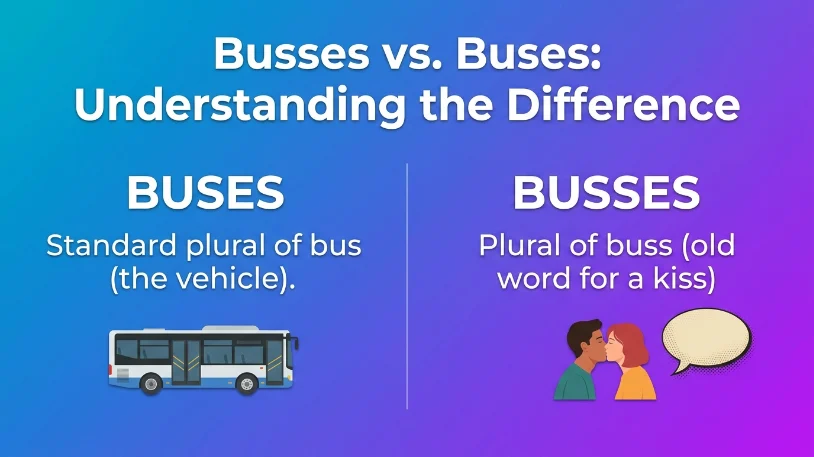
“Buses” is the standard plural form of the noun “bus.” A bus is a large motor vehicle designed to carry many passengers along a fixed route . The word originated as a shortened form of “omnibus,” a Latin term meaning “for all .
People use “buses” in several contexts:
- Multiple passenger vehicles: “The buses arrive every ten minutes.”
- The present tense verb form meaning to transport by bus: “The company buses employees to the office.
- The present tense verb form meaning to clear tables in a restaurant: “He buses tables during his evening shift.
What Does “Busses” Mean?
Busses” has two distinct meanings. First, it can be an alternative and now outdated plural form of “bus” . Some older texts use this spelling, but it has largely disappeared from modern usage.
Second, “busses” is a verb meaning “kisses.” This usage comes from the noun “buss,” an archaic word for a kiss . In this context, “busses” is the correct present tense form: “She busses her child on the forehead.”
The Spelling Rule Explained
The confusion between “buses” and “busses” stems from a common English spelling rule. When a word ends in “s,” adding “-es” to form the plural is standard. For example, “class” becomes “classes,” and “truss” becomes “trusses” . Following this rule, “bus” should become “buses.”
However, some words with a short vowel sound double the final consonant before adding endings. For instance, “nag” becomes “nagged” . This doubling helps preserve the short vowel pronunciation. Since “buse” is not a common word, the need to double the “s” in “bus” is less pressing. Therefore, the standard plural became “buses” rather than “busses.”
Verb Forms of “Bus”
The verb “to bus” has two very different meanings in American English:
- To transport someone by bus: “The school buses children from across the district.”
- To clear dirty dishes from tables at a restaurant: “She buses tables during the lunch rush.”
For verb forms, both “buses” and “busses” are acceptable in present tense usage . Similarly, “bused” and “bussed” both appear as past tense forms. This flexibility applies to the verb but not to the noun plural.
| Word Form | Noun (Vehicle) | Verb (Transport) | Verb (Clear Tables) |
| Present Tense Singular | bus | bus | bus |
| Present Tense Plural | buses | bus (they bus) | bus (they bus) |
| 3rd Person Singular Present | buses | buses | buses |
| Past Tense | – | bused/bussed | bused/bussed |
| Present Participle | – | busing/bussing | busing/bussing |
Advantages and Disadvantages
The Case for “Buses”
The overwhelming advantage of “buses” is that it is the standard, modern form. Major style guides and dictionaries list “buses” as the preferred plural of “bus” . According to usage data, in the United States, there is an 85% preference for “buses” over “busses.” In the United Kingdom, this preference rises to 92% . Using “buses” ensures your writing aligns with current conventions and avoids distracting readers.
The only disadvantage is that “buses” might look like it should rhyme with “fuses” to some readers. Yet this is a minor concern, and the spelling is widely recognized and accepted.
The Case for “Busses”
“Busses” offers no real advantage as a plural for “bus” in modern writing. Its use is limited to highly specific contexts. The main reason to know this spelling is to recognize it in older texts or to use it correctly when referring to “kisses” .
The primary disadvantage of “busses” is that it looks like a misspelling to most readers . Using it for the plural of “bus” can harm your credibility and make your writing appear dated or careless.
Real-World Examples
Examples of “Buses” in Context
- “City buses provide an affordable transportation option for millions of commuters.”
- “The school district purchased thirty-two new buses for the upcoming academic year.”
- “Several buses were parked outside the stadium after the game concluded.”
- “Public transportation, including buses and trains, operates on a reduced schedule during holidays.”
- “The company buses its employees from the parking lot to the main office every morning.”
- “She buses tables at the local diner to earn extra money during her college years.”
Examples of “Busses” in Correct Contexts
- The children exchanged busses before saying goodbye for the summer.” (Here, “busses” means “kisses.”)
- “In Charles Dickens’ novels, characters often describe busses shared between loved ones.”
- “The affectionate grandmother busses her grandchildren whenever they visit.”
Regional and Global Usage
The Global Preference for “Buses”
The preference for “buses” over “busses” is consistent across the English-speaking world. This data illustrates the global consensus:
| Country | Preference for “Buses” | Preference for “Busses” |
| United States | 85% | 15% |
| United Kingdom | 92% | 8% |
| Canada | 83% | 17% |
| Australia | 90% | 10% |
| India | 96% | 4% |
| Philippines | 91% | 9% |
| Ireland | 92% | 8% |
Historical Usage
“Busses” was once considered an accepted plural form of “bus.” The variation “buss” appeared as a spelling for the vehicle in the 1800s . However, as the English language became more standardized over the last century, “buses” emerged as the dominant form. Today, “busses” is considered archaic or a misspelling in most contexts.
Common Mistakes and How to Avoid Them
Mistake 1: Using “Busses” for Vehicles
This is the most common error. Many people assume that because “bus” ends in “s,” doubling the “s” is required. This confusion leads to misspelling the plural as “busses.”
Correction: Always use “buses” when referring to multiple passenger vehicles. As one source notes, “The second spelling, with an extra s, is a common misspelling that may appear for a couple of reasons” .
Mistake 2: Misunderstanding “Busses” as a Verb
Some writers incorrectly believe “busses” is always wrong. This is not the case. “Busses” is the correct present tense form of the verb “to kiss.”
Correction: Use “busses” only when you mean “kisses.” For example, “He busses his daughter on the cheek” is grammatically correct.
Mistake 3: Confusing Verb and Noun Forms
The verb “to bus” has two meanings, and both accept either “buses” or “busses” in present tense forms. This flexibility can make the noun plural seem similarly flexible, which it is not.
Correction: Remember the key distinction. For the noun, use “buses.” For the verb, either “buses” or “busses” may be acceptable depending on context.
Related Concepts and Comparisons
Buses vs. Busses as Homophones
“Buses” and “busses” are true homophones. They sound exactly the same when spoken. This auditory similarity adds to the confusion in writing. In speech, context clarifies which word the speaker means. In writing, the spelling must do the work.
Bus vs. Coach
In American English, “bus” and “coach” are sometimes used interchangeably. However, in British English, a “coach” usually refers to a comfortable bus used for long-distance travel . Both words share the same plural rule. The plural of “coach” is always “coaches,” which follows the standard “-es” rule for words ending in “ch.”
Bus as a Verb
As a verb, “bus” has two distinct meanings in American English:
- To transport by bus: “The organization buses volunteers to the event.”
- To clear tables: “She buses tables at the restaurant.”
Both forms can use either “buses” or “busses” in the present tense. Dictionaries list both spellings for verb forms, though “buses” remains more common .
Other Words with Similar Confusion
Several other English words cause similar plural confusion:
- Gas: The plural is “gases,” not “gasses,” though both appear .
- Focus: The plural can be “focuses” or “foci.”
- Cactus: The plural can be “cacti” or “cactuses.”
These examples show that English pluralization is not always straightforward. However, the rule for “bus” is clear: use “buses.”
Exercises
Exercise 1: Fill in the Blank
Choose the correct word (“buses” or “busses”) to complete each sentence.
- The school _____ arrive at 8:00 AM every morning.
- The grandmother _____ her grandchildren whenever they visit.
- Several _____ were rerouted due to the road construction.
- He _____ tables at the diner after school.
- The city is purchasing twenty new electric _____ .
- The film featured a scene where characters exchanged _____ .
- She _____ her children to school every day.
- Public _____ offer a reliable way to travel around the city.
Exercise 2: Identify the Error
Each sentence below has a mistake. Identify the incorrect word and correct it.
- “The busses were delayed due to the snowstorm.”
- “She busses the dirty dishes away after each customer.”
- “The old couple exchanged sweet busses on the park bench.”
- “Our company busses employees from the parking garage.”
Answer Key
Exercise 1 Answers:
- buses (vehicles)
- busses (kisses)
- buses (vehicles)
- busses (clears tables – also acceptable as “buses”)
- buses (vehicles)
- busses (kisses)
- busses (transports by bus – also acceptable as “buses”)
- buses (vehicles)
Exercise 2 Corrections:
- “The buses were delayed due to the snowstorm.” (use “buses” for the plural noun)
- “She buses the dirty dishes away after each customer.” (while “busses” is acceptable for the verb, “buses” is more common)
- “The old couple exchanged sweet busses on the park bench.” (correct if meaning “kisses”)
- “Our company buses employees from the parking garage.” (while “busses” is acceptable, “buses” is the preferred form)
Frequently Asked Questions
Is the plural of bus “buses” or “busses”?
The standard and preferred plural of “bus” is “buses” . While “busses” appears in some dictionaries as an alternative, it is rarely used and considered outdated. For modern writing, always use “buses” for the plural noun.
Why do people confuse “buses” and “busses”?
The confusion arises from two factors. First, English spelling rules often double the final consonant when adding endings. Second, “buss” is an actual word meaning “kiss.” This makes “busses” look correct to many writers, even when it is not.
Is “busses” ever correct?
Yes, “busses” is correct when it is used as the present tense verb meaning “kisses” . It can also appear as an outdated plural of “bus” in historical texts. However, in modern English, “busses” for the vehicle plural is considered a misspelling.
What is the rule for forming the plural of “bus”?
The rule is simple: add “-es” to the end of “bus.” This follows the standard pattern for English nouns ending in “s.” The resulting word is “buses” .
Can I use “busses” in a professional document?
No. For professional documents, always use “buses” as the plural of “bus.” Using “busses” in formal writing appears unprofessional and will likely be marked as an error .
What is a “buss” in English?
A “buss” is an archaic or literary word for a kiss . It is rarely used in modern conversation but appears occasionally in literature or in phrases describing affection.
Is “bussing” a correct spelling?
Yes, “bussing” is an acceptable spelling for the present participle of the verb “to bus” . It can mean either “transporting by bus” or “clearing tables.” Both “busing” and “bussing” appear in dictionaries.
How do you spell “bused” or “bussed”?
Both “bused” and “bussed” are acceptable past tense forms of the verb “to bus” . “Bussed” is the more common form, especially in American English.
What is the plural of “bus” in British English?
The plural of “bus” in British English is “buses” . This follows the same rule as American English. British usage data shows a 92% preference for “buses” over “busses.”
Does “busses” mean something different from “buses”?
Yes, “busses” can have a different meaning. While “buses” always refers to multiple vehicles, “busses” can mean “kisses.” This additional meaning makes the distinction even more important.
Why is “buses” the preferred spelling?
“Buses” became the standard because English rules generally avoid unnecessary doubling. Since “buse” is not a common word, there is no confusion about pronunciation. The single “s” spelling prevailed.
Is “buses” pronounced like “booses”?
No. Despite the spelling, “buses” is pronounced with a short “u” sound, like “buh-sez.” It rhymes with “fusses” and “cusses,” not with “fuses” .
What are some common examples of “buses” in sentences?
Common examples include: “The school buses arrive at 7:30 AM,” “City buses provide transportation for commuters,” and “The company buses employees from the parking lot to the office.”
Do dictionaries list “busses” as an option?
Some dictionaries list “busses” as a variant plural of “bus” . However, they also note that “buses” is the preferred and more common form. For standard usage, “buses” is always the better choice.
Is “busses” used in UK English?
“Busses” is rare in UK English. Data shows a 92% preference for “buses” in the UK . The spelling is equally discouraged in British and American English contexts.
Conclusion
The rule for the plural of “bus” is refreshingly straightforward. In modern English, the correct spelling is “buses.” This is the accepted form in dictionaries, style guides, and across all English-speaking countries. While “busses” appears as a variant, it is outdated and likely to confuse readers.
The confusion between “buses” and “busses” is understandable. English spelling rules are complex, and “busses” looks like it should be correct. However, the evidence is clear. Usage data shows that “buses” is preferred by over 85% of writers globally. For professional and academic writing, “buses” is the only appropriate choice.
Remember this simple tip: If you are writing about passenger vehicles, always use “buses.” Save “busses” only for the rare occasions when you need to talk about “kisses.” This distinction will keep your writing clear and accurate. With this guide, you can now confidently spell the plural of “bus” every time.