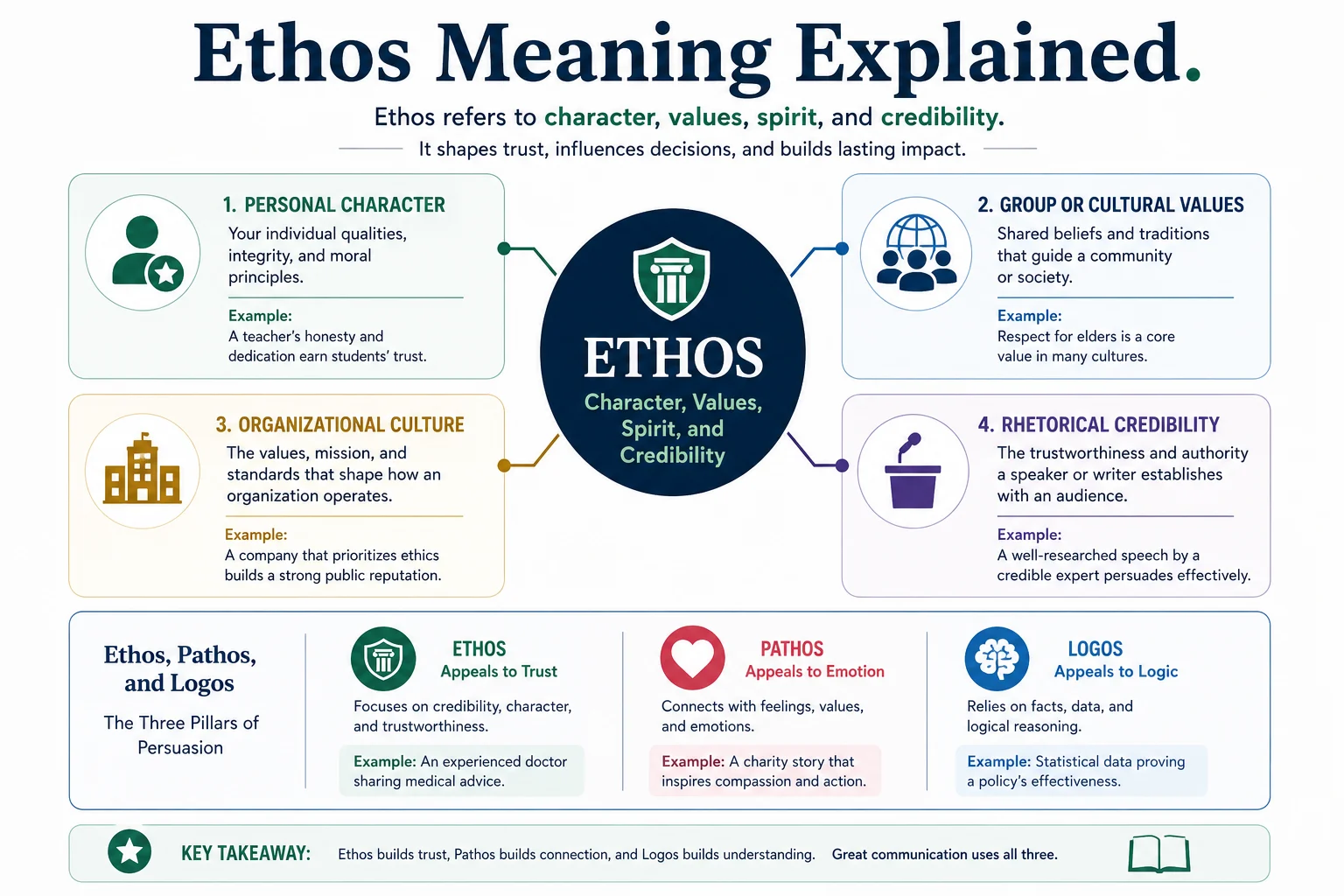
Ethos means the characteristic beliefs, values, spirit, or moral character of a person, group, culture, or organization. In rhetoric, it also means credibility or character used to persuade an audience. For example, a company’s ethos describes the values that guide its behavior.
what does ethos mean is a common question because the word appears in everyday writing, business discussions, literature, philosophy, and persuasive communication. However, it does not have only one narrow definition.
In simple terms, ethos describes the character, values, or guiding spirit associated with a person, group, culture, organization, or era. In rhetoric, the word takes on a more specific meaning. It describes the credibility and character a speaker or writer uses to make an audience trust an argument.
For example, someone might say, “The company’s ethos centers on innovation and customer service.” Here, ethos means the company’s underlying values and character.
Similarly, a teacher might establish ethos by demonstrating knowledge, fairness, and genuine concern for students. Consequently, people become more willing to trust that teacher’s claims.
The word comes from ancient Greek and is associated with character, habit, custom, and disposition. Its rhetorical meaning became especially important through Aristotle’s discussion of persuasion.
One important clarification comes first: ethos is not normally Internet slang. People may encounter it on TikTok, Instagram, Snapchat, Reddit, or in text messages, but the word itself remains a standard English term. Its meaning depends on context rather than a platform-specific slang definition.
Quick Answer Box
| Meaning | Context | Primary Platforms | Example | Tone |
| Character, values, or guiding spirit | Culture and society | All platforms | “The brand has a strong environmental ethos.” | Neutral |
| Credibility or character | Rhetoric and persuasion | Writing, speeches, videos | “The doctor builds ethos through expertise.” | Formal |
| Shared values | Organizations and communities | Workplace, social media | “Teamwork is part of our company ethos.” | Professional |
| Characteristic style or spirit | Art, music, literature | Reviews and discussions | “The film has a rebellious ethos.” | Descriptive |
| Moral or personal character | Personal discussions | Conversation and writing | “Her ethos emphasizes honesty.” | Thoughtful |
What Does what does ethos mean Mean?
The simplest definition is the distinctive character, values, beliefs, or spirit that shapes a person, group, culture, organization, or period.
The term can describe something visible in behavior, but it usually goes deeper than a single action. An ethos reflects recurring principles and attitudes.
For example:
“The school has an ethos of respect.”
This statement means that respect represents an important part of the school’s culture and guiding values.
Another example is:
“The startup has a strong innovation ethos.”
Here, ethos describes the mindset and principles that influence how the company operates.
The word can also describe a culture or historical period. Someone might discuss the “ethos of the 1960s” when describing the broader attitudes and ideals associated with that era.
Dictionary sources define ethos as the fundamental character or spirit of a culture, group, person, or institution. They also connect it with underlying beliefs, attitudes, customs, and practices.
The Two Major Meanings
Ethos generally appears in two major forms.
| Meaning | Explanation | Example |
| Cultural or personal character | The values, attitudes, and spirit that characterize someone or something | “The organization has a strong community ethos.” |
| Rhetorical credibility | The character and credibility used to persuade an audience | “The scientist establishes ethos through expertise.” |
These meanings overlap.
A person with a reputation for honesty may have strong personal ethos. In a speech, that reputation can also strengthen the speaker’s rhetorical ethos.
Ethos in Rhetoric
Rhetoric gives the word a more specialized meaning.
Aristotle identified ethos as one of three major modes of persuasion. The other two are pathos, which appeals to emotion, and logos, which appeals to reasoning and logic.
A speaker uses ethos when they establish reasons for the audience to trust them.
For example:
“I have spent 20 years researching coastal ecosystems, and my team has published dozens of studies on this issue.”
The statement can establish credibility because it presents relevant experience and expertise.
However, ethos does not simply mean having impressive credentials. A speaker can also build credibility through fairness, honesty, good judgment, and concern for the audience. Aristotle’s rhetorical tradition connects credible character with qualities such as practical wisdom, moral character, and goodwill.
Where the Word Comes From
The English word comes from Greek ēthos, a term associated with character, habit, custom, and disposition. The word entered English through Latin and later developed its modern uses.
That history helps explain why modern uses can feel broader than simple “credibility.”
When someone talks about a group’s ethos, they often mean the habits, values, assumptions, and attitudes that give that group its recognizable character.
Contextual Dynamics & Nuances of the Term
Understanding ethos requires more than memorizing one definition. The surrounding words usually reveal which meaning applies.
Ethos as Shared Values
When people use ethos to describe a community, they usually mean its shared character.
For example:
“The neighborhood has a strong ethos of helping one another.”
The statement does not mean every resident behaves identically. Instead, it suggests that mutual support represents an important community value.
Furthermore, an ethos can influence behavior without appearing as a formal rule.
A company might not have a written rule saying employees must help one another. Yet if collaboration repeatedly shapes workplace behavior, people may describe collaboration as part of the company’s ethos.
Ethos as Personal Character
Ethos can also describe an individual’s guiding character.
Consider:
“Her professional ethos is based on honesty and accountability.”
This sentence describes the principles that influence how she works.
It does not necessarily mean she announces those principles. Instead, her consistent decisions may demonstrate them.
Ethos as Organizational Culture
Businesses frequently use ethos to describe their underlying culture.
A company’s ethos might emphasize:
- Customer service
- Innovation
- Transparency
- Sustainability
- Collaboration
- Quality
- Community involvement
- Employee development
For example, a company could say:
“Our ethos is simple: build useful products and treat customers fairly.”
The word therefore captures something broader than a single policy.
Ethos Versus Ethics
These words look and sound similar, so confusion is common.
Ethics usually refers to principles or standards concerning right and wrong behavior.
Ethos refers to the characteristic values, spirit, character, or guiding attitudes of a person or group.
| Word | Basic Meaning | Example |
| Ethos | Character, spirit, or guiding values | “The company’s ethos values creativity.” |
| Ethics | Principles concerning right and wrong | “The company follows strict ethical standards.” |
| Ethical | Describes behavior that follows accepted moral principles | “That was an ethical decision.” |
The terms share a historical connection, but they are not interchangeable.
For instance, “professional ethics” refers to standards governing professional behavior. “Professional ethos” refers more broadly to the character, values, and spirit associated with that profession.
Ethos Versus Reputation
Ethos and reputation also overlap, but they are different.
Reputation concerns how others perceive someone.
Ethos concerns the character or values associated with that person or group.
A company might have a reputation for excellent customer service because customers consistently report positive experiences. Its ethos might be described as customer-focused because that value influences its policies and behavior.
Therefore, reputation can be evidence of ethos, but the two concepts are not identical.
Ethos Versus Vibe
In casual language, people sometimes use “vibe” where a more formal writer might use ethos.
For example:
“The cafe has a relaxed vibe.”
This focuses on the atmosphere or feeling.
“The cafe has an ethos centered on community and sustainability.”
This focuses more on the underlying values and principles.
Consequently, ethos often carries more intellectual and cultural weight than “vibe.”
Real-Life Conversation Examples Using what does ethos mean
Because ethos is not typical slang, people usually discuss it rather than use it as a casual abbreviation. The following conversations show natural ways the word can appear.
Conversation 1: School Assignment
Alex: What does ethos mean in my English assignment?
Jordan: It usually means the credibility or character a writer uses to persuade readers.
Alex: So if the writer says they have 20 years of experience, that’s ethos?
Jordan: Yes. That experience can make the writer seem more trustworthy on the subject.
Conversation 2: Company Culture
Maya: What does the company mean by “our core ethos”?
Chris: They mean the values that guide how the company operates.
Maya: So things like honesty and customer service?
Chris: Exactly.
Conversation 3: Social Media Discussion
Sam: I keep seeing people mention the ethos of this brand.
Taylor: They are probably talking about the brand’s overall values and identity.
Sam: So it is basically the brand’s guiding philosophy?
Taylor: That’s a good way to understand it.
Conversation 4: Literature Class
Nina: My professor said the novel reflects the ethos of its time.
Evan: That means the story reflects the attitudes or values of the historical period.
Nina: Got it. So it isn’t just about one character.
Evan: Right. It can describe the broader culture surrounding the story.
Conversation 5: Workplace Discussion
Manager: Our team’s ethos should be collaboration.
Employee: Does that mean everyone should communicate more?
Manager: Yes. We want people to share ideas, support one another, and solve problems together.
Employee: Then collaboration describes the values we want the team to follow.
Manager: Exactly.
Platform-Specific Breakdown
Ethos does not have a special slang definition on social platforms. However, social media can provide many contexts where the standard word appears.
How It Is Used on Snapchat
Snapchat conversations tend to favor short, informal messages. Even so, someone might use ethos when discussing a brand, creator, community, or cultural movement.
For example:
“I like their ethos.”
In this context, the speaker probably means:
“I like the values or principles behind what they do.”
However, the word can sound more formal than common Snapchat slang.
If a friend uses ethos in a message, you generally should not assume they are using a hidden abbreviation. Instead, read the surrounding conversation.
The Role of what does ethos mean on TikTok
TikTok frequently introduces users to vocabulary from education, business, philosophy, literature, and popular culture.
A creator might say:
“This brand’s ethos is completely different from its competitors.”
Here, ethos means the brand’s underlying character and values.
Another creator might discuss rhetorical persuasion:
“The speaker establishes ethos before presenting the argument.”
In that case, the word has its rhetorical meaning.
Therefore, TikTok does not create a separate definition. Instead, the platform can expose the term to audiences through different subjects.
Instagram and Texting Dynamics
Instagram captions and comments may use ethos when discussing:
- Personal branding
- Fashion
- Art
- Music
- Activism
- Company culture
- Creative identity
- Community values
For example:
“Their entire creative ethos is about simplicity.”
That means the creator’s work consistently reflects simplicity as a guiding principle.
In texting, however, people are more likely to say “values,” “mindset,” “character,” or “approach.”
Consequently, context matters more than platform.
Alternative Meanings & NLP Variations of the Phrase
The word appears alongside many related concepts. Understanding these semantic variations makes the term easier to recognize.
Common Synonyms
Depending on context, useful alternatives include:
- Character
- Spirit
- Values
- Principles
- Mindset
- Culture
- Philosophy
- Outlook
- Disposition
- Identity
- Credibility
- Moral character
- Guiding beliefs
These words are not perfect substitutes in every sentence.
For example, credibility works well when discussing rhetoric. Culture may work better when discussing an organization. Spirit can work when describing a historical period or community.
Common Phrases With Ethos
You may encounter phrases such as:
| Phrase | Meaning |
| Company ethos | Values and character guiding a company |
| Corporate ethos | Broader values and culture of a corporation |
| Professional ethos | Values and character associated with a profession |
| Cultural ethos | Shared attitudes and values within a culture |
| Community ethos | Shared character and values of a community |
| Work ethos | Attitudes toward work and professional behavior |
| Ethical ethos | A character strongly associated with ethical values |
| Rhetorical ethos | Credibility or character used in persuasion |
Ethos, Pathos, and Logos
One of the most important semantic relationships is the trio of ethos, pathos, and logos.
| Concept | Main Appeal | Simple Question |
| Ethos | Credibility and character | “Why should I trust you?” |
| Pathos | Emotion | “How should I feel?” |
| Logos | Logic and reasoning | “Does the evidence make sense?” |
For example, imagine a doctor explaining why people should receive a particular vaccine.
The doctor could use
ethos by discussing relevant medical expertise.
logos by presenting research and statistical evidence.
pathos by describing the emotional consequences of serious illness.
Strong persuasive communication can combine all three.
Misinterpretations: When NOT to Use what does ethos mean
Although ethos is useful, it can sound unnatural when used in very casual situations.
Do Not Treat It as Universal Slang
If someone asks, “What does ethos mean?” do not automatically explain it as Internet slang.
It is a standard English noun with established meanings in rhetoric, culture, literature, sociology, business, and everyday formal communication.
Do Not Confuse It With Ethics
Saying:
“The company’s ethos prohibits discrimination.”
may work if you mean the company’s guiding character or values.
However, if you specifically mean formal moral rules, “ethical policy” or “ethics” may be more precise.
Do Not Equate Ethos With Credentials Alone
Credentials can strengthen rhetorical ethos, but ethos involves more than degrees, titles, or experience.
A speaker can have impressive qualifications while still losing credibility because of dishonesty or obvious bias.
Consequently, ethos involves the broader impression of character and trustworthiness.
Do Not Use It When “Mood” Is More Accurate
If you mean the emotional atmosphere of a place, “mood,” “tone,” or “vibe” may fit better.
For example:
“The restaurant has a cozy atmosphere.”
This sentence does not necessarily require ethos.
Ethos becomes more appropriate when you want to describe the deeper values or character behind that atmosphere.
How to Respond in Chat Comfortably
If someone asks you about the word in a message, you can answer simply.
Casual Response
“It basically means the values, character, or overall spirit of a person or group.”
Rhetorical Response
“In rhetoric, ethos means credibility or character that makes an audience more likely to trust the speaker.”
Very Short Response
“Ethos = character, values, or credibility, depending on context.”
If Someone Uses It About a Brand
You can respond:
“Yeah, they mean the brand’s values and overall identity.”
If You Are Unsure of the Context
Ask:
“Do you mean ethos in rhetoric or in the sense of a group’s values?”
That question works because the two major meanings can overlap while still requiring different explanations.
FAQs
1. What does ethos mean in simple terms?
Ethos means the character, values, spirit, or guiding beliefs associated with a person, group, culture, organization, or period. In rhetoric, it can mean credibility used to persuade an audience.
2. Is ethos the same as ethics?
No. Ethics generally concerns principles about right and wrong behavior. Ethos describes character, spirit, values, or guiding beliefs. The words are historically related, but they serve different purposes.
3. What does ethos mean in rhetoric?
In rhetoric, ethos refers to the credibility and character a speaker or writer establishes to make an audience more likely to trust their message. Aristotle identified ethos as one of three major persuasive appeals.
4. What does ethos mean in literature?
In literature, ethos can describe the characteristic spirit or values reflected by a person, community, culture, period, or work. For example, a novel may reflect the social ethos of the historical period in which it takes place.
5. What is an example of ethos?
“The doctor established credibility by explaining her decades of experience treating the condition.”
The speaker’s relevant experience supports rhetorical ethos.
6. What is the difference between ethos, pathos, and logos?
Ethos focuses on credibility and character. Pathos focuses on emotion. Logos focuses on reasoning and evidence. Together, they form three classic approaches to persuasion.
7. Can ethos describe a company?
Yes. A company’s ethos can describe the values, beliefs, and character that influence its culture and decisions.
8. Is ethos positive or negative?
It can be either. A person, group, or organization can have an ethos that people view positively or negatively. The word itself does not automatically mean “good.”
9. How do you pronounce ethos?
In American English, common pronunciations include approximately EE-thoss and EE-thohs. Dictionaries list pronunciation variations, so hearing either form does not necessarily indicate an error.
10. Is ethos Internet slang?
No. Ethos is a standard English word. Social media users may use it when discussing values, culture, branding, rhetoric, or identity, but platforms do not give it a special slang definition.
Conclusion
The question what does ethos mean has a surprisingly broad answer because the word operates across several fields.
At its core, ethos describes character, values, spirit, or guiding beliefs. When applied to a culture, it describes the attitudes and principles that help characterize that community. When applied to a company, it can describe the values that shape its identity and behavior.
In rhetoric, the meaning becomes more specific. Ethos describes credibility and character used to persuade an audience. Aristotle’s rhetorical framework places ethos alongside pathos and logos, creating a useful model for understanding how people build persuasive messages.
The distinction between ethos and ethics also matters. Ethics focuses more directly on principles concerning right and wrong. Ethos covers a broader sense of character, spirit, and values.
Furthermore, social media has not transformed ethos into a conventional slang abbreviation. TikTok, Instagram, Snapchat, and texting can all feature the word, but its core meaning remains tied to established English usage.
So, when you encounter the term, look at the context. If someone discusses a
brand’s ethos, think values and identity.
culture’s ethos, think shared character and spirit.
speaker’s ethos, think credibility and character.
ethos alongside pathos and logos, think persuasive rhetoric.
Ultimately, ethos is about what gives a person, group, institution, culture, or argument its recognizable character and credibility. Understanding that central idea makes the word much easier to interpret in everyday English, academic writing, professional communication, and modern digital conversations.

Jack Murphy is a language writer with a passion for word meanings, synonyms, and effective communication. He creates informative and easy to understand content to help readers enhance their vocabulary and language skills.



26 thoughts on “what does ethos mean| The Ultimate Guide and Meaning”