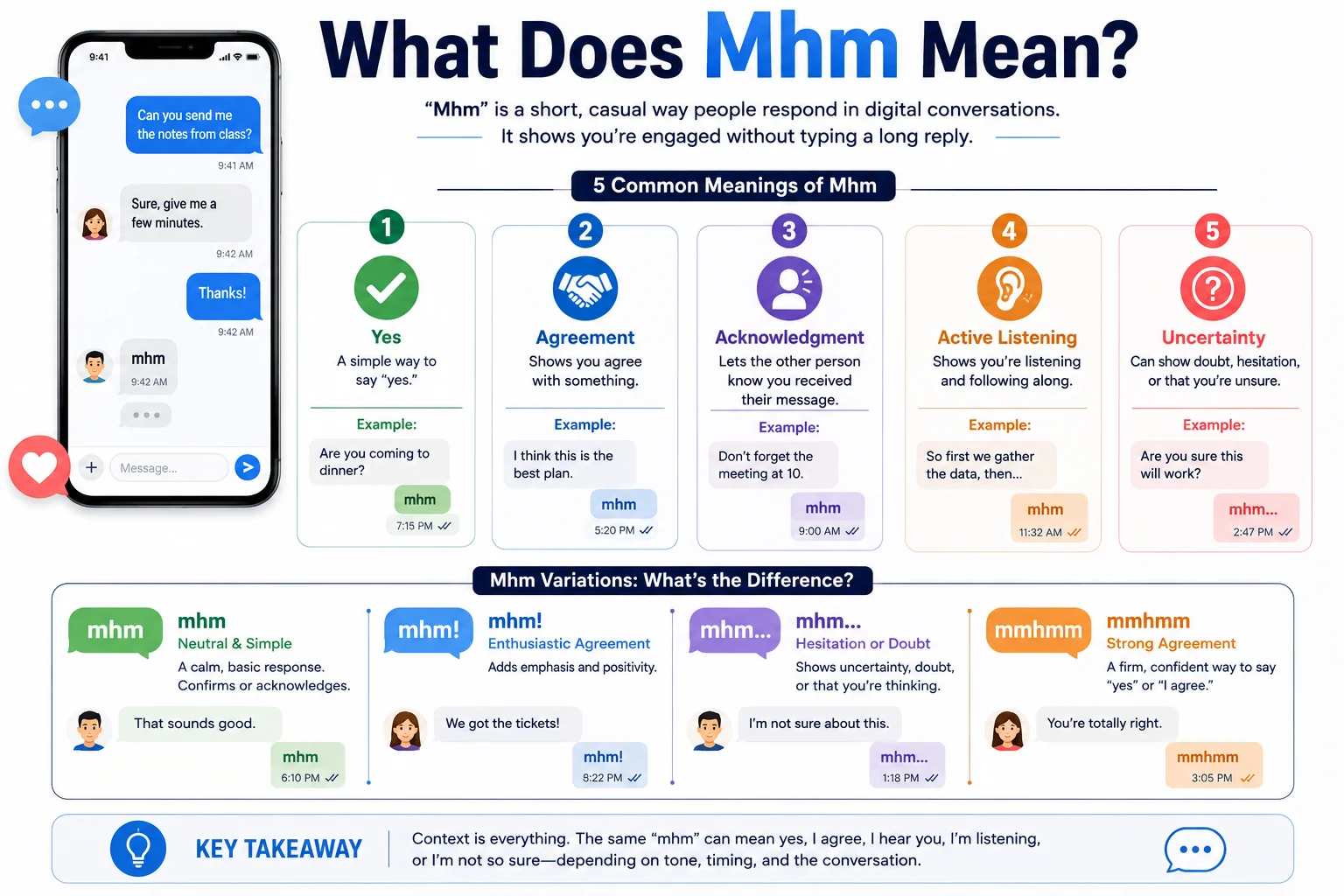
Mhm usually means “yes,” “I agree,” “I understand,” or “I’m listening.” Its exact meaning depends on context and tone. In texting, it can sound casual, warm, neutral, doubtful, or slightly dismissive, depending on the conversation.
what does mhm mean is a common question because this tiny expression can communicate several different feelings without using a full sentence. In most conversations, mhm works as a casual response that shows agreement, acknowledgment, understanding, or attention.
However, its meaning can shift dramatically with context. A friendly “mhm!” may mean an enthusiastic yes. A short “mhm” after a serious message may simply mean “I hear you.” On the other hand, a repeated “mhm” can sometimes suggest impatience or a desire to end the conversation.
The expression appears frequently in texting, social media comments, direct messages, and everyday speech. It resembles sounds people naturally make while listening, such as “mm hmm” or “uh huh.”
Therefore, you should not interpret it as having one fixed definition. The surrounding words, punctuation, relationship between the speakers, and timing all matter.
QUICK ANSWER BOX
| Meaning | Context | Primary Platforms | Example | Tone |
| Yes | Agreement | Texting, Snapchat | “Mhm, I agree.” | Positive |
| I understand | Acknowledgment | Instagram, Messages | “Mhm, I get it.” | Neutral |
| I’m listening | Active conversation | Texting, DMs | “Mhm, keep going.” | Attentive |
| Probably yes | Uncertain agreement | Social media | “Mhm, I think so.” | Uncertain |
| Okay | Casual acknowledgment | Snapchat, TikTok | “Mhm.” | Neutral |
| I’m not fully convinced | Difficult conversation | Texting | “Mhm… sure.” | Skeptical |
| Yes, exactly | Strong agreement | DMs, comments | “Mhm! Exactly.” | Enthusiastic |
What Does what does mhm mean? Full Semantic Definition and Origin
The simplest answer to what does mhm mean is “yes,” “I agree,” or “I understand.” Yet that answer does not capture all of its conversational functions.
“Mhm” represents a vocal response rather than a traditional word. People often use it while listening to show that they are following what someone says. In spoken English, you might hear “mm hmm” during a conversation. Online, people often shorten that sound to “mhm.”
The spelling varies considerably. Common forms include:
| Form | Common interpretation | Typical feeling |
| mhm | Yes or acknowledgment | Neutral |
| mhm! | Strong agreement | Positive |
| mhmm | Softer or more expressive acknowledgment | Warm |
| mmhmm | Spoken style written down | Conversational |
| mm hmm | More closely reflects speech | Casual |
| mmm | Depends heavily on context | Uncertain |
| mhm… | Possible hesitation | Doubtful |
| MHM | Emphasis or excitement | Strong |
| mhm okay | Acknowledgment | Neutral or dismissive |
Importantly, “mhm” does not always mean a literal “yes.” Sometimes it simply signals that the reader received the message.
For example:
Person A: “I had such a long day at work.”
Person B: “Mhm, I know.”
Here, the response communicates empathy and acknowledgment. Person B does not necessarily answer a question.
Now consider another example:
Person A: “So you agree that we should leave at eight?”
Person B: “Mhm.”
Here, the same expression functions much more like “yes.”
Consequently, context determines the intended meaning.
The expression also has roots in natural conversational listening behavior. English speakers have long used sounds such as “mm hmm” to indicate attention or agreement. Digital communication simply transformed that vocal cue into a typed expression.
This explains why the term feels more conversational than formal. You would rarely use “mhm” in a business report, academic essay, or formal letter. Instead, you might write “I agree,” “Understood,” or “Yes.”
Contextual Dynamics and Nuances of the Term
Understanding what does mhm mean requires more than memorizing a definition. You also need to recognize its emotional range.
Agreement
The most common interpretation involves agreement.
“Are you coming with us?”
“Mhm.”
The speaker probably means “yes.”
However, the strength of that agreement depends on the surrounding conversation. “Mhm!” sounds more enthusiastic than “mhm.”
Acknowledgment
“Mhm” can also mean “I heard you.”
For example:
“I’ll send the files tonight.”
“Mhm.”
The response does not necessarily express excitement. Instead, it confirms that the message was received.
Active Listening
People often use “mhm” as a listening signal.
Imagine a friend telling you a long story:
“Then I got to the restaurant, and nobody was there.”
“Mhm.”
“So I called Jake.”
“Mhm, yeah.”
Here, the listener encourages the speaker to continue.
Hesitation
Tone can completely change the meaning.
“Mhm…”
The trailing dots introduce uncertainty. The speaker may mean “I’m not sure,” “maybe,” or “I’m thinking about it.”
Therefore, punctuation matters in text conversations.
Skepticism
Sometimes people use “mhm” when they do not completely believe someone.
For example:
“I definitely didn’t eat the last cookie.”
“Mhm.”
In this situation, the response might mean, “Sure, I believe you,” with an obvious skeptical undertone.
The same spelling can therefore communicate agreement, doubt, patience, or sarcasm.
Emotional Distance
A very short response can also feel emotionally distant.
If someone normally writes detailed messages but suddenly responds with “mhm,” the change may indicate reduced enthusiasm.
Still, you should avoid jumping to conclusions. The person could simply be busy.
Real Life Conversation Examples Using what does mhm mean
The following scenarios show how the expression changes according to context.
Example 1: Friendly Agreement
Alex: “We should grab pizza tonight.”
Jordan: “Mhm! I’m definitely down.”
Here, “mhm” clearly communicates agreement. The second sentence reinforces the positive tone.
Example 2: Simple Acknowledgment
Alex: “I’ll call you after work.”
Jordan: “Mhm.”
This response most likely means “okay” or “I understand.”
It does not necessarily indicate excitement.
Example 3: Active Listening
Alex: “Then she called me and explained everything.”
Jordan: “Mhm, keep going.”
Here, the response encourages Alex to continue the story.
The phrase functions almost like “I’m listening.”
Example 4: Uncertainty
Alex: “Do you think he’ll actually show up?”
Jordan: “Mhm… probably.”
The hesitation suggests that Jordan is not completely confident.
The word “probably” makes the uncertainty even clearer.
Example 5: Possible Sarcasm
Alex: “I totally remembered to charge my phone.”
Jordan: “Mhm.”
If Alex’s phone has just died, Jordan’s response may sound sarcastic.
The meaning comes from the situation rather than the word itself.
Platform Specific Breakdown
Online platforms use casual language differently. However, “mhm” remains recognizable across most major messaging environments.
How It Is Used on Snapchat
Snapchat conversations often favor short, informal replies. As a result, “mhm” fits naturally into quick exchanges.
Someone might send:
“You still coming?”
“Mhm.”
That usually means “yes.”
However, Snapchat also relies heavily on context. A person might respond with “mhm” because they are multitasking or because they want to acknowledge a message without starting a longer conversation.
The visual environment can also influence interpretation. A message paired with a laughing emoji may sound playful. A message with no punctuation can feel neutral.
For example:
“You really did that 😂”
“Mhm 😂”
This exchange feels playful.
By contrast:
“Are you upset with me?”
“Mhm.”
That response sounds more serious.
Therefore, Snapchat users should consider the complete exchange instead of interpreting the expression alone.
The Role of what does mhm mean on TikTok
TikTok has helped spread informal internet language across different age groups and online communities. Users may encounter “mhm” in comments, direct messages, captions, and replies.
In comments, it can express agreement:
“This is exactly what happened to me.”
“Mhm, same.”
It can also show skepticism:
“He said he wasn’t jealous.”
“Mhm 👀”
The added eyes emoji changes the emotional signal. It can imply suspicion or playful disbelief.
TikTok conversations also move quickly. Therefore, short expressions often replace complete sentences.
The expression can work as a conversational shortcut. Instead of typing “Yes, I completely agree with you,” someone may simply write “mhm.”
Instagram and Texting Dynamics
Instagram DMs work similarly to standard texting. The meaning depends heavily on the relationship between the people involved.
Friends may use “mhm” casually without any negative intention.
“You watching the game tonight?”
“Mhm.”
A romantic partner may interpret the same message differently if they expect a warmer response.
“I miss you.”
“Mhm.”
That answer could feel confusing or emotionally distant because the message deserves a more direct response.
Therefore, communication style matters. A short response does not automatically mean something is wrong. However, repeated one word responses can indicate that someone does not want to continue a conversation.
Alternative Meanings and NLP Variations of the Phrase
Natural language processing systems treat informal expressions differently from conventional dictionary words. That matters because “mhm” carries meaning through context, punctuation, and conversation history.
From a semantic perspective, the expression can fall into several categories.
| Semantic function | Possible interpretation | Example |
| Affirmation | Yes | “Mhm, that’s right.” |
| Acknowledgment | I understand | “Mhm, got it.” |
| Listening cue | Continue | “Mhm, tell me more.” |
| Agreement | I agree | “Mhm, exactly.” |
| Uncertainty | Maybe | “Mhm… I’m not sure.” |
| Skepticism | I doubt it | “Mhm, sure.” |
| Dismissal | Okay, whatever | “Mhm.” |
| Emotional support | I hear you | “Mhm, that sounds difficult.” |
Several related expressions appear in English.
“Uh huh” commonly signals agreement or acknowledgment.
“Yeah” provides more explicit agreement.
“Yep” sounds more direct.
“Okay” can communicate acceptance, understanding, or closure.
“Right” can signal agreement or confirmation.
“Mm hmm” closely resembles the spoken version of “mhm.”
“Sure” can mean agreement, although it can also sound sarcastic.
Consequently, replacing “mhm” with another expression can slightly change the emotional tone.
For example:
“Mhm.” sounds understated.
“Yeah!” sounds more energetic.
“Absolutely.” sounds stronger and more deliberate.
“Okay.” sounds neutral but may suggest closure.
The expression also differs from “mmm,” which often communicates enjoyment, thought, uncertainty, or hesitation.
For example:
“Mmm, that sounds good.”
Here, “mmm” may express pleasure.
That distinction helps prevent misunderstandings.
Misinterpretations: When NOT to Use what does mhm mean
Although the expression works well in casual communication, it does not fit every situation.
Formal Communication
Avoid it in professional emails, official documents, academic writing, and formal customer service communication.
Instead of:
“Mhm, I received the contract.”
Write:
“Yes, I received the contract. Thank you.”
The second version sounds clearer and more professional.
Sensitive Conversations
Be careful when someone discusses grief, conflict, anxiety, or another serious subject.
If someone says:
“I’ve been having a really difficult week.”
A simple “mhm” may sound uninterested.
A better response could be:
“I’m sorry you’re dealing with that. Do you want to talk about it?”
The problem is not the expression itself. The issue is whether the response matches the emotional importance of the message.
When Someone Asks a Direct Question
If the other person needs a clear answer, “mhm” can sometimes create ambiguity.
For example:
“Did you submit the application?”
“Mhm.”
The recipient may wonder whether that means yes, maybe, or simply “I saw your message.”
In situations involving appointments, deadlines, money, travel, or important decisions, use explicit language.
When Tone Could Be Misread
Text removes vocal tone. Therefore, short expressions can become ambiguous.
A person might interpret “mhm” as passive aggressive even when the sender intended “yes.”
If the conversation already feels tense, choose clearer wording.
For example:
“Yes, I understand what you mean.”
That leaves much less room for interpretation.
How to Respond in Chat Comfortably
If someone sends “mhm,” your response should depend on what they appear to communicate.
If They Mean Yes
Continue naturally.
You: “Want to get coffee later?”
Them: “Mhm.”
You: “Great. Around six?”
If They Are Listening
Keep explaining.
You: “Then I realized the email went to the wrong person.”
Them: “Mhm.”
You: “So I had to resend everything.”
The acknowledgment indicates that they are following your story.
If You Are Unsure
Ask a simple clarification question.
“Do you mean yes?”
There is nothing wrong with asking. Clear communication beats guessing.
If Their Reply Feels Cold
Do not immediately assume they are angry.
Instead, consider the broader conversation.
If they have repeatedly answered with very short messages, you could ask:
“Everything okay?”
This approach gives them room to explain.
If You Want to Sound Warmer
Use a more expressive response.
Instead of:
“Mhm.”
Try:
“Mhm, absolutely!”
Or:
“Yeah, I agree.”
Or:
“Mhm, I know exactly what you mean.”
The added words make your intention clearer.
FAQs
1. What does mhm mean in texting?
In texting, it usually means “yes,” “I agree,” “okay,” or “I understand.” However, its emotional tone depends on context, punctuation, and the relationship between the people chatting.
2. Is mhm a positive response?
Usually, yes. It can communicate agreement or acknowledgment. However, a short or delayed response may sound neutral, distant, skeptical, or dismissive.
3. Is mhm rude?
Not inherently. Friends commonly use it as a casual acknowledgment. Nevertheless, it can sound rude when someone expects a detailed answer, especially during a serious conversation.
4. Does mhm mean yes?
Often, yes. When someone asks a question that requires a yes or no response, “mhm” commonly functions as an informal yes.
5. What is the difference between mhm and mmhmm?
Both expressions represent a similar conversational sound. “Mmhmm” often looks more like the spoken phrase, while “mhm” appears shorter and more casual in digital communication.
6. Can mhm mean I understand?
Yes. Someone may use it to show that they heard and understood what another person said. In that case, it works more like “I get it” than a direct “yes.”
7. Why would someone reply with only mhm?
They may be busy, listening, agreeing, uncertain, or simply keeping the conversation brief. Therefore, you should examine the surrounding messages before assuming a negative meaning.
8. Is mhm the same as okay?
Not exactly. “Okay” explicitly acknowledges acceptance or understanding. “Mhm” can do the same thing, but it can also function as a listening sound or agreement.
9. Can mhm sound sarcastic?
Yes. Tone and context can make it sarcastic. For example, replying “mhm” after an obviously questionable claim can communicate disbelief rather than agreement.
10. Should I use mhm in professional messages?
Generally, no. Use clearer language in professional settings. “Yes,” “Understood,” “I agree,” or “Thanks, I received it” communicates your meaning more precisely.
Conclusion
Understanding what does mhm mean becomes much easier when you look beyond the letters themselves. The expression represents a conversational sound that people have used in spoken English for a long time.
In digital communication, however, that sound became a convenient written response. People use it to say yes, acknowledge a message, show that they are listening, or communicate uncertainty.
Context remains the most important factor.
A friendly “mhm!” can express enthusiastic agreement. A simple “mhm” can mean “okay” or “I understand.” Meanwhile, “mhm…” can suggest hesitation or doubt.
Furthermore, punctuation, emojis, message length, timing, and relationship dynamics can influence interpretation. A response that feels perfectly normal between close friends may sound cold in a romantic conversation or unprofessional in a workplace setting.
The safest approach involves reading the entire conversation rather than analyzing one expression in isolation.
If someone sends “mhm” after a casual question, you can usually interpret it as agreement or acknowledgment. If the conversation involves an important decision, ask for clarification when necessary.
Internet slang constantly evolves. New platforms create new communication habits, while older spoken expressions continue to appear in digital form. “Mhm” demonstrates this process clearly.
It is short, flexible, and highly dependent on context. That combination explains why such a small expression can carry several different meanings.
Ultimately, the best interpretation comes from the message around it, not from the abbreviation alone.
Discover More Articles
- What Does EYP Mean| The Complete Texting, Slang and TikTok Guide
- What Does NFS Mean in Text| Complete Slang Guide

Harry Edwards is a language writer specializing in word meanings, synonyms, and language usage. He creates clear, accurate, and engaging content to help readers improve their vocabulary and communication skills.
3 thoughts on “What Does MHM Mean in Text? From Agreement to Hesitation, Every Meaning Explained 2026”