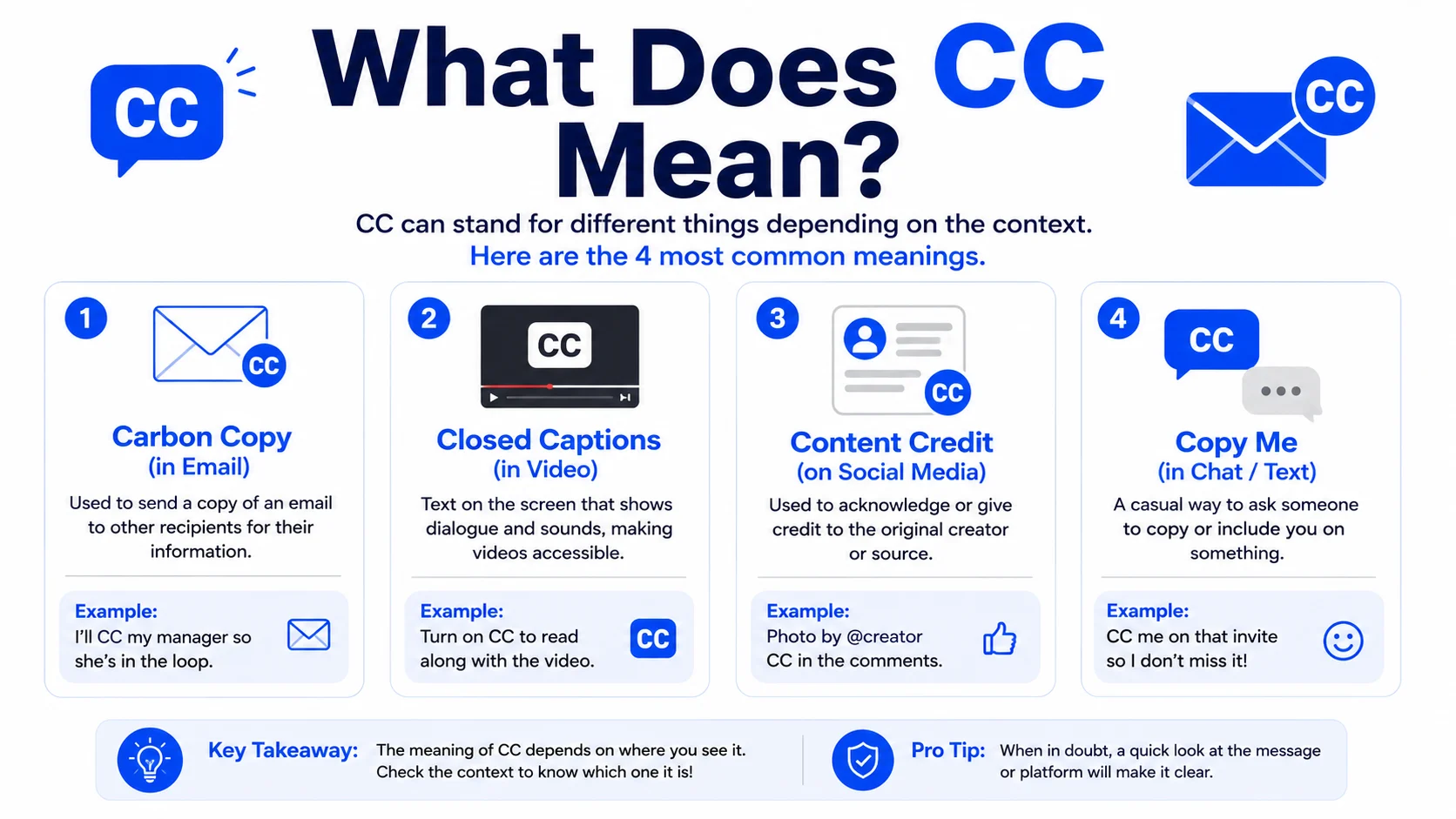
What does CC mean? CC most commonly means “carbon copy,” especially in email. It tells recipients that someone else receives a visible copy of the message. In texting and social media, CC can also have different meanings depending on context.
What does CC mean depends on where you see it and how someone uses it. In email, CC almost always means carbon copy. It lets you send a visible copy of a message to another person without making that person the main recipient.
However, digital communication has expanded the meaning of CC. People may use the abbreviation in texts, comments, captions, gaming chats, workplace messages, and social media. Therefore, context matters.
For example, an employee might write, “I’m CCing Sarah so she knows about the update.” Here, CC has its traditional email meaning.
On social platforms, the abbreviation can sometimes refer to content credit, closed captions, or other community specific meanings. Consequently, you should never assume that every CC has the same definition.
This guide explains the major meanings, common platforms, conversation examples, and situations where CC can cause confusion. It also shows you how to respond naturally when you are unsure what someone means.
Quick Answer Box
| Meaning | Context | Primary Platforms | Example | Tone |
| Carbon copy | Email and work | Gmail, Outlook, business email | “CC John on the email.” | Professional |
| Content credit | Social media | Instagram, TikTok, posts | “CC to the original creator.” | Casual or appreciative |
| Closed captions | Video content | TikTok, YouTube, Instagram | “Turn on CC.” | Informational |
| Copy or copied | Informal messaging | Texts and chats | “CC me on that.” | Casual |
| Context dependent abbreviation | Internet communities | Social apps, gaming, forums | “What does CC mean here?” | Varies |
What Does CC Mean? Full Semantic Definition and Origin
The most common answer to what does CC mean is carbon copy.
The term comes from older office communication. Before email became standard, people could create duplicate documents by placing carbon paper between sheets. Pressure from a typewriter transferred the text onto the sheet underneath.
That duplicate became a carbon copy.
Email later adopted the same concept. The CC field allows someone to receive a visible copy of an email. Everyone who receives the message can generally see the addresses listed in the CC field.
For example:
| Email Field | Purpose |
| To | Main recipient |
| CC | Person receiving a visible copy |
| BCC | Person receiving a hidden copy |
| Subject | Main topic of the email |
Suppose Maria sends a project update to her manager and copies a coworker.
To: Manager
CC: Coworker
The manager remains the primary recipient. The coworker receives the same email for awareness.
Therefore, CC does not normally mean that the copied person must take action.
Why People Use CC in Email
People use CC for several practical reasons.
First, CC keeps relevant people informed. For example, a project manager may CC a designer when sending a client update.
Second, CC creates communication visibility. A team member can see that another colleague received the same information.
Third, CC can reduce unnecessary forwarding. Instead of sending an email separately, the sender includes everyone who needs visibility.
However, too much CC can create unnecessary email traffic. A person may receive dozens of messages that do not require their attention.
Consequently, good email etiquette means copying people only when they genuinely need the information.
CC vs BCC
BCC and CC serve different purposes.
CC means carbon copy. Recipients can normally see who else received the message.
BCC means blind carbon copy. Recipients cannot normally see the other BCC recipients.
For example, a company might use BCC when sending a general announcement to many unrelated recipients. This protects their email addresses from being exposed to everyone else.
CC, meanwhile, works better for transparent workplace communication.
Is CC Professional?
Yes. CC is completely normal in professional communication.
You might see phrases such as:
“Please CC me on future updates.”
“I’ve CC’d the accounting team.”
“Can you CC James?”
“Sarah is CC’d for visibility.”
These phrases all use the traditional email meaning.
However, the tone can change slightly depending on the sentence. “CC me” sounds direct and practical. “I’ve CC’d you” sounds like a simple notification.
Contextual Dynamics and Nuances of the Term
The meaning of CC changes with context. That makes the abbreviation interesting because the same two letters can describe different actions.
CC as Carbon Copy
This remains the strongest and most established meaning.
If you see CC beside an email address, it almost certainly means carbon copy.
For example:
To: Alex
CC: Daniel
Daniel receives a copy of the email.
CC as Content Credit
Social media users sometimes use CC to indicate credit for content.
For example, someone might write:
“CC: @creator”
In this setting, the intended meaning may be related to giving credit or identifying a content source.
However, usage varies between communities. Some creators prefer clearer phrases such as “credit,” “original creator,” or “source.”
Therefore, do not automatically interpret CC as content credit unless the surrounding post supports that meaning.
CC as Closed Captions
On video platforms, CC commonly means closed captions.
You may see a CC button on a video player. Selecting it can display written dialogue and other relevant audio information.
This meaning is especially common when people discuss accessibility.
For example:
“Does this video have CC?”
Here, the person is asking whether the video has closed captions.
CC as a Casual “Copy” Reference
In informal communication, someone may use CC as a shortened form of copying someone into a conversation or communication.
For example:
“CC me when you send it.”
This usually means, “Include me when you send it.”
The expression still connects to the traditional email meaning, even when someone says it casually.
Context Changes Everything
The safest way to understand an abbreviation is to examine the words around it.
| Example | Most Likely Meaning |
| “CC my manager.” | Carbon copy |
| “Turn on CC.” | Closed captions |
| “CC the creator.” | Content credit or creator attribution |
| “CC me on the update.” | Copy me into the communication |
| “What does CC stand for?” | Usually asking about the abbreviation itself |
Therefore, surrounding words provide the strongest clue.
Real Life Conversation Examples Using What Does CC Mean
Below are five natural scenarios showing how people use the abbreviation.
Example 1: Workplace Email
Alex: I just sent the proposal to the client.
Jordan: Did you CC me?
Alex: Not yet. I’ll send it again with you copied.
Jordan: Thanks. I want to keep track of the conversation.
Here, CC clearly means adding someone as a visible email recipient.
Example 2: Asking for an Email Copy
Maya: I’m sending the invoice this afternoon.
Chris: Can you CC me?
Maya: Sure. I’ll include you.
Chris: Perfect.
The phrase “CC me” means “include me in the email.”
Example 3: Closed Captions
Sam: I can’t hear part of the video.
Taylor: Try turning on CC.
Sam: Oh, I see it now.
Taylor: The captions should make it easier.
Here, CC means closed captions rather than carbon copy.
Example 4: Social Media Credit
Lena: Who made this artwork?
Nora: I found it from another creator.
Lena: Did you add CC?
Nora: Yes. I tagged the original creator in the caption.
In this context, CC may refer to creator or content credit. However, the exact meaning can vary by community.
Example 5: Team Communication
David: I’m emailing the final schedule tonight.
Emma: CC the entire planning team.
David: Everyone?
Emma: Yes. They should see the final version.
Here, CC refers to including additional recipients in the email.
Platform Specific Breakdown
Different platforms create different expectations around abbreviations. Therefore, the surrounding interface often gives you the answer.
How It Is Used on Snapchat
On Snapchat, CC does not have one universal slang definition that applies to every conversation.
The meaning depends heavily on the message.
If someone says:
“CC me when you send it.”
They probably mean to include or copy them in communication.
If CC appears in a video context, it may refer to closed captions.
Furthermore, Snapchat users frequently create personal abbreviations within friend groups. Those expressions may not have a standard dictionary meaning.
Therefore, context matters more than the platform name alone.
If you are unsure, a simple question works:
“Do you mean closed captions or something else?”
That avoids guessing.
The Role of What Does CC Mean on TikTok
TikTok has a wide range of abbreviations, and CC can appear in multiple contexts.
One common interpretation involves closed captions. TikTok videos often include captions to make spoken content easier to follow.
CC can also appear around creator attribution or content discussions. However, those meanings depend on the creator or community.
For example:
“Does this have CC?”
Usually points toward captions.
Meanwhile:
“CC to the original creator.”
May indicate credit or attribution.
The surrounding words make the distinction clear.
Instagram and Texting Dynamics
Instagram users may encounter CC in captions, comments, direct messages, and video discussions.
1. Video discussion, CC can mean closed captions.
2. Creator conversation, it might relate to credit.
3. Private message about work or email, it can retain the traditional meaning of carbon copy.
Texting follows the same principle.
For example:
“CC me on that email.”
Almost certainly refers to copying the person into the email.
But:
“Does this video have CC?”
Likely refers to captions.
Consequently, the phrase itself does not determine the meaning. The situation does.
Alternative Meanings and NLP Variations of the Phrase
Search engines and language models encounter many variations around this abbreviation.
Common semantic variations include:
| Phrase | Likely Interpretation |
| CC meaning | Asking for the definition |
| CC in email | Carbon copy |
| CC someone | Add someone to an email |
| CC me | Include me |
| CC button | Closed captions |
| CC on video | Closed captions |
| CC creator | Credit or attribution |
| CC abbreviation | General abbreviation question |
| What does CC stand for | Definition request |
| What is CC | General meaning request |
The phrase can also appear in grammatical variations.
For example:
“I CC’d him.”
“I’m CCing her.”
“She was CC’d.”
“Please CC me.”
All of these commonly refer to copying someone into an email.
CC as a Verb
English speakers often turn the abbreviation into a verb.
For example:
“I’ll CC you.”
This means:
“I’ll add you as a CC recipient.”
The past tense commonly appears as:
“I CC’d you.”
You may also see:
“I’ve CC’d Sarah.”
This means Sarah has been included as a copied recipient.
CC as a Noun
CC can also function as a noun.
For example:
“Put him on CC.”
This means to add him to the CC field.
Another example is:
“She’s on CC.”
That means she received the email as a copied recipient.
CC in Accessibility Language
When CC means closed captions, the abbreviation belongs to accessibility and media terminology.
Closed captions can display spoken dialogue and relevant sound information. They help viewers who cannot hear the audio clearly and can also help people watching videos in noisy or quiet environments.
Therefore, “CC” in a video player usually has nothing to do with email.
Misinterpretations: When NOT to Use What Does CC Mean
Understanding the abbreviation also means knowing when not to assume a definition.
Do Not Assume CC Always Means Carbon Copy
Email makes carbon copy the most familiar meaning. However, a video player may use CC for closed captions.
Therefore, look at the interface.
If you see CC beside video controls, captions are the likely meaning.
Do Not Assume Social Media CC Has One Fixed Definition
Social media communities create their own shorthand.
Consequently, CC may have different meanings between creators, fandoms, gaming communities, and private groups.
If the context does not make the meaning obvious, ask.
Do Not Use CC When “Credit” Is Clearer
If you are giving credit to a creator, writing “Credit: @username” may be easier to understand.
Likewise, “Original creator: @username” removes ambiguity.
Clear language often works better than unexplained abbreviations.
Do Not Confuse CC With BCC
This mistake can cause privacy problems.
CC shows recipients who else received the email.
BCC hides those recipients from other recipients.
Therefore, use BCC when recipient privacy requires it.
Do Not Add Everyone to CC
More recipients do not automatically create better communication.
Before adding someone, ask whether they need the information.
If they do not need to read the message, leaving them out can reduce unnecessary inbox clutter.
How to Respond in Chat Comfortably
If someone uses CC and the meaning seems obvious, respond naturally.
For email:
“Sure, I’ll CC you.”
“Yep, I’ll add you to the email.”
“I’ve CC’d you.”
For closed captions:
“Yep, the video has CC.”
“Try turning on the CC option.”
For an unclear social media use:
“What do you mean by CC here?”
“Do you mean credit?”
“Are you talking about closed captions?”
These responses sound natural because they match the context.
What to Say When You Are Unsure
You do not need to pretend that you understand an abbreviation.
A short clarification is usually best.
For example:
“CC as in closed captions?”
Or:
“Do you mean copy me on the email?”
These questions prevent misunderstandings without making the conversation awkward.
Professional Responses
In workplace communication, clarity matters more than slang.
Good responses include:
“Absolutely. I’ll CC you on the next update.”
“Sure. I’ll add you to the email thread.”
“I’ve included you on CC.”
“Would you like me to CC the whole team?”
These phrases are concise and professional.
Casual Responses
Friends may use shorter expressions.
“Yep, got you.”
“Sure, I’ll CC you.”
“Got it.”
“I’ll add you.”
The best response depends on your relationship with the other person.
FAQs
1. What does CC mean in an email?
It usually means carbon copy. The CC field sends another recipient a visible copy of the email.
2. What does CC mean on a video?
It usually means closed captions. The feature displays text for spoken dialogue and other relevant audio information.
3. What does CC mean in texting?
In texting, CC can mean different things. If the conversation involves email, it usually means copying someone into the communication.
4. What does CC mean on Instagram?
Instagram does not give CC one universal slang meaning. It may refer to closed captions, credit, or another context specific abbreviation.
5. Is CC the same as BCC?
No. CC recipients are normally visible to other recipients. BCC recipients are hidden from the other recipients.
6. What does “CC me” mean?
“CC me” usually means “include me in the email.” The speaker wants to receive a copy of the communication.
7. What does “I CC’d you” mean?
It means the sender added you to the CC field of an email. You should receive a copy of that message.
8. Can CC be used as a verb?
Yes. People commonly say “CC me,” “CC her,” or “I CC’d him.” This informal verb comes from the email function.
9. Why is CC called carbon copy?
The term comes from carbon paper. Carbon paper allowed people to create duplicate written documents. Email adopted the same concept for sending visible copies.
10. Should I ask if I do not understand CC?
Yes. Context can change the meaning. A quick clarification such as “Do you mean closed captions?” can prevent confusion.
Conclusion
The answer to what does CC mean starts with carbon copy, especially in email. That remains the standard professional meaning.
However, modern digital communication has expanded the abbreviation.
On video platforms, CC commonly means closed captions. In social media communities, it may refer to credit or attribution. In casual conversation, “CC me” can simply mean “include me.”
Therefore, context remains the key.
Look at the platform. Check the surrounding words. Consider whether the conversation involves email, video, social media, or another digital environment.
When the meaning still feels unclear, ask a short clarification question.
That approach works because internet language changes quickly. Abbreviations often move between platforms and communities. A term that means one thing in an email can mean something completely different beside a video control.
Ultimately, good digital communication is not about memorizing every abbreviation. It is about understanding context and choosing clear language.
Whether you see CC in Gmail, a TikTok video, an Instagram message, or a casual text, the surrounding situation usually provides the answer.

Jack Murphy is a language writer with a passion for word meanings, synonyms, and effective communication. He creates informative and easy to understand content to help readers enhance their vocabulary and language skills.

13 thoughts on “What Does CC Mean| The Ultimate Guide to CC”