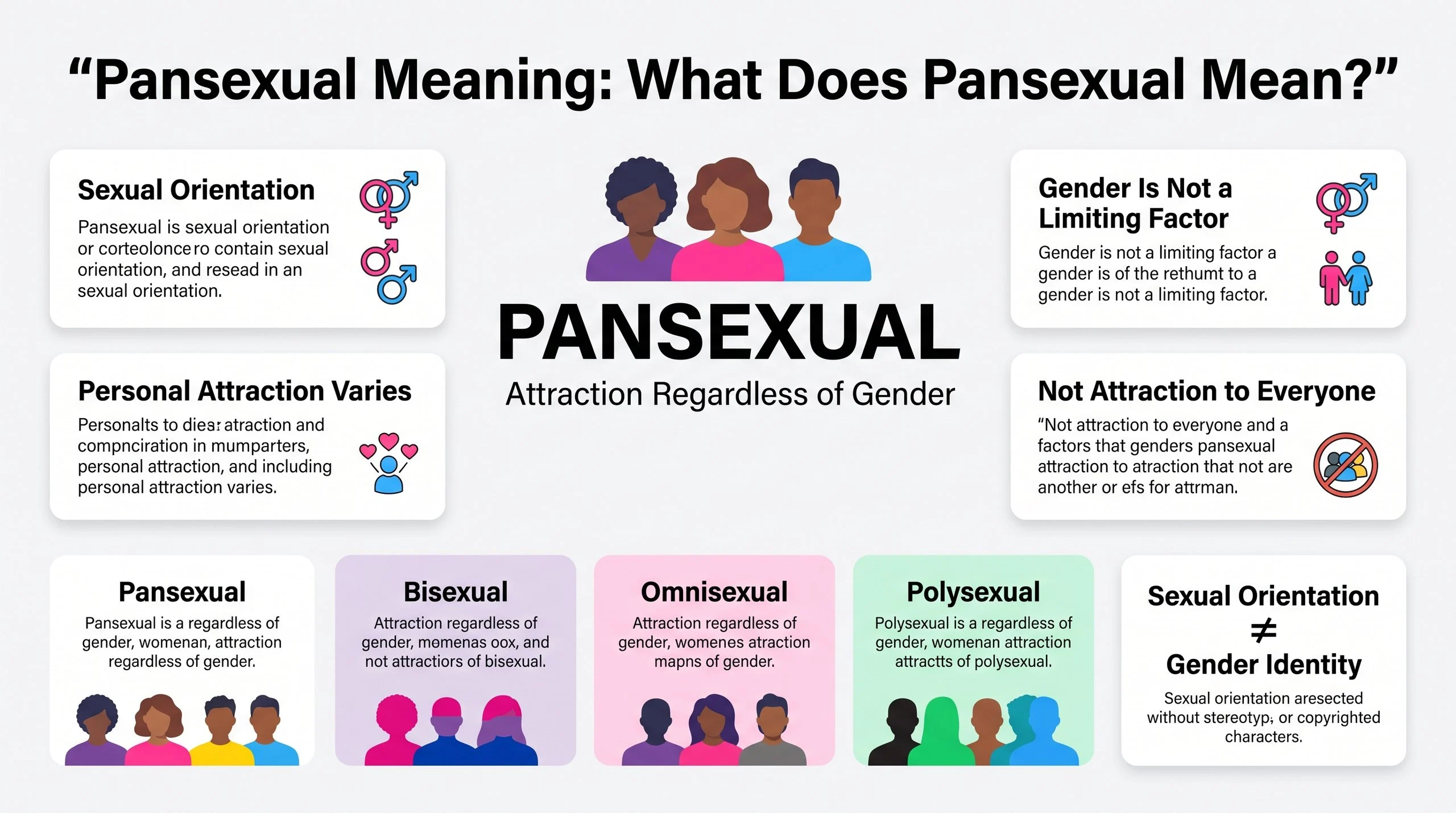
The pansexual meaning is a sexual orientation describing a person who can experience sexual attraction to people regardless of their gender. In simple terms, a pansexual person may be attracted to people of different genders, and gender itself is not necessarily a limiting factor in that attraction.
Pansexuality is about potential attraction, not attraction to every person. A pansexual person can have preferences, experience attraction at different levels, or not feel attracted to someone at all.
The term is also different from gender identity. Pansexuality describes sexual orientation, while terms such as woman, man, nonbinary, and transgender describe aspects of gender identity.
1. What Does Pansexual Mean?
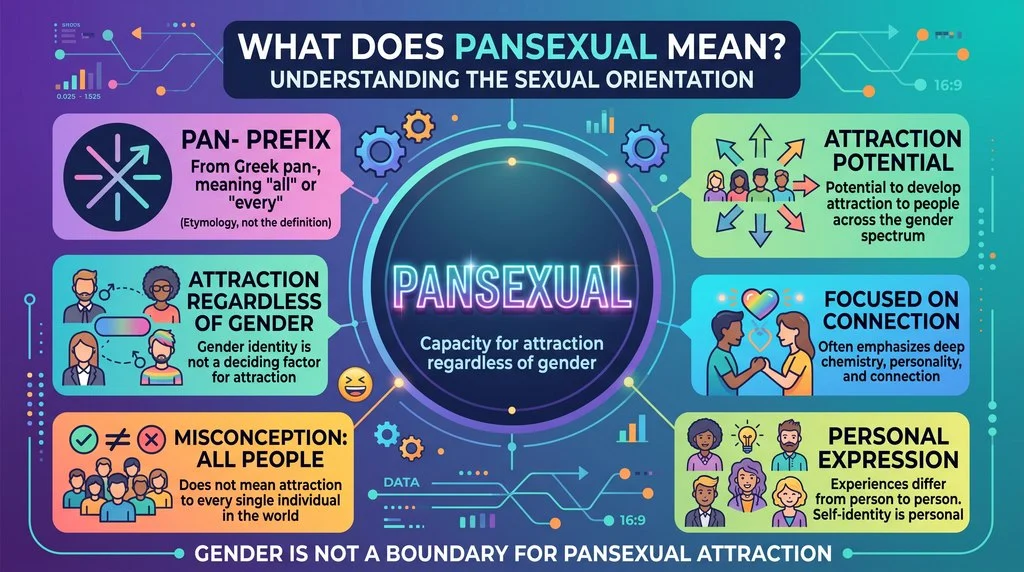
The word pansexual comes from the prefix pan-, meaning “all” or “every.”
In discussions of sexual orientation, however, it is more accurate to understand pansexuality as the capacity for attraction regardless of gender, rather than interpreting the word as meaning attraction to every person.
For instance, someone might identify as pansexual because they can develop attraction to people of different gender identities without gender being a deciding factor.
A person’s sexual orientation is personal. Therefore, someone who identifies as pansexual may describe their experiences differently from another pansexual person.
2. What Is Pansexuality?
Pansexuality is the sexual orientation associated with being pansexual.
It describes the possibility of experiencing sexual attraction across genders, with gender not necessarily determining that attraction.
Pansexuality does not tell you:
- Who someone is currently dating
- How many people they have dated
- Whether they are sexually active
- Whether they prefer one gender
- Whether they experience romantic attraction in the same way as sexual attraction
Instead, it describes an aspect of a person’s sexual orientation.
Pansexuality Is About Attraction
Attraction can take different forms.
Someone may experience:
- Sexual attraction
- Romantic attraction
- Emotional attraction
- Physical attraction
- A combination of these
A pansexual person may experience sexual attraction regardless of gender, while their romantic orientation may be described differently.
3. Pansexual Meaning in Simple Words
In very simple language:
Pansexual means a person can be attracted to someone regardless of that person’s gender.
For example:
“Jordan identifies as pansexual.”
This means Jordan’s sexual orientation allows for attraction to people regardless of gender.
It does not mean:
“Jordan is attracted to everyone.”
That distinction is important.
Sexual orientation describes patterns or possibilities of attraction. It does not mean that a person automatically feels attraction toward every individual.
4. Pansexual Meaning in Texting and Social Media
When someone uses pansexual in texting or social media, they are generally referring to their sexual orientation or discussing pansexuality.
For example:
“I’m pansexual.”
This is a statement about the person’s sexual orientation.
Someone might also write:
“I’m learning more about pansexuality.”
Here, the person is talking about the concept rather than identifying themselves.
The term can appear in:
- Text messages
- Social media posts
- Dating profiles
- Online communities
- Educational discussions
- LGBTQ+ conversations
Because sexual orientation is personal, it is best not to assume someone’s orientation based solely on their dating history, appearance, or friendships.
5. Pansexual Meaning in Dating
In dating, a pansexual person may be open to romantic or sexual relationships with people of different genders.
For example:
“She identifies as pansexual and has dated people of different genders.”
The important point is that dating history does not automatically determine someone’s orientation.
A person can identify as pansexual even if they have only dated one gender. Likewise, someone may have dated people of several genders without using the pansexual label.
Identity and behavior are related but not identical.
6. Pansexual vs. Bisexual
One of the most common questions about pansexuality is how it differs from bisexuality.
The terms can overlap, and people may define them somewhat differently.
Traditionally, bisexual has often been understood as attraction to more than one gender. Modern definitions can include attraction to people of the same gender and other genders, and bisexual people may experience attraction in many different ways.
Pansexual generally emphasizes that gender is not a limiting factor in attraction.
A simplified comparison looks like this:
| TermGeneral meaning | |
|---|---|
| Bisexual | Attraction to more than one gender |
| Pansexual | Attraction regardless of gender |
| Heterosexual | Attraction to a different gender |
| Homosexual | Attraction to the same gender |
| Asexual | Little or no sexual attraction |
These definitions are broad rather than rigid rules.
Most importantly, bisexual and pansexual are not competing labels. A person may choose whichever term best describes their own experience.
7. Is Pansexual the Same as Bisexual?
No, although the concepts can overlap.
A bisexual person may experience attraction to multiple genders. A pansexual person may experience attraction where gender itself is not a determining factor.
The distinction can be especially personal.
For one person, “bisexual” may feel like the most accurate label. Another person with similar experiences may prefer “pansexual” because it better reflects how they understand gender and attraction.
Therefore, it is usually better to respect the label a person chooses rather than telling them which identity they should use.
8. Pansexual vs. Omnisexual
Pansexual and omnisexual can also overlap, but there is a commonly described distinction.
Pansexuality generally emphasizes attraction regardless of gender.
Omnisexuality is often described as attraction to people of all genders while still recognizing gender as part of the attraction experience.
For example:
Pansexual: “Gender isn’t a limiting factor in who I’m attracted to.”
Omnisexual: “I can be attracted to people of all genders, and gender may still influence how I experience that attraction.”
Individual definitions can vary, so these descriptions should not be treated as universal rules.
9. Pansexual vs. Polysexual
The terms pansexual and polysexual are also different.
Polysexual generally refers to attraction to multiple genders, but not necessarily all genders.
Pansexuality, by contrast, is commonly defined as attraction regardless of gender.
For example:
- Polysexual: attracted to several genders.
- Pansexual: capable of attraction regardless of gender.
Again, personal identity labels can have slightly different meanings for different people.
10. Pansexuality vs. Gender Identity
Pansexuality and gender identity describe different things.
Sexual orientation concerns patterns of attraction.
Gender identity concerns how a person understands and identifies their own gender.
For example, someone can be:
- A pansexual woman
- A pansexual man
- A pansexual nonbinary person
- A pansexual transgender person
These descriptions combine different aspects of identity.
Being pansexual does not tell you what someone’s gender is.
11. Examples of Pansexual Attraction
Because attraction is personal, examples should be understood as illustrations rather than rules.
1. Attraction Regardless of Gender
“Alex can develop attraction to someone without gender being a deciding factor.”
This illustrates the central idea behind pansexuality.
2. Dating Different Genders
“Taylor has dated people of different genders and identifies as pansexual.”
This is an example of how someone might describe their identity.
3. Gender Is Not the Main Factor
“For Sam, personality and connection matter more than gender when attraction develops.”
This can describe one person’s experience of pansexuality, although individual experiences vary.
4. Different Forms of Attraction
“Chris may experience romantic and sexual attraction toward people of different genders.”
This illustrates how attraction can involve multiple dimensions.
12. Common Misconceptions About Pansexuality
Pansexuality is sometimes misunderstood because people interpret the prefix “pan-” too literally.
Misconception 1: Pansexual Means Attracted to Everyone
This is incorrect.
Being pansexual does not mean being attracted to every person.
It means that gender itself does not necessarily restrict the genders toward whom a person can experience attraction.
Misconception 2: Pansexual People Cannot Have Preferences
A pansexual person can absolutely have preferences.
Sexual orientation does not eliminate individual tastes, chemistry, personality preferences, or physical preferences.
Misconception 3: Pansexuality Means Being Confused
Pansexuality is a recognized sexual-orientation identity.
A person’s choice of label is personal and does not automatically indicate confusion.
Misconception 4: Pansexual People Date Everyone
Being pansexual does not determine someone’s dating behavior.
A pansexual person may be single, monogamous, married, dating, or not interested in relationships.
Misconception 5: Pansexuality Is a Gender
It is not.
Pansexuality describes sexual orientation, not gender identity.
13. Is Pansexual a Sexual Orientation?
Yes.
Pansexuality is a sexual orientation.
Sexual orientation describes patterns of sexual, romantic, or emotional attraction.
Gender identity, meanwhile, describes a person’s internal sense of gender.
Keeping these concepts separate helps avoid confusion.
For example:
“She is pansexual.”
describes sexual orientation.
It does not tell you whether she is transgender, cisgender, nonbinary, or any other gender identity.
14. Can Pansexual People Be in Monogamous Relationships?
Yes.
Sexual orientation does not determine whether someone wants a monogamous or non-monogamous relationship.
A pansexual person can choose:
- A monogamous relationship
- A long-term partnership
- Casual dating
- No relationship
- Other consensual relationship structures
Therefore, being capable of attraction to people of different genders does not mean someone wants multiple partners.
Relationship preferences and sexual orientation are separate concepts.
15. Pansexual Meaning in a Relationship
A person’s pansexual identity does not change the basic principles of a healthy relationship.
Communication, trust, respect, boundaries, and consent remain important.
For example:
“My partner is pansexual, but we’re in a monogamous relationship.”
There is no contradiction in this statement.
A person’s capacity for attraction to different genders does not mean they are automatically interested in pursuing every attraction.
16. How to Use “Pansexual” Respectfully
When discussing someone’s sexual orientation, respectful language is important.
Use the Label They Choose
If someone identifies as pansexual, use that term when referring to them.
Avoid Making Assumptions
Do not infer someone’s sexual orientation from their clothing, appearance, friends, or relationship history.
Do Not Treat Orientation as a Joke
Sexual orientation is a meaningful aspect of identity for many people.
Let People Explain Their Own Identity
If someone uses a particular label, they are generally the best person to explain what that label means to them.
These simple practices help make conversations more respectful.
17. Grammar and Usage Notes
Pansexual can function as an adjective and a noun, although adjective usage is often preferred when describing a person’s identity.
As an Adjective
“She is pansexual.”
“He identifies as a pansexual man.”
“They are pansexual.”
As a Noun
Some people may say:
“She is a pansexual.”
However, many people prefer person-first constructions such as:
“She is pansexual.”
or:
“She is a pansexual person.”
Following an individual’s preferred language is the most respectful approach.
Pansexuality
Pansexuality is the noun referring to the orientation or concept.
“Pansexuality describes a form of attraction that is not limited by gender.”
18. Is Pansexual an Appropriate Word?
Yes.
Pansexual is an established term used to describe a sexual orientation.
It can be used in educational writing, conversations about sexuality, social media, and personal identity discussions.
In sensitive contexts, however, it is best to use the term accurately and avoid turning someone’s identity into a stereotype.
19. Related Terms to Know
Understanding related vocabulary can make conversations about sexual orientation easier.
Bisexual
Generally refers to attraction to more than one gender.
Pansexual
Generally refers to attraction regardless of gender.
Omnisexual
Often describes attraction to people of all genders while recognizing gender as part of the attraction experience.
Polysexual
Generally refers to attraction to multiple genders.
Asexual
Describes experiencing little or no sexual attraction.
Heterosexual
Generally refers to attraction to a different gender.
Homosexual
Generally refers to attraction to the same gender.
These terms describe different experiences, although some definitions can overlap.
20. Common Mistakes When Using the Term Pansexual
Mistake 1: Saying Pansexual Means “Everyone”
A more accurate explanation is attraction regardless of gender, not attraction to every individual.
Mistake 2: Assuming Dating History Proves Orientation
A person’s past relationships do not necessarily define the label they use.
Mistake 3: Confusing Sexual Orientation With Gender
Pansexuality describes attraction, not someone’s gender.
Mistake 4: Assuming Pansexual People Have No Preferences
A person can be pansexual and still have personal preferences and boundaries.
Mistake 5: Treating Pansexual and Bisexual as Completely Opposite
The concepts can overlap. Different people may choose different labels for similar experiences.
Mistake 6: Assuming the Label Predicts Relationship Style
Being pansexual does not determine whether someone prefers monogamy, non-monogamy, dating, or being single.
21. Pansexual Meaning Compared With Similar Terms
| Term | General meaning |
|---|---|
| Pansexual | Attraction regardless of gender |
| Bisexual | Attraction to more than one gender |
| Omnisexual | Attraction to all genders, with gender potentially influencing attraction |
| Polysexual | Attraction to multiple genders |
| Asexual | Little or no sexual attraction |
| Heterosexual | Attraction to a different gender |
| Homosexual | Attraction to the same gender |
These are broad definitions. Personal experiences and individual definitions can vary.
22. Quick Pansexual Meaning Guide
- Pansexual: A sexual orientation involving potential attraction regardless of gender.
2. Pansexuality: The state or experience of being pansexual.
3. Pansexual attraction: Attraction that is not necessarily limited by gender.
4. Pansexual identity: A person’s identification with the pansexual orientation.
5. Pansexual dating: Dating experiences involving a pansexual person.
6. Pansexual vs. bisexual: Related orientations that can overlap, but which individuals may define differently.
7. Pansexual vs. omnisexual: Pansexuality generally emphasizes attraction regardless of gender, while omnisexuality is often described as attraction to all genders with gender still potentially playing a role.
FAQs
What does pansexual mean?
Pansexual means a person can experience sexual attraction to people regardless of their gender. It does not mean that the person is attracted to everyone.
What does pansexual mean in simple terms?
In simple terms, pansexual means being capable of attraction regardless of gender. Gender is not necessarily a limiting factor in that attraction.
Is pansexual a sexual orientation?
Yes. Pansexuality is a sexual orientation describing a pattern or possibility of attraction across genders.
What is the difference between pansexual and bisexual?
Bisexual is generally understood as attraction to more than one gender, while pansexual generally emphasizes attraction regardless of gender. The terms can overlap, and individuals may define or use them differently.
Does pansexual mean attracted to everyone?
No. Pansexual people are not automatically attracted to everyone. The term describes the potential range of genders toward whom someone can experience attraction.
Can pansexual people have preferences?
Yes. Being pansexual does not mean having no preferences. A person’s attraction can still be influenced by personality, appearance, chemistry, values, and many other factors.
Is pansexual a gender identity?
No. Pansexuality describes sexual orientation, while gender identity describes a person’s sense of their own gender.
Can a pansexual person be in a monogamous relationship?
Yes. A pansexual person can have a monogamous relationship. Sexual orientation does not determine a person’s preferred relationship structure.
Conclusion
The pansexual meaning refers to a sexual orientation in which a person can experience sexual attraction regardless of gender. The central idea is that gender does not necessarily determine whether attraction is possible.
Pansexuality should not be confused with being attracted to everyone. A pansexual person can have preferences, boundaries, and individual experiences of attraction, just like anyone else.
The term can also overlap with related identities such as bisexual, omnisexual, and polysexual, but people may use these labels in different ways. Consequently, the most respectful approach is to allow individuals to describe their own identities in the terms that feel right to them.
Understanding the distinction between sexual orientation, gender identity, attraction, and relationship preferences makes the meaning of pansexual much easier to understand. Above all, pansexual is a legitimate identity term that should be discussed accurately and respectfully.

Jack Murphy is a language writer with a passion for word meanings, synonyms, and effective communication. He creates informative and easy to understand content to help readers enhance their vocabulary and language skills.

15 thoughts on “Pansexual Meaning| Definition, Examples & What It Really Means in Modern Relationships 2026”