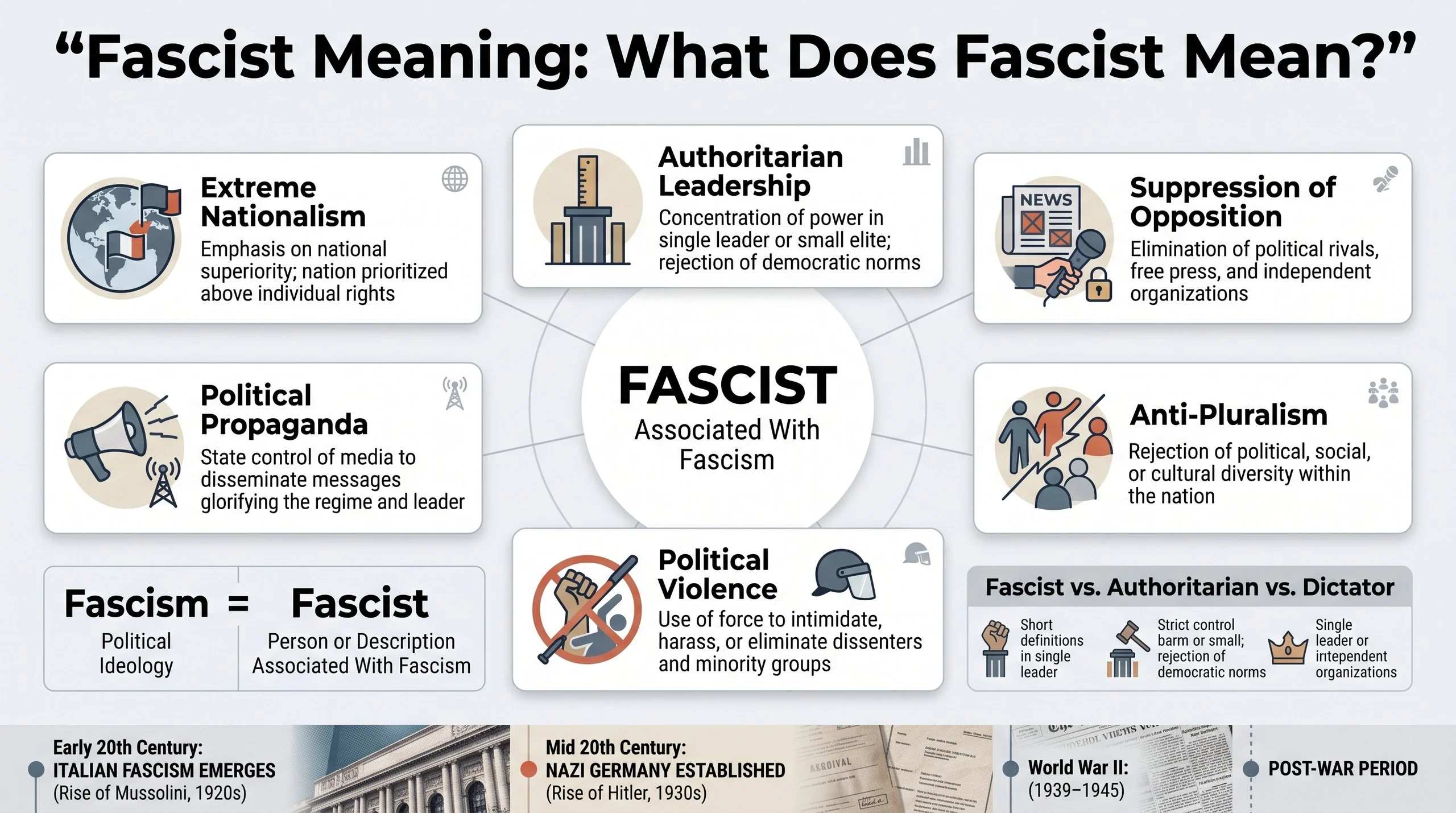
The fascist meaning refers to a person, movement, or system associated with fascism, a far-right authoritarian political ideology characterized by extreme nationalism, centralized power, suppression of political opposition, and rejection of liberal democratic principles. Historically, the term is most strongly associated with Fascist Italy under Benito Mussolini and Nazi Germany under Adolf Hitler, although scholars distinguish between different fascist movements and their specific beliefs.
In everyday language, fascist is also sometimes used more loosely to describe someone perceived as extremely authoritarian, controlling, or intolerant of opposition. However, that casual use can be much broader than the historical and political meaning.
Understanding the context is therefore important. A person can use “fascist” as a precise political description, a historical term, or an exaggerated insult.
What Does Fascist Mean?
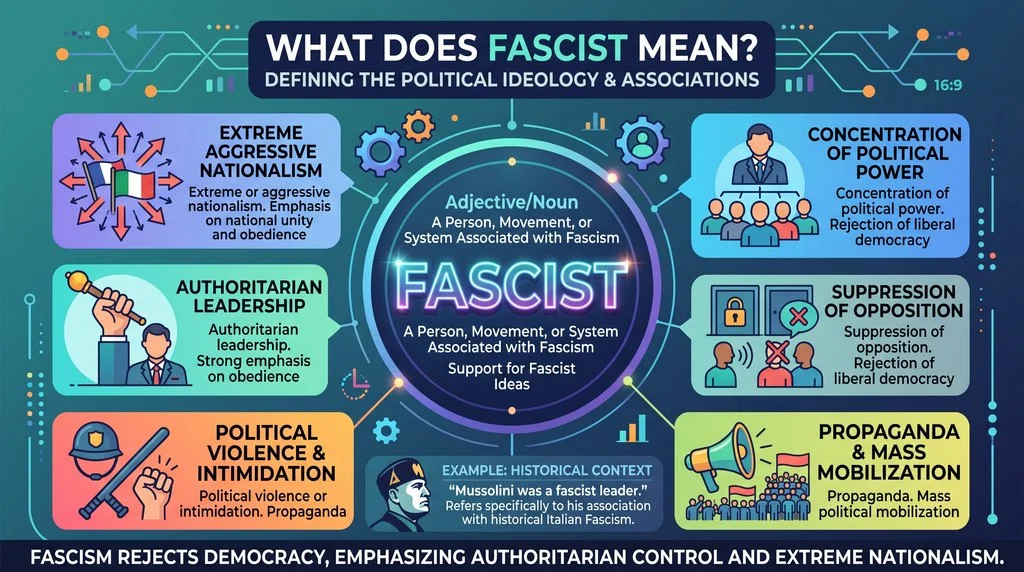
Fascist generally describes a person, movement, or system associated with fascism.
Fascism is a political ideology historically associated with:
- Extreme or aggressive nationalism
- Authoritarian leadership
- Concentration of political power
- Suppression of opposition
- Rejection of liberal democracy
- Political violence or intimidation
- Strong emphasis on national unity and obedience
- Propaganda and mass political mobilization
A fascist can therefore mean someone who supports fascism or a political movement characterized by fascist ideas.
For example:
“Mussolini was a fascist leader.”
Here, “fascist” refers specifically to Mussolini’s association with historical Italian Fascism.
1. What Does Fascist Mean?
The word fascist is primarily a political and historical term.
It describes someone who supports, identifies with, or is associated with fascism.
The word can also describe something connected to fascist political movements.
For example:
“The historian studied fascist movements in twentieth-century Europe.”
Here, “fascist” functions as an adjective describing political movements associated with fascism.
As a noun:
“The fascist organized a political rally.”
In this sentence, the word refers to a person associated with fascism.
Because the term carries strong historical and political meaning, it should not automatically be applied to anyone who behaves in a strict or controlling way.
2. What Is Fascism?
Fascism is an authoritarian political ideology and movement associated particularly with Europe in the early twentieth century.
Fascist movements generally emphasize the nation, strong centralized leadership, political unity, and obedience over individual political freedoms and pluralism.
Historically, fascist movements often opposed:
- Liberal democracy
- Political pluralism
- Marxist and communist movements
- Independent political opposition
- Certain forms of individualism
- Institutions that challenged centralized authority
Fascist governments have also used propaganda, censorship, political repression, and violence to maintain power.
However, fascism is not defined by one single policy. Historians and political scholars debate the precise boundaries of the term and how different movements should be classified.
3. Fascist Meaning in Simple Words
In simple terms:
A fascist is someone associated with a political ideology that strongly emphasizes authoritarian power, extreme nationalism, and suppression of political opposition.
Fascism generally places the interests of the nation or state above individual political freedoms.
A fascist political system may concentrate authority in a powerful leader or ruling movement while limiting opposition and democratic competition.
It is important to distinguish this definition from the casual use of “fascist” as a synonym for strict or controlling.
Someone being strict does not automatically make them fascist.
4. Origin of the Word Fascist
The word fascist comes from the Italian political movement known as Fascismo, which developed under Benito Mussolini after World War I.
The Italian word fascio can mean a group, bundle, or association. Fascist symbolism also drew on the ancient Roman fasces, a bundle of rods that represented authority and collective strength.
Mussolini’s movement eventually established a dictatorship in Italy.
The English words fascism and fascist developed from this historical political movement and later became associated with other authoritarian nationalist movements, especially in Europe during the 1920s and 1930s.
5. Key Characteristics of Fascism
Fascist movements have differed from one another, but several characteristics are commonly associated with fascism.
1. Extreme Nationalism
Fascist movements often place exceptional importance on national identity and national unity.
The nation may be presented as more important than competing political, class, or individual interests.
2. Authoritarian Leadership
Fascist systems typically favor concentrated political authority.
A powerful leader may be presented as a symbol of national strength and unity.
3. Suppression of Opposition
Fascist governments have historically restricted or eliminated political opposition.
Opposition parties, independent organizations, journalists, and activists may face censorship, imprisonment, intimidation, or violence.
4. Political Violence
Violence can play a significant role in fascist movements.
Historical fascist organizations sometimes used paramilitary groups to intimidate political opponents and enforce political goals.
5. Propaganda
Fascist governments have historically relied heavily on propaganda.
Political messaging can be used to glorify national identity, portray the leader as heroic, and depict opponents as threats to society.
6. Anti-Pluralism
Fascist ideology generally rejects the idea that competing political groups should freely share power.
Instead, fascist movements tend to emphasize unity under a dominant political movement or leadership.
7. Militarism
Some fascist movements strongly emphasized military strength, discipline, sacrifice, and national power.
Military imagery could become an important part of political culture and propaganda.
8. Rejection of Liberal Democracy
Historical fascist movements generally opposed liberal democratic institutions when those institutions limited their ability to exercise centralized power.
This could involve eliminating competitive elections, weakening legislatures, or destroying independent institutions.
6. Fascist Meaning in Politics
In political discussions, fascist can have a specific ideological meaning.
A political scientist or historian may use the term when discussing movements that display characteristics associated with fascism.
For example:
“The historian examined the rise of fascist politics in interwar Europe.”
Here, the word refers to a historical and ideological category.
In modern political arguments, however, “fascist” is sometimes used more loosely as an accusation against someone considered extremely authoritarian.
Because of this broader usage, readers should examine the specific behavior or ideology being described rather than assuming that every use of the word has the same meaning.
7. Historical Examples of Fascist Movements
The most important historical examples emerged in Europe during the twentieth century.
1. Italian Fascism
Italian Fascism developed under Benito Mussolini.
Mussolini established an authoritarian dictatorship and used nationalist propaganda, political repression, and state power to consolidate control.
The movement became the historical source of the term “fascism.”
2. Nazi Germany
Adolf Hitler’s Nazi movement is widely treated as a fascist movement, although Nazism had its own distinctive racial ideology and political characteristics.
Nazi Germany combined extreme nationalism, dictatorship, militarism, propaganda, political repression, antisemitism, racism, and systematic mass murder.
The Holocaust was central to Nazi persecution and genocide.
3. Other European Movements
Various movements in Europe during the interwar period have been described as fascist or fascist-influenced.
Their beliefs and political structures were not identical.
Consequently, historians examine each movement within its specific historical context rather than assuming that all fascist movements were exactly the same.
8. Fascist vs. Fascism
The words fascist and fascism are closely related but have different grammatical functions.
| Word | Meaning | Example |
|---|---|---|
| Fascism | The political ideology or system | “Fascism developed in Europe.” |
| Fascist | A person associated with fascism | “He was a fascist.” |
| Fascist | Something related to fascism | “The fascist movement gained support.” |
A simple way to remember the difference is:
Fascism = ideology
Fascist = person or adjective
9. Fascist vs. Authoritarian
These terms overlap, but they are not identical.
Authoritarian is a broad term for systems or leaders that concentrate political power and restrict political freedoms.
Fascist refers to a more specific ideological tradition associated with characteristics such as extreme nationalism, anti-pluralism, mass political mobilization, and authoritarian leadership.
Therefore, every fascist system is authoritarian, but not every authoritarian system is fascist.
For example, a military dictatorship may be authoritarian without being fascist.
10. Fascist vs. Dictator
A dictator is a person who exercises highly concentrated political power, usually without meaningful democratic accountability.
A fascist is someone associated with fascism.
These concepts can overlap.
For example, Benito Mussolini was both a dictator and a fascist leader.
However, not every dictator is fascist. Dictatorships can arise from military rule, personalist politics, monarchies, revolutionary movements, or other political traditions.
11. Fascist vs. Totalitarian
Totalitarianism describes a system that seeks extensive control over political and social life.
Fascist regimes can be totalitarian, particularly in their ambitions to mobilize society around the state or ruling movement.
However, the concepts are not interchangeable.
“Totalitarian” focuses on the extent and nature of political and social control, while “fascist” identifies a particular political ideology and tradition.
12. Fascist Meaning in Everyday Language
In everyday conversation, people sometimes use fascist to describe someone they consider extremely controlling or authoritarian.
For example:
“My boss is a fascist about office rules.”
In this sentence, the speaker probably does not mean that the boss literally supports historical fascism.
Instead, “fascist” is being used as an exaggerated insult meaning extremely controlling or authoritarian.
This usage is informal and can be controversial because it can weaken the historical meaning of the term.
13. Fascist as an Insult
The word fascist can function as a strong insult in political and everyday arguments.
For example:
“You’re acting like a fascist.”
Depending on context, the speaker may be accusing someone of authoritarian behavior rather than making a historically precise claim about fascist ideology.
Because the word has a connection to dictatorship, repression, political violence, and historical atrocities, it carries substantial emotional weight.
For serious discussions, it is usually better to identify the specific behavior being criticized.
14. Examples of How to Use Fascist
1. Historical Use
“Mussolini was a fascist leader in Italy.”
This uses fascist in a historically specific way.
2. Political Analysis
“The movement displayed several characteristics associated with fascist politics.”
This is a more analytical use.
3. Historical Description
“The museum contains documents from the fascist period.”
Here, fascist describes a historical period associated with fascism.
4. Informal Use
“My teacher is a fascist about phones in class.”
This is an exaggerated informal use meaning extremely strict or controlling.
The last example is much less precise than the first three.
15. Common Synonyms and Related Words for Fascist
There is no perfect synonym for fascist because the term refers to a specific political ideology.
Depending on context, related terms may include:
- Authoritarian
- Dictatorial
- Totalitarian
- Repressive
- Tyrannical
- Autocratic
- Ultranationalist
However, these words are not interchangeable.
For example, “authoritarian” has a broader meaning than “fascist.”
Similarly, “dictatorial” describes a style of political rule but does not necessarily identify a fascist ideology.
16. Stronger and Milder Alternatives
If the goal is to describe someone’s behavior rather than make a specific ideological claim, a more precise word may be better.
Strong Alternatives
- Tyrannical
- Repressive
- Dictatorial
- Oppressive
Mild Alternatives
- Strict
- Controlling
- Authoritarian
- Heavy-handed
For example:
Instead of:
“The manager is fascist.”
You might write:
“The manager is extremely controlling.”
That statement is more precise if the issue is simply workplace behavior.
17. Words Similar to Fascist
Several words may seem similar to fascist but describe different concepts.
Authoritarian
A person or system that favors strong centralized authority and limited political freedom.
Autocratic
Describes rule in which power is concentrated in one person or a small group.
Dictatorial
Describes behavior or government characterized by dictatorial power.
Tyrannical
Describes cruel or oppressive use of power.
Totalitarian
Describes an extreme form of political control extending deeply into society.
Ultranationalist
Describes an extreme form of nationalism.
These terms can describe characteristics associated with fascism without necessarily meaning fascist.
18. Antonyms of Fascist
There is no single perfect opposite of fascist.
Depending on the context, contrasting political concepts may include:
- Democratic
- Liberal
- Pluralist
- Anti-authoritarian
- Libertarian
- Egalitarian
For example:
“A pluralist political system allows competing political groups to participate.”
This contrasts with the anti-pluralist tendencies associated with historical fascist movements.
19. How to Use the Word Fascist Correctly
Context is especially important when using this term.
1. Use It Historically
“The fascist government used propaganda to strengthen its political control.”
2. Use It Politically
“Researchers are debating whether the movement should be classified as fascist.”
3. Avoid Using It as a Generic Synonym for Strict
Being strict does not automatically make someone fascist.
4. Explain the Specific Behavior
If you mean someone is controlling, authoritarian, or oppressive, using the more precise word can make your statement clearer.
5. Consider the Historical Weight
Fascism is connected to political repression, dictatorship, war, racism, and mass violence in its major historical manifestations.
Therefore, casually using the word can create a much stronger impression than intended.
20. Common Mistakes When Using Fascist
Mistake 1: Treating Fascist as a Synonym for Strict
A strict teacher, parent, or manager is not automatically fascist.
Mistake 2: Confusing Fascism With Any Dictatorship
Fascism is one particular political tradition. Other authoritarian systems may not be fascist.
Mistake 3: Ignoring Historical Context
The term has strong historical associations, particularly with Mussolini’s Italy and Nazi Germany.
Mistake 4: Assuming Every Nationalist Is Fascist
Nationalism exists in many political forms. Nationalism alone does not establish that a movement is fascist.
Mistake 5: Using the Word Without Explaining the Meaning
Because “fascist” has both technical and informal uses, context helps readers understand the intended meaning.
21. Fascist Meaning Compared With Related Terms
| Term | General meaning |
|---|---|
| Fascist | Associated with fascism |
| Fascism | Authoritarian, ultranationalist political ideology |
| Authoritarian | Favoring concentrated political power |
| Dictator | Person exercising highly concentrated political power |
| Totalitarian | Seeking extensive control over political and social life |
| Autocrat | Ruler with concentrated personal authority |
| Tyrant | Ruler who exercises power oppressively |
| Ultranationalist | Extremely focused on national identity or interests |
These definitions overlap in places, but they should not be treated as exact equivalents.
22. Quick Fascist Meaning Guide
Fascist: A person associated with fascism.
Fascism: A political ideology historically associated with authoritarian leadership, extreme nationalism, anti-pluralism, political repression, and mass mobilization.
Fascist government: A government organized around or strongly influenced by fascist ideology.
Fascist movement: A political movement promoting fascist ideas.
Authoritarian: A broader term describing concentrated political power and restricted political freedom.
Dictator: A ruler with highly concentrated political authority.
Fascist vs. authoritarian: Fascism is a specific political ideology, while authoritarianism is a broader category of political rule.
Fascist in everyday language: An informal term sometimes used to describe someone perceived as extremely controlling or authoritarian.
FAQs
1. What does fascist mean in simple words?
Fascist generally means a person, movement, or system associated with fascism. Fascism is an authoritarian political ideology historically linked to extreme nationalism, concentrated power, suppression of opposition, and rejection of liberal democracy.
2. What is the difference between fascist and fascism?
Fascism is the political ideology or system, while fascist describes a person, movement, or thing associated with that ideology.
3. Is fascist the same as dictator?
No. A fascist can be a dictator, but not every dictator is fascist. Dictatorships can follow many different political ideologies.
4. Is fascist the same as authoritarian?
No. Authoritarianism is a broader concept involving concentrated political power and restricted political freedom. Fascism refers to a specific political tradition with additional ideological characteristics.
5. Why do people call someone fascist?
People may use the word to accuse someone of supporting fascist politics or, more loosely, to describe behavior they consider extremely controlling or authoritarian. The latter is an informal use and may not be historically precise.
6. Was Mussolini a fascist?
Yes. Benito Mussolini was the founder and leader of Italian Fascism and established a fascist dictatorship in Italy.
7. Was Hitler a fascist?
Adolf Hitler and the Nazi movement are widely classified as fascist, although Nazism had distinctive features, particularly its extreme racial ideology and antisemitism.
8. Is fascist always a political word?
Its primary meaning is political and historical. However, people sometimes use “fascist” informally to describe someone who is extremely strict, controlling, or authoritarian.
Conclusion
The fascist meaning refers to a person, movement, or system associated with fascism, an authoritarian political ideology historically linked to extreme nationalism, centralized leadership, suppression of opposition, political violence, propaganda, and rejection of liberal democratic pluralism.
The word has deep historical significance because of movements such as Italian Fascism under Benito Mussolini and Nazism under Adolf Hitler. At the same time, modern speakers sometimes use fascist more loosely to describe someone they consider extremely controlling or authoritarian.
That distinction matters. A strict person is not automatically fascist, and authoritarian does not always mean fascist. Using the more precise term, such as authoritarian, dictatorial, oppressive, or controlling, can make a statement clearer when the historical ideology of fascism is not actually what is being discussed.
Ultimately, understanding the fascist meaning requires attention to both its historical political definition and its broader informal use in modern language.

Harry Edwards is a language writer specializing in word meanings, synonyms, and language usage. He creates clear, accurate, and engaging content to help readers improve their vocabulary and communication skills.

6 thoughts on “Fascist Meaning| Definition, History, Examples & How Fascism Shaped Modern Politics 2026”