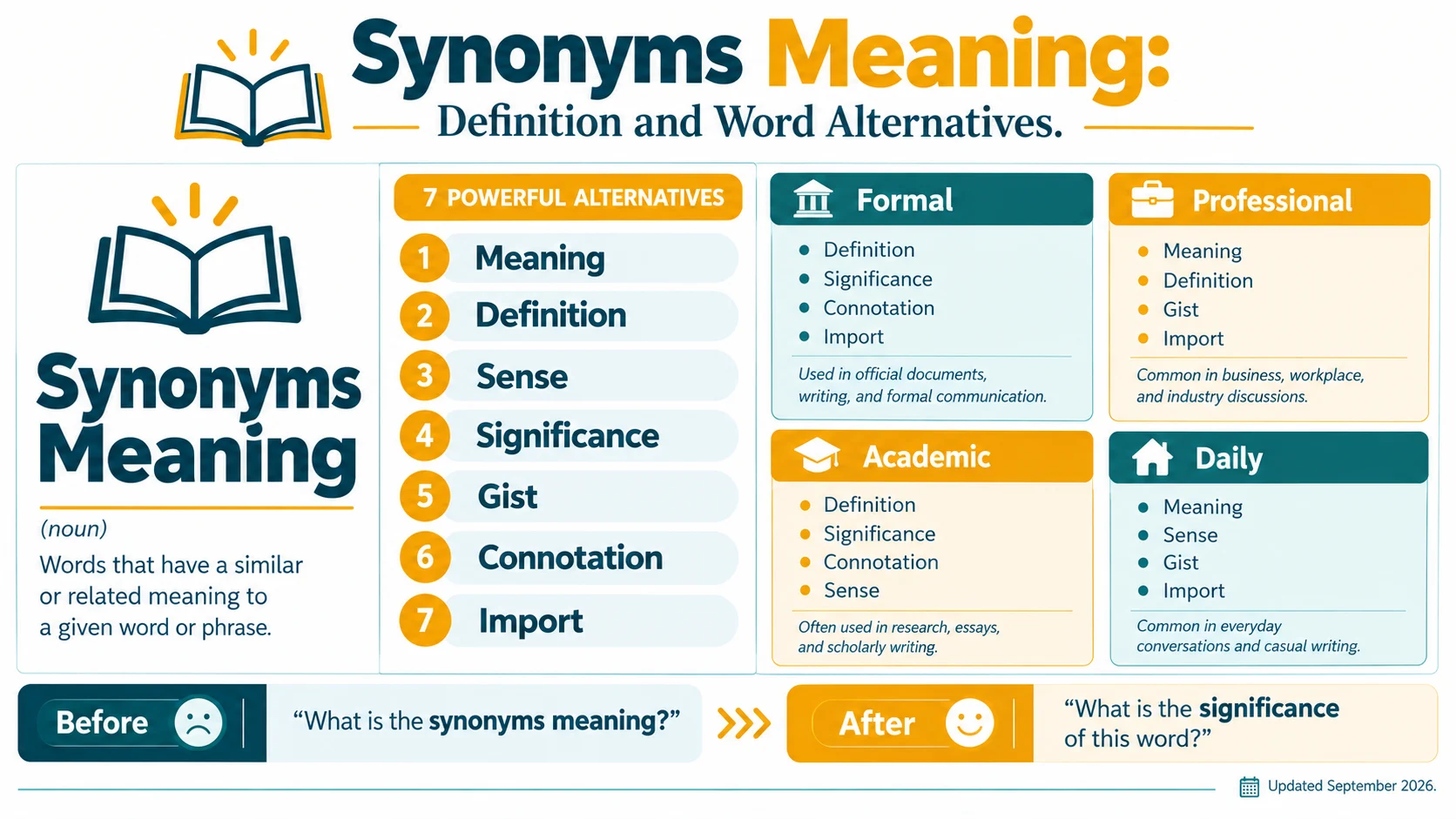
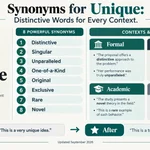
Synonyms meaning refers to words that share the same or nearly the same meaning as another word. Examples include “happy” and “glad,” or “big” and “large.” Understanding synonyms helps writers avoid repetition, match tone, and choose the most precise word for any context.
What Does “Synonyms Meaning” Mean?
Definition
The phrase synonyms meaning combines two ideas. A synonym is a word or phrase that means the same thing, or almost the same thing, as another word. Meaning, in this context, refers to the definition, sense, or significance that a word carries.
Put together, “synonyms meaning” is what people search when they want to understand what the term “synonym” actually refers to, or when they want words that express the idea of “meaning” itself. This page answers both needs.
A synonym does not have to be a perfect match. In real usage, most synonyms are near-synonyms — words that overlap in meaning but differ in tone, intensity, or formality. House” and “home” share a core meaning, yet they feel different. “Slim” and “skinny” describe the same body type but carry different connotations. That nuance is what makes synonym study valuable.
Common Uses
| Usage | What It Means | Example |
|---|---|---|
| Vocabulary learning | Students discover word relationships | What is the synonyms meaning of ‘happy’? |
| Writing improvement | Writers find fresher wording | “I need a synonym meaning ‘important.'” |
| SEO research | Marketers expand keyword coverage | “Find synonyms meaning the same as ‘cheap.'” |
| Translation work | Linguists match meaning across languages | “The synonyms meaning differs by region.” |
| Editing and proofing | Editors reduce repetition | “Replace repeated words with synonyms meaning the same.” |
Best Synonyms for “Meaning”
If you are looking for words that carry the sense of “meaning,” these are the strongest options.
| Synonym | Meaning | Best Used When | Example |
|---|---|---|---|
| Definition | A clear statement of what something is | Technical or educational writing | “The definition of ‘synonym’ is simple.” |
| Sense | The intended idea behind a word | Linguistic or philosophical writing | Which sense of ‘bank’ do you mean?” |
| Significance | Importance or underlying value | Formal and analytical writing | “The significance of the finding is clear.” |
| Interpretation | One’s understanding of meaning | Academic and legal writing | “Her interpretation differs from mine.” |
| Import | The core message or gist | Literary and formal writing | “The import of his speech was clear.” |
| Denotation | The literal dictionary meaning | Linguistics and academic writing | “The denotation of ‘cold’ is temperature.” |
| Connotation | The emotional or implied meaning | Writing and communication | “‘Cheap’ has a negative connotation.” |
| Substance | The essential content | Analytical and formal writing | “The substance of the argument holds.” |
| Gist | The main point | Casual and professional writing | “I got the gist of the article.” |
| Message | The idea being communicated | Business and daily writing | “The message was clear and direct.” |
Synonyms by Context
Formal Writing
Formal writing favors precision over decoration. Use definition, significance, or interpretation when you need a measured, authoritative tone.
- “The definition of the term varies across disciplines.”
- “The significance of this shift cannot be overstated.”
Professional Writing
Business documents and emails benefit from words like message, gist, and substance. They are direct, understood by everyone, and fit a professional register.
- “The gist of the proposal is straightforward.”
- “We need to clarify the substance of the agreement.”
Academic Writing
Academic work calls for terms like denotation, connotation, sense, and import. These signal linguistic awareness and keep the discussion technical.
- “The denotation and connotation of the word differ sharply.”
- “The import of the study lies in its methodology.”
Daily Conversation
In everyday speech, keep it simple. Meaning, point, and gist are natural and easy.
- “What’s the meaning of this word?”
- “I get the point, no need to explain.”
Professional Alternatives for “Meaning”
When you need a polished term for a resume, proposal, or report:
| Word | Why It Works | Example |
|---|---|---|
| Significance | Sounds analytical and mature | “The significance of the results is clear.” |
| Substance | Suggests depth and value | “The substance of the report stands.” |
| Implication | Implies consequence or hidden meaning | “The implication of the data matters.” |
| Message | Clear and universally understood | “The message of the campaign was strong.” |
| Intent | Focuses on purpose behind meaning | “The intent behind the wording is clear.” |
Simple Alternatives for “Meaning”
If you want plain, everyday words anyone can grasp:
| Simple Word | Example |
|---|---|
| Point | “What’s the point of this rule?” |
| Sense | “That makes sense to me.” |
| Idea | “The main idea is simple.” |
| Gist | “Tell me the gist of it.” |
| Message | “The message was easy to follow.” |
Stronger Alternatives for “Meaning”
When you want more weight or specificity:
| Stronger Term | Best For | Example |
|---|---|---|
| Denotation | Linguistics, academic writing | “The denotation is literal, not figurative.” |
| Connotation | Writing, communication | “The connotation of the word is negative.” |
| Significance | Formal analysis | “The significance of the change is profound.” |
| Import | Literary and formal writing | “The import of the passage is subtle.” |
| Interpretation | Academic, legal, critical writing | “Her interpretation of the text is original.” |
Difference Between Similar Synonyms
People often confuse meaning, definition, sense, and significance. They overlap, but they are not the same.
Meaning is the broadest term. It covers everything a word, phrase, or action communicates, whether literal or implied.
Definition is narrower. It is the formal statement of what a word means, usually found in a dictionary. A definition is one way to express meaning, but meaning goes beyond definition.
Sense refers to one specific meaning of a word when it has several. “Bank” has a different sense when it means a riverbank than when it means a financial institution.
Significance shifts the focus from what something means to why it matters. A symbol can have meaning, but its significance lies in its importance within a larger context.
Connotation is the emotional or cultural meaning attached to a word. “Home” and “house” share a denotation, but “home” carries warmth that “house” does not.
Understanding these distinctions helps you choose the right word instead of the first one you find.
Opposite Words (Antonyms)
If synonyms describe words of similar meaning, antonyms describe the opposite.
| Antonym Term | Meaning | Example |
|---|---|---|
| Antonym | A word with opposite meaning | “Hot” and “cold” are antonyms. |
| Opposite | Everyday term for antonym | “Name the opposite of ‘expand.'” |
| Contrast | A clear difference in meaning | “The contrast between the words is sharp.” |
| Nonsense | Lack of meaning | “That sentence is pure nonsense.” |
| Ambiguity | Unclear or multiple meanings | “The ambiguity of the phrase caused confusion.” |
Key Synonym Analysis
Synonym: Meaning
Meaning: The idea or concept that a word, phrase, or action expresses.
Best Used For: General reference, education, daily writing.
Tone: Neutral.
Difficulty: Easy.
Usage Frequency: Very Common.
Best For: Resume, Email Writing, Essay Writing, Marketing Copy, Business Writing.
- Business Example: “The meaning of the clause must be clarified before signing.
- Academic Example: “The meaning of the term shifts across historical periods.”
- Daily Conversation Example: “I didn’t catch the meaning of that joke.”
Synonym: Significance
Meaning: The importance or deeper value of something.
Best Used For: Analytical and formal writing.
Tone: Formal.
Difficulty: Medium.
Usage Frequency: Common.
Best For: Essay Writing, Business Writing.
- Business Example: “The significance of the merger is still unfolding.”
- Academic Example: “The significance of the study lies in its sample size.”
- Daily Conversation Example: “I didn’t realize the significance of that moment.”
Synonym: Gist
Meaning: The main point or general meaning.
Best Used For: Quick summaries and casual writing.
Tone: Informal.
Difficulty: Easy.
Usage Frequency: Common.
Best For: Email Writing, Daily Writing.
- Business Example: “Here’s the gist of the client’s request.”
- Academic Example: “The gist of the theory is simple.”
- Daily Conversation Example: “I got the gist of what he said.”
FAQs
What is the synonyms meaning?
Synonyms meaning refers to words that share the same or nearly the same meaning. For example, “happy” and “glad” are synonyms. The term also describes the study of how words relate in meaning.
What is a formal synonym for meaning?
Significance, import, and interpretation are strong formal options. In academic writing, denotation and connotation add precision.
What is a professional alternative for meaning?
Use substance, significance, or message. These fit business reports, proposals, and executive summaries.
What word can replace “meaning”?
Sense, gist, point, definition, significance, and import all work depending on context.
Conclusion
The phrase synonyms meaning touches on two important ideas: what synonyms are and what “meaning” itself conveys. Synonyms are words that share meaning, and “meaning” is the concept those words carry. Together they form the backbone of vocabulary study and effective writing.
Use definition for formal precision, significance for weight, gist for quick summaries, and connotation when emotion matters. Match the word to the moment, and your writing will read clearer, sharper, and more confident.
Keep this guide nearby when you edit. The right synonym, chosen with care, does more than replace a word. It sharpens the thought behind it.

Harry Edwards is a language writer specializing in word meanings, synonyms, and language usage. He creates clear, accurate, and engaging content to help readers improve their vocabulary and communication skills.

5 thoughts on “Synonyms Meaning | Definition and 40+ Word Alternatives”