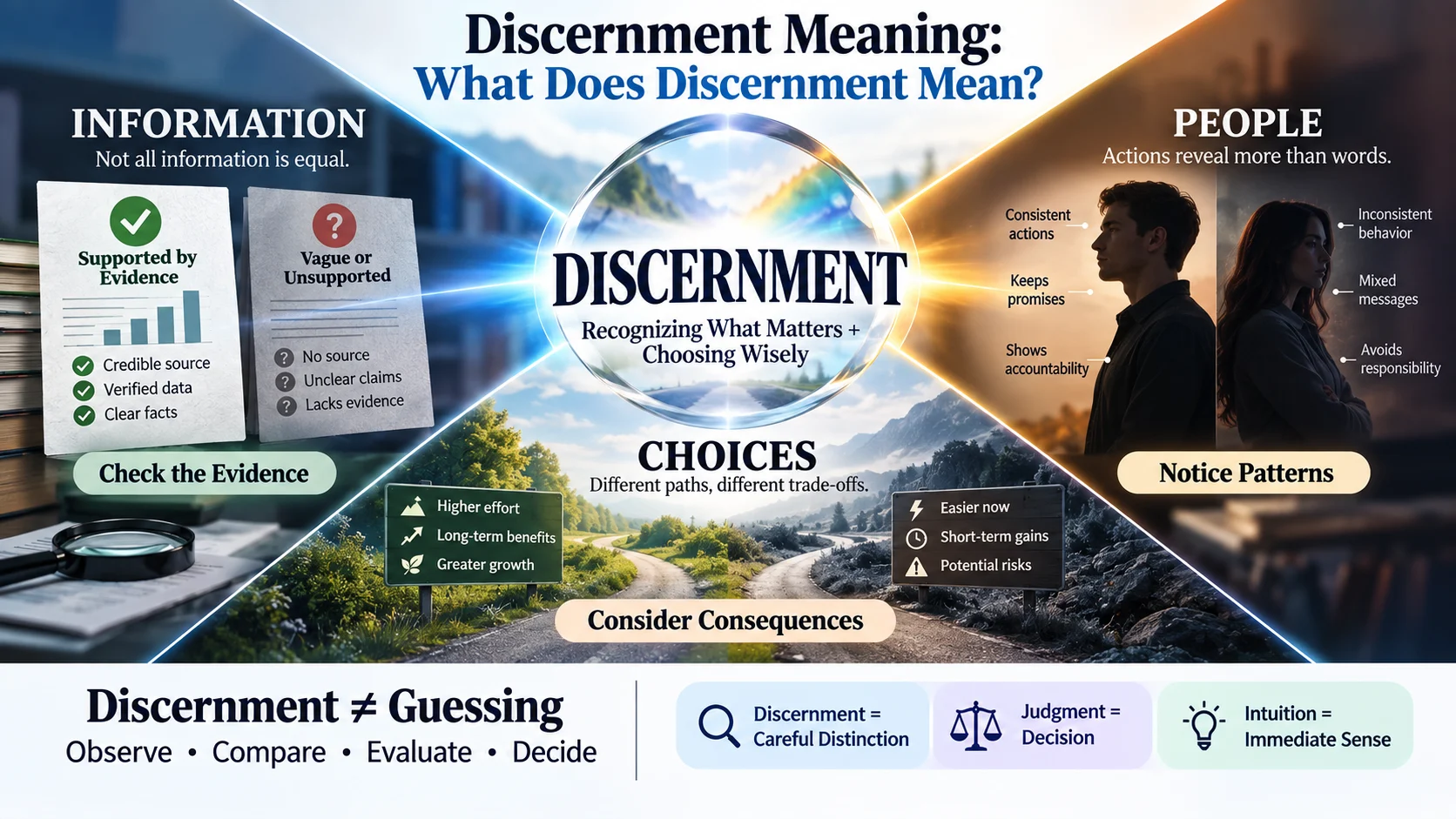
Discernment means the ability to recognize important differences and make thoughtful judgments based on careful understanding. A person with discernment can evaluate people, situations, ideas, or choices and identify what is useful, appropriate, true, or important. For example, using discernment can help you decide whether advice is trustworthy before acting on it.
The discernment meaning centers on the ability to notice differences, understand situations clearly, and make thoughtful judgments. When you use discernment, you do not simply react to what you see or hear. Instead, you look at the details, consider the circumstances, and decide what matters.
For example, imagine that two people give you advice about an important decision. One person has relevant experience, while the other speaks confidently but lacks useful knowledge. Discernment helps you recognize that difference before choosing whose advice to follow.
The word can describe everyday decisions, professional choices, relationships, education, and personal growth. It can also appear in religious or philosophical discussions, where it may refer to recognizing what is right, wise, or spiritually meaningful.
In simple terms, discernment is careful understanding that leads to sound judgment.
This guide explains what discernment means, how to use it, how it differs from judgment and intuition, and how the word works in everyday English.
What Does Discernment Mean?
Discernment means the ability to recognize differences and make wise or careful judgments.
It involves looking beyond the surface and paying attention to important details.
For example:
She showed great discernment when choosing a business partner.
This means she carefully evaluated the person and recognized whether they were a suitable choice.
In simple terms:
Discernment = noticing what matters + understanding the difference + making a thoughtful choice.
Discernment Definition
The noun discernment refers to the ability to judge something well by recognizing subtle or important differences.
A person uses discernment when they:
- Examine a situation carefully
- Notice details
- Separate useful information from misleading information
- Recognize good and poor choices
- Understand people’s intentions or behavior
- Evaluate different options
- Make thoughtful decisions
Discernment does not require perfect knowledge.
Instead, it describes the ability to look carefully, understand what you can, and make a reasonable judgment.
What Does It Mean to Have Discernment?
To have discernment means that you can distinguish between things and recognize which differences matter.
For example, a person might hear two similar arguments. Both sound convincing at first. However, one argument uses strong evidence while the other relies on assumptions.
A person with discernment can notice that difference.
Similarly, discernment can help someone recognize:
- Reliable advice versus poor advice
- Genuine concern versus manipulation
- Useful criticism versus pointless negativity
- A good opportunity versus a risky offer
- Important information versus distraction
- A temporary problem versus a serious issue
Therefore, discernment involves more than simply having an opinion.
Simple Meaning of Discernment
The simplest meaning of discernment is:
The ability to understand the difference between things and choose wisely.
Another simple explanation is:
Discernment means seeing and understanding what is important before making a decision.
For English learners, think of it this way:
Discernment = careful judgment based on understanding.
How Discernment Works
Discernment usually involves several mental steps.
1. Observe
First, you pay attention to what is happening.
You gather information instead of immediately reacting.
2. Compare
Next, you look at differences between the available choices, people, ideas, or situations.
3. Evaluate
Then, you consider which details matter.
You may ask:
- Is this information reliable?
- What evidence supports it?
- What are the risks?
- What are the benefits?
- What might I be missing?
4. Understand
After examining the information, you develop a clearer picture.
5. Decide
Finally, you make a judgment or choose an action based on what you have learned.
This process explains why discernment often supports good decision-making.
Examples of Discernment in Everyday Life
Discernment appears in many ordinary situations.
Choosing Friends
You may meet several new people. Everyone seems friendly at first.
With discernment, you pay attention to how each person behaves over time. You notice whether they respect boundaries, keep promises, and treat others fairly.
That information can guide your choice of friendships.
Evaluating Online Information
The internet contains useful information as well as misleading claims.
Discernment helps you ask:
- Who created this information?
- Is there evidence?
- Does another reliable source support it?
- Could the information be misleading?
You do not automatically believe or reject something. Instead, you evaluate it.
Making a Purchase
Suppose two products have similar prices.
One has strong specifications and reliable reviews. The other has impressive advertising but limited information.
Discernment helps you look beyond the marketing and compare what actually matters.
Choosing Career Opportunities
A job offer may look attractive because of its salary.
However, discernment encourages you to consider other factors, such as:
- Responsibilities
- Work environment
- Growth opportunities
- Schedule
- Stability
- Expectations
That broader view can support a more informed decision.
Discernment in Relationships
Discernment can play an important role in relationships.
It can help you distinguish between:
- Honest communication and manipulation
- Healthy disagreement and disrespect
- Genuine support and conditional support
- A temporary mistake and a repeated pattern
For example, someone may apologize after making a mistake. Discernment does not require you to accept or reject the apology immediately.
Instead, you can consider the person’s behavior, circumstances, and actions over time.
This approach encourages thoughtful judgment rather than an immediate emotional reaction.
Discernment in Decision-Making
Good decisions often require more than information.
You also need to understand which information matters most.
That is where discernment becomes useful.
Imagine that you have three possible solutions to a problem. One is cheap, one is fast, and one is reliable.
Discernment helps you determine which quality matters most in your situation.
If the decision involves safety, reliability may matter more than speed.
If the decision involves a minor task, speed may matter more.
Thus, discernment is partly about understanding context.
Discernment in the Workplace
Professionals use discernment when making decisions that require judgment.
For example, a manager may need to decide whether a project should move forward.
They may consider:
- Available resources
- Evidence
- Risks
- Deadlines
- Customer needs
- Team capacity
Discernment helps the manager separate important factors from minor distractions.
Similarly, employees use discernment when deciding how to respond to difficult situations, prioritize tasks, or evaluate information.
Discernment in Education
Students can use discernment when evaluating information and forming conclusions.
For example, a student researching a topic may find several websites with different claims.
Instead of copying the first answer, the student can examine:
- The author’s qualifications
- Supporting evidence
- Publication date
- Source quality
- Agreement with other reliable sources
That process demonstrates discernment.
Therefore, discernment can support both academic research and critical thinking.
Discernment in Spiritual and Religious Contexts
The word discernment also has a long history in religious and spiritual writing.
In these contexts, discernment may describe the process of recognizing what is considered spiritually wise, morally appropriate, or aligned with one’s beliefs.
For example, someone might talk about:
“spiritual discernment”
or
“discernment of God’s will.”
The exact meaning depends on the religious tradition and context.
In general, however, the central idea remains similar: carefully recognizing and evaluating what is meaningful, right, or appropriate rather than acting without reflection.
Discernment vs. Judgment
Discernment and judgment are closely related, but they are not exactly the same.
Judgment involves forming an opinion or making a decision about something.
Discernment emphasizes the process of recognizing differences and understanding what those differences mean.
For example:
He used judgment to choose the better option.
This focuses on the final decision.
He used discernment to recognize why one option was better.
This emphasizes careful observation and understanding.
Therefore, discernment can contribute to sound judgment.
Discernment vs. Wisdom
Wisdom refers to deep understanding and the ability to apply knowledge well, often based on experience.
Discernment focuses more specifically on recognizing differences and evaluating situations.
For example:
Wisdom may help you understand the long-term consequences of a decision.
Discernment may help you recognize which choice deserves closer consideration.
The two qualities often work together.
Discernment can help you identify the right factors, while wisdom can help you understand what to do with them.
Discernment vs. Intuition
Intuition is a feeling or immediate sense about something without consciously reasoning through every detail.
Discernment generally involves more deliberate evaluation.
For example:
“Something feels wrong.”
That may describe intuition.
By contrast:
“I noticed several inconsistencies, so I decided not to proceed.”
That demonstrates discernment.
However, the two can overlap. A person may notice an intuitive feeling and then use discernment to investigate whether that feeling has a reasonable basis.
Discernment vs. Critical Thinking
Critical thinking involves analyzing information, questioning assumptions, evaluating evidence, and forming reasoned conclusions.
Discernment has a related purpose but focuses more on recognizing meaningful differences and making careful distinctions.
For example, critical thinking may help you analyze an argument.
Discernment may help you recognize which part of the argument deserves attention.
As a result, both skills can support better decisions.
Discernment Synonyms
Depending on the context, useful synonyms or closely related terms for discernment include:
- Judgment
- Insight
- Perception
- Wisdom
- Awareness
- Understanding
- Discrimination
- Prudence
- Good sense
- Sound judgment
These words are related, but they are not always interchangeable.
Discernment and Judgment
These are the closest general alternatives.
Discernment emphasizes distinguishing and recognizing.
Judgment emphasizes forming an opinion or making a decision.
Discernment and Insight
Insight means a deep or clear understanding of something.
Discernment may use insight when evaluating a situation.
Discernment and Perception
Perception refers to how someone notices or understands something.
Discernment goes further by using that understanding to make careful distinctions.
Discernment and Prudence
Prudence means acting with care and good judgment, especially when considering risks.
Discernment can help a person recognize those risks before acting.
“Discern” vs. “Discernment”
The word discernment comes from the verb discern.
Discern
Discern means to recognize, identify, or understand something, especially when the difference is subtle.
Example:
She could discern a change in his tone.
Discernment
Discernment is the ability or skill involved in making those distinctions.
Example:
Her discernment helped her evaluate the situation carefully.
So:
Discern = recognize or distinguish
Discernment = the ability to recognize or distinguish wisely
How to Use Discernment in a Sentence
Here are natural examples:
- She showed great discernment when evaluating the offer.
- Good leaders need discernment when making difficult decisions.
- His discernment helped him recognize the unreliable information.
- Discernment allows people to distinguish useful advice from harmful advice.
- The manager used discernment before approving the proposal.
- Developing discernment can improve decision-making.
- She handled the situation with patience and discernment.
- His discernment helped him see the difference between confidence and arrogance.
Common Phrases With Discernment
“Use discernment”
This means to evaluate something carefully before deciding.
Use discernment when choosing which advice to follow.
“Show discernment”
This means demonstrate good judgment or the ability to recognize important differences.
She showed discernment during the negotiation.
“Good discernment”
This refers to strong ability to evaluate situations and make careful distinctions.
His good discernment helped the team avoid unnecessary risks.
“Exercise discernment”
This means actively use careful judgment.
Consumers should exercise discernment when evaluating online claims.
“Discernment skills”
This refers to abilities that help a person evaluate information, situations, people, or choices.
Signs of Strong Discernment
A person with strong discernment often:
- Pays attention to details
- Thinks before reacting
- Asks useful questions
- Recognizes important differences
- Considers context
- Evaluates evidence
- Notices patterns
- Understands consequences
- Avoids quick assumptions
- Makes deliberate choices
These traits do not mean the person always makes the correct decision.
Instead, they suggest that the person approaches decisions thoughtfully.
How to Develop Discernment
Discernment can improve through practice.
Slow Down
Avoid making important decisions purely from an immediate emotional reaction.
Give yourself time to understand the situation.
Ask Better Questions
Instead of asking only, “Do I like this?” ask:
- Why do I like it?
- What evidence supports my view?
- What risks exist?
- What information is missing?
Compare Options
Look at more than one possibility.
Comparison can reveal differences that are easy to miss.
Check Sources
When evaluating information, consider where it came from.
Reliable sources usually provide stronger foundations for decisions than unsupported claims.
Learn From Experience
Past decisions can teach you what you overlooked before.
Reflecting on those experiences can strengthen future judgment.
Consider Context
A choice that works in one situation may fail in another.
Therefore, consider the circumstances before applying a general rule.
Common Mistakes About Discernment
Mistake 1: Thinking Discernment Means Being Suspicious of Everyone
Discernment does not mean assuming that everyone has bad intentions.
Instead, it means evaluating people and situations carefully.
Mistake 2: Assuming Discernment Means Always Being Right
Even thoughtful decisions can produce unexpected results.
Discernment improves the decision-making process, but it does not guarantee perfection.
Mistake 3: Confusing Discernment With Intuition
Intuition can be an immediate feeling.
Discernment usually involves more deliberate evaluation.
Mistake 4: Thinking Discernment Means Overthinking
Careful evaluation does not require endless analysis.
Good discernment means focusing on the information that actually matters.
Mistake 5: Using Discernment as a Synonym for Intelligence
Intelligence and discernment overlap in some situations, but they are different concepts.
A person can know a great deal and still make poor judgments.
Discernment focuses on recognizing what matters and applying sound judgment.
What Is the Opposite of Discernment?
There is no single perfect opposite in every context.
However, words such as these can express the opposite idea:
- Indiscrimination
- Carelessness
- Thoughtlessness
- Impulsiveness
- Poor judgment
- Naivety
- Unawareness
The appropriate opposite depends on the situation.
For example, acting without considering important differences may show poor discernment.
Discernment in Different Situations
| Situation | How Discernment Helps |
|---|---|
| Relationships | Recognizes healthy and unhealthy patterns |
| Work | Supports thoughtful decisions |
| School | Helps evaluate information |
| Shopping | Separates useful features from marketing |
| Online research | Helps assess credibility |
| Leadership | Helps identify important risks |
| Personal choices | Supports careful decision-making |
| Spiritual life | Helps evaluate beliefs or choices within a faith context |
Discernment: Quick Reference
| Question | Answer |
|---|---|
| What does discernment mean? | The ability to recognize differences and make thoughtful judgments |
| What is simple discernment? | Seeing what matters and choosing carefully |
| What is discernment used for? | Evaluating people, choices, information, and situations |
| What is a synonym for discernment? | Judgment, insight, perception, or good sense |
| Is discernment the same as judgment? | They are related, but discernment emphasizes recognizing meaningful differences |
| Is discernment the same as intuition? | No; intuition is often immediate, while discernment usually involves evaluation |
| What does discern mean? | To recognize, identify, or distinguish something |
| Can discernment be learned? | Yes, people can strengthen it through reflection and practice |
| What is good discernment? | Careful evaluation that leads to a thoughtful judgment |
| What is poor discernment? | Failure to recognize important differences or evaluate a situation carefully |
Frequently Asked Questions
What does discernment mean?
Discernment means the ability to recognize important differences and make thoughtful judgments. It helps people evaluate situations before deciding how to respond.
What is a simple definition of discernment?
A simple definition is the ability to see the difference between things and understand what matters.
What does it mean to have discernment?
Having discernment means being able to evaluate people, information, choices, or situations carefully and recognize meaningful differences.
Is discernment a skill?
Yes. People can develop discernment by practicing careful observation, asking questions, evaluating evidence, and learning from experience.
What is an example of discernment?
Choosing reliable information over an unsupported online claim can demonstrate discernment. The person notices differences in evidence and credibility before accepting the information.
What is another word for discernment?
Depending on the context, related words include judgment, insight, perception, wisdom, awareness, prudence, and good sense.
What is the difference between discernment and judgment?
Judgment involves forming an opinion or making a decision. Discernment emphasizes recognizing differences and understanding which factors matter before reaching that decision.
What is the difference between discernment and intuition?
Intuition often describes an immediate feeling or sense. Discernment usually involves more deliberate observation and evaluation.
What does spiritual discernment mean?
Spiritual discernment generally refers to carefully evaluating experiences, choices, or beliefs within a religious or spiritual framework. Its exact meaning varies among traditions.
What does “use discernment” mean?
“Use discernment” means think carefully, recognize important differences, and make a thoughtful decision.
What does “show discernment” mean?
“Show discernment” means demonstrating the ability to evaluate a situation wisely and recognize what matters.
What is the opposite of discernment?
Depending on the context, possible opposites include carelessness, poor judgment, thoughtlessness, impulsiveness, and indiscrimination.
Can discernment be negative?
Discernment itself describes a skill rather than a moral quality. A person’s judgment can still be mistaken, biased, or poorly informed. Good discernment generally involves careful and reasonable evaluation.
Is discernment the same as wisdom?
No. Wisdom involves broad, often experience-based understanding. Discernment focuses more specifically on recognizing distinctions and evaluating choices or situations.
Conclusion
The discernment meaning is the ability to recognize important differences, understand situations clearly, and make thoughtful judgments. It helps people look beyond surface appearances and consider the details that actually matter.
In everyday life, discernment can guide decisions about relationships, work, education, purchases, online information, and personal choices. Likewise, it can support critical thinking and wise decision-making.
Although discernment is closely related to judgment, wisdom, insight, and intuition, each word has a slightly different focus. Discernment emphasizes recognizing distinctions and evaluating what those distinctions mean.
In simple terms:
Discernment means knowing what to notice, understanding why it matters, and choosing carefully.

Charlotte Wilson is a language writer passionate about word meanings, synonyms, and clear communication. She creates accurate and engaging content to help readers expand their vocabulary and language skills.








3 thoughts on “Discernment Meaning| What Does Discernment Mean in Life and Everyday Use?”