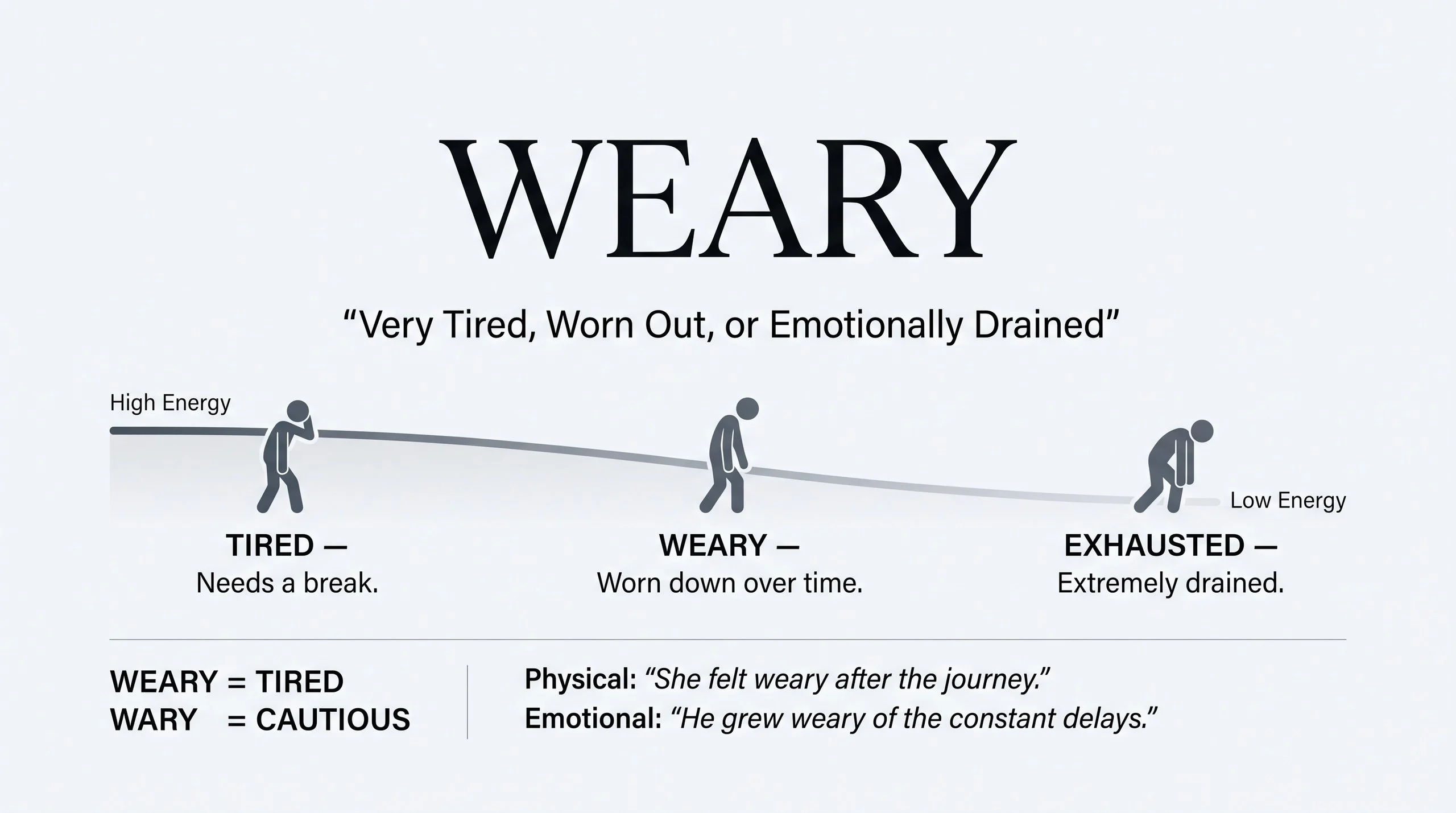
Weary means feeling very tired, worn out, or lacking energy, usually after prolonged effort, stress, or difficulty. It can describe physical exhaustion or emotional tiredness and often suggests that someone has become drained over time.
Weary meaning refers to a feeling of deep tiredness, exhaustion, or weariness. Unlike ordinary tiredness, the word often suggests that someone has been worn down by continued effort, stress, difficulty, or repetition.
For example, you might say, “She was weary after the long journey.” This means the journey left her very tired.
However, weary can also describe emotional or mental exhaustion. Someone may become weary of an argument, routine, problem, or repeated disappointment. In that sense, the word means that a person has grown tired of something emotionally rather than simply needing sleep.
The word is common in books, articles, speeches, formal writing, and everyday English. It can sound slightly more literary or expressive than the simple word tired.
Therefore, understanding the context matters. Weary can describe a person’s physical condition, emotional state, or growing frustration with something that has continued for too long.
Quick Answer Box
| Meaning | Context | Primary Use | Example | Tone |
|---|---|---|---|---|
| Very tired or worn out | Physical, mental, emotional | Describing exhaustion | “He looked weary after the journey.” | Neutral/Literary |
What Does Weary Mean?
Weary means extremely tired, drained, or worn out.
It usually describes a deeper or longer-lasting form of tiredness. Someone can become weary after working for many hours, traveling for a long time, dealing with stress, or facing repeated problems.
For example:
“The weary traveler finally reached the hotel.”
The sentence suggests that the traveler was deeply tired after the journey.
The word can also describe emotional exhaustion:
“She grew weary of the constant arguments.”
Here, weary means she became emotionally tired of dealing with the arguments.
Simple Definition
In simple terms:
Weary = very tired, worn out, or emotionally drained.
Depending on the sentence, it can be similar to:
- Tired
- Exhausted
- Drained
- Worn out
- Fatigued
- Fed up
Still, these words are not always interchangeable. Weary often carries the idea of tiredness that develops through prolonged effort or difficulty.
Weary Meaning in Different Contexts
The word can describe several kinds of tiredness.
1. Weary Meaning in Everyday English
In everyday English, weary usually means very tired.
For example:
“I was weary after driving all night.”
The speaker is saying that the long period of driving left them exhausted.
Similarly:
“The children were weary after the hike.”
This means the children were very tired after walking for a long time.
2. Weary Meaning in Emotional Situations
Weary can describe emotional exhaustion as well.
For example:
“He became weary of hearing the same excuse.”
The person is not necessarily physically tired. Instead, repeated exposure to the same excuse has made him emotionally frustrated or drained.
This usage is especially common with the structure:
weary of + noun/gerund
Examples include:
- weary of waiting
- weary of arguing
- weary of excuses
- weary of criticism
- weary of uncertainty
3. Weary Meaning in Literature
The word appears frequently in literature because it creates a stronger image than tired.
Consider:
“The weary traveler walked through the quiet village.”
The word suggests more than a lack of energy. It can make the reader imagine someone who has endured a long or difficult journey.
As a result, writers often choose weary when they want to communicate exhaustion with an emotional or atmospheric quality.
4. Weary Meaning in Work
A person may feel weary after prolonged work.
For example:
“The workers were weary after completing the project.”
This sentence suggests that the workers became physically or mentally drained by sustained effort.
Similarly:
“She felt weary after weeks of overtime.”
The word emphasizes accumulated tiredness rather than a brief feeling of fatigue.
5. Weary Meaning in Relationships
People can become weary of repeated conflict, misunderstandings, or disappointment.
For example:
“They were weary of arguing about the same issue.”
Here, weary communicates emotional exhaustion.
The person may still care about the relationship. However, repeated problems have drained their patience and energy.
Contextual Dynamics & Nuances of Weary
One important feature of weary is that it can describe both a person’s condition and their response to something.
Compare these two sentences:
“She was weary after the trip.”
This describes physical or general tiredness.
“She was weary of the constant complaints.”
This describes emotional frustration or exhaustion.
The preposition changes the meaning slightly.
Weary + From
Use weary from when something causes tiredness.
“He was weary from the long journey.”
This emphasizes the cause of the exhaustion.
Weary + Of
Use weary of when someone has become tired of something emotionally or mentally.
“She was weary of the endless delays.”
This suggests frustration, boredom, or emotional exhaustion.
Weary + Person
You can also describe someone as weary:
“The weary soldier rested beside the road.”
Here, the adjective describes the person’s condition.
Real-Life Conversation Examples Using Weary
Example 1: After Work
Sam: “You look exhausted.”
Alex: “I am. I’m weary after working all day.”
The speaker uses weary to emphasize deep tiredness.
Example 2: Long Travel
Maya: “How was the trip?”
Daniel: “Beautiful, but I was weary by the time I got home.”
Here, weary describes physical exhaustion caused by traveling.
Example 3: Repeated Arguments
Anna: “Are you still discussing the same problem?”
James: “Honestly, I’m weary of arguing about it.”
In this example, the speaker is emotionally tired rather than simply sleepy.
Example 4: Studying
Student: “I still have three chapters to finish.”
Friend: “Take a break. You look weary.”
The word describes visible tiredness.
Example 5: Ongoing Problems
Manager: “How are things going with the project?”
Employee: “I’m starting to feel weary of the constant delays.”
Here, the employee feels emotionally drained by a repeated problem.
Platform-Specific Breakdown
Weary is not typical internet slang. Instead, it is a standard English adjective that may appear in social media captions, comments, literary posts, motivational content, and personal messages.
How It Is Used on Snapchat
On Snapchat, people are more likely to use simple words such as tired, exhausted, or done.
Still, weary may appear in a thoughtful caption:
“Feeling weary after a long week.”
The meaning remains very tired or drained.
The Role of Weary on TikTok
TikTok creators may use weary when discussing burnout, difficult experiences, relationships, or emotional exhaustion.
For example:
“When you’re weary of starting over.”
Here, the word conveys emotional tiredness rather than ordinary sleepiness.
However, it should not be treated as a special TikTok slang term. Its standard dictionary meaning remains unchanged.
Instagram and Texting Dynamics
On Instagram, weary may appear in captions that have a reflective, emotional, or literary tone.
In casual texting, someone might say:
“I’m so tired.”
A more expressive version could be:
“I’m feeling weary lately.”
The second sentence sounds more thoughtful and serious.
Alternative Meanings & NLP Variations of the Phrase
Several forms and related expressions help clarify how the word works.
Weary as an Adjective
The most common form is the adjective weary.
“The weary traveler needed rest.”
It describes someone who is tired or worn out.
Weariness as a Noun
Weariness means the state of being weary.
“A feeling of weariness came over him.”
The word refers to the condition itself.
Weary of
This expression means becoming tired of something through continued exposure.
“She was weary of the constant noise.”
Weary from
This expression identifies the source of physical or mental exhaustion.
“He was weary from the demanding schedule.”
Grow Weary
Grow weary means gradually become tired or discouraged.
“They grew weary of waiting.”
This expression highlights a change over time.
Never Weary
The phrase never weary of means to never become tired of something.
“She never grew weary of reading.”
In this construction, weary refers to losing enthusiasm or becoming tired of repeated activity.
Weary vs. Tired
These words are closely related, but they are not always equal.
| Word | Meaning | Example |
|---|---|---|
| Weary | Very tired or worn out | “She felt weary after the journey.” |
| Tired | Needing rest or lacking energy | “I’m tired after work.” |
Tired is more common in everyday conversation.
Weary often suggests deeper, prolonged, or emotionally meaningful exhaustion.
Therefore, someone who is tired may simply need a break. Someone who is weary may feel worn down by something that has continued for a long time.
Weary vs. Exhausted
Both words indicate strong tiredness, but exhausted often suggests an extreme lack of energy.
For example:
“I was exhausted after running the race.”
This emphasizes the intensity of the physical effort.
By contrast:
“I was weary after weeks of hard work.”
This emphasizes accumulated tiredness over time.
The distinction is not absolute, but it can help you choose the more natural word.
Weary vs. Wary
These two words are commonly confused because they sound somewhat similar.
However, their meanings are completely different.
Weary means tired or worn out.
“She was weary after the journey.”
Wary means cautious or careful because you suspect a possible problem.
“She was wary of the unfamiliar website.”
A useful memory trick is:
Weary = tired.
Wary = cautious.
Common Mistake
Do not write:
“I am weary of strangers because they might scam me.”
if you actually mean that you are cautious.
The more accurate sentence is:
“I am wary of strangers because they might scam me.”
However, if you mean that repeated experiences have emotionally drained you, weary may fit:
“I’m weary of dealing with scammers.”
Weary vs. Wearied
Weary is the adjective describing a state.
“He looked weary.”
Wearied usually describes someone who has been made tired by something.
“The long journey wearied him.”
The distinction is subtle but useful in formal writing.
Synonyms for Weary
The best synonym depends on the situation.
Physical Tiredness
- Tired
- Exhausted
- Fatigued
- Drained
- Worn out
- Spent
- Depleted
Emotional Tiredness
- Drained
- Burned out
- Discouraged
- Frustrated
- Fed up
- Worn down
Literary Alternatives
- Faint
- Spent
- Worn
- Exhausted
- Enervated
However, some alternatives have stronger or more specific meanings. For example, burned out often refers to prolonged physical or emotional stress, especially related to work.
Misinterpretations: When NOT to Use Weary
Although weary is a useful word, it does not fit every situation involving tiredness.
1. Do Not Use Weary When You Mean Cautious
Use wary when someone is being careful because they suspect danger or trouble.
Incorrect meaning:
“She was weary of the stranger.”
If you mean she was cautious, write:
“She was wary of the stranger.”
2. Do Not Automatically Replace Every Use of Tired
The words overlap, but weary can sound more formal or literary.
For a casual text, this is usually more natural:
“I’m really tired today.”
Instead of:
“I’m extremely weary today.”
Both can be grammatically correct, but the tone differs.
3. Do Not Use Weary for Simple Caution
If someone carefully checks a deal because they do not trust it, they are wary, not weary.
4. Do Not Assume Weary Always Means Sleepy
Someone can be emotionally weary without wanting to sleep.
For example:
“She was weary of the constant criticism.”
This describes emotional exhaustion.
How to Respond in Chat Comfortably
If someone says:
“I’m feeling weary.”
a natural response might be:
“Sounds like you’ve had a long day. Get some rest.”
If they say:
“I’m weary of dealing with this.”
you can understand it as emotional frustration or exhaustion.
A natural response could be:
“I understand. It sounds like this has been going on for a while.”
The context usually reveals whether the person means physical tiredness or emotional exhaustion.
FAQs
1. What does weary mean?
Weary means very tired, worn out, or drained. It can describe physical exhaustion as well as emotional or mental tiredness.
2. Is weary the same as tired?
Not exactly. Both describe a lack of energy, but weary often suggests deeper or prolonged tiredness.
3. Does weary mean exhausted?
It can. However, exhausted often emphasizes an extreme lack of energy, while weary can also suggest being worn down over time.
4. What does weary of mean?
Weary of means becoming tired, frustrated, or emotionally drained by something that continues or happens repeatedly.
5. What does weary from mean?
Weary from identifies the cause of someone’s tiredness.
For example, “She was weary from traveling” means traveling made her very tired.
6. What is the difference between weary and wary?
Weary means tired or worn out. Wary means cautious or suspicious.
7. Is weary a positive or negative word?
It usually describes an unpleasant state of tiredness, exhaustion, or emotional strain. However, its tone depends on the context.
8. Can weary describe emotions?
Yes. Someone can become weary of arguments, delays, criticism, uncertainty, or repeated problems.
9. What is the noun form of weary?
The noun form is weariness, meaning the state of being tired, worn out, or emotionally drained.
10. What is the opposite of weary?
Possible opposites include energetic, refreshed, rested, lively, and vigorous, depending on the context.
Conclusion
The weary meaning is closely connected to deep tiredness, exhaustion, and feeling worn down. The word can describe physical fatigue, but it can also communicate emotional or mental exhaustion.
For example, someone can feel weary after a long journey. Likewise, a person can grow weary of repeated arguments, delays, criticism, or disappointment. In these situations, the word communicates more than simple tiredness.
The distinction between weary and wary is especially important. Weary means tired, while wary means cautious. Meanwhile, tired is the more common everyday alternative, and exhausted can express a stronger degree of fatigue.
Therefore, choose weary when you want to communicate that someone has become significantly tired or worn down, especially after prolonged effort or difficulty. Its slightly expressive tone makes it useful in both everyday writing and more reflective language.