Reign means the period when a king, queen, or other ruler holds power. It can also describe the exercise of royal authority. As a verb, reign means to rule or hold supreme power. In figurative English, it can describe something dominant or widespread.
Reign meaning refers to the period or authority associated with a ruler, especially a king or queen. In simple terms, a monarch reigns when that person holds the throne and exercises royal authority.
However, the word has a broader use in modern English. Writers can use it to describe dominance, popularity, or control. For example, someone might say that a particular artist “reigns supreme” in a music genre. Here, the expression does not suggest literal royal power.
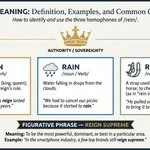
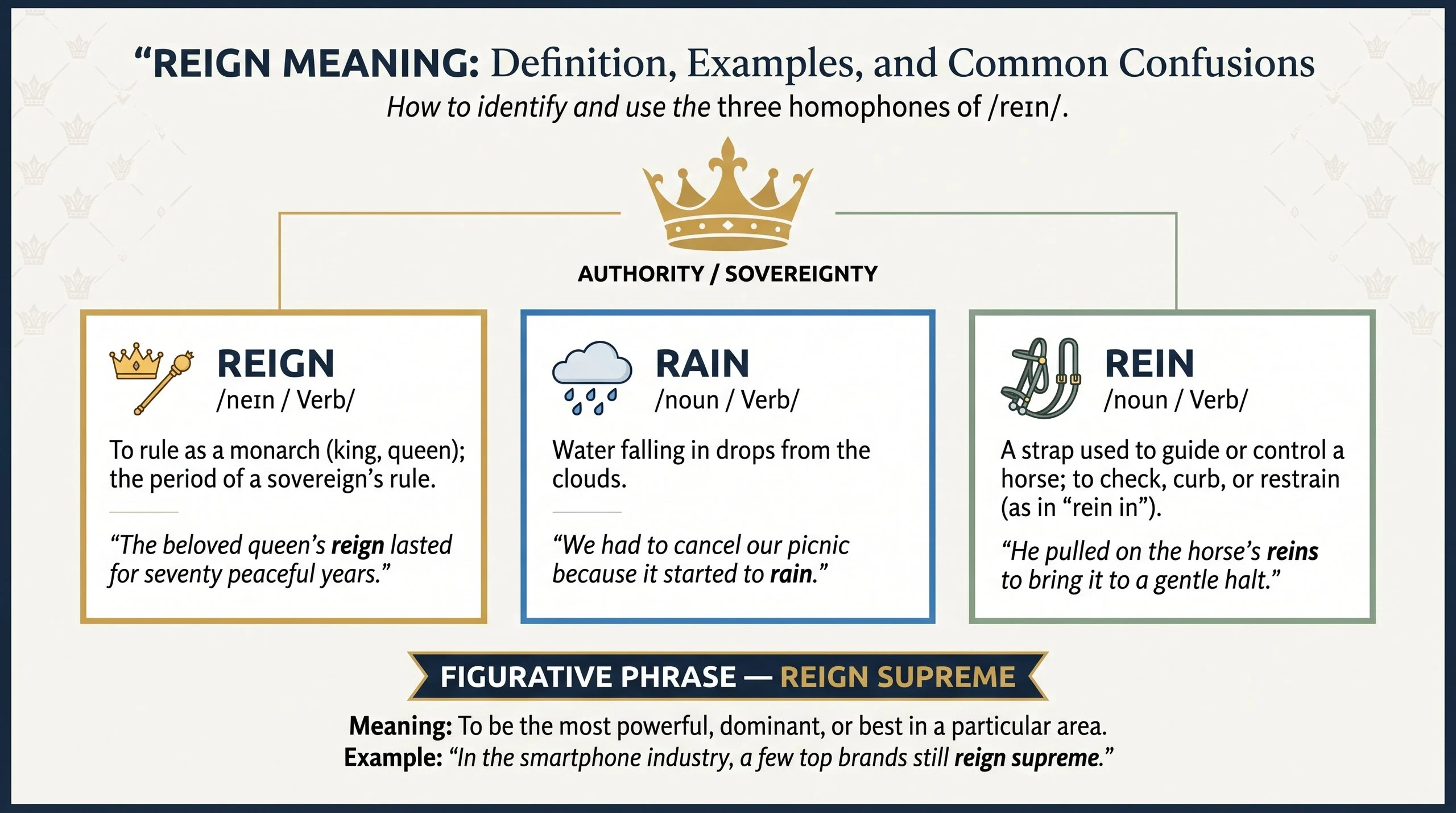
The word also causes confusion because it sounds exactly like rain and rein. These words have completely different meanings. Rain refers to water falling from clouds. Rein refers to a strap used to control a horse. Therefore, understanding the spelling and context matters.
The term appears frequently in history books, biographies, literature, journalism, political writing, sports commentary, and everyday figurative expressions. Its meaning becomes clearer when you examine the noun and verb forms separately.
Quick Answer Box
| Meaning | Context | Primary Platforms | Example | Tone |
| A ruler’s period of power | History and monarchy | Books, articles, education | “Her reign lasted forty years.” | Formal |
| Royal authority | Government and history | News, academic writing | “The king began his reign in 1950.” | Formal |
| To rule | General and figurative English | Writing and conversation | “The champion reigned for years.” | Formal |
| To dominate | Figurative language | Sports and entertainment | “The team reigned supreme.” | Expressive |
| A period of dominance | Popular culture | Social media and journalism | “Her songs reigned at the top.” | Informal to expressive |
What Does Reign Meaning Mean?
The central reign meaning concerns a ruler’s period of authority. It usually describes the time during which a monarch occupies the throne.
For example:
“Queen Elizabeth II had one of the longest reigns in British history.”
Here, reign functions as a noun. It identifies the period during which Elizabeth II served as monarch.
The word can also function as a verb.
“King Charles III reigns as the British monarch.”
In this sentence, reign means to rule as a monarch.
Reign as a Noun
As a noun, reign usually refers to a period of rule.
Consider these examples:
- “The emperor’s reign lasted three decades.”
- “Her reign changed the country.”
- “The dynasty experienced a peaceful reign.”
- “His reign ended after a major political crisis.”
The noun often appears with words such as long, short, peaceful, successful, absolute, and brief.
Reign as a Verb
As a verb, reign means to rule or hold sovereign authority.
Examples include:
- “The queen reigned for seventy years.”
- “The dynasty reigned over the region.”
- “The monarch reigned during a period of major change.”
The verb usually describes authority rather than ordinary management.
Where Did the Word Come From?
The English word reign developed through Old French and ultimately traces back to Latin roots associated with ruling and governing.
Its history connects it with words such as regal, regent, and regime. These related terms share historical connections with concepts of authority and rule.
Therefore, the word carries a strong historical association with monarchy and political power.
Reign Versus Rule
The words reign and rule overlap, but they are not always interchangeable.
| Word | Main Meaning | Typical Context |
| Reign | A monarch’s period of power or act of ruling | Kings and queens |
| Rule | Control or authority over people or places | Broad political and social contexts |
| Govern | Direct or administer a state | Government |
| Lead | Guide people or an organization | General |
| Dominate | Hold greater power or influence | Competition and figurative use |
Reign sounds more closely connected to monarchy. Rule has a much wider range of applications.
For example, a president can rule a country in a broad historical description. However, calling a president’s time in office a reign can sound figurative, dramatic, or critical depending on context.
Contextual Dynamics and Nuances of the Term
Understanding the reign meaning requires more than memorizing one definition. Context determines whether the word refers to literal monarchy or figurative dominance.
Historical Context
Historical writing frequently uses reign to identify a monarch’s time on the throne.
For example:
“During Henry VIII’s reign, England experienced major religious changes.”
The word establishes a specific historical period.
Historians often use the phrase during the reign of before a monarch’s name.
Example:
“During the reign of Queen Victoria, Britain experienced major industrial growth.”
This construction sounds formal and natural.
Political Context
The word can appear in political analysis, particularly when discussing monarchies.
For example:
“The king began his reign after the death of his father.”
It can also describe the end of royal authority.
“The ruler’s reign ended after his abdication.”
The term does not necessarily describe whether the reign was good or bad. Additional language supplies that evaluation.
Literary Context
Authors often use reign to create a sense of power, grandeur, or historical distance.
For example:
“The sorcerer’s reign over the kingdom lasted a century.”
The character may not be a real monarch. Yet the writer uses the word to create a royal or authoritative atmosphere.
Figurative Context
Modern English often uses reign metaphorically.
Consider:
“The singer reigned supreme on the charts.”
The singer does not literally possess a throne. Instead, the phrase means that the singer dominated the charts.
Other examples include:
- “The team reigned supreme throughout the tournament.”
- “The company reigned as the market leader.”
- “For years, the actor reigned at the box office.”
- “The restaurant reigned as the city’s favorite.”
This figurative use is especially common in entertainment, sports, marketing, and journalism.
The Expression “Reign Supreme”
Reign supreme means to hold the highest position or demonstrate overwhelming dominance.
For example:
“The champion continued to reign supreme.”
The expression sounds strong and dramatic. Therefore, it works particularly well in sports writing, entertainment articles, headlines, and creative prose.
It is less suitable for plain professional communication when a neutral phrase such as remain the leader would communicate the idea more directly.
Real Life Conversation Examples Using Reign Meaning
Conversation 1: History Class
Maya: When did Queen Victoria become queen?
Daniel: She began her reign in 1837.
Maya: How long did her reign last?
Daniel: More than sixty years.
This conversation uses reign in a literal historical sense.
Conversation 2: Sports
Alex: Who dominated the league during that period?
Jordan: That team basically reigned supreme for several seasons.
Alex: So they were the clear champions?
Jordan: Exactly.
Here, reigned supreme has a figurative meaning. The team did not possess royal authority.
Conversation 3: Entertainment
Sam: Why does everyone keep talking about that singer?
Taylor: She has been reigning at the top of the charts.
Sam: Her popularity seems huge.
Taylor: Yes. She has dominated the industry lately.
This example uses the word to express cultural dominance.
Conversation 4: Literature
Teacher: What does the word mean in this chapter?
Student: It refers to the king’s period of authority.
Teacher: Correct. The author uses it to establish the historical setting.
The word carries a formal literary tone here.
Conversation 5: Everyday Figurative Use
Chris: Which restaurant is most popular downtown?
Morgan: That new Italian place seems to reign supreme right now.
Chris: I keep seeing long lines outside it.
Morgan: That probably explains its popularity.
This usage is expressive rather than literal.
Platform Specific Breakdown
The word reign behaves differently across digital platforms. Social media users usually encounter it in figurative expressions rather than historical discussions.
How It Is Used on Snapchat
Snapchat conversations tend to favor short, informal messages. Users may use reign when praising someone’s dominance or success.
Examples include:
“You reign!”
“She still reigns supreme.”
“He is reigning today.”
These statements usually express admiration. They do not normally refer to actual monarchy.
However, context matters. A message about history could use the word literally.
For example:
“We learned about her reign today.”
That sentence has a completely different meaning from:
“You reign!”
The first discusses historical authority. The second praises someone.
The Role of Reign Meaning on TikTok
TikTok frequently uses dramatic and exaggerated language. Consequently, reign can appear in captions, comments, memes, and fan discussions.
A creator might write:
“She continues to reign.”
The statement usually means that the person remains highly popular or influential.
Similarly, a sports fan might comment:
“Our team reigns supreme!”
The phrase communicates enthusiasm and dominance.
However, users should not assume that every appearance has slang status. Reign remains a standard English word. Social media simply gives it more figurative applications.
Instagram and Texting Dynamics
Instagram captions often use expressive language. Therefore, reign can add a dramatic quality to posts.
Examples include:
“Confidence reigns today.”
“She continues to reign.”
“Let the queen reign.”
The last example can be literal or playful depending on context.
In texting, the word may appear in short praise.
“You absolutely reign.”
This means something similar to:
“You are amazing.”
However, reign is not a replacement for every positive expression. The word usually suggests influence, dominance, excellence, or authority.
Alternative Meanings and NLP Variations of the Phrase
Natural language processing systems must distinguish reign from similar sounding words. Human readers rely heavily on context, while automated systems examine surrounding words and sentence structure.
Reign
Meaning:
To rule or hold authority.
Example:
“The monarch reigned for decades.”
Rain
Meaning:
Water that falls from clouds.
Example:
“Heavy rain delayed the game.”
Rein
Meaning:
A strap used to control or guide a horse.
Example:
“The rider pulled the reins gently.”
These three words are homophones. They sound alike but have different spellings and meanings.
Common Related Terms
| Related Term | Meaning |
| Monarch | A king or queen |
| Monarchy | A system involving a monarch |
| Sovereign | A supreme ruler |
| Royal | Connected with a monarch |
| Reign | Period or exercise of royal authority |
| Regency | Rule exercised by a regent |
| Dynasty | A succession of rulers from the same family |
| Abdication | Giving up a throne or position of royal authority |
| Coronation | Ceremony associated with becoming a monarch |
Figurative Synonyms
Depending on context, possible alternatives include:
- Rule
- Dominate
- Lead
- Prevail
- Command
- Control
- Triumph
- Remain dominant
- Hold the top position
- Maintain supremacy
These alternatives do not always have exactly the same tone. Dominate can sound competitive. Command can emphasize authority. Prevail can emphasize success.
Misinterpretations: When Not to Use Reign Meaning
Using the wrong form can change the meaning completely.
Do Not Confuse Reign With Rain
Incorrect:
“The reign is falling heavily today.”
Correct:
“The rain is falling heavily today.”
The weather requires rain.
Do Not Confuse Reign With Rein
Incorrect:
“The rider held the reign tightly.”
Correct:
“The rider held the rein tightly.”
The horse related term is rein.
Do Not Use Reign for Ordinary Management
Saying:
“My manager reigns the department.”
sounds unnatural in standard American English.
Better choices include:
“My manager leads the department.”
or:
“My manager runs the department.”
Reign usually suggests sovereign authority or strong dominance.
Avoid Unintended Dramatic Language
Consider:
“The director reigns over the staff.”
This sounds dramatic and potentially authoritarian.
A neutral professional version would be:
“The director oversees the staff.”
Word choice affects tone. Therefore, writers should consider the relationship between the subject and the action.
Avoid Treating Figurative Use as Literal
When someone says:
“She reigns supreme in fashion.”
they usually mean that she dominates or excels in fashion.
They are not claiming that she holds political authority.
How to Respond in Chat Comfortably
When someone uses reign in a casual message, your response should match the context.
If Someone Says “You Reign”
Possible responses include:
“Haha, thank you!”
“I appreciate that!”
“You’re too kind.”
“Thanks! That means a lot.”
These responses work because the expression usually functions as praise.
If Someone Says “They Reign Supreme”
You can respond naturally:
“Absolutely. They have been dominating lately.”
Or:
“I agree. They are having an incredible run.”
If the Context Is Historical
Use a factual response.
Example:
Friend: “When did her reign begin?”
You: “It began after she succeeded her predecessor.”
If You Are Unsure About the Meaning
Ask for context.
“Do you mean they are ruling, or that they are dominating?”
This approach avoids misunderstanding.
Matching the Tone
| Situation | Natural Response |
| Casual praise | “Thank you!” |
| Sports discussion | “They have been dominant.” |
| Historical discussion | “Her reign began in…” |
| Social media praise | “Absolutely!” |
| Academic discussion | “The term refers to the ruler’s period of authority.” |
FAQs
What is the basic reign meaning?
The basic meaning refers to a monarch’s period of rule or authority. As a verb, it means to rule as a monarch.
Is reign a slang word?
No. Reign is a standard English word. Social media sometimes uses it figuratively, but the word itself is not slang.
What does reign mean in simple English?
It means to rule, or it can mean the time when someone rules, especially when discussing a king or queen.
What is the difference between reign and rule?
Reign strongly connects with monarchs and royal authority. Rule has a broader meaning and can describe many forms of control or governance.
What does “reign supreme” mean?
It means to hold the highest position or dominate a particular field, competition, or situation.
Is “reign” the same as “rain”?
No. Reign relates to ruling. Rain refers to water falling from clouds.
Is “reign” the same as “rein”?
No. A rein is a strap used to control a horse. Reign concerns ruling or authority.
Can reign describe someone who is not a king or queen?
Yes, especially in figurative language. For example, a writer may say that an athlete “reigns supreme” to describe dominance.
What does “her reign ended” mean?
It usually means that her period of royal authority ended. The exact reason could involve death, abdication, succession, or another change in power.
Is reign formal or informal?
The word is generally neutral to formal when used literally. Figurative expressions such as reign supreme can sound more expressive and dramatic.
Conclusion
The modern reign meaning extends beyond kings, queens, and historical timelines. The word remains a standard part of English, yet digital communication has expanded its figurative reach.
Today, people may use reign to describe excellence, popularity, influence, or dominance. Sports fans may say a champion “reigns supreme.” Music audiences may describe a successful artist as someone who “reigns at the top.” Social media users may even use the word as a playful form of praise.
Still, the traditional meaning remains essential. In historical writing, reign identifies a ruler’s period of authority. As a verb, it describes the act of ruling.
The spelling also matters. Rain, rein, and reign sound alike, but their meanings differ sharply. Remembering this distinction helps prevent common writing errors.
The simplest way to remember the word is this: reign relates to ruling. When the context involves a monarch, royal authority, or figurative dominance, the word can communicate power with precision and style.