Have you ever questioned your own memory after someone insisted that an event never happened? You may have heard the term gaslighting used in conversations about relationships, friendships, family, or work. Understanding the gaslighting meaning can help explain why certain patterns of manipulation feel confusing and emotionally exhausting.
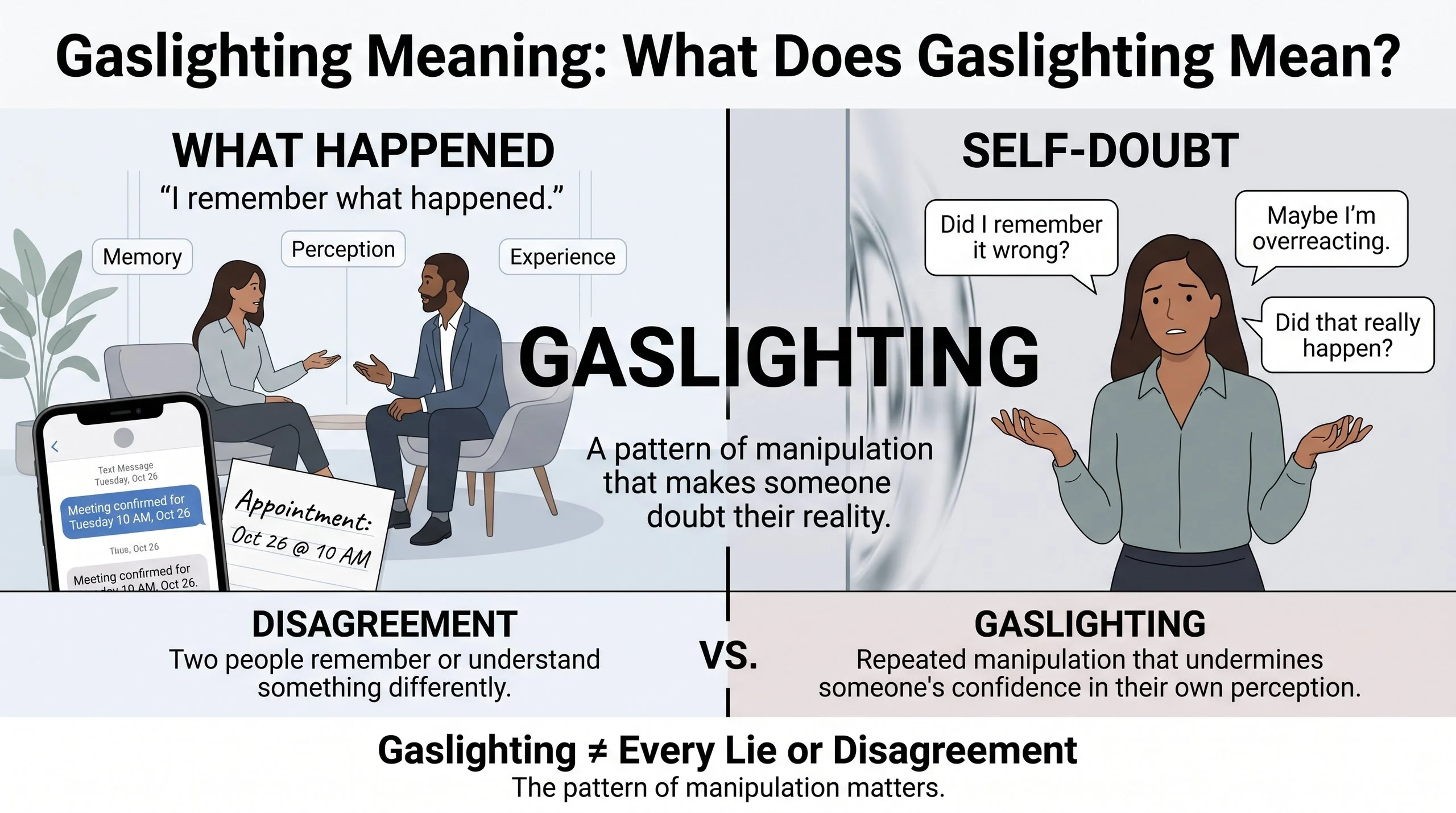
In simple terms, gaslighting is a form of psychological manipulation that makes a person doubt their own memory, perception, feelings, or judgment. Instead of simply disagreeing, the other person may repeatedly deny events, change their version of what happened, minimize your feelings, or insist that you are remembering things incorrectly. Over time, this pattern can make you question yourself even when you have good reasons to trust your experience.
However, not every lie, argument, misunderstanding, or disagreement is gaslighting. The key difference is the repeated pattern of manipulation and its effect on a person’s confidence in their own perception. In this guide, we will explore the gaslighting meaning, common signs, real-life examples, related terms, and how gaslighting can appear in relationships, workplaces, friendships, texting, and social media.
What Does Gaslighting Mean?
The gaslighting meaning refers to a form of psychological manipulation in which someone repeatedly causes another person to question their memory, perception, feelings, or understanding of events.
For example, a person may clearly remember something that happened. The other person repeatedly denies it, changes the story, or insists that the memory is completely wrong. Over time, this pattern can make the person doubt their own judgment.
Gaslighting is more than simply lying or having a different opinion. The key feature is a repeated pattern that undermines someone’s confidence in their own perception of reality.
The term is now common in conversations about relationships, family, friendships, workplaces, and social media.
What Does Gaslighting Mean in Simple Words?
In simple terms, gaslighting means manipulating someone into doubting their own reality or judgment.
Imagine this situation:
You hear someone make a hurtful comment. Later, you mention it. They respond:
“I never said that. You must have imagined it.”
If this happens repeatedly, you may begin questioning your memory.
However, one disagreement does not automatically mean gaslighting. People can genuinely remember the same event differently.
The pattern matters.
Gaslighting usually involves repeated denial, distortion, blame, or manipulation that makes another person doubt themselves.
Gaslighting Definition
A simple definition of gaslighting is:
Gaslighting is a pattern of psychological manipulation that causes someone to question their memory, perception, feelings, or sense of reality.
The behavior can take many forms.
For instance, someone might:
- Deny something they clearly said
- Rewrite what happened
- Tell you that you are imagining things
- Blame you for their behavior
- Dismiss your feelings
- Contradict facts repeatedly
- Make you feel confused
- Insist that your reaction is unreasonable
As the pattern continues, the target may become less confident in their own judgment.
Where Did the Term Gaslighting Come From?
The term gaslighting comes from the 1938 stage play Gas Light and its later film adaptations.
In the story, a husband manipulates his wife and tries to make her believe that she is losing her mind. One detail involves changes in the home’s gas lighting.
When she notices the lights changing, he denies that anything is happening.
Consequently, she begins to question her own perception.
The story gave rise to the modern term gaslighting.
Today, the word is used more broadly to describe psychological manipulation that makes someone doubt their own perception or memory.
How Does Gaslighting Work?
Gaslighting often develops gradually.
At first, the behavior may seem like a small disagreement. However, repeated manipulation can slowly undermine someone’s confidence.
A common pattern looks like this:
1. Something Happens
An argument, comment, action, or event takes place.
2. The Person Denies It
The other person claims that the event did not happen.
3. The Story Changes
They may offer a different version of what happened.
4. The Target Questions Themselves
After repeated denial, the person may wonder whether their memory is wrong.
5. Self-Doubt Grows
Eventually, they may begin relying on the other person’s version of events.
That pattern is one reason gaslighting can be difficult to recognize.
Common Signs of Gaslighting
Gaslighting does not always look dramatic.
Instead, it can appear through repeated small behaviors.
Constantly Denying Events
Someone may repeatedly say something never happened, even when you have strong reasons to remember it.
Rewriting Conversations
The person may describe a previous conversation in a completely different way.
Calling You Too Sensitive
Instead of addressing your concern, they may focus on your emotional reaction.
Common phrases include:
- “You’re too sensitive.”
- “You’re overreacting.”
- “You always make everything a big deal.”
Making You Question Your Memory
A person may repeatedly tell you that you remember things incorrectly.
For example:
“You always remember things wrong.”
Shifting the Blame
Rather than discussing their behavior, they may make the entire situation your fault.
For example:
“I only did that because you made me.”
Using Confusion as a Tool
The person may change details, deny previous statements, and introduce conflicting explanations.
As a result, you may struggle to understand what actually happened.
Minimizing Your Feelings
Your emotions may be dismissed instead of discussed.
For example:
“There’s no reason to be upset.”
Making You Apologize Constantly
Repeated manipulation can eventually make you feel responsible for problems you did not cause.
Common Gaslighting Phrases
Certain phrases can appear in gaslighting situations.
However, a phrase alone does not prove that someone is gaslighting you. Context and repeated behavior matter.
Common examples include:
- “That never happened.”
- “You’re imagining things.”
- “You’re remembering it wrong.”
- “You’re too sensitive.”
- “You’re overreacting.”
- “You’re making this up.”
- “Everyone agrees you’re the problem.”
- “You’re wild.”
- “I was only joking.”
- “You always misunderstand me.”
- “That is not what I said.”
- “You made me do it.”
Some of these statements can also occur during ordinary arguments. Therefore, look at the overall pattern rather than one sentence.
Gaslighting Examples
Example 1: Relationship
One partner says:
“You told me you would call me last night.”
The other responds:
“I never said that. You make things up all the time.”
If this happens repeatedly despite clear evidence, it may be part of a gaslighting pattern.
Example 2: Friendship
A friend makes an insulting comment.
When you mention it later, they respond:
“I was never rude to you. You’re always looking for problems.”
Repeatedly dismissing clear behavior can cause self-doubt.
Example 3: Workplace
A manager gives an employee a specific instruction.
Later, the manager denies giving that instruction and blames the employee for the outcome.
If this pattern happens repeatedly, it can create confusion and undermine the employee’s confidence.
Example 4: Family
A family member repeatedly says:
“You were never treated that way.”
The person remembers many incidents differently.
If the family member consistently denies events and pressures them to distrust their own memories, the behavior may be manipulative.
Gaslighting in Relationships
Gaslighting can occur in romantic relationships.
One partner may repeatedly deny actions, rewrite conversations, minimize emotions, or shift blame.
For example, imagine that one partner repeatedly breaks an agreement. Whenever the issue comes up, they say:
“You are obsessed with the past.”
Instead of addressing the broken agreement, they make the other person’s concern seem unreasonable.
Over time, the targeted person may stop raising valid concerns.
Healthy relationships work differently.
Partners can disagree while still acknowledging each other’s experiences and feelings.
Gaslighting in Friendships
Friendships can also involve manipulative behavior.
A friend might repeatedly exclude someone and then deny doing so. Another example involves hurtful comments that are later dismissed as jokes.
Healthy friends can make mistakes. They can also disagree.
The important difference is whether someone consistently refuses to acknowledge their actions and instead tries to make you doubt yourself.
Gaslighting in the Workplace
Gaslighting can occur at work as well.
For example, an employee might receive an instruction from a manager. Later, the manager denies giving it and claims the employee misunderstood.
One isolated misunderstanding does not establish gaslighting.
However, repeated denial and blame can become a serious workplace problem.
Keeping clear records of important instructions and decisions can help reduce confusion.
Gaslighting in Texting
Gaslighting can happen through text messages.
In fact, written conversations sometimes provide a clearer record of what was said.
Examples include:
“I never sent that message.”
“You’re imagining what I said.”
“You always twist my words.”
“That conversation never happened.”
If the original messages still exist, you may be able to check the actual conversation.
Therefore, written evidence can sometimes help you separate genuine disagreement from deliberate denial.
Gaslighting on Social Media
The word gaslighting is also common on social media.
People may use it when discussing:
- Relationships
- Dating
- Friendships
- Family conflicts
- Workplace experiences
- Public arguments
- Online disputes
However, social media users sometimes use the term too broadly.
A person disagreeing with you is not automatically gaslighting you.
Likewise, someone correcting a false claim is not necessarily gaslighting.
The term is most accurate when there is a repeated pattern of manipulation that causes someone to question their own perception or memory.
Gaslighting vs. Lying
Gaslighting and lying are related, but they are not identical.
Lying means deliberately giving false information.
Gaslighting involves a broader pattern of manipulation that can cause someone to question their own perception, memory, or judgment.
For example:
“I didn’t eat the last cookie.”
That may simply be a lie.
By contrast:
“I never ate it. You must be imagining that you saw me.”
If this kind of denial is repeated to undermine your confidence in what you observed, it may be gaslighting.
Therefore, gaslighting can involve lying, but not every lie is gaslighting.
Gaslighting vs. Manipulation
Gaslighting is a type of manipulation, but manipulation is a broader term.
Manipulation can include:
- Guilt-tripping
- Pressure
- Emotional blackmail
- Deception
- Intimidation
- Gaslighting
Gaslighting specifically focuses on undermining someone’s confidence in their perception or understanding.
Therefore:
Manipulation = broad category
Gaslighting = specific form of psychological manipulation
Gaslighting vs. Disagreement
A disagreement is not automatically gaslighting.
Two people can remember an event differently without either person trying to manipulate the other.
For example:
“I remember the meeting starting at 10.”
“I thought it started at 10:30.”
That is a normal disagreement.
However, repeatedly insisting that someone is mentally unstable simply because they remember an event differently is a different situation.
The intent, pattern, and effect matter.
Gaslighting vs. Misunderstanding
Misunderstandings happen in normal communication.
Someone may forget a detail, mishear a statement, or remember an event incorrectly.
For example:
“I thought you said Tuesday.”
“No, I said Thursday.”
That exchange does not automatically involve manipulation.
In contrast, a repeated pattern of deliberate denial and reality distortion can be much more concerning.
Gaslighting vs. Being Wrong
People can simply be wrong.
Memory is not perfect, and honest mistakes happen.
Someone saying:
“I don’t remember saying that.”
is not automatically gaslighting.
The difference often becomes clearer through what happens next.
A person acting in good faith may check the facts, listen to another perspective, or acknowledge the possibility of a mistake.
Someone using gaslighting may repeatedly deny obvious information and attack the other person’s credibility instead.
Why Is Gaslighting Harmful?
Repeated gaslighting can affect a person’s confidence.
Over time, someone may begin to:
- Doubt their memory
- Question their judgment
- Apologize unnecessarily
- Avoid difficult conversations
- Feel confused
- Depend heavily on another person’s version of events
- Lose confidence in their decisions
The emotional impact can become significant when the pattern continues for a long time.
Consequently, recognizing the behavior early can be important.
What Does a Gaslighter Want?
There is no single reason why someone may use gaslighting.
Possible motives can include:
- Avoiding responsibility
- Controlling a situation
- Protecting a false story
- Escaping consequences
- Maintaining power
- Confusing another person
- Shifting blame
However, it is not always possible to know someone’s exact intention.
For that reason, focus on the observable behavior and its effect rather than trying to diagnose the person’s motives.
How to Respond to Gaslighting
If you believe someone is repeatedly undermining your perception, consider slowing the conversation down.
Keep Records
When appropriate, save important messages, emails, dates, or agreements.
Trust Verifiable Evidence
Check documents, messages, calendars, or other reliable records when available.
Set Clear Boundaries
You can say:
“I remember the situation differently, and I don’t want to continue this conversation if my experience is being dismissed.”
Talk to Someone You Trust
A trusted friend, family member, counselor, or other qualified professional can provide another perspective.
Avoid Endless Arguments
You do not always need to prove your memory to someone who refuses to engage honestly.
Instead, focus on what you know, what you can verify, and what boundaries you need.
Is Gaslighting Always Intentional?
Intent can be difficult to determine.
Some definitions emphasize deliberate manipulation, while everyday use sometimes applies the term to harmful patterns regardless of whether intent can be proven.
Therefore, it is safer not to assume someone’s internal motives.
Instead, examine the behavior:
What happened?
Is the denial repeated?
Are facts being deliberately distorted?
Are you being pressured to distrust your own perception?
Those questions can provide more useful information than trying to read someone’s mind.
Is Gaslighting Emotional Abuse?
Gaslighting can be a form of emotional or psychological abuse, especially when it occurs repeatedly as part of a controlling or harmful relationship pattern.
However, not every disagreement, memory conflict, or lie should be labeled abuse.
The broader pattern matters.
If someone repeatedly undermines your sense of reality, controls you through confusion, or causes significant emotional distress, consider seeking support from someone you trust or a qualified professional.
Can You Gaslight Yourself?
The phrase “self-gaslighting” is commonly used to describe repeatedly dismissing or doubting your own feelings, memories, or perceptions.
For example:
“Maybe it wasn’t really that bad.”
“Maybe I’m just being dramatic.”
“Perhaps everything was my fault.”
This language can describe intense self-doubt. However, it is not the same as another person deliberately gaslighting you.
Self-doubt can develop for many reasons, including repeated criticism, stressful experiences, or low confidence.
Common Misconceptions About Gaslighting
Every Lie Is Gaslighting
False.
A lie can be dishonest without being an attempt to undermine someone’s perception of reality.
Every Argument Is Gaslighting
False.
Healthy people can disagree, remember events differently, and still respect each other.
Saying “You’re Wrong” Is Always Gaslighting
Not necessarily.
Someone can disagree with you without manipulating you.
Gaslighting Always Involves Memory
Memory is common in gaslighting situations, but manipulation can also target feelings, perceptions, and interpretations.
Only Romantic Partners Gaslight
Not true.
Gaslighting can occur in families, friendships, workplaces, and other interpersonal settings.
Calling Someone a Gaslighter Proves They Are One
It does not.
The label should be based on repeated behavior rather than a single accusation.
Grammar and Usage of Gaslighting
Gaslighting is commonly used as a noun and a verb.
As a Noun
“Gaslighting can damage trust.”
As a Verb
“He is gaslighting her about what happened.”
As an Adjective
The related adjective is usually gaslighting:
“That was a gaslighting tactic.”
The word is informal enough for everyday discussion but is also widely used in journalism, psychology-related writing, and public conversations.
Quick Gaslighting Meaning Guide
| Question | Answer |
|---|---|
| What does gaslighting mean? | A pattern of psychological manipulation that causes someone to doubt their perception, memory, feelings, or judgment. |
| Is gaslighting manipulation? | Yes. Gaslighting is a specific type of psychological manipulation. |
| Is gaslighting the same as lying? | No. Lying is broader; gaslighting involves undermining another person’s confidence in their reality. |
| Can gaslighting happen in relationships? | Yes. It can occur in romantic relationships, friendships, families, and workplaces. |
| What are common gaslighting phrases? | “That never happened,” “You’re imagining things,” and “You’re too sensitive,” among others. |
| Is disagreement gaslighting? | No. Normal disagreement does not automatically involve manipulation. |
| Can gaslighting happen over text? | Yes. Repeated denial or distortion can occur through messages. |
| Is gaslighting emotional abuse? | It can be, particularly when it forms part of a repeated controlling or abusive pattern. |
| Does gaslighting always happen intentionally? | Intent can be difficult to establish, so the repeated behavior and its effects are important to consider. |
| What is a gaslighter? | A person who repeatedly uses gaslighting behavior to undermine another person’s perception or confidence. |
FAQs
What does gaslighting mean in simple terms?
Gaslighting means repeatedly manipulating someone so they begin to doubt their own memory, perception, feelings, or understanding of events.
What is an example of gaslighting?
A simple example is repeatedly denying something you clearly said or did and insisting that the other person imagined it.
What are the most common signs of gaslighting?
Common signs include repeated denial, rewriting events, blame shifting, dismissing feelings, and making someone question their own memory or judgment.
Is gaslighting the same as manipulation?
Gaslighting is a form of manipulation. However, manipulation is a broader category that includes many other behaviors.
Is gaslighting the same as lying?
No. Someone can lie without gaslighting another person. Gaslighting involves a broader pattern of undermining someone’s confidence in their own reality.
Can someone gaslight you without realizing it?
Intent can be difficult to determine. Some harmful communication may involve denial or defensiveness without a deliberate plan to manipulate. Therefore, focus on the repeated pattern and its effect.
Can gaslighting happen in friendships?
Yes. A friend can repeatedly deny events, dismiss your feelings, or rewrite conversations in ways that cause you to question yourself.
Can gaslighting happen at work?
Yes. Repeatedly denying instructions, changing accounts of events, or shifting blame can create a gaslighting pattern in workplace relationships.
What does gaslighting mean in texting?
In texting, gaslighting can involve repeatedly denying messages, changing the story, or telling someone that they imagined a conversation despite available evidence.
Is calling someone “too sensitive” gaslighting?
Not by itself. The phrase can be dismissive, but context and repeated behavior determine whether it forms part of a gaslighting pattern.
How do I know if someone is gaslighting me?
Look for a repeated pattern. Ask whether the person consistently denies verifiable events, changes their story, dismisses your perception, and makes you doubt yourself.
What should I do if someone is gaslighting me?
Keep reliable records when appropriate, set clear boundaries, seek perspective from trusted people, and consider professional support if the situation is causing serious distress or feels unsafe.
Conclusion
The gaslighting meaning refers to a repeated pattern of psychological manipulation that causes someone to question their memory, perception, feelings, or judgment.
Although gaslighting can involve lying, it is not simply another word for dishonesty. Likewise, an ordinary disagreement does not automatically qualify as gaslighting.
The key difference is the pattern.
Repeated denial, reality distortion, blame shifting, and dismissal can gradually weaken a person’s confidence in their own experiences. As a result, recognizing these behaviors can help people understand unhealthy communication more clearly.
At the same time, the word should be used carefully. Not every mistake, disagreement, lie, or insensitive comment is gaslighting.
In short:
Gaslighting = repeated psychological manipulation that makes someone doubt their own reality.
Understanding that distinction makes it easier to identify the term accurately and use it responsibly.

Charlotte Wilson is a language writer passionate about word meanings, synonyms, and clear communication. She creates accurate and engaging content to help readers expand their vocabulary and language skills.








5 thoughts on “Gaslighting Meaning| What Does Gaslighting Mean? Signs, Examples & How to Recognize It 2026”