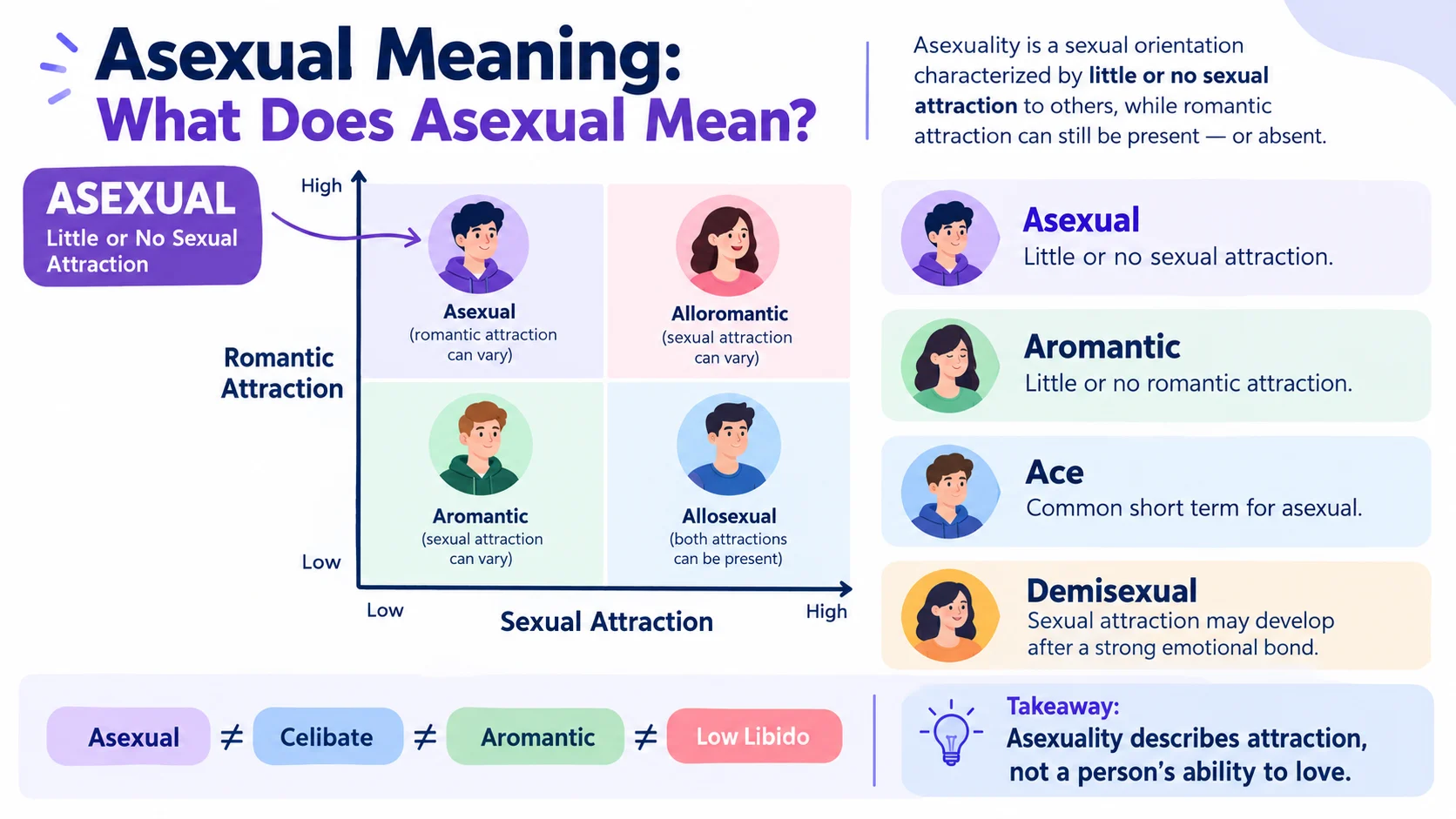
The asexual meaning describes a sexual orientation in which a person experiences little or no sexual attraction toward other people. In simple terms, an asexual person may not feel the sexual pull that many people experience toward potential partners. However, asexuality does not mean that someone cannot love, date, marry, have close relationships, or enjoy affection.
Instead, asexuality focuses mainly on sexual attraction. That distinction matters because sexual attraction and romantic attraction do not always occur together. For example, an asexual person might want a romantic relationship but not experience sexual attraction. Another person may feel little interest in romance as well.
Asexuality exists on a spectrum, so experiences can differ widely. Some people identify as ace, while others use terms such as graysexual or demisexual to describe their experience more precisely. Likewise, some asexual people enjoy certain forms of intimacy, while others prefer little or no physical intimacy.
Therefore, understanding the term requires more than simply saying “not interested in sex.” Asexuality describes a pattern of sexual attraction, not a person’s personality, ability to love, relationship status, or personal worth.
What Does Asexual Mean?
Asexual means experiencing little or no sexual attraction to other people. Asexuality is a sexual orientation, and people may experience it in different ways.
For instance, an asexual person may:
- Feel no sexual attraction.
- Experience sexual attraction very rarely.
- Want romantic relationships.
- Fall in love.
- Enjoy kissing, cuddling, or other forms of affection.
- Have little or no interest in sexual activity.
- Identify with another orientation or identity related to the asexual spectrum.
Most importantly, being asexual does not automatically mean being aromantic, celibate, single, or incapable of love.
Asexual Definition in Simple English
The simplest asexual definition is:
Asexual describes a person who experiences little or no sexual attraction to other people.
The word usually refers to a person’s sexual orientation. In contrast, terms such as heterosexual, homosexual, and bisexual describe different patterns of sexual attraction.
However, asexuality does not always fit into a simple yes-or-no category. Some people experience no sexual attraction at all. Others experience it only occasionally or under specific circumstances.
Because of that range, the asexual spectrum includes several identities and experiences.
What Is Asexuality?
Asexuality is the experience of little or no sexual attraction. People commonly use the shorter term ace when discussing asexual identity.
Sexual attraction refers to feeling sexually drawn toward another person. It differs from simply noticing that someone looks attractive. A person can recognize someone’s beauty without wanting sexual contact with them.
Likewise, attraction can take several forms. Someone might experience:
- Sexual attraction
- Romantic attraction
- Emotional attraction
- Aesthetic attraction
- Sensual attraction
- Intellectual attraction
These forms of attraction do not always appear together.
For example, an asexual person might think someone is beautiful and want to spend time with them. They might even develop strong romantic feelings. Yet they may not experience sexual attraction toward that person.
Asexuality Is a Sexual Orientation
Asexuality is generally understood as a sexual orientation. It describes how a person experiences sexual attraction.
That point helps separate asexuality from temporary changes in sexual interest. Someone who has low sexual desire because of stress, medication, illness, exhaustion, or another circumstance does not automatically identify as asexual.
Similarly, a person who chooses not to have sex does not automatically become asexual.
Instead, the key question concerns sexual attraction, not simply sexual behavior.
What Does Asexual Mean in Relationships?
An asexual person can have a relationship just like anyone else. However, the role of sexual attraction may differ.
For example, an asexual person might want:
- A romantic partner
- Emotional closeness
- Companionship
- Commitment
- Cuddling
- Kissing
- Shared experiences
- Marriage or a long-term partnership
Another asexual person may prefer a relationship with little physical affection. Someone else may not want a romantic relationship at all.
Therefore, there is no single “asexual relationship.”
Every relationship depends on the people involved, their boundaries, their preferences, and their communication.
Can Asexual People Fall in Love?
Yes. Asexual people can fall in love.
Asexuality describes sexual attraction, not the ability to experience love.
An asexual person can develop deep emotional or romantic feelings for another person. They may also want a committed relationship.
For example, an asexual person might say:
“I love my partner deeply, but I do not experience sexual attraction.”
That statement is completely consistent with asexuality.
However, romantic attraction varies from person to person. Some asexual people experience strong romantic attraction, while others experience little or none.
Asexual vs. Aromantic
These terms describe different types of attraction.
Asexual means experiencing little or no sexual attraction.
Aromantic means experiencing little or no romantic attraction.
As a result, a person can be:
- Asexual and romantic
- Aromantic and not asexual
- Both asexual and aromantic
- Neither asexual nor aromantic
For example, an asexual person might want a romantic relationship. An aromantic person might not feel romantic attraction but could still experience sexual attraction.
The two identities can overlap, but they are not interchangeable.
What Does Ace Mean?
Ace is a common short term for asexual or asexuality.
You may see the word in online communities, social media posts, forums, dating profiles, and conversations about sexual orientation.
For example:
- “I’m ace.”
- “She identifies as ace.”
- “He is part of the ace community.”
The term usually has the same basic connection to asexuality, although individual people may use it differently.
The Asexual Spectrum
Asexuality can include a range of experiences. Therefore, not every person who identifies somewhere on the ace spectrum experiences attraction in exactly the same way.
Two commonly discussed identities are graysexual and demisexual.
Graysexual
Graysexual, sometimes written as gray-asexual, generally describes someone who experiences sexual attraction rarely, weakly, or only under certain circumstances.
The experience sits somewhere between common sexual attraction and complete absence of sexual attraction.
For example, someone might experience sexual attraction only once in a long period. Another person may experience it so rarely that a graysexual label feels more accurate than another identity.
Demisexual
Demisexual generally describes a person who experiences sexual attraction only after forming a strong emotional bond with someone.
That does not simply mean “wanting to know someone before having sex.” Instead, the emotional connection plays a central role in whether sexual attraction occurs at all.
For a demisexual person, physical appearance alone may not create sexual attraction.
Other Experiences
The asexual spectrum contains many personal experiences and labels. Some people use a specific term, while others simply identify as asexual.
In addition, people can change the labels they use as they understand themselves better. A label can provide useful language, but nobody needs to choose one if it does not feel right.
Asexual Does Not Mean Celibate
Asexuality and celibacy are different.
Celibacy generally refers to a choice or practice of abstaining from sexual activity.
Asexuality describes a pattern of sexual attraction.
Therefore, an asexual person may choose to have sex, while a person who experiences sexual attraction may choose celibacy.
These situations can look similar from the outside. Nevertheless, they describe different concepts.
Simple Comparison
| TermMain Meaning | |
|---|---|
| Asexual | Little or no sexual attraction |
| Celibate | Chooses to abstain from sexual activity |
| Aromantic | Little or no romantic attraction |
| Demisexual | Sexual attraction develops after a strong emotional bond |
| Graysexual | Sexual attraction occurs rarely or under limited circumstances |
Asexual Does Not Mean “No Libido”
Another common misunderstanding involves libido.
Libido refers to sexual drive or desire. Sexual attraction, however, refers to feeling sexually drawn toward another person.
These concepts can overlap, but they are not identical.
An asexual person may have a libido while experiencing little or no sexual attraction. Likewise, another person may have low libido without being asexual.
Therefore, libido alone does not determine whether someone is asexual.
Asexual Does Not Mean Broken
Asexuality is not automatically a problem that needs fixing.
Some people mistakenly assume that a lack of sexual attraction must result from trauma, hormones, fear, or another issue. Those factors can affect sexual feelings, but they do not explain every asexual experience.
Asexuality itself is a recognized sexual orientation.
Consequently, an asexual person does not need to become sexually attracted to others to have a valid identity.
Can Asexual People Date?
Yes, asexual people can date.
Some enjoy dating because they want romance, companionship, emotional connection, or a long-term partnership.
Others may not enjoy traditional dating. Instead, they may prefer close friendships, nontraditional relationships, or no romantic relationship.
Because asexuality covers different experiences, dating preferences vary.
For example, one asexual person might enjoy romantic dates and physical affection. Another might prefer emotional closeness without romance. Both experiences can exist within the broader asexual community.
Can Asexual People Have Sex?
Some asexual people have sex, while others do not.
This fact can confuse people who assume that asexuality means complete avoidance of sexual activity. However, sexual orientation and sexual behavior are not identical.
An asexual person might have sex for different personal reasons. Another person may have no interest in it.
Therefore, you cannot determine someone’s sexual orientation simply by looking at their behavior.
The same principle works in reverse. A person who has never had sex is not automatically asexual.
Asexuality and Physical Affection
Asexual people can have different feelings about physical affection.
Some may enjoy:
- Holding hands
- Hugging
- Cuddling
- Kissing
- Sleeping beside a partner
- Other forms of closeness
Others may dislike some or all forms of physical affection.
As a result, it is better to ask about individual boundaries rather than assume what an asexual person likes.
Asexual Meaning in Texting and Social Media
Online, asexual usually keeps its standard meaning.
You may see the word in:
- Text messages
- TikTok discussions
- Instagram posts
- Reddit communities
- Dating profiles
- LGBTQ+ conversations
- Online identity discussions
People may also shorten the word to ace.
For example:
“I’m ace, so I don’t really experience sexual attraction.”
Here, “ace” refers to asexuality.
Another example is:
“Is asexual the same as aromantic?”
In this case, the person is asking about two different types of attraction.
Asexual Examples in Everyday Sentences
Here are several natural examples:
- “She identifies as asexual.”
- “He recently learned more about asexuality.”
- “My friend is ace but still enjoys romantic relationships.”
- “Asexual people can have different experiences with intimacy.”
- “Asexual and aromantic do not mean the same thing.”
- “Some people discover their asexual identity later in life.”
- “The term ace is commonly used as a shorter form of asexual.”
These examples show how the word can appear in ordinary conversation.
Common Signs Someone May Identify as Asexual
No checklist can determine whether someone is asexual. A person chooses the label that best describes their experience.
Still, some people who identify as ace describe experiences such as:
- Rarely experiencing sexual attraction
- Never experiencing sexual attraction
- Feeling confused by how others describe sexual attraction
- Understanding romantic attraction but not sexual attraction
- Feeling little interest in sexual relationships
- Relating strongly to asexual experiences or communities
However, these experiences do not create a required test.
Someone can identify as asexual without matching every description. Likewise, someone may question their identity for a long time before choosing a label.
How Do You Know If You Are Asexual?
There is no official test for asexuality.
Instead, people often reflect on how they experience attraction. Questions such as these may help:
- Do I experience sexual attraction toward other people?
- If so, how often?
- Does sexual attraction feel different from romantic attraction for me?
- Do I want sexual relationships, or do I mainly want emotional or romantic closeness?
- Does the word “asexual” feel useful or accurate when describing my experience?
You do not need to rush toward an answer.
Furthermore, identity can be personal and complex. Exploring different terms can help someone find language that feels comfortable.
Asexuality and LGBTQ+ Identity
Asexual people may be part of the broader LGBTQ+ community, although individual people choose how they identify.
The asexual community includes people with many different romantic orientations and gender identities.
For instance, an asexual person might also identify as:
- Heteroromantic
- Homoromantic
- Biromantic
- Panromantic
- Aromantic
These terms help describe romantic attraction separately from sexual attraction.
Therefore, a person’s full identity may involve several different aspects.
Common Misconceptions About Asexuality
“Asexual Means You Cannot Love”
This is false.
Asexuality concerns sexual attraction. Asexual people can experience romantic love, emotional attachment, friendship, and deep affection.
“Asexual People Are All Aromantic”
Not necessarily.
Asexual and aromantic describe different forms of attraction. Some asexual people experience strong romantic attraction.
“Asexual Means You Hate Sex”
Not necessarily.
Some asexual people dislike sexual activity. Others feel neutral about it, and some choose to participate in sexual activity.
“Asexuality Is Just a Phase”
For some people, identity labels can change over time. However, that does not make someone’s current identity meaningless.
A person can use the label that best describes their experience at a particular point in life.
“Asexual People Have No Feelings”
Asexuality does not remove emotions.
Asexual people can experience love, excitement, jealousy, happiness, sadness, attraction, and many other emotions.
“Everyone Becomes Sexual Eventually”
People experience attraction differently. There is no universal requirement that everyone experience sexual attraction.
Asexual vs. Bisexual
Asexual generally means little or no sexual attraction.
Bisexual generally refers to attraction to more than one gender.
These terms describe different patterns of attraction. However, a person can use multiple identity labels when they feel those labels accurately describe their experience.
Asexual vs. Pansexual
Asexuality concerns experiencing little or no sexual attraction.
Pansexuality generally describes sexual or romantic attraction that can occur regardless of gender.
Therefore, the terms address different patterns of attraction.
Asexual vs. Heterosexual
Heterosexual generally means experiencing sexual attraction toward people of a different gender.
Asexual generally means experiencing little or no sexual attraction.
These identities describe different experiences. A person can also describe their romantic orientation separately from their sexual orientation.
Why Context Matters
The word asexual usually has a clear meaning when people discuss identity. However, context still matters.
In everyday conversation, someone might use the word to describe their sexual orientation. Meanwhile, another person might use it while discussing the broader asexual spectrum.
The best way to understand someone’s meaning is to consider the surrounding conversation. When discussing a specific person’s identity, it is also respectful to use the label they choose for themselves.
How to Talk Respectfully About Asexuality
A few simple practices can make conversations more respectful.
First, avoid assuming that every asexual person has the same preferences. Their experiences can differ significantly.
Next, respect the label someone chooses. If a person says they are ace or asexual, there is usually no need to challenge that identity.
Also, avoid asking intrusive sexual questions unless the person has invited that discussion.
Finally, remember that asexuality does not require a person to justify their identity through dating history or sexual experience.
Grammar and Usage of “Asexual”
Asexual can function as an adjective and, in some contexts, as a noun.
As an Adjective
- “She is asexual.”
- “He identifies as an asexual person.”
- “They discussed asexual identity.”
As a Noun
Some people use “asexual” as a noun when referring to an asexual person. However, many people prefer person-first phrasing, such as “an asexual person.”
The safest approach is to follow the language a person uses for themselves.
Asexuality
Asexuality is the noun form used to describe the orientation or broader experience.
For example:
- “Asexuality is a sexual orientation.”
- “She learned more about asexuality.”
Quick Reference: Asexual Meaning
| Question | Answer |
|---|---|
| What does asexual mean? | Experiencing little or no sexual attraction |
| Is asexuality a sexual orientation? | Yes |
| Can asexual people fall in love? | Yes |
| Can asexual people date? | Yes |
| Can asexual people have relationships? | Yes |
| Are asexual people automatically aromantic? | No |
| Does asexual mean celibate? | No |
| Does asexual mean no libido? | No |
| Can an asexual person have sex? | Some do, while others do not |
| What does ace mean? | A common short term for asexual or asexuality |
| Is there one asexual experience? | No, experiences vary |
Frequently Asked Questions
What is the basic asexual meaning?
The basic asexual meaning is experiencing little or no sexual attraction toward other people. Asexuality is a sexual orientation, and experiences can vary across the asexual spectrum.
What does asexual mean in simple terms?
In simple terms, asexual means that someone does not usually experience sexual attraction toward other people, or experiences it very rarely.
Can asexual people fall in love?
Yes. Asexual people can experience romantic and emotional love. Asexuality describes sexual attraction, not the ability to love.
Is asexual the same as aromantic?
No. Asexual relates to sexual attraction, while aromantic relates to romantic attraction. A person can be one, both, or neither.
Is asexual the same as celibate?
No. Asexuality describes sexual attraction, while celibacy generally describes a choice or practice involving sexual abstinence.
Can asexual people have relationships?
Yes. Asexual people can have romantic, emotional, or other committed relationships. Their relationship preferences vary from person to person.
Can an asexual person have sex?
Yes, some asexual people have sex, while others do not. Sexual behavior does not automatically determine sexual orientation.
What does ace mean?
Ace is a common shortened term for asexual or asexuality.
Is asexuality a choice?
Asexuality describes a person’s experience of sexual attraction rather than a decision to avoid sexual activity.
Does being asexual mean something is wrong?
No. Asexuality is not automatically a problem or something that needs to be fixed.
Can someone discover they are asexual later in life?
Yes. Some people recognize or understand their asexuality later in life. People can learn more about themselves at different stages of life.
Does every asexual person feel the same way?
No. Asexual experiences vary. Some people experience no sexual attraction, while others experience it rarely or under particular circumstances.
Conclusion
The asexual meaning is simple at its core: an asexual person experiences little or no sexual attraction to other people. However, asexuality includes a wide range of personal experiences, so no single description fits everyone.
Most importantly, asexuality is different from celibacy, low libido, and aromanticism. An asexual person may still fall in love, enjoy romance, build meaningful relationships, or experience other forms of attraction. Some people identify as ace, while others use terms such as graysexual or demisexual to describe their experience more specifically.
Ultimately, the best way to understand asexuality is to focus on sexual attraction rather than assumptions about behavior. Respecting each person’s chosen identity and boundaries also creates a clearer and more respectful conversation about relationships, attraction, and identity.

Harry Edwards is a language writer specializing in word meanings, synonyms, and language usage. He creates clear, accurate, and engaging content to help readers improve their vocabulary and communication skills.







4 thoughts on “What Does Asexual Mean? Definition, Attraction, Identity, Spectrum & Common Misconceptions Explained Clearly in 2026”