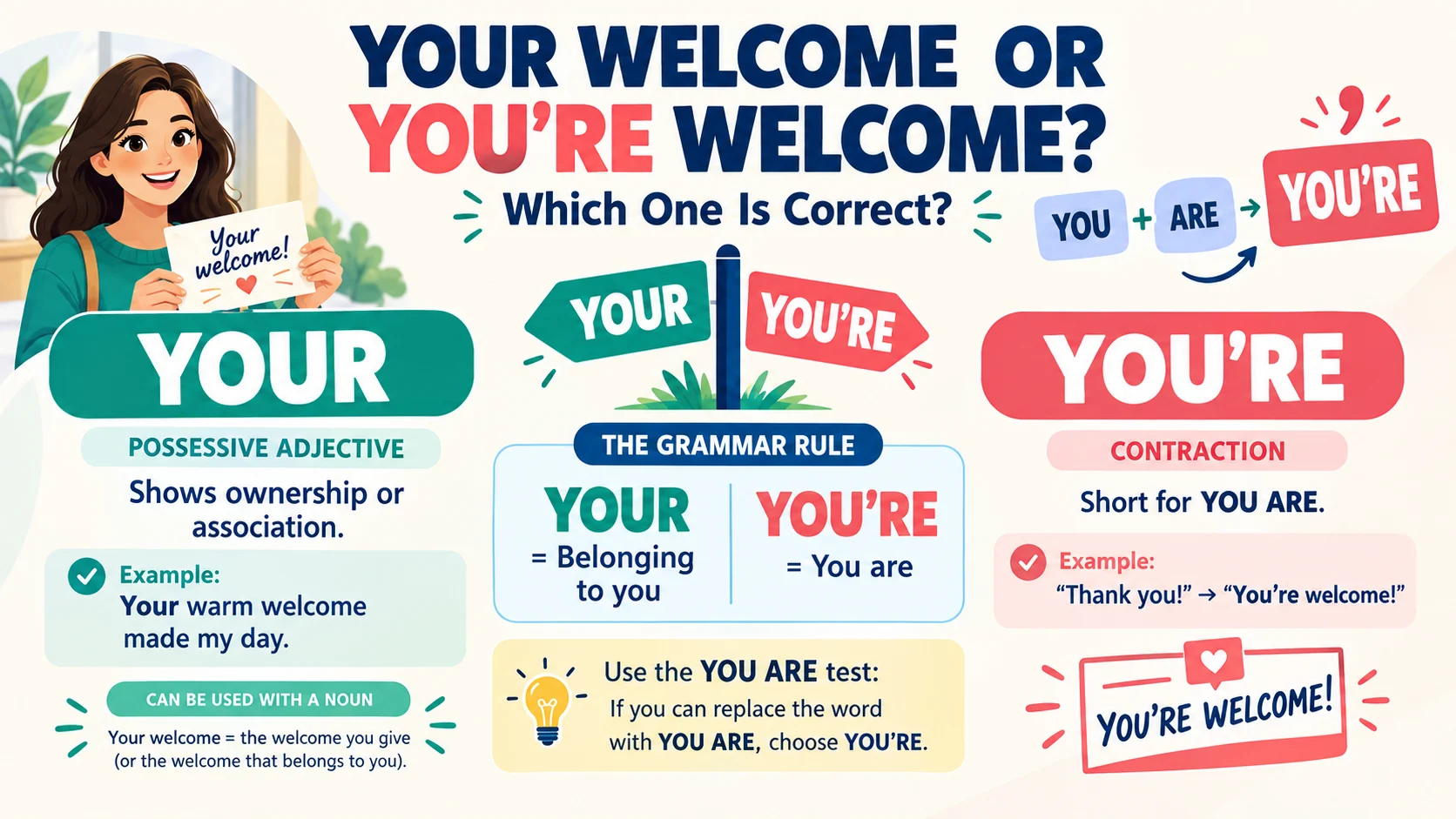
You’re welcome is the correct expression to use when responding to someone who says “thank you.” It means that you are happy to help or that the person does not need to thank you. In contrast, your welcome is generally incorrect in this context because “your” shows possession, while “you’re” is a contraction of “you are.” For example, write “You’re welcome!” instead of “Your welcome!”
Have you ever wondered whether to write your welcome or you’re welcome when responding to someone who says thank you? Although these expressions look and sound almost identical, only one is grammatically correct in a typical thank-you response. This small spelling difference can change the entire meaning of a sentence.
The correct expression is you’re welcome, which is a polite way to acknowledge someone’s gratitude. It is commonly used in everyday conversations, emails, text messages, workplace communication, and social interactions. On the other hand, your is a possessive adjective that indicates ownership, so it does not work as a replacement for you’re in this expression.
However, understanding the difference is easier than you might think. Once you learn what each word means and how contractions work, you can avoid this common grammar mistake. In this guide, you’ll discover the correct spelling, definitions, grammar rules, practical examples, common mistakes, and useful alternatives to “you’re welcome.” You’ll also learn how to use both expressions correctly in different situations.
What Is the Difference Between Your Welcome and You’re Welcome?
The main difference between your welcome and you’re welcome is their grammatical function.
You’re welcome is the standard expression used to respond politely when someone thanks you. It is a contraction of “you are welcome.” Meanwhile, your welcome uses a possessive adjective and refers to something that belongs to someone.
Consider these differences:
- You’re welcome: A polite response to someone’s gratitude.
- Your welcome: Refers to a welcome belonging to someone, although this construction is uncommon and needs an appropriate context.
For example:
- Correct: “Thank you for helping me.” “You’re welcome!”
- Incorrect: “Thank you for helping me.” “Your welcome!”
The second sentence is incorrect because the speaker needs to say “you are welcome,” not refer to something that belongs to the other person.
Therefore, when someone thanks you, always use you’re welcome.
You’re Welcome Meaning
You’re welcome means “you are welcome.” It is a polite expression used after someone expresses appreciation or gratitude.
People use it to show that they are happy to help, that they appreciate the other person’s thanks, or that the person does not need to feel obligated.
For example:
- “Thanks for opening the door.” “You’re welcome!”
- “I appreciate your advice.” “You’re welcome. Anytime!”
- “Thank you for helping me move.” “You’re welcome. I’m glad I could help.”
Moreover, the expression can communicate warmth, friendliness, and good manners.
It is suitable for almost every social situation, including conversations with friends, family members, coworkers, customers, teachers, and strangers.
When to Use You’re Welcome
Use you’re welcome whenever someone thanks you for something you have done.
Common situations include:
Everyday conversations: When someone appreciates a small favor, such as holding a door or sharing information.
Professional communication: When a coworker or customer thanks you for your assistance.
Text messages: When responding to a friend who appreciates your help.
Formal interactions: When acknowledging someone’s gratitude in a respectful manner.
Social situations: When someone appreciates your kindness, support, or generosity.
For example, if your coworker says, “Thank you for sending me the report,” you can simply respond, “You’re welcome!”
Your Welcome Meaning
The phrase your welcome is generally a grammatical mistake when someone intends to respond to “thank you.”
The problem comes from confusing the words “your” and “you’re.” Although they sound alike in everyday American English, they have different meanings and grammatical functions.
However, the words can appear together correctly when “welcome” functions as a noun.
For example:
- “Your welcome made me feel comfortable.”
- “Your warm welcome was greatly appreciated.”
- “I will always remember your kind welcome.”
In these sentences, “your” indicates possession, while “welcome” refers to an act of greeting or receiving someone warmly.
Therefore, your welcome is not always grammatically incorrect. It simply cannot replace “you’re welcome” when responding to someone’s gratitude.
Your vs. You’re: Understanding the Grammar Rules
The easiest way to understand this difference is to learn what each word does in a sentence.
What Does Your Mean?
Your is a possessive adjective. It shows that something belongs to or is associated with the person being addressed.
It usually appears before a noun.
Examples:
- Your phone is ringing.
- I like your new shoes.
- Your advice helped me.
- Is this your notebook?
- Your welcome message was lovely.
In each example, “your” indicates possession or association.
Therefore, use “your” when talking about something belonging to another person.
What Does You’re Mean?
You’re is a contraction of two words: “you” and “are.”
The apostrophe replaces the missing letter “a” in “are.”
Examples:
- You’re very helpful.
- You’re doing a great job.
- You’re my best friend.
- You’re welcome.
- You’re always on time.
In these examples, “you’re” means “you are.”
A useful trick is to replace “you’re” with “you are.” If the sentence still makes sense, the contraction is correct.
For example:
“You’re welcome.”
Replace it:
“You are welcome.”
The sentence makes perfect sense. Therefore, “you’re” is correct.
However, “Your welcome” becomes “You are welcome” only if you replace the word rather than read it literally. That is why checking the actual contraction is important.
How to Remember the Difference Between Your and You’re
Remembering the difference is simple when you use a few practical grammar tricks.
The You Are Test
This is one of the easiest ways to avoid the mistake.
Whenever you want to write “you’re,” replace it with “you are.”
- “You’re welcome” becomes “You are welcome.” Correct.
- “You’re amazing” becomes “You are amazing.” Correct.
- “You’re invited” becomes “You are invited.” Correct.
If the replacement sounds natural and makes grammatical sense, use “you’re.”
The Ownership Test
Use “your” when something belongs to the person you are addressing.
For example:
- Your car is beautiful.
- Your family is wonderful.
- Your welcome was very warm.
If the sentence talks about ownership or association, “your” is probably the correct choice.
Remember the Apostrophe
An apostrophe often signals a contraction.
In “you’re,” the apostrophe shows that two words have been combined.
By contrast, “your” has no apostrophe because it is already a complete possessive word.
Your Welcome or You’re Welcome in Everyday Conversations
In everyday communication, you’re welcome is the natural and grammatically correct response to someone’s gratitude.
Although people sometimes type “your welcome” in text messages or online comments, that does not make it correct.
Here are some common conversational situations.
At home:
Person A: “Thanks for making dinner.”
Person B: “You’re welcome! I hope you enjoyed it.”
At school:
Student: “Thank you for explaining the assignment.”
Teacher: “You’re welcome. Let me know if you need more help.”
At work:
Coworker A: “Thanks for helping me finish the presentation.”
Coworker B: “You’re welcome. We make a good team.”
Among friends:
Friend A: “Thanks for picking me up.”
Friend B: “You’re welcome! Anytime.”
Online:
Person A: “Thank you for sharing this information.”
Person B: “You’re welcome!”
In every example, “you’re welcome” acknowledges gratitude and maintains a polite tone.
Examples of Your Welcome vs. You’re Welcome
The following examples demonstrate how to use both expressions correctly.
Correct Examples of You’re Welcome
- You’re welcome! I’m happy to help.
- You’re welcome for the advice.
- You’re welcome to join us for dinner.
- You’re welcome anytime you need assistance.
- You’re welcome to use my computer.
- You’re welcome, and thank you for asking.
- You’re welcome to visit whenever you like.
- You’re welcome! It was my pleasure.
- You’re welcome for the invitation.
- You’re welcome to contact me again.
Notice that “you’re welcome” does not always function as a response to thanks. It can also mean that someone is invited or permitted to do something.
Correct Examples of Your Welcome
Although less common, “your welcome” can be correct when “welcome” is used as a noun.
- Your welcome made everyone feel comfortable.
- Your warm welcome was unforgettable.
- I appreciated your friendly welcome.
- Your welcome message was very thoughtful.
- Everyone enjoyed your wonderful welcome.
- Your welcome speech was inspiring.
- We will remember your kind welcome.
- Your welcome at the event was very generous.
In these examples, “your” describes the welcome someone gave.
Incorrect Examples to Avoid
Here are some common mistakes and their corrections:
| Incorrect | Correct |
|---|---|
| Your welcome! | You’re welcome! |
| Your welcome, buddy. | You’re welcome, buddy. |
| Your welcome for the help. | You’re welcome for the help. |
| Your welcome anytime. | You’re welcome anytime. |
| Your welcome to join us. | You’re welcome to join us. |
Remember, the correct choice depends on whether you mean “you are” or something belonging to another person.
Is Your Welcome Ever Correct?
Yes! Although “your welcome” is incorrect as a response to gratitude, it can be grammatically correct when “welcome” functions as a noun.
A noun identifies a person, place, thing, or idea. In this case, “welcome” describes the act of receiving someone warmly.
For example:
“Your welcome made my first day at work special.”
Here, the sentence refers to the friendly reception someone provided.
Similarly:
“I appreciated your warm welcome.”
In this example, “your” identifies whose welcome is being discussed.
However, remember that the phrase is different from the familiar expression used after someone says thank you.
Is You’re Welcome Formal or Informal?
You’re welcome is appropriate in both formal and informal communication.
It is a polite, widely accepted expression that works in nearly every everyday situation.
In formal settings, you can use it when speaking with customers, managers, colleagues, teachers, or business partners.
For example:
“Thank you for your assistance with the project.”
“You’re welcome. I’m pleased I could help.”
In casual situations, the same expression works naturally among friends and family.
For example:
“Thanks for grabbing my coffee!”
“You’re welcome!”
However, you can choose a more formal alternative when the situation requires a particularly professional tone.
Examples include:
- My pleasure.
- It was my pleasure.
- Happy to help.
- Glad I could assist.
Alternative Ways to Say You’re Welcome
Although “you’re welcome” is the most familiar response to gratitude, English offers several other expressions.
Here are some useful alternatives.
| Alternative | Meaning | Best Context |
|---|---|---|
| My pleasure | I was happy to help | Professional and polite |
| No problem | It was not an inconvenience | Casual |
| Anytime | I’m always willing to help | Friendly |
| Not at all | You don’t need to thank me | Polite |
| Happy to help | I enjoyed helping you | Professional and casual |
| Don’t mention it | It was a small favor | Informal |
| Glad I could help | I’m pleased I was useful | Everyday |
| Of course | Helping was natural | Friendly |
| No worries | There is nothing to worry about | Casual |
| It was nothing | The favor was not difficult | Informal |
Which Alternative Should You Choose?
The best alternative depends on the situation.
For professional emails, “My pleasure” and “Happy to help” sound polite and appropriate.
Meanwhile, “No problem,” “Anytime,” and “No worries” work well in casual conversations.
If you want to sound warm and sincere, “I’m glad I could help” is another excellent choice.
Common Mistakes When Using Your and You’re
Even fluent English speakers sometimes confuse these words because they sound identical. Nevertheless, understanding their grammatical roles can prevent common writing errors.
Using Your Instead of You’re
Incorrect: “Your welcome for the recommendation.”
Correct: “You’re welcome for the recommendation.”
The first sentence uses a possessive adjective where a contraction is required.
Using You’re Before a Noun
Incorrect: “You’re phone is on the table.”
Correct: “Your phone is on the table.”
A phone can belong to someone, so the possessive adjective “your” is necessary.
Forgetting the Apostrophe
Incorrect: “Your doing a great job.”
Correct: “You’re doing a great job.”
The intended meaning is “you are doing a great job.” Therefore, the contraction needs an apostrophe.
Assuming Your and You’re Are Interchangeable
These words are not interchangeable, even though they have the same pronunciation.
For example:
- “You’re talented” means “You are talented.”
- “Your talent is impressive” refers to someone’s talent.
Consequently, always consider the sentence’s meaning before choosing a word.
Your Welcome vs. You’re Welcome: Quick Comparison
| Feature | Your | You’re |
|---|---|---|
| Grammatical role | Possessive adjective | Contraction |
| Full meaning | Belonging to you | You are |
| Apostrophe | No | Yes |
| Shows possession | Yes | No |
| Used after thank you | No | Yes |
| Example | Your welcome was kind. | You’re welcome! |
Quick rule: If you mean “you are,” write “you’re.” If you mean something belongs to someone, write “your.”
Why Do People Confuse Your and You’re?
There are several reasons why these words are frequently mixed up.
Identical pronunciation: In standard American English, “your” and “you’re” sound very similar. As a result, people may recognize the correct word when speaking but choose the wrong spelling when typing.
Fast texting: People often write messages quickly without checking their grammar. Consequently, small mistakes can easily appear in everyday conversations.
Autocorrect errors: Sometimes, typing suggestions replace the intended word with the wrong one.
Limited grammar knowledge: English learners may not understand the difference between possessive adjectives and contractions.
Writing habits: When people repeatedly see an incorrect spelling online, they may begin to assume that it is acceptable.
Fortunately, a simple understanding of “you are” and possession can solve most of these problems.
Your Welcome or You’re Welcome in Texting and Social Media
On platforms such as Instagram, Facebook, TikTok, Snapchat, and WhatsApp, people frequently use “you’re welcome” when responding to appreciation.
For example:
- “Thanks for the follow!” — “You’re welcome!”
- “Thank you for the recommendation.” — “You’re welcome!”
- “Thanks for sharing my post.” — “You’re welcome!”
- “You’re the best!” — “You’re welcome, haha.”
However, informal online communication does not change the underlying grammar rules.
Even in short messages, “you’re welcome” remains the correct expression when responding to thanks.
You may also encounter abbreviations or shorter responses, such as “NP” (no problem), “YW” (you’re welcome), and “NVM” (never mind). Nevertheless, these are informal alternatives rather than replacements for the standard spelling in formal writing.
Advantages and Disadvantages of Using You’re Welcome
Like other common expressions, “you’re welcome” has strengths and a few limitations depending on the communication style.
Advantages
- Polite communication: It acknowledges another person’s gratitude.
- Easy to understand: Almost every English speaker recognizes the expression.
- Versatile: It works in professional and casual situations.
- Friendly tone: It can make conversations feel more comfortable.
- Widely accepted: It is appropriate in spoken and written English.
Disadvantages
- Can sound repetitive: Using it after every thank-you may make conversations feel predictable.
- May sound automatic: Sometimes, people use it without expressing genuine warmth.
- Not always personal: A more specific response may sound more sincere in certain situations.
However, these limitations do not make the expression incorrect. You can simply choose an alternative when you want to vary your communication style.
How to Use Your Welcome and You’re Welcome Correctly
Follow these simple guidelines to choose the correct expression.
- Use “you’re” when you mean “you are.”
- Use “your” when showing possession.
- Add an apostrophe when writing “you’re.”
- Use “you’re welcome” after someone thanks you.
- Use “your welcome” when referring to a welcome someone gave.
- Read your sentence aloud or replace “you’re” with “you are” to check its grammar.
- Review your writing before sending professional emails or important messages.
By following these rules, you can avoid one of the most common English spelling mistakes.
Practice Exercises: Your Welcome or You’re Welcome
Test your understanding with these sentences. Choose the correct word to complete each one.
Fill in the blanks:
- Thank you for helping me. ______ welcome!
- Is this ______ new laptop?
- ______ doing an excellent job.
- I appreciate ______ warm welcome.
- ______ always welcome to visit us.
- ______ advice was very helpful.
- Thank you for the invitation. ______ welcome!
- ______ going to enjoy this movie.
- Everyone appreciated ______ kindness.
- ______ welcome to join our team.
Answers and Explanations
You’re welcome! — This is a response to gratitude. “You’re” means “you are.”
Your new laptop — The laptop belongs to the person being addressed.
You’re doing an excellent job. — The sentence means “You are doing an excellent job.”
Your warm welcome — “Your” describes the welcome someone provided.
You’re always welcome — The sentence means “You are always welcome.”
Your advice — The advice belongs to or comes from the person being addressed.
You’re welcome! — This is the standard response to thanks.
You’re going to enjoy this movie. — “You’re” means “you are.”
Your kindness — “Your” indicates whose kindness is being discussed.
You’re welcome to join our team. — This means “You are welcome to join our team.”
Related Comparisons: Commonly Confused English Words
Your and you’re are not the only English words that sound similar or create confusion. Here are some other common comparisons worth learning.
Its or It’s
Its is a possessive word, while it’s is a contraction of “it is” or “it has.”
Example:
- The dog wagged its tail.
- It’s a beautiful day.
Their or There
Their indicates possession, while there refers to a place or introduces a statement.
Example:
- Their house is beautiful.
- The books are over there.
Your or You’re
Your indicates possession, while you’re means “you are.”
Example:
- Your shoes are clean.
- You’re very kind.
To or Too
To is commonly used as a preposition or before a verb, while too means also or excessively.
Example:
- I want to learn English.
- I want to come too.
Then or Than
Then refers to time or sequence, while than is used for comparisons.
Example:
- We ate dinner and then watched a movie.
- She is taller than her brother.
Understanding these differences can improve your spelling, grammar, and confidence in everyday writing.
Frequently Asked Questions
Is it your welcome or you’re welcome?
“You’re welcome” is correct when responding to someone who says thank you. It is a contraction of “you are welcome.” “Your welcome” is generally incorrect in this situation because “your” indicates possession.
Why is you’re welcome correct?
“You’re welcome” is correct because it means “you are welcome.” The apostrophe represents the missing letter “a” in the contraction of “you are.”
Is your welcome ever grammatically correct?
Yes. “Your welcome” can be correct when “welcome” is a noun referring to someone’s greeting or reception. For example, “Your warm welcome made me feel at home.”
Can I write your welcome in a text message?
You should write “you’re welcome” when replying to someone who thanks you. Although “your welcome” sometimes appears in informal messages, it is still a spelling and grammar mistake in this context.
Is you’re welcome formal or informal?
“You’re welcome” works in both formal and informal communication. It is polite, natural, and widely accepted in everyday conversations, professional emails, and workplace interactions.
What does you’re welcome mean?
“You’re welcome” means “you are welcome.” It is a polite response to gratitude and communicates that you are happy to help or that the other person does not need to thank you.
What is the difference between your and you’re?
“Your” is a possessive adjective that shows ownership, while “you’re” is a contraction of “you are.” For example, “Your book is here” and “You’re welcome” are both correct.
Is it you’re welcome or your welcomed?
“You’re welcome” is the correct expression when responding to thanks. “Your welcomed” is not correct in this context. The word “welcomed” is the past tense or past participle of the verb “welcome.”
Can I say you’re welcome after someone apologizes?
You can, but it is not usually the most natural response. When someone apologizes, expressions such as “No worries,” “That’s okay,” or “It’s alright” may be more appropriate.
What is a short way to say you’re welcome?
Common short alternatives include “No problem,” “Anytime,” “My pleasure,” “NP,” and “YW.” These expressions are useful in casual conversations and text messages.
Is thanks, your welcome correct?
No. The correct response is “Thanks, you’re welcome” only if the speaker is acknowledging thanks in a suitable conversational context. More naturally, one person says “Thank you,” and the other replies, “You’re welcome.”
Do Americans say you’re welcome?
Yes. “You’re welcome” is a standard expression in American English. People commonly use it at home, at work, in stores, and in everyday conversations.
Key Takeaways and Summary
The difference between your welcome and you’re welcome is simple once you understand their grammatical functions.
- You’re welcome is the correct expression when responding to someone who says thank you.
- You’re is a contraction of “you are.”
- Your is a possessive adjective that indicates ownership.
- Your welcome can be grammatically correct when referring to someone’s greeting or reception.
- Both words sound similar, but they cannot be used interchangeably.
- The “you are” test is an easy way to check whether “you’re” is correct.
Ultimately, remember this simple rule: When someone thanks you, respond with “You’re welcome!” The apostrophe makes all the difference.
Conclusion
Choosing between your welcome or you’re welcome becomes easy when you understand the difference between possession and contractions. Although both expressions sound similar, they serve different grammatical purposes.
You’re welcome is the correct phrase to use when responding to someone’s gratitude because it means “you are welcome.” On the other hand, your welcome refers to a welcome or greeting belonging to someone and is only correct in specific sentence structures.
Therefore, remember to use “you’re” whenever you mean “you are” and “your” when showing ownership. With this simple rule, you can avoid a common English grammar mistake and communicate more confidently in everyday conversations, emails, and social media posts.