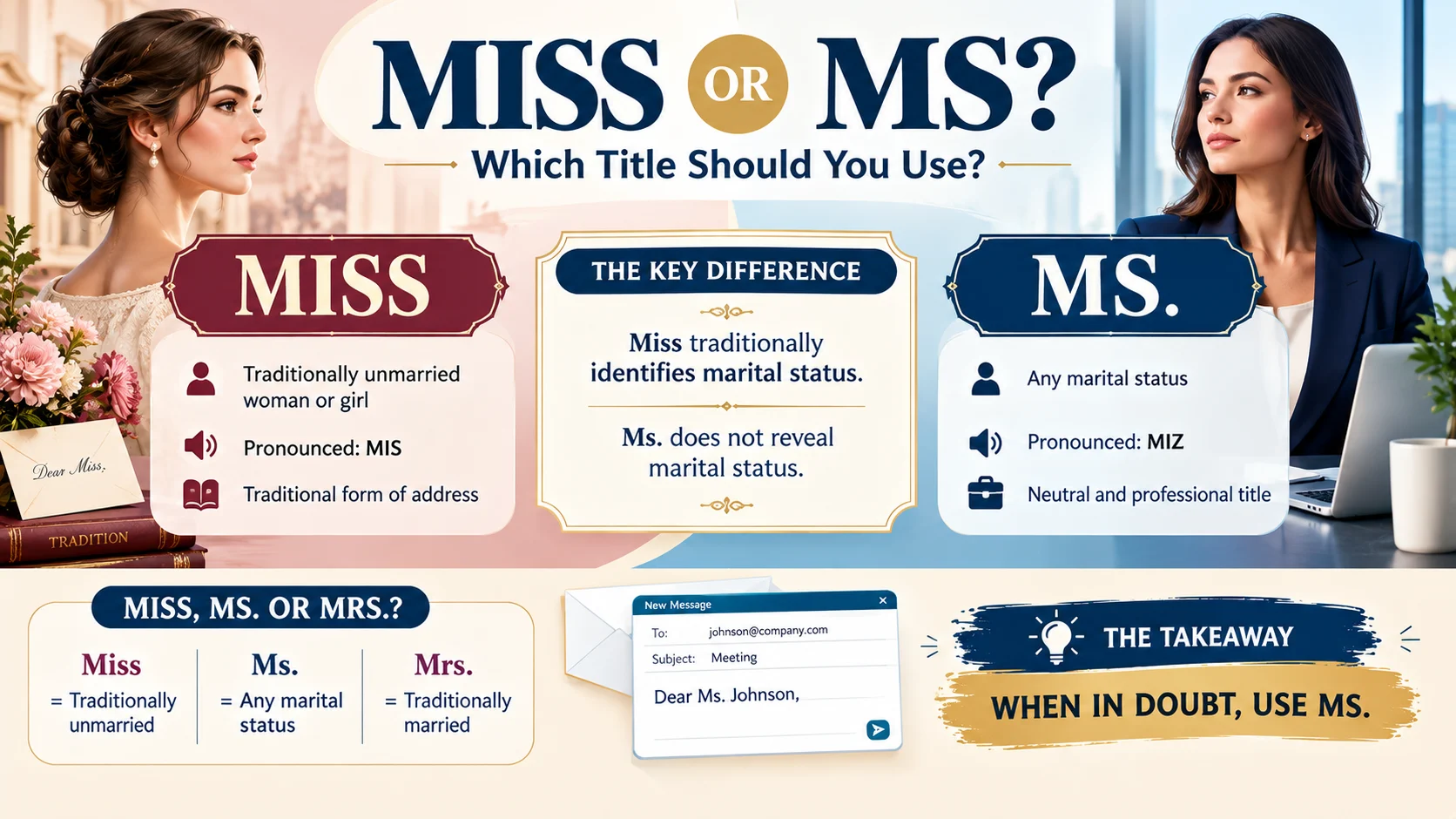
Miss and Ms are titles used before a woman’s name, but they have different meanings. Miss traditionally refers to an unmarried woman or girl, while Ms. is a neutral title that does not reveal whether a woman is married or unmarried. For professional communication, Ms. is generally the safest choice when you do not know someone’s preference or marital status.
Choosing between Miss or Ms might seem like a small grammar decision, but the correct title can make a difference in emails, letters, invitations, job applications, and everyday conversations. Both terms are used before a woman’s name, yet they communicate different things about the person being addressed. Therefore, understanding their meanings helps you avoid awkward situations and communicate more respectfully.
Traditionally, people use Miss for unmarried women and girls. In contrast, Ms. provides a neutral way to address a woman without identifying her marital status. This distinction becomes especially important in professional environments, where a person’s marriage status is usually irrelevant to the conversation.
Moreover, these titles have different pronunciations, social conventions, and appropriate uses. For example, you might address an unmarried teacher as Miss Wilson, while Ms. Wilson would be suitable when you do not know her marital status or personal preference.
In this guide, you’ll discover the difference between Miss or Ms, learn when to use each title, explore real-life examples, and understand how they compare with Mrs. By the end, you’ll know which form is appropriate for professional emails, formal letters, school settings, and everyday communication.
WHAT DOES MISS MEAN?
Miss is a traditional English title placed before a woman’s name. It is generally used for an unmarried woman or a girl. The title communicates a traditional distinction based on marital status.
For example, if a woman is unmarried and prefers this title, you can address her as Miss Johnson or Miss Emily Johnson.
The word is especially common in schools, social introductions, formal conversations, and situations involving young women.
However, its usage can depend on personal preference and cultural expectations. Some adult women continue to use Miss even after marriage, while others prefer a different title.
Here are some examples:
- Miss Taylor is our new English teacher.
- Good morning, Miss Wilson.
- Miss Sarah will attend the meeting.
- I received a letter from Miss Anderson.
- Please ask Miss Brown to come inside.
In each example, Miss functions as a title rather than an ordinary vocabulary word.
When Is Miss Used?
You can use Miss in several situations:
For unmarried women: Traditionally, Miss identifies a woman who is not married.
For girls: Adults commonly use Miss when addressing girls, especially in educational and social settings.
For teachers: Students sometimes address female teachers as Miss, even when they do not know the teacher’s marital status.
For formal introductions: The title can appear before a woman’s name when she prefers it.
For traditional communication: Some families and communities continue to use Miss as a conventional form of address.
Nevertheless, remember that Miss is not automatically the correct choice for every unmarried woman. Personal preference matters, and modern communication increasingly favors titles that do not disclose marital status.
WHAT DOES MS MEAN?
Ms. is a title used before a woman’s name without indicating whether she is married or unmarried. It provides a neutral and respectful form of address.
For example, you can write Ms. Johnson even if you have no idea whether she is married.
Unlike Miss and Mrs., Ms. does not communicate a woman’s marital status. Consequently, it is particularly useful in workplaces, business correspondence, professional introductions, and formal documents.
The title became increasingly popular during the twentieth century as women sought a form of address that treated marital status as a personal matter rather than a necessary part of their identity.
For instance:
- Ms. Taylor is the new department manager.
- Please send the documents to Ms. Wilson.
- Dear Ms. Anderson, thank you for your application.
- Ms. Brown will lead today’s presentation.
- We would like to invite Ms. Johnson to the conference.
In these examples, the title communicates respect without making assumptions about marriage.
When Is Ms. Used?
Ms. is appropriate in many everyday and professional situations.
When marital status is unknown: If you do not know whether a woman is married, Ms. is generally a safe option.
In professional emails: Business correspondence often uses Ms. when addressing female clients, colleagues, managers, and applicants.
In formal letters: It provides a neutral alternative to Miss or Mrs.
When marital status is irrelevant: If the person’s relationship status has nothing to do with the conversation, Ms. avoids unnecessary personal information.
When a woman prefers it: Many women choose Ms. regardless of whether they are married.
Furthermore, Ms. is often recommended in modern workplace communication because it treats women consistently without requiring assumptions about their personal lives.
MISS OR MS: WHAT IS THE MAIN DIFFERENCE?
The main difference between Miss and Ms. is their relationship to marital status.
Miss traditionally identifies an unmarried woman or girl, whereas Ms. is a neutral title that does not reveal whether a woman is married.
Although both titles appear before a woman’s name, they are not always interchangeable.
Consider the following comparison:
| Feature | Miss | Ms. |
|---|---|---|
| Meaning | Traditionally an unmarried woman or girl | A woman of any marital status |
| Marital status | Traditionally identifies unmarried status | Does not reveal marital status |
| Pronunciation | Miss | Miz |
| Professional use | Depends on preference and context | Commonly preferred |
| Formal letters | Yes | Yes |
| Workplace communication | Sometimes | Generally suitable |
| Married women | Usually not the traditional choice | Yes |
| Unmarried women | Yes | Yes |
| Personal preference | Should be respected | Should be respected |
For example, imagine you are writing to a woman named Jessica Wilson.
If she prefers the traditional title and is unmarried, you might write Miss Wilson.
However, if you do not know her marital status, Ms. Wilson is generally the better choice.
Therefore, the difference is not simply spelling. It also involves pronunciation, tradition, personal preference, and modern communication practices.
MISS VS MS PRONUNCIATION
Another important difference between these titles is how people pronounce them.
Although their written forms look similar, their sounds are noticeably different.
How to Pronounce Miss
Miss is pronounced MIS.
It rhymes with words such as:
- Kiss
- Bliss
- This
- Hiss
The pronunciation has a short vowel sound followed by an S sound.
Example: Miss Johnson is waiting outside.
How to Pronounce Ms.
Ms. is pronounced MIZ.
It sounds similar to the first part of the word miserable or the word business when spoken naturally.
The ending has a voiced Z sound rather than the S sound in Miss.
Example: Ms. Wilson will attend the meeting.
Easy Pronunciation Trick
Remember this simple distinction:
- Miss = MIS
- Ms. = MIZ
- Mrs. = MISS-iz
Although Miss and Ms. look almost identical, their pronunciations help distinguish them in spoken English.
MISS OR MS IN PROFESSIONAL EMAILS
Choosing the correct title becomes particularly important when writing professional emails.
In business communication, you usually want to sound polite, respectful, and professional. However, you may not know the recipient’s marital status or preferred title.
In that situation, Ms. is generally the most appropriate choice.
For example:
Professional email using Ms.:
Dear Ms. Johnson,
Thank you for your interest in our company. We have reviewed your application and would like to schedule an interview.
Best regards,
Human Resources Team
This greeting is professional because it does not make assumptions about the recipient’s personal life.
Should You Use Miss in a Business Email?
You can use Miss if the recipient has indicated that she prefers this title or if the context makes it appropriate.
However, using Miss simply because you assume a woman is unmarried can create an uncomfortable situation.
For that reason, Ms. is usually the more practical option in professional communication.
What If You Know Her Preferred Title?
Always respect the title someone uses for herself.
For example, if a client signs her email as Miss Emily Brown, you can address her as Miss Brown in your response.
Similarly, if she signs as Ms. Emily Brown, follow that preference.
Ultimately, professional etiquette is about addressing people respectfully rather than guessing their personal circumstances.
MISS OR MS IN FORMAL LETTERS
Both titles can appear in formal letters, but your choice should depend on the recipient’s preference and the information available.
For example:
Using Miss:
Dear Miss Anderson,
We are pleased to invite you to our annual awards ceremony.
Using Ms.:
Dear Ms. Anderson,
We appreciate your interest in our organization and look forward to meeting you.
Both greetings are grammatically acceptable.
Nevertheless, Ms. is generally preferable when the recipient’s marital status or preferred title is unknown.
In addition, you should remember that some organizations follow their own style guidelines. If you are writing an official letter, follow the organization’s preferred format.
MISS, MS, OR MRS: UNDERSTANDING ALL THREE TITLES
Many English learners confuse Miss, Ms., and Mrs. because all three titles appear before women’s names.
However, each has a different traditional meaning.
Miss
Miss traditionally refers to an unmarried woman or girl.
Example: Miss Olivia Smith is my classmate.
Ms.
Ms. refers to a woman without identifying her marital status.
Example: Ms. Olivia Smith is our new supervisor.
Mrs.
Mrs. traditionally refers to a married woman.
Example: Mrs. Olivia Smith teaches mathematics.
The following table makes the differences easier to understand.
| Title | Traditional Meaning | Pronunciation | Marital Status |
|---|---|---|---|
| Miss | Unmarried woman or girl | MIS | Unmarried |
| Ms. | Neutral title for a woman | MIZ | Any status |
| Mrs. | Married woman | MISS-iz | Married |
Which Title Is the Most Professional?
In most modern professional settings, Ms. is a practical default because it does not identify marital status.
However, that does not mean Miss and Mrs. are incorrect or unprofessional.
If someone specifically prefers Miss or Mrs., you should use that title instead.
Therefore, the best title is the one that respects the individual’s preference and the situation.
IS MS FOR MARRIED OR UNMARRIED WOMEN?
Ms. can be used for both married and unmarried women.
This is one of its most important features.
Unlike Miss and Mrs., Ms. does not indicate whether a woman has a husband or is unmarried.
For example, consider two women:
- Emily is unmarried and prefers Ms.
- Sarah is married and prefers Ms.
You can address both women as Ms. Emily Johnson and Ms. Sarah Wilson.
Their marital status does not change the meaning of the title.
Furthermore, a woman may continue using Ms. after marriage because she does not want her title to change based on her relationship status.
Thus, Ms. is not exclusively for unmarried women. It is a neutral title for adult women regardless of marital status.
IS MISS ONLY FOR UNMARRIED WOMEN?
Traditionally, yes. Miss has been used to identify unmarried women and girls.
However, modern usage is not always this strict.
Some women continue using Miss because they prefer its traditional sound or have always used it. Others may use it in specific professional or cultural environments.
For example, in some schools, students call their female teachers Miss even when those teachers are married.
Similarly, a woman may prefer Miss as her personal title regardless of her marital status.
Nevertheless, if you do not know someone’s preference, Ms. is generally a more neutral choice.
MISS OR MS FOR A FEMALE TEACHER
Both Miss and Ms. can be used when addressing a female teacher.
The appropriate choice often depends on the school’s traditions, the teacher’s preference, and local customs.
For example, students in some schools address female teachers as Miss Johnson, even when they do not know whether the teacher is married.
In other educational environments, teachers may prefer Ms. Johnson because it does not refer to their marital status.
Here are some examples:
- Good morning, Miss Wilson.
- Excuse me, Ms. Anderson.
- Miss Brown, may I ask a question?
- Ms. Taylor, could you explain this lesson again?
All these examples can be correct in their respective contexts.
However, if you are unsure which title to use, asking the teacher or following the school’s established convention is a sensible approach.
MISS OR MS FOR A YOUNG GIRL
Miss is traditionally used when addressing a young girl.
For example, parents, teachers, and other adults may use Miss Emily or Miss Sarah when speaking politely.
However, Ms. can also be used for adult women regardless of marital status.
When addressing a child, the choice often depends on family preferences and cultural conventions rather than strict grammar rules.
For example:
- Miss Lily is performing in the school play.
- Miss Emma received a certificate.
- Ms. Johnson is Lily’s mother.
The important distinction is that Miss traditionally suggests unmarried status, while Ms. does not.
MISS OR MS ON JOB APPLICATIONS AND RESUMES
Job applications sometimes ask applicants to select a title such as Miss, Ms., or Mrs.
If you encounter this question, choose the title you personally prefer.
However, if you are unsure, Ms. is generally a suitable option because it does not disclose your marital status.
For example:
| Situation | Suggested Title |
|---|---|
| Unmarried woman who prefers traditional usage | Miss |
| Married woman who prefers a neutral title | Ms. |
| Woman whose marital status is unknown | Ms. |
| Woman who prefers Mrs. | Mrs. |
| Woman who prefers Miss regardless of marital status | Miss |
Your professional qualifications, experience, and skills matter more than your marital status.
Therefore, a title should not distract from the main purpose of your resume or job application.
COMMON EXAMPLES OF MISS OR MS IN SENTENCES
Understanding the rules is helpful, but seeing the titles in real sentences makes their usage easier to remember.
Examples Using Miss
- Miss Johnson is our new neighbor.
- I spoke with Miss Emily after class.
- Miss Brown will organize the school event.
- Good afternoon, Miss Taylor.
- Miss Anderson received an award.
- We invited Miss Wilson to the ceremony.
- Miss Sarah is waiting in the reception area.
- The students thanked Miss Davis for her help.
- Miss Olivia will lead the presentation.
- Please give this invitation to Miss Miller.
Examples Using Ms.
- Ms. Johnson is our new manager.
- I sent the report to Ms. Anderson.
- Ms. Wilson will attend the conference.
- Dear Ms. Brown, thank you for your response.
- Ms. Taylor works in the marketing department.
- We invited Ms. Davis to the annual meeting.
- Ms. Smith is responsible for the project.
- Please contact Ms. Miller for further information.
- Ms. Olivia is an experienced professional.
- The company appointed Ms. Harris as director.
Notice that both titles appear before names, but they communicate different information.
REAL-LIFE CONVERSATION EXAMPLES
The following conversations demonstrate how people naturally use Miss and Ms. in everyday situations.
Conversation About a Teacher
Student: Is Miss Wilson teaching our English class today?
Friend: Yes, she is coming in a few minutes.
Student: Great! I need help with my assignment.
Conversation in an Office
Employee: Who should I send this document to?
Manager: Please send it to Ms. Johnson.
Employee: Do I need to include her department?
Manager: Yes, she works in human resources.
Conversation About a Formal Invitation
Person A: How should I address the invitation?
Person B: Use Ms. Brown because I don’t know which title she prefers.
Person A: That sounds appropriate.
Conversation About Personal Preference
Person A: Should I call you Miss Taylor or Ms. Taylor?
Person B: I prefer Ms. Taylor, please.
Person A: Of course. Thank you for letting me know.
These conversations demonstrate that personal preference is often more important than traditional assumptions.
COMMON MISTAKES WHEN USING MISS OR MS
Even experienced English speakers sometimes confuse these titles. Fortunately, a few simple rules can help you avoid common mistakes.
Assuming Ms. Means Unmarried
One common mistake is thinking that Ms. is another word for Miss.
However, Ms. does not communicate marital status.
Incorrect understanding: Ms. means an unmarried woman.
Correct understanding: Ms. is a neutral title for a woman of any marital status.
Using Miss for Every Woman
Some people automatically use Miss when addressing a woman.
However, this can be inappropriate if the woman prefers Ms. or Mrs.
Instead, use the person’s preferred title whenever possible.
Confusing Pronunciation
Miss and Ms. do not sound the same.
Miss is pronounced MIS, while Ms. is pronounced MIZ.
Therefore, learning their pronunciations helps prevent confusion during conversations.
Thinking Mrs. and Ms. Are Interchangeable
Mrs. traditionally indicates a married woman, while Ms. does not reveal marital status.
Although some married women prefer Ms., the titles have different conventional meanings.
Forgetting the Period After Ms.
In American English, Ms. is commonly written with a period.
For example:
- Ms. Johnson
- Ms. Emily Wilson
- Dear Ms. Brown
Some style guides and publications omit periods in certain abbreviations, especially in British English. Therefore, follow the style guide used by your organization.
Assuming Every Woman Wants a Title
Another mistake is assuming that everyone wants to be addressed using Miss, Ms., or Mrs.
Some women prefer their first names, professional titles, or other forms of address.
Consequently, it is always helpful to respect individual preferences.
ADVANTAGES AND DISADVANTAGES OF USING MISS AND MS
Both titles have practical uses. Nevertheless, each has certain limitations depending on the communication setting.
Advantages of Miss
- It follows a familiar traditional convention.
- It is commonly understood in everyday English.
- It can be appropriate for girls and unmarried women.
- It is frequently used in educational environments.
- Some women prefer its traditional form.
Disadvantages of Miss
- It traditionally identifies marital status.
- It may create assumptions about a woman’s personal life.
- It may not be suitable for every adult woman.
- It can feel outdated in some professional environments.
- It may be inappropriate if the recipient prefers another title.
Advantages of Ms.
- It does not reveal marital status.
- It works for married and unmarried women.
- It is suitable for professional correspondence.
- It avoids unnecessary assumptions.
- It provides a neutral form of address.
Disadvantages of Ms.
- Some people are unfamiliar with its pronunciation.
- It can be confused with Miss in spoken conversations.
- Some women prefer Miss or Mrs. instead.
- It may not match certain traditional or cultural conventions.
Overall, Ms. offers greater flexibility in modern professional communication, while Miss remains useful when it matches someone’s preference.
MISS OR MS: WHICH ONE SHOULD YOU USE?
The correct choice depends on whom you are addressing and what you know about their preferences.
Here are some simple guidelines:
Use Miss when a woman prefers this title, or when the traditional context makes it appropriate.
Use Ms. when you do not know the woman’s marital status or preferred title and need a neutral form of address.
Use Mrs. when a woman prefers this traditional title.
Use the person’s first name when the situation is informal and the person has invited you to do so.
For example, if you are writing a business email to someone named Olivia Brown and have no information about her preferred title, Dear Ms. Brown is generally a safe greeting.
On the other hand, if Olivia has introduced herself as Miss Olivia Brown, you should respect her choice.
Ultimately, there is no need to guess someone’s marital status when a neutral or preferred form of address is available.
RELATED COMPARISONS: MISS OR MS AND OTHER CONFUSING WORDS
Understanding related titles can make formal English communication easier.
Miss vs Mrs.
Miss traditionally refers to an unmarried woman, whereas Mrs. traditionally refers to a married woman.
Example:
- Miss Wilson is my teacher.
- Mrs. Wilson is my neighbor.
However, individual preferences can differ from traditional conventions.
Ms. vs Mrs.
Ms. does not reveal marital status, while Mrs. traditionally identifies a married woman.
Example:
- Ms. Johnson is our company director.
- Mrs. Johnson is attending the family celebration.
A married woman may prefer Ms. instead of Mrs.
Miss vs Ms. vs Mr.
Miss and Ms. are traditionally titles for women, while Mr. is a title for men.
Examples:
- Miss Emily Brown
- Ms. Emily Brown
- Mr. James Wilson
Ms. vs Mx.
Ms. is traditionally a title for women. In contrast, Mx. is a gender-neutral title used by some people who do not identify with traditional gendered titles.
For example, a person who prefers Mx. may use Mx. Taylor.
However, not everyone uses or recognizes this title, so personal preference remains important.
HOW TO REMEMBER THE DIFFERENCE BETWEEN MISS AND MS
If you frequently confuse these titles, use the following memory tricks.
Miss = Traditionally unmarried
Remember that Miss traditionally identifies an unmarried woman or girl.
Ms. = Marital status unspecified
Think of Ms. as a neutral option that does not tell you whether someone is married.
Mrs. = Traditionally married
Remember Mrs. as the traditional title for a married woman.
You can also remember their pronunciation:
- Miss sounds like kiss.
- Ms. sounds like quiz without the final sound.
- Mrs. sounds like MISS-iz.
These simple associations make the distinction easier to remember.
PRACTICE EXERCISES: MISS OR MS
Test your understanding with these questions. Choose the most appropriate title based on each situation.
Fill in the Blanks
Choose Miss or Ms. for each sentence.
- I don’t know whether Sarah Johnson is married, so I will address her as ______ Johnson.
- ______ Brown is my unmarried cousin and prefers the traditional title.
- Please send the business proposal to ______ Wilson.
- The students call their teacher ______ Taylor.
- ______ Anderson is our new department manager and prefers a neutral title.
- I am writing a formal letter to a woman whose marital status is unknown. Should I use ______?
- ______ Emily prefers the traditional title Miss.
- The company invited ______ Davis, who uses a neutral title.
Multiple-Choice Questions
Which title does not reveal a woman’s marital status?
A. Miss
B. Ms.
C. Mrs.
D. Mr.
How do you pronounce Ms.?
A. MIS
B. MIZ
C. MISS-iz
D. MESS
Which title traditionally refers to an unmarried woman?
A. Mrs.
B. Mr.
C. Miss
D. Mx.
Which title is generally suitable when writing to a woman whose marital status is unknown?
A. Miss
B. Ms.
C. Mrs.
D. Sir
Can a married woman use Ms.?
A. No
B. Yes
C. Only in informal conversations
D. Only before marriage
Exercise Answers and Explanations
Fill in the blanks:
- Ms. Johnson — Her marital status is unknown.
- Miss Brown — She prefers the traditional title.
- Ms. Wilson — A neutral title is suitable for business correspondence.
- Miss Taylor — This is a common traditional school convention, although individual preferences vary.
- Ms. Anderson — She prefers a neutral title.
- Ms. — It does not reveal marital status.
- Miss Emily — She prefers the traditional title.
- Ms. Davis — She uses a neutral title.
Multiple-choice answers:
- B. Ms. — It does not identify marital status.
- B. MIZ — This is the standard pronunciation.
- C. Miss — It traditionally refers to an unmarried woman.
- B. Ms. — It is a neutral and professional option.
- B. Yes — Married women can use Ms.
FREQUENTLY ASKED QUESTIONS
Is it Miss or Ms. for an unmarried woman?
Both titles can be used for an unmarried woman. However, Miss traditionally identifies an unmarried woman, while Ms. does not communicate marital status. The best choice depends on the woman’s personal preference.
Is Ms. for married or unmarried women?
Ms. can be used for both married and unmarried women. It is a neutral title that does not reveal relationship status.
What is the difference between Miss and Ms.?
Miss traditionally refers to an unmarried woman or girl, whereas Ms. is a neutral title for a woman regardless of marital status.
Is Ms. more professional than Miss?
Ms. is generally the more practical choice in modern professional communication because it does not reveal marital status. However, Miss is also professional when it reflects the recipient’s preference.
How do you pronounce Miss and Ms.?
Miss is pronounced MIS, while Ms. is pronounced MIZ. Their different ending sounds help distinguish them in spoken English.
Can a married woman use Miss?
Traditionally, Miss is used for unmarried women. However, some married women may continue using it because of personal preference or cultural convention. It is best to respect the title someone chooses.
Can an unmarried woman use Ms.?
Yes. An unmarried woman can use Ms. because the title does not identify marital status. It is a common option in professional and formal communication.
Should I use Miss or Ms. in an email?
Use Ms. when you do not know the recipient’s preferred title or marital status. However, if the recipient has indicated that she prefers Miss, use that title instead.
Is Ms. short for Miss?
No. Ms. is not simply an abbreviation of Miss. It is a separate title that developed as a neutral alternative to titles that identify marital status.
Does Ms. need a period?
In American English, Ms. is commonly written with a period. Some British English style guides omit the period. Therefore, follow the spelling conventions of your chosen style guide.
Is Miss used for children?
Yes. Miss is traditionally used when addressing girls and is also common in some school environments. Nevertheless, family and individual preferences can vary.
Can I use Ms. without knowing a woman’s name?
Yes, you can use Ms. in a general greeting such as Dear Madam in certain formal situations, but Ms. normally appears before a person’s surname or full name. If you do not know the recipient’s name, Dear Hiring Manager or Dear Customer Service Team may be more appropriate.
Which is correct: Dear Miss Johnson or Dear Ms. Johnson?
Both are grammatically correct. However, Dear Ms. Johnson is generally a safer choice when you do not know the recipient’s preference or marital status.
Is Ms. a respectful title?
Yes. Ms. is a widely accepted and respectful title for women. It is particularly useful in professional communication because it does not make assumptions about marital status.
Can I use Ms. after a woman’s first name?
Yes. Ms. can appear before a full name, such as Ms. Emily Johnson. In formal correspondence, it is also common to use Ms. followed by the surname, such as Ms. Johnson.
What is the plural of Miss?
Misses is the plural form of the title Miss, although its usage is less common in everyday modern English. Ms. is generally used as an individual title rather than a plural form.
KEY TAKEAWAYS: MISS OR MS
Here are the most important points to remember:
- Miss traditionally refers to an unmarried woman or girl.
- Ms. is a neutral title that does not reveal marital status.
- Miss is pronounced MIS.
- Ms. is pronounced MIZ.
- Ms. is generally a safe choice in professional correspondence.
- Married and unmarried women can use Ms.
- Miss remains appropriate when it matches a woman’s preference.
- Mrs. traditionally refers to a married woman.
- Personal preference should guide your choice whenever possible.
Most importantly, you do not need to know someone’s marital status to address them respectfully.
CONCLUSION
Understanding the difference between Miss or Ms makes everyday and professional communication easier. Although both titles appear before a woman’s name, they serve different purposes. Miss traditionally refers to an unmarried woman or girl, while Ms. provides a neutral form of address for women regardless of marital status.
Moreover, Ms. is generally the safest choice when writing professional emails, formal letters, or business documents and you do not know someone’s preferred title. However, Miss remains appropriate when a woman prefers traditional usage or when the situation calls for it.
Remember that these titles are not simply grammar choices; they also reflect personal preferences and social conventions. Therefore, the most respectful approach is to use the title a woman chooses for herself.
Ultimately, once you understand these differences, choosing between Miss and Ms. becomes a simple part of communicating clearly, confidently, and respectfully.