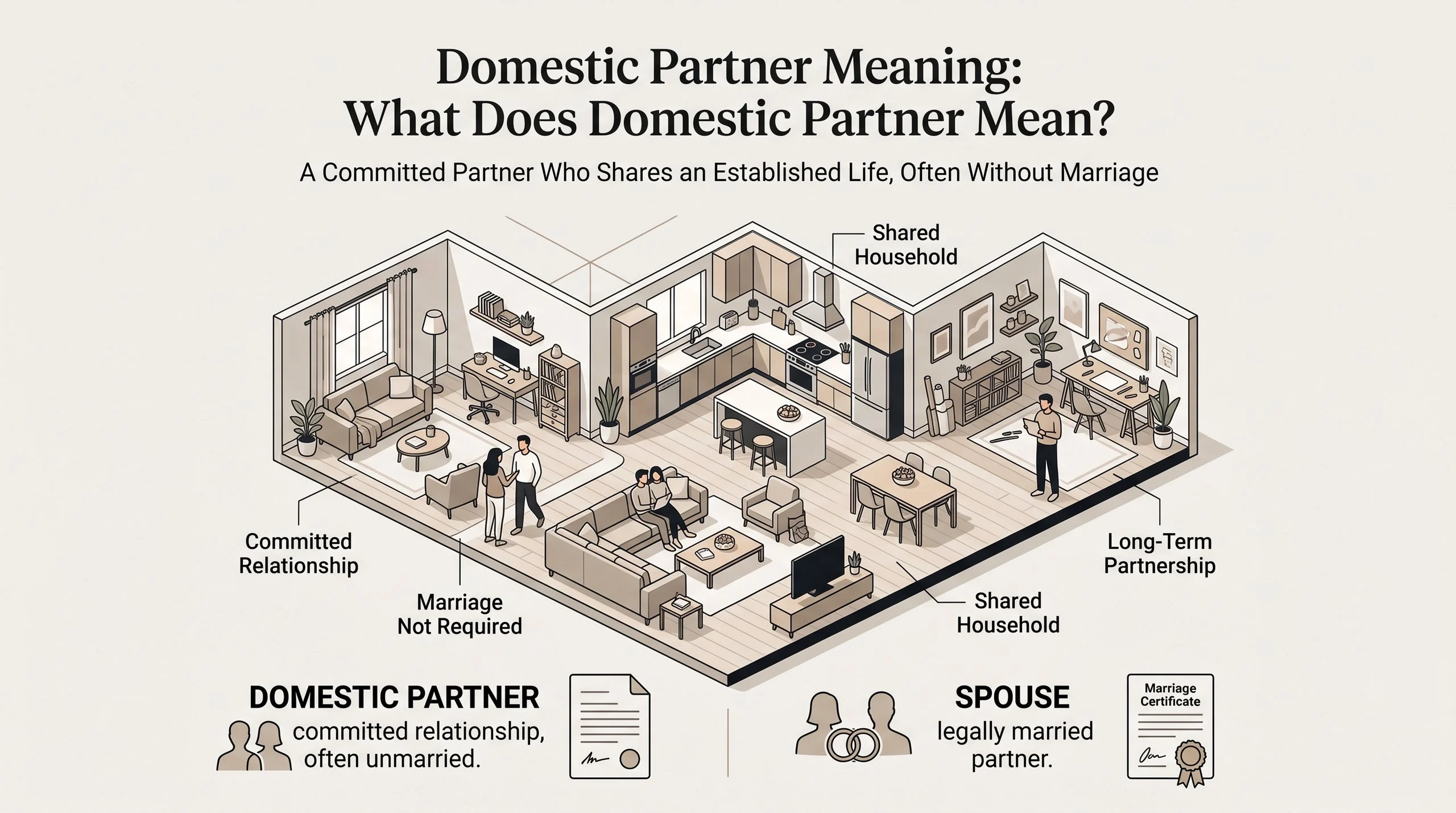
Domestic partner meaning refers to a person who shares a committed, long-term relationship and household with another person without necessarily being legally married. The term often appears in legal, workplace, insurance, housing, and relationship contexts, although its exact legal meaning varies by location.
Domestic partner meaning describes a person who is in a committed relationship with another person and commonly shares a home or household with them. Unlike the word “spouse,” however, the term does not automatically mean that the couple is legally married.
The phrase can appear in everyday conversations, employment forms, insurance documents, housing applications, and legal policies. Therefore, its meaning can change slightly depending on the context.
For example, a company may ask whether an employee has a domestic partner when determining eligibility for certain benefits. Similarly, a legal document may use the term to describe an unmarried couple who meets specific requirements.
Importantly, domestic partnership is not simply another word for dating. It usually suggests a more established relationship involving shared responsibilities, financial ties, a common residence, or long-term commitment.
Because laws differ between countries, states, cities, employers, and organizations, the exact rights associated with a domestic partnership can also differ. As a result, understanding the context is essential.
This guide explains the term in plain American English. It covers the definition, relationship meaning, legal context, workplace usage, examples, common misunderstandings, related terms, and frequently asked questions.
What Does Domestic Partner Mean?
| Meaning | Context | Primary Platforms | Example | Tone |
|---|---|---|---|---|
| A person in a committed, usually unmarried relationship | Relationships, legal forms, benefits, housing | Forms, workplace portals, texting, social media | “My domestic partner is listed on my benefits.” | Neutral, formal |
In simple terms, a domestic partner is someone with whom a person has an established, committed relationship that may involve living together and sharing household responsibilities.
What Does Domestic Partner Mean?
The domestic partner meaning centers on a committed relationship between two people who are not necessarily married to each other.
The word “domestic” relates to home or household life. Meanwhile, “partner” describes someone who shares an important relationship, responsibility, or activity with another person.
Together, domestic partner generally describes someone with whom a person has a committed personal relationship, often including a shared residence.
For example:
“Alex listed Jordan as his domestic partner on the insurance form.”
Here, the sentence suggests that Alex and Jordan have an established relationship that qualifies under the relevant policy. It does not necessarily mean they are legally married.
Domestic Partner vs. Boyfriend or Girlfriend
The terms can overlap, but they do not always communicate the same level of commitment.
A boyfriend or girlfriend can describe someone in a romantic relationship. The relationship may be new, long-term, casual, or serious.
A domestic partner, on the other hand, usually suggests a more established relationship. The couple may live together, share expenses, maintain a household, or have other responsibilities similar to those commonly associated with marriage.
For instance:
- “My girlfriend is coming over tonight” sounds casual and conversational.
- “My domestic partner is listed on my benefits” sounds formal and administrative.
Thus, the surrounding situation often determines which term sounds most appropriate.
Contextual Dynamics & Nuances of Domestic Partner
The phrase has both everyday and formal uses. In ordinary conversation, someone may use it to describe a long-term partner without using the word “husband” or “wife.”
In official settings, however, the phrase can have a specific definition.
1. Relationship Context
In a relationship context, a domestic partner is generally a committed romantic partner with whom someone shares an established life.
The couple may:
- Live together
- Share household expenses
- Make important decisions together
- Maintain a long-term relationship
- Share pets or property
- Support each other financially
- Describe themselves as partners rather than spouses
Still, none of these characteristics alone automatically creates a legal domestic partnership.
2. Workplace Context
Employers sometimes use the term when discussing benefits.
For example, a benefits form might ask whether an employee wants to add a spouse or eligible domestic partner to a health plan.
In that situation, the employer may require documentation showing that the relationship satisfies its eligibility rules.
Those requirements can vary considerably. Some organizations may require proof of shared residence, financial interdependence, or a formal declaration.
3. Legal Context
In legal documents, the phrase can have a narrower meaning.
A government agency, court, employer, insurer, or other organization may define “domestic partner” according to specific rules.
Therefore, simply living together does not necessarily mean that two people legally qualify as domestic partners.
The exact definition depends on the relevant jurisdiction and institution.
4. Housing Context
Landlords or housing providers may sometimes use terms such as spouse, partner, co-tenant, or domestic partner.
Here, the term can help describe the relationship between two adults who share a household.
However, a domestic partner may have different legal rights from a married spouse depending on local law.
5. Personal Identity Context
Some people prefer partner or domestic partner because those terms feel more inclusive or accurately describe their relationship.
For example:
“I live with my domestic partner.”
This statement identifies a committed relationship without specifying whether the couple is married.
Domestic Partner Meaning in Everyday English
In everyday American English, the phrase generally communicates three ideas:
- Commitment
- Shared domestic life
- A relationship that may not involve marriage
The term therefore sits somewhere between a broad romantic label and a formal relationship designation.
For example, someone might say:
“My domestic partner and I have lived together for eight years.”
The sentence emphasizes the couple’s established household and long-term relationship.
By comparison:
“I’m dating someone.”
This gives much less information about the relationship’s duration or domestic arrangements.
Does Domestic Partner Mean Married?
No.
A domestic partner is not automatically a spouse.
Some legal systems may recognize domestic partnerships as a formal relationship status. Others may not. Some employers and organizations may also provide benefits to domestic partners even when the government does not treat the relationship exactly like a marriage.
Therefore, domestic partner and spouse should not automatically be treated as interchangeable terms.
Real-Life Conversation Examples Using Domestic Partner
The phrase often sounds more natural in formal or practical conversations than in casual romantic dialogue.
Example 1: Workplace Benefits
Employee: “Can I add my domestic partner to my health plan?”
HR Representative: “Yes, if you meet the plan’s eligibility requirements.”
This example uses the phrase in an employee-benefits context.
Example 2: Introducing a Partner
Friend: “Who are you going to the event with?”
Taylor: “My domestic partner, Sam.”
The speaker uses the term to describe a committed relationship.
Example 3: Housing
Property Manager: “Will anyone else be living in the apartment?”
Applicant: “Yes. My domestic partner will live with me.”
Here, the phrase identifies another adult who will share the household.
Example 4: Insurance
Customer: “I want to check whether my domestic partner can be included on the policy.”
Representative: “Eligibility depends on the policy terms.”
This example shows why the phrase can have a technical meaning in administrative situations.
Example 5: Everyday Conversation
Friend: “Are you married?”
Jordan: “No, but I live with my domestic partner.”
The response makes the relationship clear without describing the couple as married.
Platform-Specific Breakdown
The phrase appears across digital communication, although it is not primarily internet slang.
How It Is Used on Snapchat
On Snapchat, people are more likely to use casual words such as partner, boyfriend, girlfriend, or a person’s name.
Still, someone may use “domestic partner” when discussing a long-term relationship, household, or official matter.
For example:
“My domestic partner is picking me up after work.”
The wording is understandable, although “my partner” would usually sound more conversational.
The Role of Domestic Partner on TikTok
TikTok discussions about relationships may use the phrase when creators discuss cohabitation, benefits, family structures, or legal terminology.
For example, a video might explain the difference between:
- Dating
- Living together
- Domestic partnership
- Marriage
The phrase can therefore appear in educational or informational content rather than as typical TikTok slang.
Instagram and Texting Dynamics
On Instagram, captions often favor shorter terms.
Someone might write:
“Celebrating another year with my partner.”
Instead of:
“Celebrating another year with my domestic partner.”
However, the longer phrase can appear when a post discusses legal, financial, insurance, or workplace issues.
In texting, the choice depends heavily on tone. “My partner” usually sounds more natural in casual messages, while “domestic partner” can sound more formal.
Alternative Meanings & NLP Variations of the Phrase
Although the core idea remains consistent, several related terms appear in similar contexts.
Domestic Partner
A committed partner who shares a domestic life, often without being legally married.
Partner
A broad term for someone in a romantic or committed relationship.
It does not necessarily indicate that the couple lives together.
Life Partner
A person with whom someone expects to share a long-term life.
This phrase emphasizes commitment rather than a specific legal status.
Unmarried Partner
A person in a committed relationship who is not married to their partner.
This term focuses directly on marital status.
Cohabitating Partner
A partner who lives in the same home.
The term emphasizes shared residence rather than legal recognition.
Spouse
A legally recognized husband or wife.
Depending on the jurisdiction, spouses generally have a specific legal status that may differ from domestic partners.
Civil Partner
A person in a legally recognized civil partnership where such a legal framework exists.
This is not automatically identical to domestic partnership.
Domestic Partner vs. Spouse
These terms may describe similar relationships, but they can carry different legal implications.
| Term | General Meaning | Marriage Required? | Legal Meaning |
|---|---|---|---|
| Domestic partner | Committed partner, often unmarried | No | Depends on jurisdiction or policy |
| Spouse | Married partner | Usually yes | Generally defined by marriage law |
| Partner | Romantic or committed partner | No | Usually broad and context-dependent |
| Boyfriend/Girlfriend | Romantic partner | No | Usually informal |
| Life partner | Long-term committed partner | No | Usually descriptive rather than technical |
The key difference is legal status.
A spouse typically receives rights and responsibilities established by marriage law. A domestic partner may receive certain rights, benefits, or protections, but those depend on the applicable rules.
Domestic Partner vs. Boyfriend or Girlfriend
These labels overlap, but their emphasis differs.
| Term | Typical Emphasis |
|---|---|
| Boyfriend | Romantic relationship |
| Girlfriend | Romantic relationship |
| Partner | Committed relationship |
| Domestic partner | Established relationship and shared domestic life |
| Spouse | Legal marriage |
For example, a person might have a boyfriend without living with him. In contrast, calling someone a domestic partner often suggests a more established shared life.
Still, people choose relationship labels according to personal preference. There is no universal requirement that everyone use these terms in exactly the same way.
When Not to Use Domestic Partner
The phrase can sound overly formal in situations where a simpler term would communicate the same idea.
1. Casual Dating
If two people have just started seeing each other, domestic partner may suggest a level of commitment that the relationship does not have.
Instead, terms such as:
- Date
- Boyfriend
- Girlfriend
- Partner
may fit better.
2. When You Mean Spouse
If someone is legally married and specifically wants to communicate their marital status, spouse may be more precise.
3. When the Relationship Is Not Romantic
Domestic partnership generally refers to a committed personal relationship. Therefore, calling a roommate a domestic partner simply because you share a home can create confusion.
4. When a Form Has a Specific Definition
Administrative forms may define eligibility differently.
For example, a form may require a formally registered domestic partnership. In that case, simply living together may not satisfy the requirement.
Common Misunderstandings About Domestic Partner
Several misconceptions surround the phrase.
Misunderstanding 1: It Always Means Married
It does not.
Domestic partners may be unmarried, and the legal treatment of their relationship can differ from marriage.
Misunderstanding 2: Living Together Automatically Creates a Domestic Partnership
Not necessarily.
Some organizations or jurisdictions require additional conditions.
Misunderstanding 3: Domestic Partner Is Only Used for Same-Sex Couples
Historically, domestic partnership policies were often discussed in connection with same-sex couples who could not access marriage in certain jurisdictions.
However, domestic partnership rules have also applied to unmarried couples more broadly in some settings.
Therefore, the phrase itself does not automatically identify the genders of the partners.
Misunderstanding 4: Every Domestic Partner Gets the Same Benefits as a Spouse
That is also not guaranteed.
Benefits and legal rights depend on the applicable law, employer, insurance plan, contract, or institution.
Misunderstanding 5: Partner and Domestic Partner Always Mean Exactly the Same Thing
Not quite.
“Partner” is broader and more flexible. “Domestic partner” can imply shared household life or a specific administrative status.
How to Respond to “Domestic Partner” in Chat Comfortably
If someone uses the phrase, your response can remain simple.
If They Say:
“This is my domestic partner.”
You could respond:
“Nice to meet you!”
If They Ask:
“Do you have a domestic partner?”
You could say:
“No, I’m currently single.”
Or:
“Yes, I’ve been with my partner for several years.”
If You Are Unsure What They Mean
You can ask:
“When you say domestic partner, do you mean your long-term partner?”
That question works well when the context is unclear.
If Someone Uses the Term on a Form
In an official setting, check the definition provided by the organization rather than assuming that the everyday meaning applies.
Why the Term “Domestic Partner” Is Used
The phrase can serve several purposes.
First, it provides a relationship label that does not depend on marriage.
Second, it can describe couples who share a household and long-term responsibilities.
Third, organizations may use it when creating eligibility categories for benefits.
Finally, some people simply prefer the term because it accurately describes their relationship.
The phrase therefore has both social and administrative uses.
Related Terms and Synonyms
There is no perfect synonym for domestic partner in every situation. However, these expressions can be related:
- Partner
- Life partner
- Long-term partner
- Unmarried partner
- Cohabiting partner
- Romantic partner
- Significant other
- Civil partner
- Companion
- Spouse-like partner
The best choice depends on the intended meaning.
For example, significant other works well in general conversation. Meanwhile, unmarried partner emphasizes marital status. In contrast, domestic partner may be appropriate when discussing household or benefit-related matters.
Domestic Partner Meaning in Legal and Workplace Language
In formal language, precision matters.
A workplace benefits document may define an eligible domestic partner using particular criteria. Those criteria can include factors such as shared residence, financial responsibility, or a required declaration.
Consequently, someone should not assume that an employer’s use of the term has exactly the same meaning as everyday conversation.
Likewise, government programs can establish their own definitions. A relationship that qualifies under one organization’s policy may not qualify under another.
This distinction is especially important when the phrase appears on:
- Health insurance forms
- Employee benefit applications
- Housing documents
- Tax-related paperwork
- Legal agreements
- Estate documents
- Financial forms
When the term appears in an official document, the document’s definition should take priority over its ordinary dictionary meaning.
Is Domestic Partner a Gender-Neutral Term?
Yes.
The phrase itself does not specify gender.
Someone can use domestic partner to refer to a male partner, female partner, or partner of another gender.
That makes the expression useful when gender is irrelevant to the discussion or when someone prefers a gender-neutral relationship label.
For example:
“My domestic partner works in healthcare.”
The sentence gives no information about the partner’s gender.
Is Domestic Partner Formal or Informal?
The phrase is generally more formal than “boyfriend” or “girlfriend.”
In casual conversation, many people simply say:
“My partner.”
In administrative or workplace settings, however, domestic partner can be more precise.
Therefore, the phrase is not inherently awkward. Its suitability depends on the situation.
A useful rule is:
- Casual relationship conversation: partner
- Romantic introduction: partner or boyfriend/girlfriend
- Benefits or official documents: domestic partner, if that is the category used
- Marriage-related context: spouse
FAQs
1. What does domestic partner mean?
A domestic partner is generally a person in a committed, established relationship with another person, often involving a shared household. The exact legal definition varies by jurisdiction and organization.
2. Is a domestic partner the same as a spouse?
No. A spouse is generally a person who is legally married to another person. A domestic partner may be unmarried, although some legal systems recognize domestic partnerships through specific laws or registrations.
3. Can boyfriend mean domestic partner?
Sometimes, but the terms are not identical. “Boyfriend” describes a romantic relationship, while “domestic partner” often suggests a more established relationship involving shared domestic life.
4. Can girlfriend mean domestic partner?
Yes, in some contexts. A girlfriend may also be a domestic partner if the relationship meets the relevant personal, organizational, or legal definition.
5. Do domestic partners have legal rights?
They may have certain legal rights, but those rights vary by jurisdiction and circumstance. Marriage and domestic partnership can have different legal consequences.
6. Does domestic partner mean you live together?
Often, the phrase suggests a shared household. However, whether living together is legally required depends on the relevant rules.
7. Is domestic partner gender-neutral?
Yes. The phrase does not specify the gender of either partner.
8. Is domestic partner a formal term?
Generally, yes. It sounds more formal than “boyfriend” or “girlfriend,” especially in workplace, insurance, and legal contexts.
9. Can an unmarried couple be domestic partners?
Yes, depending on how the term is being used. Domestic partnership commonly refers to committed couples who are not married.
10. Why would a form ask about a domestic partner?
A form may ask because the organization offers certain benefits, rights, or responsibilities to eligible domestic partners. The organization should provide the applicable definition and requirements.
Conclusion
The domestic partner meaning generally refers to a person in a committed, established relationship with another person, often involving a shared home or domestic life.
However, the phrase does not automatically mean marriage. A domestic partner and a spouse can have different legal statuses, while the exact rights and responsibilities associated with domestic partnership depend on the relevant jurisdiction, organization, contract, or policy.
In everyday conversation, partner may sound more natural. Meanwhile, domestic partner is especially useful in workplace, insurance, housing, and other formal contexts.
Ultimately, context determines the most precise interpretation. When the phrase appears in an official document, the organization’s own definition should be used rather than relying only on its everyday meaning.