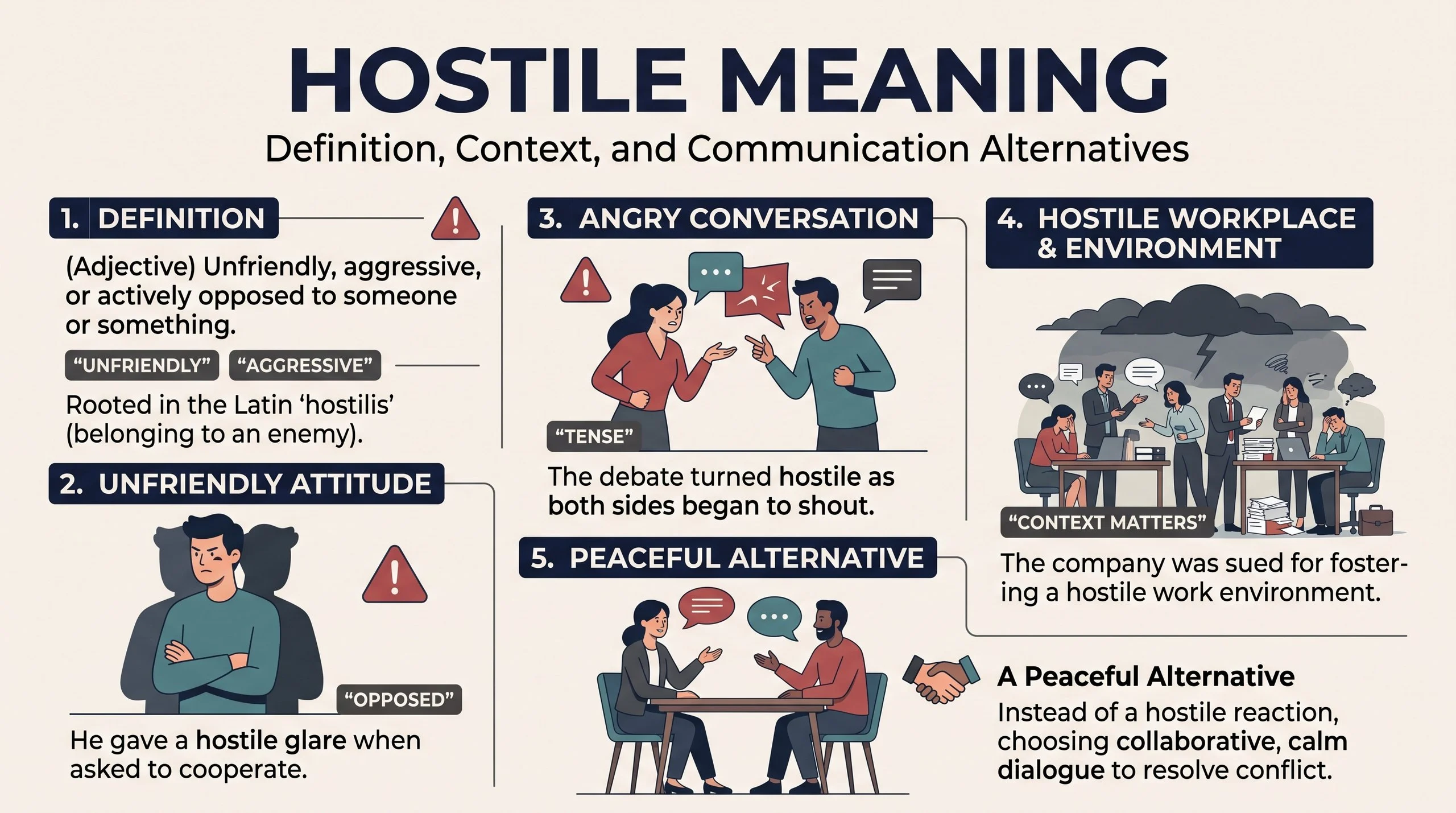
Hostile meaning refers to behavior, language, or attitudes that show strong unfriendliness, opposition, anger, or a willingness to create conflict. It can describe a person, tone, environment, action, or relationship. The word usually signals serious tension rather than simple disagreement.
Hostile meaning becomes clearer when you connect the word to behavior, tone, and context. In everyday American English, hostile describes something unfriendly, aggressive, oppositional, or openly negative toward another person or group.
The word can describe people and situations. Someone may give a hostile response. A workplace may feel hostile. A crowd may become hostile. A message can also sound hostile even when the writer does not intend to threaten anyone.
However, hostile does not always mean violent. A cold reply can feel hostile. A sharp comment can sound hostile. Likewise, an unfriendly environment can create a hostile atmosphere without physical aggression.
Context therefore matters. The same sentence may sound firm in one situation and hostile in another. Understanding that difference helps you choose the right word in conversations, emails, social media posts, and professional settings.
Quick Answer Box
| Meaning | Context | Primary Platforms | Example | Tone |
| Unfriendly, aggressive, or strongly opposed | Conversations, workplaces, relationships, conflicts | Texting, Instagram, TikTok, Snapchat, email | “His reply sounded hostile.” | Negative, tense, confrontational |
What Does Hostile Meaning Mean?
The basic definition describes something that is unfriendly, antagonistic, aggressive, or opposed to someone or something.
For example:
“She gave me a hostile look.”
This sentence suggests more than ordinary dislike. Her expression communicated strong negativity or opposition.
Another example is:
“The meeting became hostile.”
Here, hostile describes the atmosphere. The participants may have argued, raised their voices, criticized one another, or displayed strong anger.
The word can therefore describe several things:
| What it describes | Meaning | Example |
| A person | Unfriendly or aggressive | “He became hostile.” |
| A tone | Sharp or confrontational | “Her tone sounded hostile.” |
| A comment | Strongly negative or aggressive | “That was a hostile comment.” |
| An environment | Unwelcoming or threatening | “The office felt hostile.” |
| An action | Oppositional or aggressive | “They took a hostile approach.” |
| A relationship | Marked by conflict | “The two groups have hostile relations.” |
Word Origin and Development
The English word hostile comes from Latin hostilis, meaning related to an enemy. It connects with hostis, a Latin word associated with an enemy or opposing force.
Over time, English developed broader uses for the term. Today, it can describe interpersonal behavior, social environments, political relationships, business actions, and physical conditions.
For example, a scientist might describe a harsh environment as hostile to life. A business article might discuss a hostile takeover. A person might describe an aggressive response as hostile.
The central idea remains opposition or unfriendliness.
Hostile Versus Angry
These words overlap, but they are not identical.
Angry focuses on emotion.
Hostile focuses more on outward opposition, unfriendliness, or aggressive behavior.
Someone can feel angry without acting hostile. Likewise, someone can behave in a hostile way without openly expressing anger.
Consider these examples:
“I am angry about the decision.”
This describes an emotional reaction.
“He responded in a hostile manner.”
This describes how the person behaved.
Therefore, hostile often carries a stronger interpersonal meaning.
Hostile Versus Rude
Rude behavior breaks expectations of politeness. Hostile behavior suggests stronger opposition or aggression.
For example:
“He was rude to the waiter.”
This could mean he interrupted, insulted, or ignored the waiter.
“He was hostile toward the waiter.”
This suggests a more serious level of antagonism.
As a result, calling someone hostile can sound more serious than calling them rude.
Contextual Dynamics and Nuances of the Term
The meaning changes slightly depending on the situation.
In Everyday Conversation
In casual speech, people often use hostile to describe a person’s attitude.
For example:
“Why are you being so hostile?”
This question usually means:
“Why are you acting so unfriendly or aggressive?”
The speaker may not mean that the person is physically dangerous. Instead, they may be reacting to a sharp tone, defensive response, or angry behavior.
In Professional Communication
Workplace usage requires more care.
Calling a colleague hostile can sound accusatory. Therefore, professional writers often describe the specific behavior instead.
Instead of:
“John was hostile during the meeting.”
A more objective statement might be:
“John repeatedly interrupted the discussion and responded sharply to several comments.”
The second version focuses on observable behavior.
This distinction matters because professional communication benefits from precise language.
In Relationships
People may use hostile to describe repeated negativity or antagonism.
For example:
“Our conversations have become hostile.”
This does not necessarily mean physical conflict. It may refer to frequent arguments, insults, accusations, or defensive responses.
However, the word can intensify the situation. Therefore, speakers should use it carefully.
In Descriptions of Places
Hostile can also describe an environment.
Examples include:
“The desert is a hostile environment.”
“The team entered a hostile crowd.”
“The conditions were hostile to plant growth.”
Here, hostile means unfavorable, dangerous, or strongly opposed to successful activity.
In Business and Law
The term has specialized meanings in professional contexts.
A hostile takeover occurs when a company attempts to acquire another company without the target company’s approval.
A hostile work environment is also a specific workplace concept. In legal contexts, however, it has a narrower meaning than simply saying that a workplace feels unpleasant.
Therefore, casual and legal uses should not be treated as identical.
Real Life Conversation Examples Using Hostile Meaning
The following conversations show how Americans may naturally use the word.
Conversation 1: A Difficult Conversation
Alex: Why did you leave the meeting early?
Jordan: Everyone was arguing.
Alex: Was it really that bad?
Jordan: Yes. The discussion became hostile.
Alex: That sounds uncomfortable.
Here, hostile describes an atmosphere that became strongly confrontational.
Conversation 2: A Text Message
Maya: Did you read his message?
Chris: Yes.
Maya: What did you think?
Chris: It sounded hostile to me.
Maya: I thought so too. He seemed angry.
The word describes the tone of a written message.
Conversation 3: A Workplace Situation
Employee: I feel uncomfortable in that meeting.
Manager: What happened?
Employee: The discussion became hostile after the budget issue came up.
Manager: We should address the communication problems.
Here, hostile describes escalating conflict rather than physical aggression.
Conversation 4: A Social Media Comment
Sam: Did you see the comments under that video?
Taylor: Yes. People were disagreeing.
Sam: Disagreement is fine, but some comments became hostile.
Taylor: I noticed that too.
This example shows an important distinction. People can disagree without behaving aggressively.
Conversation 5: A Personal Relationship
Nina: Are you two still talking?
Ella: Barely.
Nina: What happened?
Ella: Every conversation turns into an argument.
Nina: That sounds difficult.
Ella: It does. The communication has become hostile.
Here, the word describes a repeated pattern of antagonistic communication.
Platform Specific Breakdown
Online communication adds another layer because tone can be difficult to interpret through text.
How It Is Used on Snapchat
Snapchat conversations are often short and informal. Users may therefore describe a message as hostile when it feels unusually cold, aggressive, or confrontational.
For example:
“Why are you being hostile?”
A person might send this after receiving a blunt reply.
However, short messages can create misunderstandings. A message such as:
“Whatever.”
could indicate irritation, indifference, sarcasm, or simple brevity.
Therefore, one short message does not automatically establish hostile behavior.
Context matters. Previous messages, punctuation, relationship history, and the situation can all affect interpretation.
The Role of Hostile Meaning on TikTok
TikTok discussions can become emotionally intense, especially when users debate controversial topics, creators, trends, or opinions.
A viewer might write:
“The comments are getting hostile.”
This means that the discussion has moved beyond ordinary disagreement.
Another person might say:
“That reply sounds hostile.”
Here, the focus is on the language used in a specific comment.
Importantly, disagreement alone is not hostility. A person can strongly disagree while remaining respectful.
For example:
“I completely disagree with your argument, but I understand your point.”
That response is firm but not necessarily hostile.
Instagram and Texting Dynamics
Instagram comments and direct messages often rely on very short statements.
Because written communication lacks facial expressions and vocal tone, readers may interpret neutral wording differently from the writer’s intention.
Compare these messages:
“I disagree.”
“That makes no sense.”
“You clearly have no idea what you’re talking about.”
The first is direct. The second is dismissive. The third is more confrontational and may reasonably be perceived as hostile.
However, interpretation depends on the relationship and previous conversation.
Why Digital Context Changes Interpretation
Online communication removes many social signals.
In face to face conversation, people can hear volume and notice facial expressions. Text removes those clues.
Consequently, punctuation can influence perceived tone.
For example:
“Okay.”
may feel neutral, cold, or annoyed depending on context.
Similarly:
“Fine.”
may communicate acceptance, frustration, or sarcasm.
Therefore, labeling a message hostile should involve more than one isolated word.
Alternative Meanings and NLP Variations of the Phrase
Search engines and language models connect the term with a broad semantic field.
Common related words include:
| Related word | Typical meaning | Strength |
| Unfriendly | Not warm or welcoming | Moderate |
| Aggressive | Forceful or confrontational | Strong |
| Antagonistic | Actively opposed | Strong |
| Confrontational | Likely to challenge or argue | Strong |
| Adversarial | Opposed to another side | Strong |
| Rude | Lacking politeness | Moderate |
| Angry | Experiencing anger | Emotional |
| Threatening | Suggesting possible harm | Very strong |
| Unwelcoming | Not inviting or friendly | Mild to moderate |
| Combative | Eager to argue or fight | Strong |
These words are not perfect synonyms.
For example, unfriendly can describe someone who simply seems distant. Threatening suggests potential harm. Aggressive can describe forceful behavior that is not necessarily personal.
Therefore, replacing one word with another requires attention to context.
Common Collocations
Certain combinations occur naturally in American English.
Common examples include:
- hostile attitude
- hostile behavior
- hostile response
- hostile environment
- hostile relationship
- hostile tone
- hostile crowd
- hostile reaction
- hostile takeover
- hostile forces
These combinations help learners recognize natural usage.
Opposite Terms
The opposite of hostile depends on the context.
Possible alternatives include:
friendly
welcoming
peaceful
cooperative
supportive
cordial
warm
nonaggressive
For example:
“The atmosphere was hostile.”
The opposite could be:
“The atmosphere was welcoming.”
Likewise:
“He gave a hostile response.”
could become:
“He gave a cooperative response.”
Misinterpretations: When NOT to Use Hostile Meaning
The word can sound stronger than intended.
Do Not Use It for Every Disagreement
Disagreement does not automatically equal hostility.
Consider:
“I disagree with your proposal.”
This statement can remain respectful.
Calling it hostile would exaggerate the situation unless additional behavior supports that description.
Do Not Use It as a Simple Synonym for Sad
Hostile does not mean sad, disappointed, or hurt.
For example:
“She felt disappointed after losing.”
is not the same as:
“She behaved in a hostile way after losing.”
The first describes emotion. The second describes behavior.
Do Not Confuse It With Assertiveness
Assertive communication expresses a position clearly and respectfully.
For example:
“I cannot approve this request because it exceeds the budget.”
This is firm. It is not necessarily hostile.
However:
“Your request is ridiculous, and I am not discussing it.”
sounds much more confrontational.
Avoid Personal Labels When Describing Professional Problems
In workplace writing, factual descriptions usually work better than labels.
Instead of:
“The employee was hostile.”
consider:
“The employee raised his voice and interrupted the discussion several times.”
This approach makes the statement more precise.
Do Not Assume Physical Violence
Hostile behavior can be verbal, emotional, social, or environmental.
A hostile environment may involve tension without physical violence.
Therefore, the word should not automatically be interpreted as meaning someone attacked or threatened another person.
How to Respond in Chat Comfortably
If someone tells you that your message sounds hostile, avoid immediately becoming defensive.
First, clarify the issue.
You can say:
“I did not mean for it to sound hostile.”
Or:
“Sorry if my message came across too strongly.”
Another useful response is:
“I understand how it could sound that way. Let me explain what I meant.”
These responses reduce tension.
If Someone Is Actually Being Aggressive
You do not need to mirror their tone.
Instead, remain clear and calm.
For example:
“I am happy to discuss this, but I would prefer to keep the conversation respectful.”
Or:
“We can disagree without attacking each other.”
These phrases establish a boundary without escalating the situation.
If You Are Unsure About Someone’s Tone
Ask for clarification.
For example:
“Are you upset with me?”
Or:
“I may be reading your message incorrectly. What did you mean?”
This approach is particularly useful in texting because written messages lack vocal tone.
If You Want to Sound Less Confrontational
Replace emotionally charged statements with specific observations.
Instead of:
“You’re being hostile.”
Try:
“Your response sounds frustrated. Is something wrong?”
Instead of:
“Stop attacking me.”
Try:
“I would like to continue this conversation without personal comments.”
Specific language often keeps conversations productive.
FAQs
1. What is hostile meaning in simple English?
It means strongly unfriendly, aggressive, or opposed to someone or something. It usually describes behavior, language, attitudes, or environments that create tension.
2. Is hostile a bad word?
It is a negative word, but it is not inherently offensive. It describes a type of behavior or attitude. Because it can sound serious, use it when the situation genuinely involves strong unfriendliness or opposition.
3. Is hostile the same as angry?
No. Angry describes an emotional state, while hostile usually describes outwardly unfriendly, aggressive, or oppositional behavior. A person can be angry without behaving aggressively.
4. What does hostile mean in texting?
In texting, it usually means that a message feels unusually aggressive, unfriendly, dismissive, or confrontational. However, tone can be difficult to judge from short written messages.
5. What is the opposite of hostile?
Common opposites include friendly, welcoming, peaceful, cooperative, supportive, cordial, and warm. The best opposite depends on the sentence and context.
6. Can a person be hostile without being violent?
Yes. Hostility can appear through words, facial expressions, tone, insults, dismissive behavior, or repeated confrontation. Physical violence is not required.
7. Is hostile formal English?
Yes. Hostile is standard English and works in formal, academic, professional, and everyday contexts. However, some professional situations benefit from more specific descriptions of behavior.
8. What does a hostile environment mean?
A hostile environment is a setting that feels strongly unfriendly, unsafe, aggressive, or unfavorable. In some legal contexts, the phrase has a specific technical meaning.
9. What is a polite alternative to hostile?
Depending on the situation, alternatives include unfriendly, tense, confrontational, difficult, defensive, or strongly opposed. Choose the mildest accurate term.
10. Can hostile describe a situation?
Yes. You can describe an atmosphere, environment, relationship, reaction, crowd, or situation as hostile. The term then refers to the overall level of opposition or unfriendliness.
Conclusion
The word hostile remains useful because it describes more than simple anger. It communicates a stronger sense of opposition, unfriendliness, aggression, or tension.
In everyday conversation, the term can describe a person’s behavior or attitude. In digital communication, it can describe a message, comment, or exchange that feels confrontational.
However, context remains essential.
A blunt message is not automatically hostile. A disagreement is not automatically aggressive. Likewise, an angry emotion does not necessarily produce hostile behavior.
The most accurate interpretation comes from looking at the complete interaction.
In professional communication, specific descriptions often work better than broad labels. Instead of simply calling someone hostile, explain what happened. Mention interruptions, raised voices, insults, dismissive comments, or other observable behavior.
This approach creates clearer communication and reduces unnecessary conflict.
The same principle applies to social media. Online discussions can become intense quickly because text removes facial expressions and vocal cues. Therefore, readers should consider context before assigning a strong tone to a short message.
Ultimately, understanding hostile meaning helps English learners recognize emotional intensity and choose vocabulary more precisely. It also makes conversations easier to interpret across texting, social media, workplaces, relationships, and everyday American English.