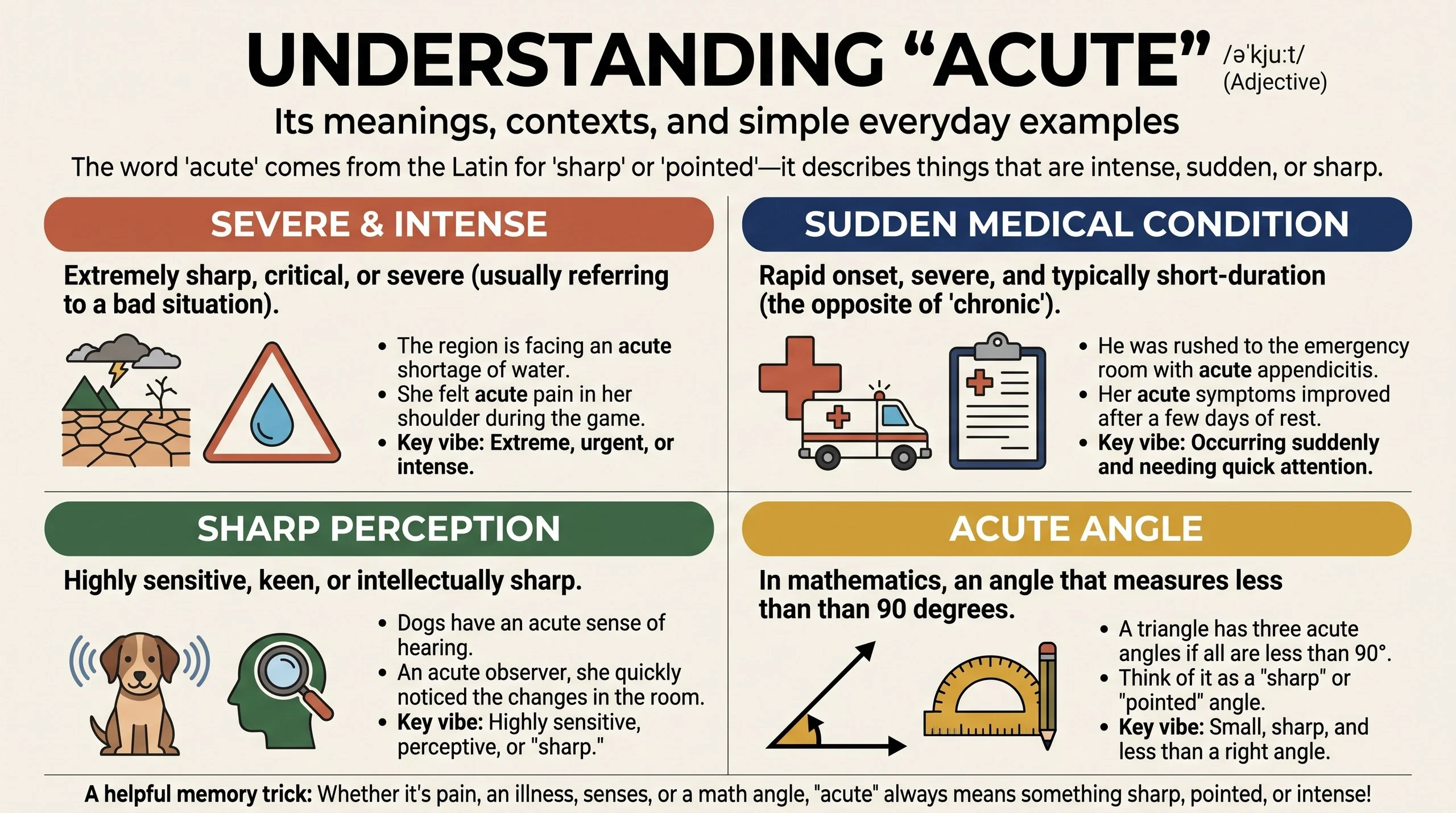
Acute meaning refers to something sharp, severe, intense, sudden, or highly perceptive. In medicine, acute usually describes a condition that begins suddenly and often lasts for a limited time. Context determines the intended sense.
acute meaning can change depending on the sentence, subject, and situation. The word commonly describes something sharp, intense, severe, sudden, or highly perceptive. However, its meaning is not limited to one definition. You may see it in medical reports, academic writing, everyday conversations, news articles, and descriptions of intelligence or awareness.
For example, acute pain is usually severe or intense. An acute illness often begins suddenly and may require prompt attention. An acute angle has a precise mathematical meaning. Meanwhile, an acute observer is someone who notices details quickly and accurately.
Therefore, understanding the word requires more than memorizing one dictionary definition. The surrounding words provide the real clue. This guide explains the major meanings, common contexts, conversational uses, related words, mistakes, and practical examples so you can recognize and use the term naturally.
QUICK ANSWER BOX
| Meaning | Context | Primary Platforms | Example | Tone |
| Sharp, severe, intense, sudden, or perceptive | Everyday English | Texting, social media, conversation | “She has an acute sense of humor.” | Neutral |
| Sudden and usually short term | Medicine | Health discussions, medical writing | “He developed an acute infection.” | Clinical |
| Sharp or less than 90 degrees | Mathematics | School, academic writing | “An acute angle measures less than 90 degrees.” | Technical |
| Highly perceptive or observant | Personality and intellect | Conversation, writing | “He has an acute awareness of detail.” | Positive |
| Extremely strong or serious | General description | News, essays, speech | “The city faced an acute shortage.” | Formal |
What Does acute meaning Mean?
The core idea behind acute meaning is connected to sharpness or intensity. Depending on context, acute can describe something physically sharp, emotionally intense, medically sudden, intellectually perceptive, or mathematically narrow.
The word comes from Latin acutus, meaning sharpened or pointed. It is related to the Latin verb acuere, meaning to sharpen. Over time, English developed several related senses from this basic idea of sharpness.
This historical connection helps explain the modern meanings. A sharp physical object has a pointed edge. Likewise, an acute observation can be mentally sharp. An acute problem can feel sharply severe. An acute illness can appear suddenly and strongly.
Acute as severe or intense
One of the most common uses describes something unusually strong.
Consider these examples:
- “She felt acute pain after the injury.”
- “The region experienced an acute water shortage.”
- “He suffered from acute anxiety before the examination.”
- “The company faced an acute staffing problem.”
In each example, the word adds a sense of seriousness or intensity. Therefore, acute is often stronger than simply saying “noticeable” or “present.”
However, the exact strength depends on the noun. An acute shortage suggests a serious lack.
- Acute pain suggests significant intensity.
- Acute embarrassment suggests a powerful emotional reaction.
Acute as sudden or short term
In medical and scientific contexts, acute often contrasts with chronic.
An acute condition generally begins suddenly or develops over a relatively short period. A chronic condition usually persists for a long time.
For example:
| Acute | Chronic |
| Often sudden | Usually persistent |
| Often short term | Usually long term |
| May develop rapidly | May develop gradually |
| Can require prompt attention | Often requires ongoing management |
This distinction matters because acute does not simply mean “severe.” A condition can be acute because it developed suddenly, even when its severity varies.
Acute as sharp or highly perceptive
The word can also describe mental ability.
- An acute mind is highly perceptive.
- An acute observer notices small details.
- An acute awareness means strong or sensitive awareness of something.
For example, “She has an acute awareness of social cues” suggests that she notices subtle behavior that others may miss.
Here, the word has a positive intellectual meaning. It suggests mental sharpness rather than physical severity.
Acute in mathematics
Mathematics gives the word another precise meaning.
An acute angle measures more than 0 degrees but less than 90 degrees. For example, a 30 degree angle and a 60 degree angle are both acute angles.
This definition is completely different from the medical sense. Therefore, readers should always examine the surrounding subject before interpreting the word.
Contextual Dynamics & Nuances of the Term
Context controls how readers understand the word. The same adjective can communicate very different ideas when it modifies different nouns.
Medical context
Medical writing frequently uses acute to describe a condition, symptom, episode, or disease process.
Examples include:
- Acute pain
- Acute infection
- Acute illness
- Acute injury
- Acute inflammation
- Acute respiratory symptoms
- Acute stress
However, acute does not automatically mean life threatening. It primarily describes timing, development, or clinical presentation. The specific medical meaning depends on the condition being discussed.
Emotional context
People also use acute to describe powerful emotions.
For example:
“Her acute embarrassment was obvious.”
“The loss caused an acute sense of loneliness.”
“The announcement created acute concern.”
These expressions sound more formal than everyday alternatives such as “really embarrassed,” “very lonely,” or “extremely worried.”
Consequently, acute works particularly well in essays, journalism, professional communication, and serious discussions.
Social and conversational context
In casual conversation, people may understand the word, but they may not use it frequently.
Someone might say:
“That was an acute observation.”
A more casual speaker could say:
“That was a really sharp observation.”
Both communicate a similar idea. However, the second sounds more relaxed.
Academic context
Academic writers often use acute when they need precision.
For example:
“Students experienced acute pressure during the examination period.”
“The study identifies an acute shortage of qualified workers.”
Academic writing benefits from precise vocabulary, but clarity should remain the priority. If a simpler word communicates the same idea, it may be preferable.
Formality and emotional strength
| Expression | Typical strength | Formality |
| Noticeable problem | Moderate | Neutral |
| Serious problem | High | Neutral |
| Acute problem | High | Formal |
| Severe problem | Very high | Formal |
| Critical problem | Very high | Formal |
| Extreme problem | Very high | Neutral |
The distinction is subtle. Acuteness often emphasizes sharpness, suddenness, or intensity. Severe primarily emphasizes seriousness or magnitude.
Real Life Conversation Examples Using acute meaning
The phrase itself is usually a search term rather than something people insert naturally into conversation. Instead, speakers use the word acute inside sentences.
Here are five realistic scenarios.
Example 1: Discussing pain
Maya: “How are you feeling after the accident?”
Jordan: “The pain was acute last night, but it feels more manageable today.”
Maya: “That sounds rough. Are you getting it checked?”
This example uses acute to emphasize strong pain. The word sounds more clinical than “really bad.”
Example 2: Talking about intelligence
Alex: “How did Priya notice that mistake so quickly?”
Sam: “She has an acute eye for details.”
Alex: “That explains it. She catches things everyone else misses.”
Here, the term communicates sharp observation. It does not describe something negative.
Example 3: Discussing a shortage
Manager: “Why are we changing the delivery schedule?”
Employee: “We have an acute shortage of supplies this week.”
Manager: “Understood. I will contact the supplier.”
In this context, acute emphasizes the seriousness of the shortage.
Example 4: Describing awareness
Teacher: “Why did you notice the change in his behavior?”
Student: “I have an acute awareness of small changes in tone.”
Teacher: “That can be useful during group discussions.”
Here, acute suggests strong sensitivity and perception.
Example 5: Mathematics
Teacher: “What type of angle is this?”
Student: “It is acute because it measures less than 90 degrees.”
Teacher: “Correct.”
This example demonstrates why context matters. The mathematical definition has nothing to do with illness or emotional intensity.
Platform Specific Breakdown
Modern internet platforms rarely use acute as a dedicated slang term. Instead, users encounter it through captions, educational posts, health discussions, comments, articles, and ordinary conversation.
The platform may change the surrounding language, but the basic meaning remains context dependent.
How It Is Used on Snapchat
Snapchat conversations tend to favor short, casual language. Therefore, users are more likely to write “really bad pain” or “sharp observation” than use the formal word acute.
Still, the word can appear in educational stories, health related conversations, schoolwork, or screenshots of articles.
For example:
“The doctor said it was an acute injury.”
That sentence sounds natural when someone is sharing information from a medical appointment.
Another example is:
“Your acute attention to detail is actually impressive.”
Here, the word sounds playful but still carries its standard meaning of sharp perception.
The Role of acute meaning on TikTok
TikTok frequently turns vocabulary into educational content. Creators may explain unfamiliar words through short videos, captions, quizzes, and examples.
A vocabulary creator might explain:
“Acute” can mean severe, sudden, sharp, or highly perceptive. Context tells you which one applies.”
This type of explanation is especially useful because many learners encounter the word in different subjects.
Medical creators may discuss acute symptoms. Teachers may explain acute angles. Language creators may discuss acute observation.
Therefore, TikTok can expose users to several definitions within a short period.
Instagram and Texting Dynamics
Instagram captions usually favor expressive language. A creator might write:
“An acute awareness of how quickly life changes.”
That sentence sounds reflective and literary.
In texting, however, people generally choose simpler alternatives.
Instead of:
“I am experiencing acute exhaustion.”
A friend might write:
“I am completely exhausted.”
Instead of:
“That was an acute observation.”
They might say:
“That was a sharp observation.”
Therefore, the word is perfectly understandable in casual communication, but it can sound more formal than necessary.
Alternative Meanings & NLP Variations of the Phrase
Understanding semantic variations makes the word easier to recognize in search results and everyday writing.
Words related to severity
When acute means severe or intense, nearby terms include:
- Severe
- Intense
- Serious
- Extreme
- Strong
- Pronounced
- Profound
These words are not perfect substitutes in every sentence. For example, “acute infection” is a standard medical expression, while “extreme infection” sounds unnatural.
Words related to perception
When acute describes mental sharpness, useful alternatives include:
- Perceptive
- Observant
- Sharp
- Astute
- Insightful
- Discerning
- Alert
For example:
“She has an acute understanding of human behavior.”
Possible alternatives include:
“She has an astute understanding of human behavior.”
“She has a perceptive understanding of human behavior.”
The exact choice depends on the intended nuance.
Words related to suddenness
When acute describes a rapid or recent condition, related expressions include:
- Sudden
- Rapid
- Immediate
- Short term
- Rapid onset
- Developing quickly
However, these are not always interchangeable. Acute is a technical term in many professional contexts.
Linguistic variations
Searchers may encounter several related phrases:
| Phrase | General interpretation |
| Acute pain | Strong or clinically significant pain |
| Acute illness | Illness with sudden or recent onset |
| Acute stress | Strong stress response |
| Acute problem | Serious or pressing problem |
| Acute awareness | Highly sensitive awareness |
| Acute observation | Sharp or perceptive observation |
| Acute angle | Angle below 90 degrees |
| Acute shortage | Serious shortage |
The surrounding noun provides the strongest semantic signal.
Misinterpretations: When NOT to Use acute meaning
The word can cause confusion when writers treat all of its definitions as interchangeable.
Do not assume acute always means severe
This is one of the most important distinctions.
In medicine, acute often refers to onset or duration. It does not automatically mean that the condition is the most severe possible form.
Therefore, replacing acute with “life threatening” can create an inaccurate statement.
Do not confuse acute with chronic
Acute and chronic frequently appear together in healthcare.
Acuteness generally relates to sudden onset or a limited period. Chronic generally describes a long lasting or persistent condition.
However, real medical conditions can be complicated. A chronic condition may have acute episodes, so the terms are not always simple opposites.
Do not use acute when you simply mean important
Consider this sentence:
“Acute customer service is important.”
That sounds incorrect because acute does not normally mean “important.”
Better options include:
“Excellent customer service is important.”
“Effective customer service is important.”
Do not use it as casual slang
Acute is not a modern internet slang term in the same way as words such as “sus,” “lowkey,” or “ghosting.”
People may search for the phrase because they encountered the word online, but the word itself remains standard English.
Do not force the word into simple sentences
If you mean “very tired,” saying “I am acutely tired” may sound unnatural in ordinary texting.
A simpler sentence works better:
“I am exhausted.”
The strongest writing choice is not always the most sophisticated word. Clarity should come first.
How to Respond in Chat Comfortably
If someone uses the word in a message, your response should depend on what they mean.
If they mean severe pain
You can respond:
“That sounds painful. Are you feeling better now?”
“I hope you can get some relief soon.”
“Was the pain sudden?”
These responses acknowledge the situation without pretending to provide medical advice.
If they mean sharp intelligence
You could say:
“That is a great way to describe it.”
“She really does notice everything.”
“Honestly, that observation was spot on.”
If they use it in a joke
You can keep the tone light:
“Okay, vocabulary flex.”
“That is a fancy way to say it.”
“Look at you bringing dictionary energy.”
The response should match the relationship and platform.
If you do not understand the context
Ask a simple clarification:
“Do you mean severe, sudden, or highly perceptive?”
That question works because the word has several common senses.
If someone asks you for the definition
A natural response is:
“It usually means sharp, severe, intense, sudden, or highly perceptive. The exact meaning depends on the context.”
That explanation is short enough for texting while still being accurate.
FAQs
1. What does acute mean in simple English?
Acute can mean very strong, severe, sudden, sharp, or highly perceptive. The correct interpretation depends on the sentence. In mathematics, it describes an angle measuring less than 90 degrees.
2. Is acute a slang word?
No. Acute is a standard English word, not modern internet slang. People may encounter it on social media, but its definitions come from established English usage.
3. What is the medical sense of acute?
In medical language, acute commonly describes something that develops suddenly or over a relatively short period. It can also describe strong symptoms, depending on the specific medical context.
4. What is the opposite of acute?
The best opposite depends on the meaning. In healthcare, chronic may contrast with acute. For an acute angle, the contrasting geometric category is an obtuse angle when the measurement is greater than 90 degrees and less than 180 degrees.
5. Can acute mean severe?
Yes. Acute can describe something extremely strong or severe, such as acute pain, acute distress, or an acute shortage. However, it does not mean severe in every context.
6. What does acute awareness mean?
Acute awareness means a very strong or sensitive awareness of something. An individual with acute awareness may notice subtle details, changes, or signals that others overlook.
7. What does acute pain mean?
Acute pain generally refers to pain that begins suddenly or is associated with a recent injury, illness, procedure, or other event. The phrase may also emphasize strong pain depending on the context.
8. What is an acute angle?
An acute angle measures more than 0 degrees and less than 90 degrees. A 45 degree angle is a common example.
9. What is a synonym for acute?
Possible synonyms include severe, intense, sharp, perceptive, astute, sudden, and serious. However, no single synonym works in every sentence because the word has multiple meanings.
10. How can I tell which definition applies?
Look at the noun and the subject of the sentence. Medical terms often point toward sudden onset or intensity. Mathematical language points toward the angle definition. Descriptions of people or thinking often indicate sharpness or perception.
Conclusion
The phrase acute meaning leads to a broader lesson about vocabulary: one word can carry several precise meanings depending on context. Acute can describe intensity, sudden development, mental sharpness, or a mathematical angle. Therefore, the surrounding words matter just as much as the term itself.
In everyday English, acute often sounds formal. In medicine, it has a more specialized role. It has a precise measurement in mathematics. In descriptions of intelligence or awareness, it communicates sharp perception.
Most importantly, do not treat acute as a modern slang word. Social media may introduce the term to new audiences, but its established meanings remain rooted in standard English. Once you identify the context, the intended definition becomes much easier to understand and use correctly.