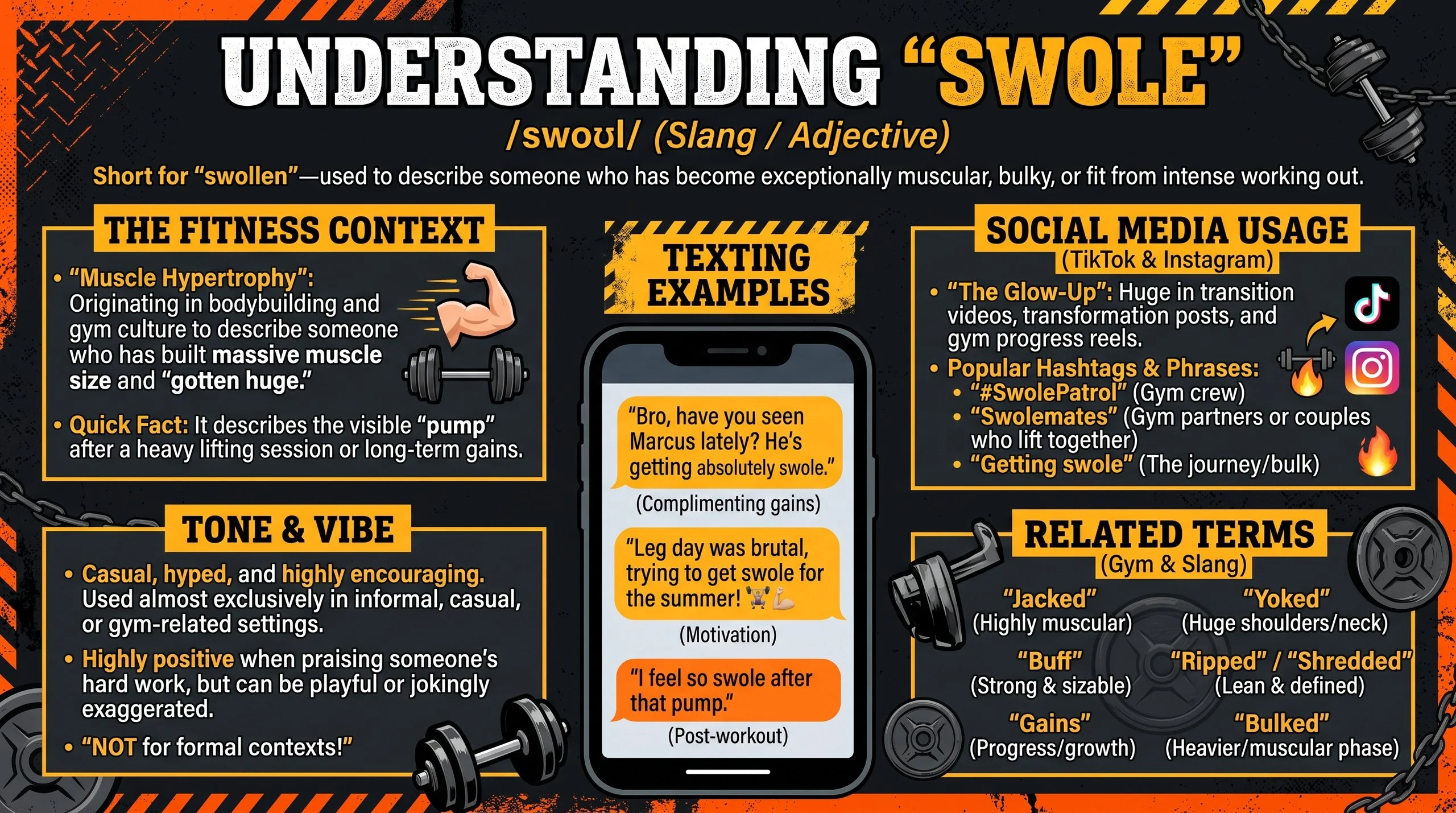
Swole meaning: “Swole” is informal slang for looking very muscular, strong, or physically well developed, especially because of weight training. It usually describes someone with noticeably large, defined muscles and often carries a positive, playful, or admiring tone.
Swole meaning refers to looking noticeably muscular, strong, or physically developed, especially after consistent strength training. The word appears frequently in gym conversations, social media captions, memes, comments, and casual texting. However, its meaning can shift slightly depending on context.
For example, someone might say, “Bro got swole,” after seeing a friend’s transformation. A gym enthusiast may use the word proudly after months of lifting. Meanwhile, a friend might use it humorously after someone eats a large meal and jokes about becoming huge.
The expression is strongly connected with modern fitness culture. It often suggests visible muscle growth rather than simply being healthy or athletic. Therefore, calling someone “swole” usually focuses on their size, muscular appearance, or impressive physique.
The word also has a relaxed internet personality. It does not sound formal or clinical. Instead, it feels casual, energetic, humorous, and sometimes exaggerated.
Understanding the expression requires more than memorizing a dictionary style definition. You also need to understand tone, context, social media culture, and the difference between being muscular, fit, strong, bulky, and athletic.
Quick Answer Box
| Meaning | Context | Primary Platforms | Example | Tone |
| Very muscular or noticeably built | Fitness, compliments, jokes | TikTok, Instagram, Snapchat, texting | “You got so swole!” | Casual, positive, playful |
What Does Swole Meaning Mean?
The simplest explanation is that swole meaning describes someone who looks muscular, built, or significantly developed from strength training.
The word is an informal form associated with “swollen,” although modern usage has developed its own slang identity. In fitness culture, it commonly suggests that muscles look bigger, fuller, or more prominent.
For example, someone may say:
“He got swole after a year of lifting.”
The sentence means that the person became visibly more muscular through training.
The expression can describe a person, body part, transformation, or even a humorous situation. Context determines whether the speaker is being serious or playful.
Swole Versus Muscular
“Swole” and “muscular” overlap, but they do not feel identical.
“Muscular” is neutral and descriptive. It can appear in formal writing, health discussions, sports coverage, or ordinary conversation.
“Swole” is much more casual. It sounds like gym slang or internet language. It can also communicate excitement.
Compare these examples:
| Expression | Typical Feeling |
| He is muscular. | Neutral and descriptive |
| He is very built. | Casual |
| He is jacked. | Strong casual slang |
| He is swole. | Casual, playful, fitness focused |
| He has developed significant muscle mass. | Formal |
Therefore, the slang version often adds personality that the neutral adjective does not provide.
Does Swole Mean Strong?
Not necessarily.
A person can be extremely strong without looking extremely muscular. Likewise, someone can have a large muscular appearance without being the strongest person in the gym.
The expression usually emphasizes appearance more than measurable strength.
For instance, saying:
“She looks swole.”
focuses on how muscular she appears.
By contrast:
“She is incredibly strong.”
focuses on physical performance.
The two qualities can exist together, but they are not synonyms in every situation.
Does Swole Mean Fat?
Generally, no.
The expression normally refers to muscular size or a visibly developed physique. It does not ordinarily mean over weight.
However, online jokes can deliberately play with the word. Someone might post a picture after eating a huge meal and jokingly claim to be “swole.” In that situation, the speaker is being humorous rather than giving an accurate physical description.
Contextual Dynamics and Nuances of the Term
Language depends heavily on context. Consequently, the same expression can sound complimentary in one conversation and humorous in another.
The most common use appears in fitness culture.
Someone who spends months lifting weights may post a progress photo with a caption such as:
“Finally getting swole.”
Here, the speaker is celebrating muscle growth.
A friend might respond:
“Okay, I see the gains!”
That response reinforces the positive meaning.
However, the word can also appear sarcastically.
Imagine someone posts a picture of a tiny dog standing next to a large dumbbell. The caption might say:
“Getting swole for summer.”
The joke comes from exaggeration.
Positive Usage
Most everyday uses are positive.
Someone may use the expression to compliment another person’s physique. It can communicate admiration without sounding overly serious.
Examples include:
“Dude, you’re getting swole.”
“You look seriously swole lately.”
“Those workouts are making you swole.”
The exact wording can vary, but the message usually celebrates visible progress.
Humorous Usage
The slang also works well in jokes.
For example, someone may take a picture holding a very small weight and write:
“One more rep and I’ll be absolutely swole.”
The humor comes from the obvious exaggeration.
Similarly, someone could post a photo of a large meal and write:
“About to get swole from this burger.”
That statement is not a literal fitness claim. It uses fitness vocabulary for comic effect.
Admiring Usage
Friends may use the term as a casual compliment.
“Bro, you got swole.”
This can mean:
“You look much more muscular than before.”
The speaker may also be expressing surprise at a transformation.
Self Descriptive Usage
People often use the expression about themselves.
“Trying to get swole before vacation.”
This communicates a fitness goal in a relaxed way.
It sounds much more conversational than saying:
“I intend to increase my muscle mass before vacation.”
The second version is technically clearer, but it sounds unnecessarily formal in ordinary conversation.
Real Life Conversation Examples Using Swole Meaning
Real conversations provide the clearest way to understand swell meaning because tone becomes easier to recognize.
Example 1: Complimenting a Friend
Alex: Bro, what happened?
Jordan: What do you mean?
Alex: You got swole. Those gym sessions are working.
Jordan: Haha, finally seeing some progress.
Here, “swole” is a friendly compliment. Alex is pointing out Jordan’s visible muscle growth.
Example 2: Talking About a Fitness Goal
Maya: What are you working toward at the gym?
Chris: Honestly, I just want to get swole.
Maya: Fair enough. What’s your routine?
Chris: Mostly strength training and progressive overload.
Here, the word communicates a casual goal. Chris wants to become more muscular.
Example 3: A Funny Social Media Comment
Sam: Posted my first gym selfie.
Taylor: Look at you getting swole 😂
Sam: Give me six months.
Taylor: I’ll check back then.
This conversation uses the term playfully. Taylor is encouraging Sam while keeping the exchange light.
Example 4: A Transformation Post
Nina: One year of consistent training.
Alex: The difference is wild.
Nina: Still working.
Alex: You’re definitely getting swole.
Here, the expression recognizes physical development over time.
Example 5: Exaggerated Humor
Ben: I lifted for ten minutes today.
Chris: Congratulations.
Ben: I expect to be completely swole by tomorrow.
Chris: Obviously. Absolute superhero transformation incoming.
The humor comes from pretending that a tiny amount of exercise will immediately create major muscle growth.
Platform Specific Breakdown
Online platforms influence how slang is interpreted. Therefore, the same word may feel slightly different on TikTok, Instagram, Snapchat, or private messages.
How It Is Used on Snapchat
Snapchat conversations tend to be fast, informal, and visually driven. Users may send gym selfies, workout clips, mirror pictures, or progress photos.
A friend might reply:
“Bro getting swole 👀”
The phrase is short because Snapchat communication often relies on quick reactions.
Emojis can also change the emotional tone.
| Message | Likely Tone |
| “Getting swole!” | Encouraging |
| “Bro is swole 💪” | Admiring |
| “Okayyy swole 👀” | Playful or teasing |
| “Swole already?” | Surprised |
| “Future gym beast 😂” | Humorous |
The platform does not create a different dictionary definition. Instead, it encourages short, visual, conversational usage.
The Role of Swole Meaning on TikTok
TikTok gives slang a strong connection with trends, memes, transformations, and fitness content.
A fitness creator might show a before and after video. The caption could describe getting stronger or becoming more muscular.
Comments may then include phrases such as:
“Bro got swole.”
“The gains are showing.”
“Actually getting built.”
“Gym progress is wild.”
TikTok also encourages exaggerated humor. As a result, the word can appear in parody videos that have little to do with serious bodybuilding.
For example, a creator could pretend that carrying grocery bags counts as an intense strength workout. The caption might joke about getting swole from groceries.
The humor comes from using serious fitness language in an ordinary situation.
Instagram and Texting Dynamics
Instagram often uses the expression in captions, comments, Stories, Reels, and direct messages.
A fitness post might say:
“Putting in the work and getting swole.”
A friend might comment:
“Okay, gains!”
In direct messages, the wording becomes even more casual.
“You’ve gotten swole since I last saw you.”
This sounds like a personal observation rather than a formal description.
Texting allows the same flexibility. Friends can use the word seriously, sarcastically, or affectionately.
The surrounding words usually reveal the intended meaning.
Alternative Meanings and NLP Variations of the Phrase
Modern slang rarely has only one fixed expression. People communicate the same concept through related words and phrases.
Understanding these variations helps with semantic search and everyday conversation.
| Expression | Core Meaning | Typical Tone |
| Swole | Very muscular or built | Casual |
| Jacked | Extremely muscular | Strong slang |
| Ripped | Muscular with visible definition | Fitness slang |
| Shredded | Very lean and highly defined | Fitness focused |
| Built | Muscular or physically solid | Casual |
| Buff | Muscular and strong looking | Casual |
| Bulky | Large or heavily built | Neutral |
| Muscular | Having developed muscles | Neutral |
| Fit | Physically healthy or conditioned | Broad |
| Yoked | Very large and muscular | Informal slang |
These words are related, but they are not interchangeable in every sentence.
For example, “fit” can describe someone with excellent cardiovascular conditioning without implying a large muscular body.
Likewise, “shredded” often emphasizes low body fat and visible muscle definition. “Swole” more strongly emphasizes size or muscular development.
Common Semantic Variations
Searchers may express the same question in many forms.
Examples include:
- What does swole mean?
- What does getting swole mean?
- What does it mean when someone says you are swole?
- Is swole a compliment?
- Does swole mean muscular?
- What does swole mean in texting?
- What does swole mean on TikTok?
These variations share the same basic semantic concept. However, the desired answer can differ depending on context.
Misinterpretations: When Not to Use Swole Meaning
Although swole meaning is generally straightforward, the slang can create awkward situations if used in the wrong setting.
Avoid It in Formal Writing
The word is informal.
Therefore, avoid it in academic essays, professional reports, medical documentation, or formal business communication.
Instead of:
“The athlete became swole.”
a formal report might say:
“The athlete developed greater muscle mass through resistance training.”
The second sentence fits professional writing much better.
Avoid Assuming Everyone Wants a Body Comment
Calling someone muscular may be intended as a compliment. However, comments about appearance can still feel uncomfortable.
Context matters.
A close friend may appreciate:
“You’re getting swole!”
A stranger might prefer a more neutral compliment about effort or performance.
For example:
“Your training consistency is impressive.”
That wording focuses on behavior rather than appearance.
Do Not Confuse Muscle With Overall Fitness
Someone can be fit without being large.
Distance runners, swimmers, dancers, climbers, and martial artists may have excellent physical conditioning without having the stereotypical bodybuilding appearance associated with the slang.
Therefore, use the term when visible muscular development is actually the point.
Avoid Using It as a Medical Description
The slang does not provide a clinical assessment.
If someone has unusual swelling, sudden changes in body size, or a medical concern, “swole” is not an appropriate diagnostic term.
Medical symptoms require precise language and professional evaluation.
How to Respond in Chat Comfortably
Knowing how to respond helps when someone uses the word toward you.
Your response should match the relationship and tone.
If Someone Compliments Your Physique
You can keep it simple:
“Haha, appreciate it!”
“The gym is finally paying off.”
“Still working on it.”
“Thanks, I’ve been consistent lately.”
These responses acknowledge the compliment without making the conversation awkward.
If You Want to Be Funny
Try:
“Give me one more protein shake.”
“The transformation is loading.”
“Just wait until leg day.”
“I have reached my final gym form.”
These responses keep the interaction playful.
If You Want to Sound Confident
You could say:
“Hard work shows.”
“Consistency does its thing.”
“Still not finished.”
“We’re just getting started.”
These lines work well with gym friends and social media comments.
If You Do Not Like Appearance Comments
You can redirect the conversation.
For example:
“Thanks. I’m mostly proud of staying consistent.”
This accepts the positive intention while shifting attention toward effort.
Linguistic Comparison With Related Fitness Slang
Slang terms can look interchangeable while carrying different emotional meanings.
Consider this comparison:
| Word | Main Focus | Formality | Typical Context |
| Swole | Noticeable muscular size | Very informal | Gym, memes, texting |
| Built | Solid muscular physique | Informal | Casual conversation |
| Buff | Muscular appearance | Informal | Everyday conversation |
| Jacked | Very muscular | Very informal | Gym culture |
| Ripped | Muscle plus definition | Informal | Fitness culture |
| Shredded | Extremely defined physique | Informal | Bodybuilding |
| Fit | Overall physical condition | Neutral | General fitness |
| Strong | Physical ability | Neutral | Sports and fitness |
This distinction matters because using the wrong word can change the intended message.
For example, calling someone “fit” does not necessarily mean they are large or muscular. Calling someone “shredded” suggests visible definition, while “swole” generally highlights size and development.
Common Mistakes With the Slang
One common mistake is assuming that the expression means exactly the same thing as “strong.” It does not.
Another mistake is using it in formal settings. Casual slang can sound strange in professional writing.
A third mistake involves using the word for any physical change. Someone losing weight, improving endurance, or becoming more flexible is not automatically “swole.”
Another issue is tone. A comment intended as praise can become uncomfortable if the relationship does not support appearance based humor.
Finally, avoid forcing the word into every fitness conversation. Natural slang works because people use it when it fits the moment.
Choosing the Right Word
- Use swole when you want a casual, energetic way to describe noticeable muscular development.
- Use muscular when you need a neutral description.
- Use fit when discussing general physical condition.
- Use strong when discussing physical capability.
- Use ripped when visible muscle definition matters.
- Use shredded when describing an especially lean and defined physique.
- Use built when you want an informal description of a solid physique.
- Use jacked when you want stronger gym slang for a very muscular person.
This simple distinction makes your language more precise.
Why Internet Slang Changes So Quickly
Internet language evolves through communities.
Fitness communities create expressions that spread through memes, captions, comments, short videos, and private conversations. Then broader audiences adopt those words, sometimes changing their tone along the way.
The slang can move from a niche gym expression into mainstream social media vocabulary.
This process also creates playful variations. People deliberately exaggerate words because exaggeration works well online.
For example, someone may describe a person as “absolutely swole” even when the physical change is modest. The exaggerated wording creates humor and enthusiasm.
Social media also rewards short expressions. A single slang word can communicate an entire idea without requiring a long explanation.
That makes fitness slang particularly effective in captions and comments.
How Tone Changes the Meaning
The same sentence can feel different depending on delivery.
“You got swole.”
This may sound like genuine admiration.
“Okay, you got swole.”
This can sound surprising or impressive.
“Look who got swole.”
This may sound teasing but friendly.
“Bro thinks he’s swole now.”
This is more likely to be humorous or sarcastic.
Therefore, vocabulary alone does not determine meaning. Punctuation, emojis, relationship, timing, and surrounding messages all contribute.
Swole in Fitness Culture
Fitness culture often celebrates progress.
People track measurements, strength numbers, workout consistency, nutrition, body composition, and visual changes. Slang gives these discussions a more relaxed personality.
The word can therefore function as a shorthand for visible gym progress.
Someone may say:
“Trying to get swole this year.”
The statement may communicate a broad goal rather than a precise training plan.
It can also create a sense of community. Gym friends understand the casual language and may respond with familiar phrases such as “gains,” “built,” “locked in,” or “getting stronger.”
However, slang should not replace accurate fitness information. A person’s appearance does not reveal everything about their health, strength, or training quality.
When the Word Is Especially Natural
The slang works particularly well in:
| Situation | Natural? | Reason |
| Gym group chat | Yes | Casual fitness setting |
| Instagram comment | Yes | Social and visual context |
| TikTok joke | Yes | Informal internet language |
| Snapchat message | Yes | Quick conversational style |
| Text to a close friend | Yes | Familiar relationship |
| College essay | Usually no | Too informal |
| Business report | No | Professional tone needed |
| Medical document | No | Lacks clinical precision |
| Academic research | Usually no | Informal vocabulary |
The best language choice always depends on the audience.
FAQs
1. What does swole mean in texting?
In texting, the slang usually means noticeably muscular, built, or physically developed. Friends often use it as a casual compliment or joke. The meaning normally depends on the surrounding conversation and whether the discussion involves fitness.
2. Is swole a compliment?
Usually, yes. Calling someone swole often expresses admiration for their muscular appearance or fitness progress. However, tone matters. Friends may also use the word sarcastically or jokingly, especially in memes and casual social media conversations.
3. Is swole the same as muscular?
They are closely related, but they do not have the same tone. “Muscular” is neutral and descriptive, while “swole” is informal slang. The slang often sounds more enthusiastic, playful, or gym oriented.
4. What does getting swole mean?
Getting swole generally means becoming more muscular through strength training or another form of resistance exercise. It can also appear humorously when someone exaggerates a small fitness achievement.
5. Is swole a formal word?
No. It is best treated as informal slang. It works naturally in texts, social media posts, gym conversations, memes, and casual chats. However, formal writing usually calls for words such as muscular, strong, developed, or physically conditioned.
6. Can women be described as swole?
Yes. The slang can describe anyone who has developed a noticeably muscular physique. The important factor is context and whether the person is comfortable with appearance based comments.
7. Does swole mean strong?
Not exactly. The term primarily emphasizes muscular appearance or size. Strength and muscle size can be related, but they are different concepts. Someone can be very strong without having a large physique.
8. What does swole mean on TikTok?
On TikTok, the expression usually keeps its core meaning of muscular or built. However, creators frequently use it for jokes, transformations, memes, exaggerated fitness claims, and reaction content.
9. Can swole be used sarcastically?
Absolutely. Sarcasm is common in online slang. Someone may jokingly claim to be swole after doing a tiny amount of exercise or eating a large meal. The exaggeration creates the joke.
10. What are better alternatives to swole?
The best alternative depends on your intended meaning. “Muscular” is neutral. “Built” is casual. “Buff” is friendly. “Jacked” is stronger slang. “Ripped” and “shredded” usually emphasize visible muscle definition.
Conclusion
Understanding swole meaning is about more than knowing that the word describes a muscular appearance. The expression carries a distinctly casual personality shaped by gym culture, social media, memes, and everyday texting.
It usually describes someone who looks noticeably muscular or has gained visible muscle through training. However, people can also use it humorously, sarcastically, or as an exaggerated compliment.
The key is context. In a gym chat, the slang can sound completely natural. On TikTok or Instagram, it can become part of a joke or transformation caption. In formal writing, however, clearer terms such as muscular, developed, strong, or physically conditioned are usually better.
Modern internet slang continues to evolve because communities constantly reshape language. Words gain new tones, spread across platforms, and become part of everyday communication. Understanding those subtle differences helps you write and respond naturally without sounding forced.