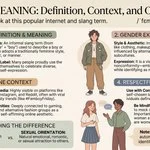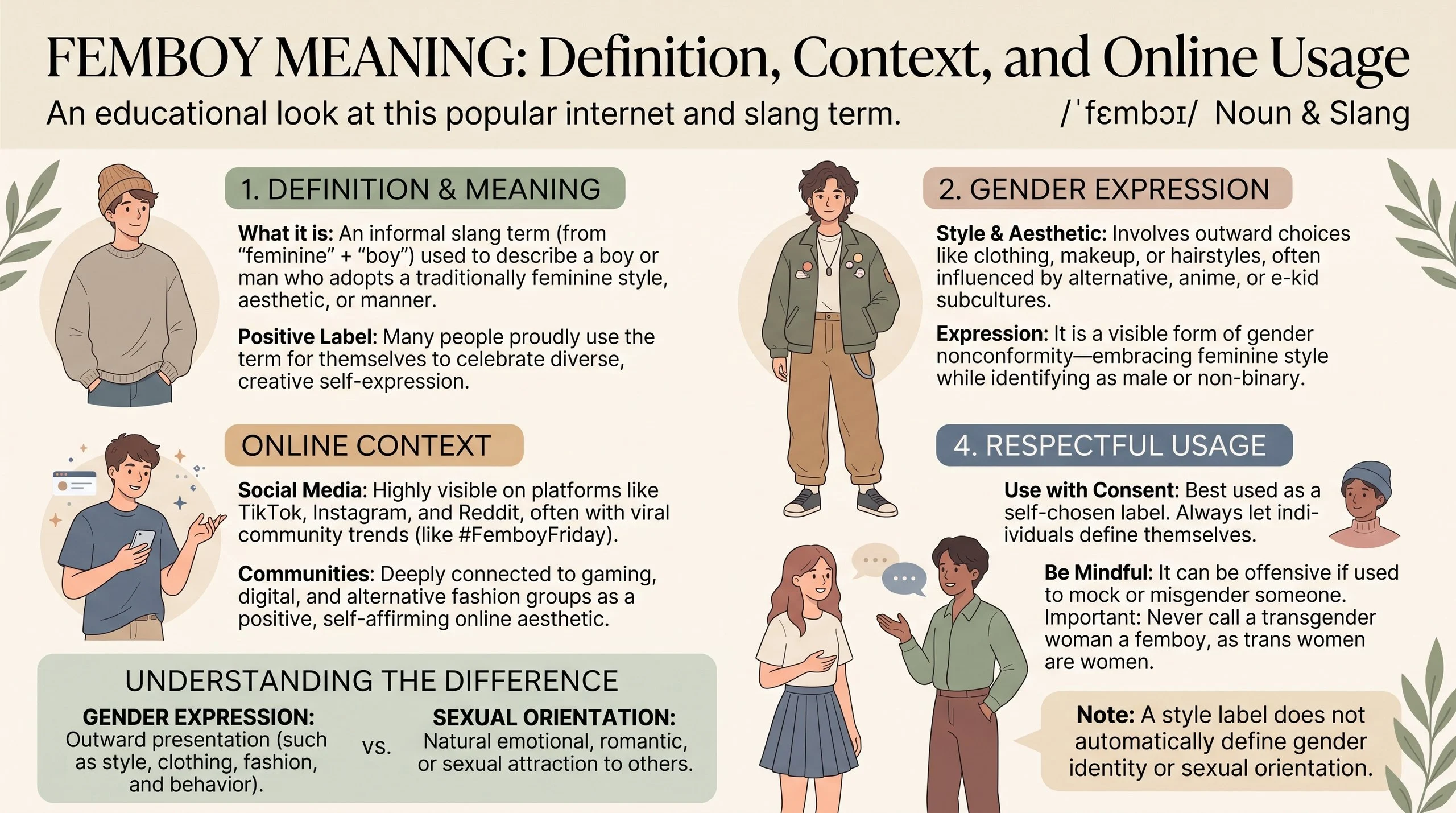
The term femboy generally describes a boy or man who presents himself with traditionally feminine clothing, appearance, mannerisms, or style. It describes gender expression, not necessarily sexual orientation or gender identity. Context and self identification matter when using the term.
INTRODUCTION
femboy meaning refers to a slang term commonly used for a boy or man who expresses femininity through clothing, appearance, mannerisms, interests, or personal style. The word appears frequently in online communities and social media. However, its meaning can change depending on who uses it, why they use it, and how the person being described identifies.
The term can function as a self description. It can also appear as a casual description of someone’s aesthetic. In other situations, it may sound disrespectful or unwanted. Therefore, understanding the social context matters as much as understanding the dictionary definition.
The word does not automatically indicate that someone is gay, bisexual, transgender, or nonbinary. Gender expression and sexual orientation are different concepts. GLAAD also emphasizes the importance of distinguishing gender expression, gender identity, sex assigned at birth, and sexual orientation.
QUICK ANSWER BOX
| Meaning | Context | Primary Platforms | Example | Tone |
| A boy or man with a feminine style or gender expression | Social, cultural, and internet slang | TikTok, Instagram, Snapchat, Reddit, texting | “He describes his style as femboy.” | Context dependent |
What Does femboy meaning Mean?
The simplest explanation is that the term describes a male person who presents in ways traditionally associated with femininity.
That presentation can involve many things. For example, someone might wear skirts, dresses, makeup, jewelry, painted nails, feminine hairstyles, or other clothing that a culture traditionally associates with women. However, clothing alone does not determine whether someone uses this label.
Some people use the word as part of their personal identity or online persona. Others use it more generally to describe an aesthetic. Therefore, you should not assume that every person with a feminine appearance identifies with the term.
Dictionary.com describes the word as slang associated with a young, usually cisgender male who displays traditionally feminine characteristics. It also notes that some people use the term positively as a form of gender expression, while the term can also be derogatory depending on context.
Where Did the Term Come From?
The word combines “fem,” a shortened form associated with feminine, and “boy.”
Dictionary.com traces the term to at least the 1990s. Its earlier usage could be derogatory toward men who did not conform to conventional masculine expectations. Later, internet communities also adopted the term as a positive self description.
This history explains why the word can carry different emotional meanings.
For one person, it may represent confidence and personal style. For another, it may recall teasing or insults. Consequently, context is essential.
Is It a Gender Identity?
Not necessarily.
A person can use the term to describe gender expression without identifying as transgender or nonbinary. Another person might combine the term with a broader gender identity. The label itself does not provide enough information to determine someone’s identity.
GLAAD explains that gender expression and gender identity are distinct concepts. It also recommends using the language people use for themselves rather than assigning labels based on appearance.
Therefore, a useful distinction is:
| Concept | What It Describes |
| Gender expression | How someone presents themselves through appearance, behavior, clothing, voice, or style |
| Gender identity | How someone internally understands their gender |
| Sexual orientation | Patterns of romantic or sexual attraction |
| Personal style | Clothing, grooming, aesthetics, and presentation choices |
These categories can overlap in someone’s life. However, they are not interchangeable.
Does the Term Mean Someone Is Gay?
No.
The word describes a style or form of gender expression. It does not automatically communicate sexual orientation.
A person who uses the label may be straight, gay, bisexual, queer, asexual, or may prefer not to use a sexual orientation label. Similarly, someone can have a feminine appearance without using the term at all.
This distinction is important because assumptions about sexuality can make a conversation uncomfortable. Instead, let people describe themselves in their own words.
Contextual Dynamics and Nuances of the Term
Language rarely has one fixed social meaning.
The same word can feel affirming in one conversation and insulting in another. The speaker, audience, relationship, platform, and surrounding language all influence interpretation.
Self Description
The safest positive context occurs when someone uses the term for themselves.
For example:
“I like the femboy aesthetic because it gives me more freedom with fashion.”
Here, the speaker clearly chooses the label.
In that situation, repeating the term respectfully is usually more natural because you are following the person’s own terminology.
Description of Another Person
Using the word for another person requires more care.
Suppose someone wears makeup and a skirt. You cannot automatically conclude that they identify as a femboy. You only know what they are wearing.
A better approach is to use neutral descriptive language when their preferred terminology is unknown.
For example:
“He has a feminine fashion style.”
That statement describes observable presentation without assigning an identity.
Positive Online Usage
Many online communities use the word positively.
It can describe fashion, photography, gaming avatars, cosplay, makeup, fashion inspiration, or personal aesthetics. In these contexts, the word may communicate confidence in feminine presentation.
However, individual preferences still vary.
Negative or Insulting Usage
The term has also appeared historically as a derogatory label. Dictionary.com notes that its earlier use could target men perceived as insufficiently masculine.
Consequently, tone matters.
A joking comment between friends may be interpreted differently from a stranger making the same comment. Public comments can also reach a much wider audience than intended.
Real Life Conversation Examples Using femboy meaning
Example 1: Asking About a Profile
Alex: “I saw the word femboy in your profile. What does it mean?”
Jordan: “It describes my fashion and the way I like to present myself.”
Alex: “Got it. Thanks for explaining.”
This conversation works because Alex asks rather than making assumptions.
Example 2: Discussing Fashion
Maya: “Your outfit looks really different today.”
Chris: “Yeah, I have been experimenting with a more feminine style.”
Maya: “That looks great. Is there a name for the style?”
Chris: “I usually call it a femboy style.”
Here, the person chooses the label for themselves.
Example 3: Clarifying a Social Media Comment
Sam: “Someone called me a femboy in the comments.”
Taylor: “Do you like that description?”
Sam: “Yeah, actually. It fits how I dress.”
Taylor: “Then I understand why you use it.”
The important feature is consent and self identification.
Example 4: Avoiding an Assumption
Alex: “Is that person a femboy?”
Morgan: “I do not know. They have a feminine style, but we should not assume their identity.”
Alex: “Fair point.”
This example demonstrates respectful uncertainty.
Example 5: Explaining the Word to a Friend
Jamie: “What does femboy mean? I keep seeing it online.”
Riley: “It usually refers to a boy or man who presents in a traditionally feminine way. It does not automatically tell you his sexuality or gender identity.”
Jamie: “That makes more sense now.”
This is a concise explanation for everyday conversation.
Platform Specific Breakdown
Different platforms create different environments for slang.
The basic definition remains similar. However, the surrounding culture can change how people interpret the term.
How It Is Used on Snapchat
Snapchat often emphasizes direct communication, stories, private messages, and short visual posts.
Because of that structure, the term may appear in captions, usernames, profile descriptions, jokes, or conversations about fashion.
For example:
“Trying a new femboy outfit today.”
In this context, the speaker may simply be discussing their own aesthetic.
A private message can create another dynamic. If someone tells you they identify with the term, a respectful response is usually simple.
“Thanks for explaining. I understand.”
Avoid turning the conversation into an interrogation. You do not need to ask personal questions simply because you learned a new label.
The Role of femboy meaning on TikTok
TikTok has helped spread many slang terms through short videos, hashtags, trends, fashion content, and creator communities.
The term can appear alongside videos about clothing, makeup, hairstyles, cosplay, gaming, fitness, or personal presentation. Consequently, seeing the word under a video does not automatically tell you the creator’s complete identity.
A hashtag also does not establish someone’s sexuality.
TikTok content can be highly contextual. A creator may use a word for humor, fashion, identity, community participation, or discoverability. Therefore, viewers should interpret the term based on the creator’s own explanation when available.
Instagram and Texting Dynamics
Instagram provides several places where the term can appear.
These include:
- Usernames
- Bios
- Captions
- Comments
- Stories
- Direct messages
- Fashion posts
Texting tends to be even more context dependent.
For example:
“I think that style is really cool.”
This statement focuses on fashion.
By contrast:
“Are you a femboy?”
asks about personal identity. Depending on the relationship, that question could feel intrusive.
A more considerate approach is:
“Is that a term you use for yourself?”
This gives the person control over the answer.
Alternative Meanings and NLP Variations of the Phrase
Search engines may connect this term with several related expressions.
Understanding those variations helps readers interpret search results without assuming they are exact synonyms.
| Related term | General relationship |
| Feminine | Describes qualities or presentation traditionally associated with women |
| Effeminate | Traditional descriptive term for feminine traits in a man or boy |
| Femme | A term associated with feminine presentation in several LGBTQ contexts |
| Gender expression | Broader concept describing outward presentation |
| Nonbinary | A gender identity category that does not fit exclusively within the man or woman binary |
| Masculine | Traditionally associated with qualities or presentation coded as male |
| Androgynous | A presentation combining or moving between traditionally masculine and feminine features |
Dictionary.com defines “femme” as a term that can describe feminine presentation in different LGBTQ contexts. It also defines “nonbinary” as relating to a gender identity outside the binary male and female division.
These terms should not be treated as interchangeable.
For example, someone can have an androgynous appearance without identifying as a femboy. Likewise, a nonbinary person may have a feminine presentation without using this slang term.
Femboy and Feminine
“Feminine” is a broad adjective.
It can describe clothing, behavior, appearance, voice, colors, design, or social expectations. The slang term is narrower because it commonly refers to a particular kind of male or masculine associated presentation.
Femboy and Effeminate
“Effeminate” is an older descriptive term.
Dictionary.com defines it as describing a man or boy with traits traditionally considered feminine.
However, the word can carry a negative or judgmental tone in many contexts. Therefore, it is not always an appropriate substitute.
Femboy and Nonbinary
These concepts address different dimensions.
A person can identify as a man while enjoying feminine presentation. Another person may identify as nonbinary. Someone else may identify differently altogether.
Appearance alone cannot establish the answer.
Misinterpretations: When NOT to Use femboy meaning
Understanding when not to use a slang label is just as important as understanding its definition.
Do Not Assume Sexual Orientation
A feminine presentation does not establish whether someone is gay, straight, bisexual, or another orientation.
Avoid statements such as:
“He dresses femininely, so he must be gay.”
That conclusion does not follow from appearance.
Do Not Assume Gender Identity
Likewise, feminine clothing does not automatically mean someone is transgender or nonbinary.
Gender identity belongs to the individual.
Do Not Use It as a Joke About Someone’s Appearance
Calling someone a label they have not chosen can embarrass them.
This is especially relevant in public comments, group chats, classrooms, and workplaces.
Do Not Treat It as a Universal Identity
Not every person who enjoys feminine clothing wants a specific label.
Some people simply like the clothing.
Others may prefer terms such as feminine, gender nonconforming, androgynous, or something else.
Do Not Confuse Style With Sexual Content
The word can appear in both nonsexual and sexualized online contexts. Dictionary.com documents both uses and notes that the term has developed through different internet communities.
Therefore, context matters.
A fashion post and an adult themed discussion may use the same word while communicating very different things.
How to Respond in Chat Comfortably
If someone uses the term about themselves, you can respond naturally.
You do not need a complicated explanation.
Friendly Responses
“Thanks for explaining.”
“That makes sense.”
“I like your style.”
“Cool. Thanks for sharing.”
If You Are Unsure What Someone Means
Ask a neutral question.
“What does that term mean to you?”
This is often better than assuming that everyone uses the word in exactly the same way.
If Someone Calls You the Term
You can decide whether you want to accept, reject, or clarify it.
For example:
“I do not really use that label for myself.”
Or:
“Yeah, I am comfortable with that term.”
Or:
“I prefer to describe my style as feminine.”
Each response communicates a personal boundary.
If Someone Uses It as an Insult
You do not have to argue about the dictionary definition.
A simple response can establish a boundary:
“Please do not use that label for me.”
If the conversation becomes hostile, ending the interaction may be more productive than continuing it.
In Professional Settings
Professional communication usually benefits from precise, neutral language.
If discussing someone’s clothing or presentation, describe the relevant feature instead of assigning an unsolicited identity label.
For example:
“The employee prefers a feminine fashion style.”
However, even this should only be mentioned when the subject is relevant to the professional discussion.
FAQs
What is the femboy meaning in simple English?
It generally describes a boy or man who presents himself in a traditionally feminine way. The presentation can involve clothing, makeup, grooming, mannerisms, or other forms of personal style.
Is a femboy always gay?
No. The term does not determine sexual orientation. A person who uses it may have any sexual orientation.
Can someone be a femboy and still identify as a man?
Yes. Feminine gender expression does not automatically change someone’s gender identity.
Is femboy a gender identity?
Not necessarily. Some people use it as a personal label for their gender expression, while others use it mainly to describe an aesthetic or style.
Is the term offensive?
It depends on context and personal preference. Some people use it positively for themselves, while others may experience it as unwanted or insulting. Dictionary.com specifically notes both positive and derogatory uses.
Is femboy the same as transgender?
No. The terms describe different concepts. A person’s gender expression does not by itself establish whether they are transgender.
Can a person use the term without dressing femininely all the time?
Yes. Personal labels do not require someone to maintain one appearance at every moment.
What should I say if someone tells me they identify this way?
A simple respectful response works well.
You could say:
“Thanks for telling me.”
You can also ask how they prefer to describe themselves if the conversation genuinely requires clarification.
Is the term appropriate at work?
Usually, identity labels should not be assigned to coworkers based on appearance. If someone voluntarily uses the term, you can follow their preferred language when relevant and appropriate.
What is the safest way to understand the term online?
Look at the surrounding context and the person’s own description. Do not infer sexuality or gender identity from clothing, hashtags, usernames, or photographs alone.
Conclusion
The modern use of this term reflects a broader change in how people discuss clothing, masculinity, femininity, and personal expression online.
Its history is important because the word has not always carried the same tone. Dictionary.com records earlier derogatory uses as well as later positive self identification within internet communities.
Today, context remains central.
A person may use the label proudly. Another person may dislike it. Someone else may prefer a completely different description. Therefore, the most accurate approach is to avoid assumptions and pay attention to how individuals describe themselves.
The key distinction is simple: gender expression does not automatically reveal gender identity or sexual orientation. Clothing, makeup, hairstyle, mannerisms, and aesthetics can communicate personal style, but they cannot provide a complete picture of a person.
When you encounter the term on TikTok, Instagram, Snapchat, Reddit, or in a text message, examine the surrounding context. Then, if the person’s own terminology is available, follow their lead.
That approach makes online communication clearer, more respectful, and more linguistically accurate.