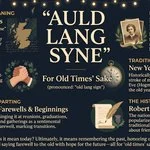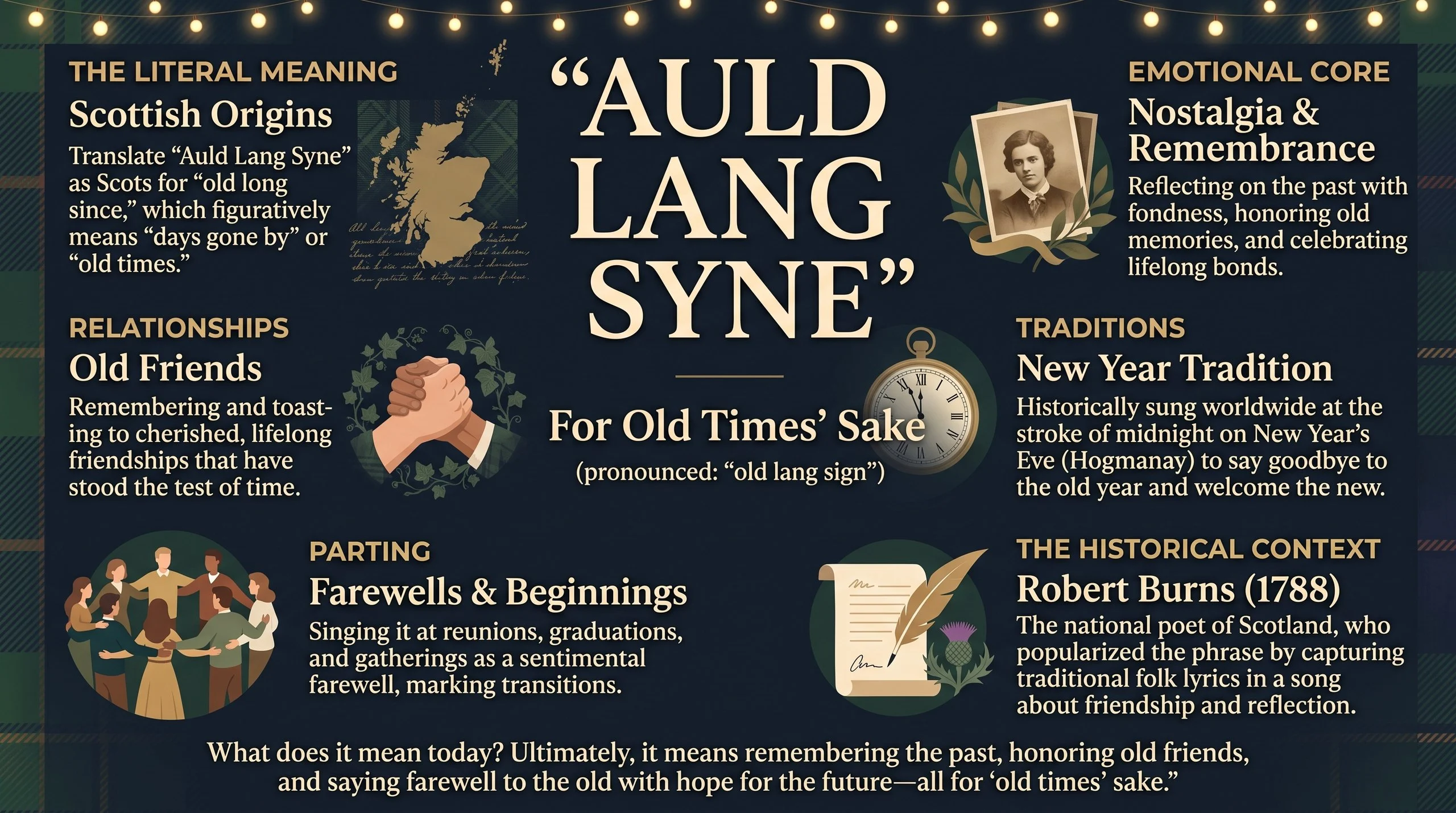
Auld lang syne means “old long since,” or more naturally, “for old times’ sake.” The phrase expresses remembrance, friendship, shared experiences, and affection for the past. It is strongly associated with New Year celebrations, farewells, reunions, and nostalgic moments.
Auld lang syne meaning centers on remembering the past with warmth, friendship, and affection. The phrase comes from Scots and roughly means “old long since” or “for old times’ sake.” Although many Americans mainly hear it during New Year celebrations, its emotional meaning reaches far beyond midnight on December 31.
The phrase became widely known through the traditional Scottish song associated with Robert Burns. Today, people recognize it as a symbol of memories, lasting friendships, reunions, endings, and new beginnings. The words may sound unfamiliar to modern English speakers, yet the idea behind them remains remarkably easy to understand.
For example, friends might sing the song at the end of a New Year’s celebration. Graduates may use it during a farewell gathering. A group of longtime friends might also refer to “auld lang syne” when remembering experiences they shared years ago.
Understanding the expression requires more than translating each individual word. Its meaning depends on history, culture, tone, and context. Therefore, this guide explains the phrase from its Scottish roots to its modern use in American English, social media, texting, and everyday conversation.
QUICK ANSWER BOX
| Meaning | Context | Primary Platforms | Example | Tone |
| For old times’ sake or in remembrance of the past | New Year, reunions, farewells, nostalgia | Conversations, Instagram, TikTok, Snapchat, texting | “We met again for auld lang syne.” | Warm, nostalgic, sentimental |
What Does auld lang syne Meaning Mean?
The phrase auld lang syne meaning is easiest to understand as “for old times’ sake.” It can also communicate the idea of remembering old friendships, shared experiences, or earlier periods of life.
The individual Scots words provide useful clues.
| Scots word | Approximate modern English | Meaning |
| Auld | Old | Something from the past |
| Lang | Long | Extended in time |
| Syne | Since or ago | Refers to an earlier time |
Taken literally, “auld lang syne” resembles “old long since.” That literal translation sounds unusual in modern English. However, the established meaning is much more natural: old times, memories of the past, or for old times’ sake.
Where did the expression come from?
The expression has deep roots in Scottish language and tradition. Robert Burns famously wrote down and published a version of the song in the eighteenth century. His work helped preserve and popularize the words.
The song asks whether old acquaintances and old memories should be forgotten. Its central message is that meaningful friendships and shared experiences deserve remembrance.
That idea explains why the song became connected with moments of transition.
New Year’s Eve is one such moment. People leave one year behind while entering another. Singing about old friendships creates a natural bridge between the past and the future.
Is it an English phrase?
It appears in English language contexts, but its wording comes from Scots. Scots developed alongside English in Scotland and has its own vocabulary and linguistic traditions.
Therefore, Americans may recognize the expression without immediately understanding every word.
The phrase has become culturally familiar in the United States. Still, speakers generally use it as a fixed expression rather than ordinary Scots vocabulary.
Why does the phrase sound unusual?
Modern American English rarely uses words such as “auld” and “syne.” Consequently, someone hearing the phrase for the first time may assume it is another language.
Pronunciation also varies.
A common approximation is:
“Auld lang syne” → “old lang sign”
The exact Scottish pronunciation can differ from this simplified American approximation. The important point is that the phrase is normally recognized through the song and cultural tradition rather than through literal everyday speech.
Contextual Dynamics and Nuances of the Term
The phrase carries several connected meanings. Context determines which meaning feels strongest.
1. Remembering the past
The most basic idea involves memories.
Someone may use the expression when discussing childhood friends, former classmates, an old workplace, or memorable experiences.
For example:
“We got together for a little auld lang syne.”
Here, the speaker suggests that the gathering celebrates shared history.
2. Honoring friendship
The expression often carries an emotional connection to friendship.
The song itself focuses on relationships and memories. As a result, the phrase can suggest affection for people who have been part of someone’s life.
3. Celebrating New Year
In American culture, the phrase has a particularly strong connection with New Year’s Eve.
At midnight, people may sing the traditional song while holding hands or raising glasses. The ritual symbolizes the closing of one period and the beginning of another.
4. Saying goodbye
The expression can also appear during farewells.
For example, a group leaving a workplace might gather for one final celebration. Someone could describe the occasion as an opportunity for “auld lang syne.”
The phrase adds nostalgia rather than simple sadness.
5. Looking back before moving forward
The expression does not necessarily mean that someone wants to return to the past.
Instead, it can acknowledge the value of previous experiences while accepting change.
This distinction matters. Nostalgia remembers what mattered. It does not always demand that the past return.
Emotional tone
The expression usually sounds:
- Nostalgic
- Warm
- Sentimental
- Reflective
- Traditional
- Occasionally bittersweet
It generally does not sound casual or modern in the way common texting expressions do.
For example, saying “I remember those days” sounds ordinary. Saying “auld lang syne” sounds literary, traditional, or intentionally nostalgic.
Real Life Conversation Examples Using auld lang syne Meaning
The expression works differently depending on the situation. These examples show how Americans might encounter or use it naturally.
Conversation 1: New Year’s Eve
Maya: What song are they playing?
Daniel: “Auld Lang Syne.”
Maya: Oh, right. The New Year song.
Daniel: Exactly. It is about remembering old times and friendships.
Maya: That makes sense for New Year’s.
This conversation uses the expression in its most recognizable cultural setting.
Conversation 2: Old classmates
Jordan: I saw our high school group photo today.
Alex: Wow, that brings back memories.
Jordan: I know. We should all meet again sometime.
Alex: Definitely. A little auld lang syne would be nice.
Here, the expression means reconnecting because of shared history.
Conversation 3: Former coworkers
Maria: Are you going to the office reunion?
Chris: Yes. I have not seen some of those people in ten years.
Maria: It should be fun.
Chris: I think so. It will be a bit of auld lang syne.
The phrase creates a nostalgic atmosphere without suggesting anything negative.
Conversation 4: A farewell gathering
Sam: Why did everyone bring old photos?
Taylor: We wanted to remember our first years here.
Sam: That is sweet.
Taylor: We thought it would make the farewell feel more meaningful.
This situation captures the emotional idea behind the expression without requiring the phrase itself.
Conversation 5: Texting after a reunion
Emma: Last night was amazing.
Noah: It really was.
Emma: I cannot believe we all ended up together again.
Noah: Same. Definitely an auld lang syne kind of night.
This is a more playful modern use. The speaker uses the traditional phrase to describe a nostalgic reunion.
Platform Specific Breakdown
Modern audiences may encounter the expression online even though it originated long before social media.
The key difference is that platforms change how people present nostalgia.
How It Is Used on Snapchat
Snapchat content often disappears quickly. That temporary format can make memories feel especially important.
Someone might post an old photograph with a caption such as:
“A little auld lang syne tonight.”
Another user might share a story featuring former classmates, childhood photographs, or a reunion.
The phrase works particularly well when the image already communicates nostalgia. It does not need a long explanation.
However, it remains less common than simpler captions such as:
- “Old times”
- “Good memories”
- “Back in the day”
- “Miss these days”
- “Old friends”
Therefore, using the traditional expression can give a post a more literary or sentimental quality.
The Role of auld lang syne Meaning on TikTok
TikTok frequently turns older cultural references into new forms of entertainment.
Creators may use the song in videos about:
- Childhood memories
- School reunions
- Friendship groups
- Family gatherings
- End of year reflections
- Before and after transformations
- Nostalgic photographs
A creator could also explain the phrase itself.
For example:
“You have heard this song every New Year, but do you know what ‘auld lang syne’ actually means?”
That format works because it combines cultural knowledge with a familiar tradition.
Still, the expression should not automatically be treated as internet slang. It is better understood as an old Scottish expression that continues to appear in modern digital culture.
Instagram and Texting Dynamics
Instagram provides a natural setting for nostalgic captions.
A user might post photographs from a reunion and write:
“Old friends, old stories, a little auld lang syne.”
The wording feels polished and sentimental.
Texting is different. Friends normally prefer shorter, more familiar language.
For example:
“Tonight was pure auld lang syne.”
This can work between people who understand the reference.
However, sending the phrase to someone unfamiliar with it could create confusion. A simpler expression may communicate the same idea more directly.
Alternative Meanings and NLP Variations of the Phrase
Search engines and language models may associate the phrase with several closely related concepts.
| Related expression | Relationship to the phrase |
| For old times’ sake | Closest everyday equivalent |
| Old times | Direct conceptual connection |
| Fond memories | Emotional connection |
| Nostalgia | Broader emotional concept |
| Old friends | Common subject of the song |
| Remembering the past | Broad semantic meaning |
| Good old days | Informal related expression |
| Reunion | Common real world context |
| Farewell | Another transitional context |
| New Year | Most famous modern association |
“For old times’ sake”
This is the closest everyday American English equivalent.
For example:
“Let’s have dinner together for old times’ sake.”
The sentence communicates nostalgia without using a traditional expression.
“The good old days”
This phrase is more conversational.
For example:
“We spent the evening talking about the good old days.”
It often sounds more casual than “auld lang syne.”
“Nostalgia”
“Nostalgia” describes a broader emotional response to the past.
Someone can feel nostalgia while looking at childhood photographs, listening to an old song, or visiting a former home.
Therefore, nostalgia and the phrase are related but not identical.
“Old friends”
This expression focuses on people rather than time.
For example:
“It was wonderful to see my old friends again.”
The phrase can include old friendships, but its meaning reaches beyond friendship alone.
Misinterpretations: When NOT to Use auld lang syne Meaning
Knowing when not to use a phrase is just as important as knowing its definition.
Do not use it for ordinary gratitude
If someone helps you with a task, saying “auld lang syne” would sound strange.
Use:
“Thank you for helping me.”
The traditional expression concerns shared history rather than ordinary appreciation.
Do not use it as a general synonym for “old”
The phrase does not simply mean “old.”
For example, you would not say:
“I bought an auld lang syne car.”
That does not work in modern English.
The phrase functions as a fixed expression connected with memories, relationships, and the past.
Do not assume everyone understands it
Some Americans know the phrase only because they have heard the New Year song.
Others may recognize the melody without knowing the meaning.
Therefore, explain it when the audience may not know the expression.
Do not treat it as modern slang
Calling it internet slang can create an inaccurate impression.
It is a traditional Scottish expression with a long cultural history. Social media can give it modern visibility, but social media did not create it.
Do not force it into casual conversation
Native speakers normally use simpler expressions for everyday situations.
For example, these sound more natural:
“That brings back memories.”
“It was good to see everyone again.”
“We were remembering the old days.”
The traditional phrase works best when the context already feels nostalgic or ceremonial.
How to Respond in Chat Comfortably
When someone uses the expression in a message, your response depends on context.
If someone uses it after a reunion
You could reply:
“Absolutely. It was great seeing everyone again.”
Or:
“Yes, such a nostalgic night.”
If someone sends it on New Year’s Eve
A natural response might be:
“Happy New Year! Here’s to the memories and the year ahead.”
This acknowledges both sides of the tradition.
If you do not understand the phrase
There is nothing wrong with asking.
Try:
“I know the song, but what does the phrase actually mean?”
That question sounds natural and invites an explanation.
If you want a simpler alternative
Use:
- “For old times’ sake”
- “For the memories”
- “Those were good times”
- “That brings back memories”
- “Remember the old days?”
These alternatives usually fit everyday American conversation more naturally.
If you want a poetic tone
The traditional phrase can work well in writing.
For example:
“We gathered once more for old friendships and auld lang syne.”
This sounds deliberately literary. The unusual wording becomes part of the style.
FAQs
What is the auld lang syne meaning?
It means “for old times’ sake” or refers to remembering the past, especially old friendships and shared experiences. The phrase comes from Scots and is strongly associated with the traditional New Year song.
Why do Americans sing Auld Lang Syne on New Year’s Eve?
The song became associated with the transition from one year to another. Its focus on remembering friends and shared experiences makes it suitable for a moment when people say goodbye to the old year.
Is Auld Lang Syne English or Scottish?
The wording comes from Scots, a language variety historically spoken in Scotland. The phrase later became widely familiar in English speaking cultures through the song and New Year tradition.
What does “syne” mean?
In this expression, “syne” refers to an earlier time. It can be understood approximately as “since,” “ago,” or “from the past,” depending on the translation and linguistic context.
What does “auld” mean?
“Auld” is a Scots form corresponding to the English word “old.”
What does “lang” mean?
“Lang” is a Scots form corresponding to “long.” Together with the other words, it contributes to the idea of a long time ago or the old days.
Can I use the phrase in everyday conversation?
Yes, but it sounds traditional, literary, or nostalgic. In ordinary American conversation, phrases such as “for old times’ sake” or “that brings back memories” are usually more direct.
Is Auld Lang Syne only about New Year’s Eve?
No. New Year’s Eve is its most famous modern context, but the underlying idea concerns remembering old relationships, experiences, and friendships. It can also suit reunions and farewells.
Is it appropriate for a farewell?
Yes. A farewell can involve shared memories and relationships, which fit the emotional meaning of the expression. However, a simpler phrase may sound more natural in casual speech.
Why does Auld Lang Syne sound unfamiliar?
The phrase contains Scots vocabulary that rarely appears in modern American English. Many people know the melody before they understand the words, so the expression can initially seem mysterious.
Conclusion
The phrase has survived because its central idea remains universal. People remember friends.
- They revisit meaningful places.
- They celebrate shared experiences.
- They say goodbye to one chapter before beginning another.
The auld lang syne meaning is therefore much richer than a simple word for “old.” It captures the idea of remembering the past with affection and recognizing the value of relationships and experiences that shaped us.
Its connection with New Year’s Eve makes it especially recognizable in the United States. Yet the expression can also appear in reunions, farewell events, nostalgic social media posts, and reflective writing.
Modern digital platforms have not changed its basic meaning. Instead, they have created new spaces where people can reuse an old expression.
On Snapchat, it can accompany temporary memories. Creators can explain its history or use its familiar song in nostalgic videos on TikTok. On Instagram, it can add a literary touch to reunion photographs. In texting, it can work when both people understand its traditional reference.
For everyday American English, however, simpler alternatives often sound more natural. “For old times’ sake,” “that brings back memories,” and “the good old days” communicate similar ideas with less cultural knowledge required.
Ultimately, the phrase represents a simple human experience: remembering where we have been while moving toward what comes next. That is why an expression with Scottish roots continues to have a recognizable place in modern American culture.