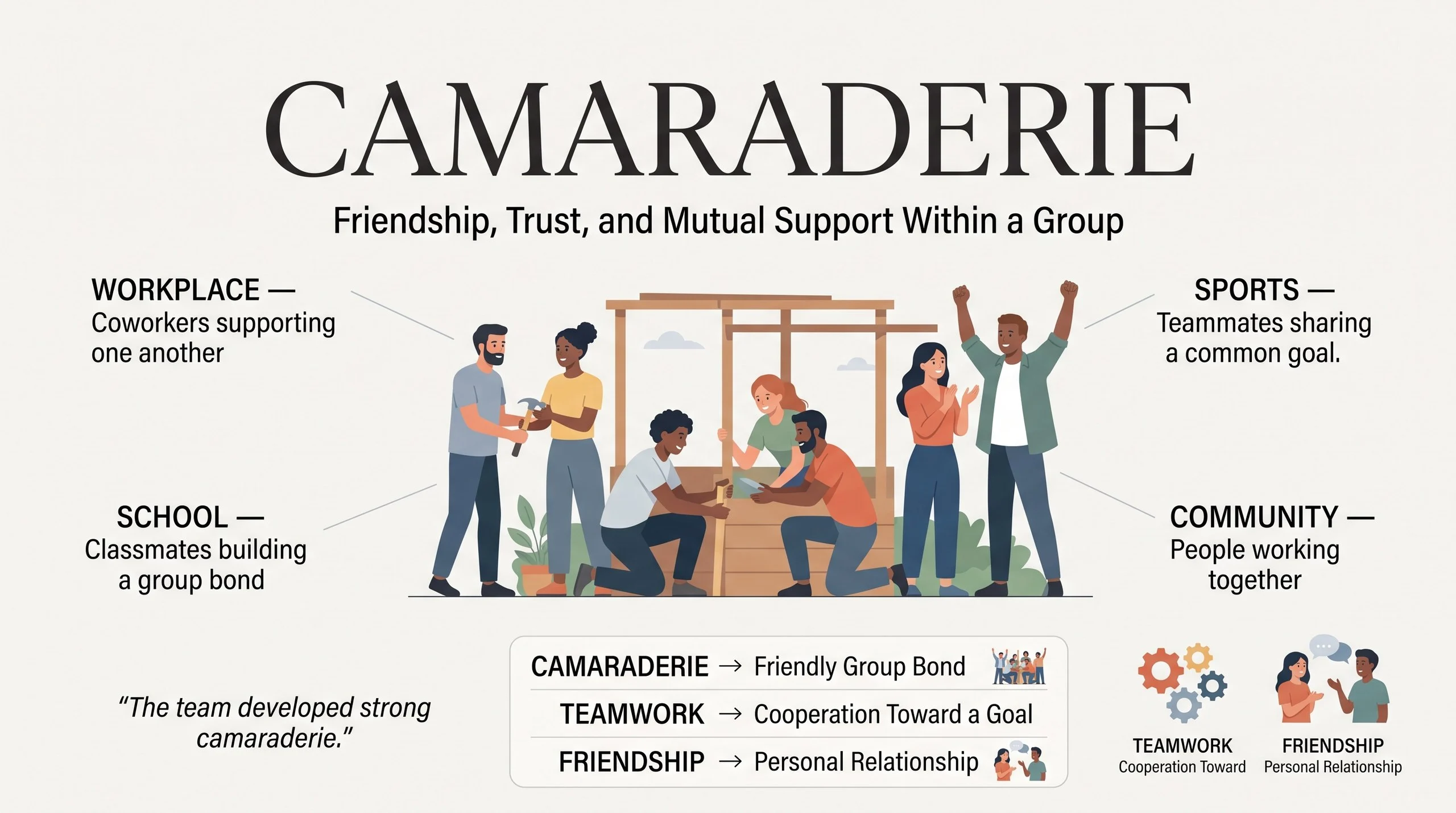
Camaraderie means a feeling of friendship, trust, and mutual support among people who spend time together or share an experience. It describes a warm sense of connection that often develops among teammates, coworkers, classmates, friends, or groups facing challenges together.
Camaraderie meaning refers to a strong feeling of friendship, trust, and mutual support within a group. The word often describes the positive connection that develops when people work, live, study, compete, or experience something together.
For example, coworkers may develop camaraderie after working on a difficult project. Likewise, teammates can build camaraderie by practicing together, supporting one another, and celebrating shared victories.
Unlike simple acquaintance, camaraderie suggests a deeper sense of belonging. However, it does not necessarily mean that everyone in the group is a close personal friend. Instead, people share a sense of trust, cooperation, and mutual respect.
The word is common in workplaces, sports, schools, military settings, social groups, and communities. It can also describe the bond that forms among strangers after they face the same unusual situation.
Therefore, understanding the context helps clarify the exact feeling. Camaraderie can develop through teamwork, shared challenges, humor, common goals, or repeated experiences.
Quick Answer Box
| Meaning | Context | Primary Use | Example | Tone |
|---|---|---|---|---|
| Friendship, trust, and mutual support within a group | Work, sports, school, teams, communities | Describing group bonds | “The team developed strong camaraderie.” | Positive/Warm |
What Does Camaraderie Mean?
Camaraderie means a friendly and supportive relationship among people who share an experience, activity, workplace, team, or goal.
In simple terms, it is the feeling of being connected to others in a group.
For example:
“The players developed strong camaraderie during the season.”
This sentence means the players developed a close, supportive relationship through their shared experience.
Camaraderie often develops naturally. People may spend time together, overcome difficulties, help each other, and gradually build trust.
Simple Definition
Camaraderie = friendship, trust, and mutual support among people in a group.
The word can describe:
- Team spirit
- Group friendship
- Mutual support
- Fellowship
- Companionship
- Shared connection
- A sense of belonging
Still, camaraderie has a slightly different emphasis from ordinary friendship. Friendship can exist between two people who spend time together socially. Camaraderie usually emphasizes the bond within a group or shared experience.
Camaraderie Meaning in Different Contexts
The word can appear in many situations. Although the central idea stays the same, the source of the connection may change.
1. Camaraderie Meaning at Work
Workplace camaraderie describes the friendly relationship and mutual support among coworkers.
For example:
“The team has developed a strong sense of camaraderie.”
This suggests that employees trust one another, communicate well, and enjoy working together.
Workplace camaraderie can develop through:
- Shared projects
- Team activities
- Informal conversations
- Helping coworkers
- Solving problems together
- Celebrating achievements
However, camaraderie does not mean everyone has to socialize outside work. People can maintain professional boundaries while still having a strong sense of teamwork and mutual respect.
2. Camaraderie Meaning in Sports
Sports provide one of the clearest examples of camaraderie.
Athletes often train together, compete together, experience setbacks, and celebrate achievements as a team. These shared experiences can create a strong bond.
For example:
“The players showed incredible camaraderie during the tournament.”
The sentence highlights their unity and support rather than simply their technical performance.
Team sports can especially encourage camaraderie because members often depend on one another to achieve a shared goal.
3. Camaraderie Meaning in School
Students can develop camaraderie through shared classes, activities, competitions, clubs, or challenging academic experiences.
For example:
“The students developed camaraderie while preparing for the competition.”
They may have become closer because they practiced together and worked toward the same goal.
The word can apply to classmates, study groups, sports teams, and student organizations.
4. Camaraderie Meaning in the Military
Military writing frequently uses camaraderie to describe the strong bond that can develop among people who undergo demanding experiences together.
Shared training, difficult conditions, teamwork, and mutual reliance can create a strong sense of connection.
For example:
“The soldiers developed camaraderie during training.”
The word emphasizes mutual trust and shared experience.
5. Camaraderie Meaning in Friend Groups
Camaraderie can also exist among friends.
For example:
“There was a great sense of camaraderie among the old friends.”
Here, the word emphasizes the group’s shared connection.
The difference is subtle. If you simply want to say that two people are friends, friendship may be more direct. If you want to emphasize the warm bond within a group, camaraderie is more precise.
6. Camaraderie in Communities
Communities can develop camaraderie when people work together toward a shared goal.
For example:
“The neighborhood developed a sense of camaraderie after organizing the event.”
The residents may not have been close friends beforehand. Working together created a stronger sense of connection.
Contextual Dynamics & Nuances of Camaraderie
The most important idea behind camaraderie is shared connection.
People often develop camaraderie when they:
- Spend significant time together.
- Work toward a common goal.
- Experience challenges together.
- Support one another.
- Share humor or memorable experiences.
- Depend on each other.
- Feel that they belong to the same group.
The word therefore suggests more than simple cooperation.
For example:
“The employees worked together to finish the project.”
This sentence describes cooperation.
By comparison:
“The employees developed camaraderie while finishing the project.”
This sentence suggests that the shared experience also created a friendly bond.
Camaraderie and Shared Experiences
Shared experiences often create camaraderie because they give people something meaningful in common.
A difficult assignment, long journey, sports season, performance, training program, or community project can bring people closer.
Even a humorous experience can create a sense of group connection.
Camaraderie and Trust
Trust is another important part of camaraderie.
People usually feel more connected when they know they can rely on one another. Therefore, a group with strong camaraderie often demonstrates cooperation and mutual support.
However, trust does not mean every member must agree on everything.
A group can have different personalities, opinions, and responsibilities while still maintaining camaraderie.
Real-Life Conversation Examples Using Camaraderie
Example 1: Workplace
Emma: “Everyone seems to enjoy working on this team.”
Daniel: “Yeah, there’s a real sense of camaraderie here.”
The speaker means that the coworkers have developed a friendly, supportive relationship.
Example 2: Sports
Coach: “What makes this team different?”
Player: “We trust each other. There’s a lot of camaraderie.”
Here, the player describes the team’s unity and mutual support.
Example 3: College
Student: “Did you enjoy the group project?”
Friend: “Actually, yes. We developed a lot of camaraderie while working on it.”
The shared project helped the students form a stronger connection.
Example 4: Community Event
Neighbor: “Everyone worked so hard to organize the festival.”
Resident: “It really brought the neighborhood together.”
This situation demonstrates camaraderie even if the word itself is not used.
Example 5: Difficult Experience
Alex: “You barely knew those people before the trip.”
Jordan: “True, but we went through a lot together. That created a real sense of camaraderie.”
The shared experience created a bond among the participants.
Platform-Specific Breakdown
Camaraderie is not internet slang. It is a standard English noun used in conversations about relationships, teams, communities, work, and shared experiences.
Still, the word can appear on social media when people discuss group experiences.
How It Is Used on Snapchat
On Snapchat, casual users may use simpler expressions such as:
- “We really bonded.”
- “We became close.”
- “Our group is tight.”
- “We had such a great time together.”
However, camaraderie can appear in captions or posts about teams and group activities.
For example:
“Nothing beats the camaraderie of a road trip with friends.”
The word highlights the shared bond created by the experience.
The Role of Camaraderie on TikTok
TikTok creators may use camaraderie in videos about sports, school, work, travel, military experiences, or group challenges.
For example:
“The camaraderie among the cast made the production special.”
This means the members developed a friendly and supportive relationship.
It is not a platform-specific slang term. Its standard meaning remains the same.
Instagram and Texting Dynamics
Instagram captions may use camaraderie when describing a team, event, group trip, or community.
For example:
“Grateful for the camaraderie we built this season.”
In casual texting, someone may instead say:
“We really bonded this season.”
Both express a similar idea, but camaraderie sounds more polished and formal.
Alternative Meanings & NLP Variations of Camaraderie
The word has one central meaning, but several related expressions can help explain it.
Sense of Camaraderie
A sense of camaraderie means a feeling of friendship, unity, and mutual support among members of a group.
Example:
“The volunteers developed a strong sense of camaraderie.”
This is one of the most common expressions using the word.
Team Camaraderie
Team camaraderie refers to the friendly connection and mutual support among team members.
Example:
“Team camaraderie improved after the players began practicing together.”
Workplace Camaraderie
Workplace camaraderie describes positive relationships among coworkers.
Example:
“Regular team activities helped build workplace camaraderie.”
Strong Camaraderie
The phrase strong camaraderie emphasizes a particularly close group bond.
Example:
“The group showed strong camaraderie throughout the competition.”
Build Camaraderie
Build camaraderie means to develop stronger connections among members of a group.
Example:
“The company organized activities to build camaraderie among employees.”
Foster Camaraderie
Foster camaraderie means to encourage the development of friendship and mutual support.
Example:
“Shared projects can foster camaraderie.”
Camaraderie vs. Friendship
These words overlap, but their emphasis differs.
| Word | Meaning | Typical Focus |
|---|---|---|
| Camaraderie | Friendship and mutual support within a group | Shared experience or group bond |
| Friendship | A close personal relationship | Connection between people |
For example:
“Their friendship lasted for decades.”
This focuses on a personal relationship.
Meanwhile:
“The team developed strong camaraderie.”
This focuses on the connection among members of a group.
Therefore, camaraderie is especially useful when the relationship grows from belonging to or participating in something together.
Camaraderie vs. Teamwork
Teamwork and camaraderie often appear together, but they are not synonyms.
Teamwork means working effectively with others toward a shared objective.
Camaraderie means having a friendly, supportive bond with those people.
Consider:
“The team demonstrated excellent teamwork.”
This focuses on performance and cooperation.
“The team developed strong camaraderie.”
This focuses on relationships and group connection.
A team can have good teamwork without close friendships. Likewise, friends can have camaraderie without working toward a formal goal.
Camaraderie vs. Fellowship
Fellowship is another close synonym.
Both words can describe friendship, companionship, and a sense of belonging.
However, fellowship can have broader social, community, or religious associations. It may also describe the condition of being together with others.
Camaraderie more strongly emphasizes the friendly bond that develops among people who share experiences.
Camaraderie vs. Comradery
These two words are closely related and are sometimes confused.
Camaraderie is the standard spelling most commonly used in modern English.
Comradery is also found in English and is generally treated as a variant spelling, although usage and dictionary treatment can vary.
If you are writing for a professional, academic, or general US English audience, camaraderie is the safest and most widely recognized form.
Synonyms for Camaraderie
The best synonym depends on the situation.
Common Synonyms
- Fellowship
- Companionship
- Friendship
- Bond
- Unity
- Solidarity
- Togetherness
- Team spirit
- Mutual support
- Connection
In a Workplace
Useful alternatives include:
- Team spirit
- Team unity
- Collaboration
- Workplace connection
- Mutual support
- Team bonding
In Sports
Useful alternatives include:
- Team spirit
- Unity
- Fellowship
- Team bond
- Solidarity
- Togetherness
However, these words do not always carry exactly the same meaning. Collaboration, for example, focuses on working together rather than friendship.
How to Use Camaraderie in a Sentence
Here are several natural sentence patterns.
- With “a sense of”
“The players developed a strong sense of camaraderie.”
- With “build”
“The activities helped build camaraderie among the employees.”
- With “develop”
“The classmates developed camaraderie during the semester.”
- With “foster”
“Shared challenges can foster camaraderie.”
- With “show”
“The volunteers showed remarkable camaraderie.”
- With “strong”
“The group had a strong sense of camaraderie.”
These structures work well in professional writing, essays, articles, and everyday descriptions.
Misinterpretations: When NOT to Use Camaraderie
Although camaraderie is a useful word, it does not fit every situation involving people.
1. Do Not Use It for Simple Cooperation
If people simply complete a task together, cooperation or teamwork may be more accurate.
Camaraderie implies some degree of social or emotional connection.
2. Do Not Use It for Every Friendship
A friendship between two people can be described as camaraderie, but friendship is usually more direct.
The word is especially useful when the connection exists within a group.
3. Do Not Assume Camaraderie Means Complete Agreement
People can disagree about ideas while still having camaraderie.
The word describes their relationship, not necessarily their opinions.
4. Do Not Use It as a Synonym for Popularity
A person being popular does not automatically create camaraderie.
Camaraderie involves mutual connection and support.
5. Do Not Confuse It With Competition
Competition can sometimes reduce group harmony. However, teammates can compete intensely while still developing camaraderie.
The context determines the relationship.
How to Respond in Chat Comfortably
If someone says:
“Our team has amazing camaraderie.”
they mean that the team members have a strong, friendly, supportive relationship.
A natural response might be:
“That makes a huge difference when you’re working toward the same goal.”
If someone asks:
“What does camaraderie mean?”
a simple answer is:
“It means a strong feeling of friendship and mutual support within a group.”
For casual conversation, you can also explain it as:
“Basically, it means people in a group really bond and support each other.”
Why Is Camaraderie Important?
Camaraderie can make group experiences more positive.
When people trust and support one another, they may communicate more comfortably and feel a stronger sense of belonging.
For example, workplace camaraderie can help create a pleasant team environment. In sports, it can strengthen team identity. At school, it can help students feel connected to their classmates.
However, camaraderie alone does not guarantee good performance or eliminate conflict. A healthy group can still have disagreements and different personalities.
The main idea is the presence of a positive social bond.
How Is Camaraderie Built?
Camaraderie often develops naturally, but shared activities can encourage it.
Some common factors include:
- Working toward common goals
- Helping each other
- Sharing challenges
- Celebrating achievements
- Communicating openly
- Spending time together
- Showing appreciation
- Solving problems collectively
For instance, coworkers may become closer after completing a demanding project together.
Similarly, teammates may develop stronger bonds after a difficult season.
The important factor is not simply spending time together. Meaningful interaction and mutual support usually make the connection stronger.
FAQs
1. What does camaraderie mean?
Camaraderie means a feeling of friendship, trust, unity, and mutual support among people who share a group, activity, experience, or goal.
2. Is camaraderie the same as friendship?
Not exactly. Friendship usually describes a personal relationship, while camaraderie often describes a positive bond among people in a group or shared experience.
3. What is an example of camaraderie?
A sports team supporting one another during a difficult season is an example of camaraderie. Coworkers who help each other through a demanding project can also demonstrate it.
4. Is camaraderie a positive word?
Yes. Camaraderie generally has a positive meaning because it describes friendship, unity, trust, and mutual support.
5. Can camaraderie be used at work?
Yes. Workplace camaraderie describes friendly and supportive relationships among coworkers.
6. What is the difference between camaraderie and teamwork?
Teamwork focuses on cooperation toward a common goal. Camaraderie focuses on the friendly relationship and mutual support among the people involved.
7. What is a synonym for camaraderie?
Common synonyms include fellowship, companionship, friendship, unity, solidarity, togetherness, team spirit, and mutual support.
8. What is the difference between camaraderie and comradery?
Camaraderie is the standard spelling most commonly used in English. Comradery is also used as a variant spelling.
9. How do you use camaraderie in a sentence?
You can say, “The team developed a strong sense of camaraderie.” This means the team members developed a close and supportive relationship.
10. Can strangers develop camaraderie?
Yes. People can develop camaraderie through shared challenges or experiences even if they did not know each other beforehand.
Conclusion
The camaraderie meaning centers on friendship, trust, unity, and mutual support among people who share an experience, group, activity, or goal. It describes the positive connection that develops when people spend time together and support one another.
The word is especially useful in discussions about teams, workplaces, schools, sports, communities, and shared challenges. For example, teammates can develop camaraderie during a season, while coworkers can build it through successful collaboration and shared experiences.
Although camaraderie, friendship, and teamwork are related, they are not identical. Friendship focuses on personal relationships, while teamwork focuses on cooperation. Camaraderie combines a sense of group connection with friendship and mutual support.
Therefore, use camaraderie when you want to describe more than people simply working or spending time together. The word highlights the warm social bond that can make a group feel connected, supportive, and united.