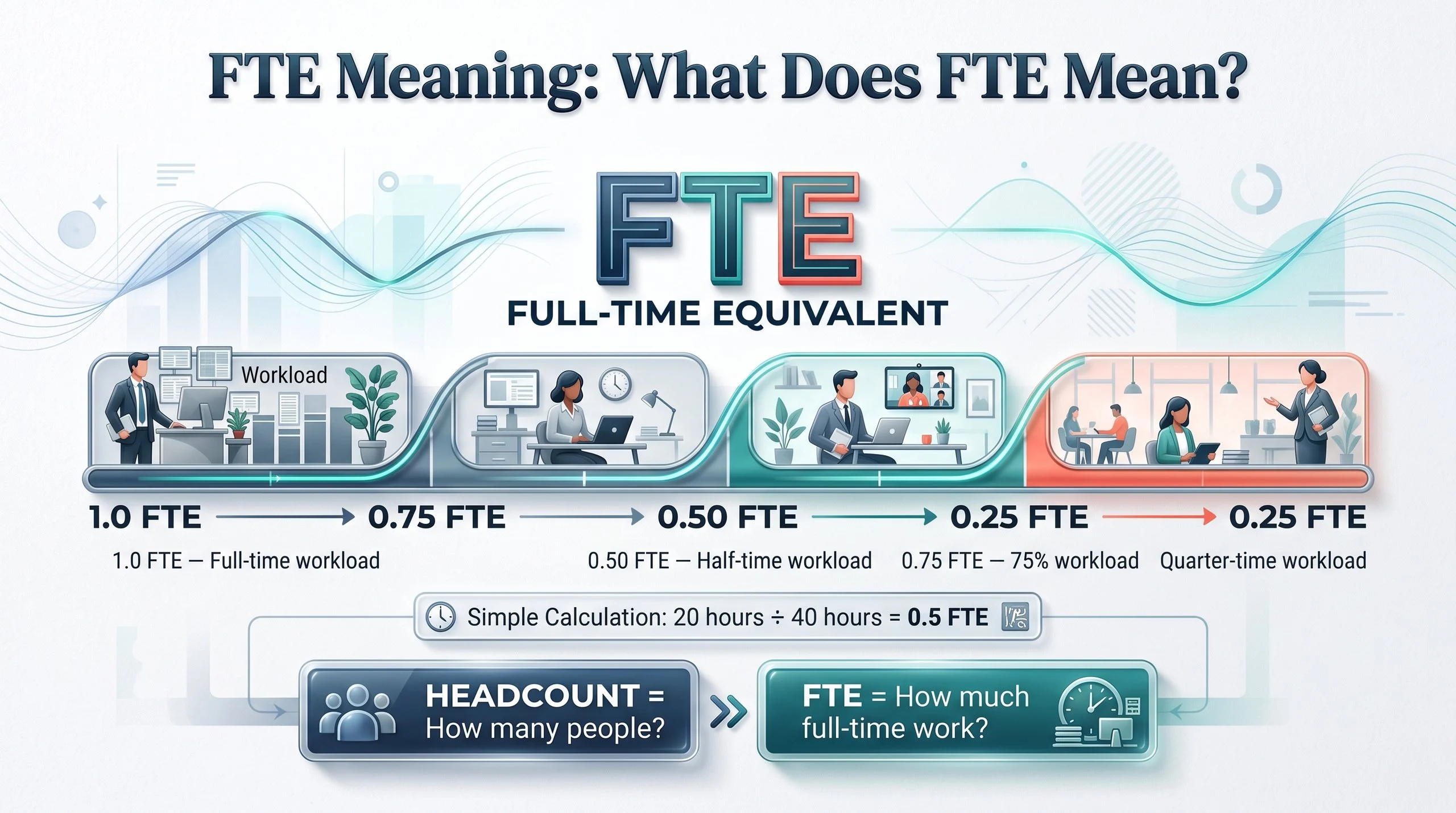
FTE meaning usually refers to Full-Time Equivalent, a standard way to measure an employee’s workload compared with a full-time position. One FTE generally represents one full-time worker or the equivalent workload of multiple part-time workers. For example, two employees working half-time can equal one FTE.
FTE meaning can vary slightly depending on context, but in business, employment, and human resources, it almost always means Full-Time Equivalent. Companies use FTE to measure workforce capacity, compare employee workloads, plan staffing, and understand labor costs.
Unlike a simple employee headcount, FTE measures the amount of full-time work being performed. For example, a company could have four employees but only 3 FTEs if some employees work part-time.
The term appears frequently in job descriptions, company reports, budgets, HR documents, payroll discussions, and workforce planning. It can also appear in phrases such as “1.0 FTE,” “0.5 FTE,” or “full-time FTE.”
Understanding FTE meaning is useful for employees, job seekers, managers, business owners, students, and anyone reading workplace information. This guide explains what FTE means, how it is calculated, how it differs from headcount, and how companies use it in real-world situations.
Quick Answer
| Meaning | Context | Primary Platforms | Example | Tone |
|---|---|---|---|---|
| Full-Time Equivalent | Employment and HR | Workplace, HR systems | “This role is 1.0 FTE.” | Professional |
| Full-time workload measurement | Staffing | Business reports | “We need two additional FTEs.” | Formal |
| Employee capacity | Workforce planning | Management | “The team has 8 FTEs.” | Business |
| Equivalent full-time position | Job postings | Careers, recruiting | “0.5 FTE position available.” | Professional |
| Workforce measurement | Budgeting | Finance and operations | “The budget covers 20 FTEs.” | Formal |
What Does FTE Mean?
FTE stands for Full-Time Equivalent.
It is a measurement used to represent the workload of a full-time employee. Rather than simply counting how many people work for an organization, FTE measures how much full-time work those employees collectively perform.
For example, imagine a company has:
- One full-time employee
- Two employees who each work half-time
The company has three employees, but their combined workload equals approximately 2 FTEs.
That distinction is important because headcount and FTE are not the same thing.
Headcount answers:
“How many people work here?”
FTE answers:
“How much full-time work do those employees represent?”
FTE Meaning in Simple English
In simple terms:
FTE tells you how many full-time workloads a group of employees represents.
One full-time employee usually equals 1.0 FTE.
Someone working half-time may represent 0.5 FTE.
Someone working one-quarter of a full-time schedule may represent 0.25 FTE.
Therefore, FTE gives organizations a consistent way to measure employee capacity.
What Is 1.0 FTE?
1.0 FTE generally represents one full-time workload.
The exact number of hours that counts as full-time can vary by employer, industry, or calculation method.
For example, if an organization defines full-time work as 40 hours per week:
- 40 hours = 1.0 FTE
- 20 hours = 0.5 FTE
- 30 hours = 0.75 FTE
- 10 hours = 0.25 FTE
The basic calculation is:
FTE = Employee Hours ÷ Full-Time Hours
So, if full-time work equals 40 hours per week:
20 ÷ 40 = 0.5 FTE
What Is 0.5 FTE?
0.5 FTE generally represents half of a full-time workload.
For example, if a company’s full-time schedule is 40 hours per week, a person working 20 hours per week represents 0.5 FTE.
A job posting might say:
“Marketing Assistant — 0.5 FTE”
This usually means the position requires approximately half of the organization’s standard full-time workload.
Importantly, 0.5 FTE does not necessarily mean half the salary in every employment situation. Compensation, benefits, employment contracts, and working arrangements can vary.
What Is 0.75 FTE?
0.75 FTE represents three-quarters of a full-time workload.
Using a 40-hour workweek:
30 ÷ 40 = 0.75 FTE
A 0.75 FTE employee could therefore work around 30 hours per week under that particular schedule.
Again, the actual schedule depends on the employer’s definition of full-time work.
What Is 0.25 FTE?
0.25 FTE represents one-quarter of a full-time workload.
If full-time work equals 40 hours per week:
10 ÷ 40 = 0.25 FTE
Organizations may use fractional FTE values when describing part-time positions, staffing needs, or project capacity.
How Is FTE Calculated?
The basic FTE calculation is straightforward:
FTE = Total Work Hours ÷ Full-Time Work Hours
Suppose a company considers 40 hours per week to be full-time.
An employee works 30 hours.
Therefore:
30 ÷ 40 = 0.75 FTE
If two employees each work 20 hours:
20 ÷ 40 + 20 ÷ 40 = 1.0 FTE
Although there are two people, together they represent one full-time workload.
FTE Example
Imagine a small company with five employees.
| Employee | Weekly Hours | FTE |
|---|---|---|
| Employee A | 40 | 1.0 |
| Employee B | 40 | 1.0 |
| Employee C | 20 | 0.5 |
| Employee D | 30 | 0.75 |
| Employee E | 10 | 0.25 |
| Total | 140 | 3.5 |
The company has five employees by headcount, but their combined workload equals 3.5 FTEs when 40 hours represents one full-time workload.
This example shows why organizations use FTE when planning staffing.
FTE vs. Headcount
One of the most important distinctions is between FTE and headcount.
Headcount
Headcount simply counts people.
If a company has:
- 10 full-time employees
- 5 part-time employees
its headcount is 15 employees.
FTE
FTE measures their equivalent full-time workload.
If those five part-time employees each work half-time, they collectively represent 2.5 FTEs.
Therefore:
Headcount = number of people
FTE = equivalent full-time workload
A company can have a high headcount but a relatively low FTE count if many employees work part-time.
Why Do Companies Use FTE?
Companies use FTE for several important reasons.
Workforce Planning
Managers can determine how much labor capacity a team has.
Budgeting
Finance teams can estimate staffing costs based on workforce capacity.
Hiring
Organizations can identify whether they need another full-time position or several part-time positions.
Productivity Analysis
Managers can compare output against workforce capacity.
Resource Allocation
Businesses can determine how much employee time is available for different projects.
Reporting
FTE provides a consistent measurement for internal and external workforce reports.
FTE in Human Resources
HR departments frequently use FTE to describe employee workloads.
For example:
“The department currently has 12 FTEs.”
This does not necessarily mean exactly 12 people work there.
The department could have:
- 10 full-time employees
- 4 part-time employees working at 50%
That would equal:
10 + 2 = 12 FTEs
Therefore, HR professionals often use FTE when discussing staffing capacity rather than simply counting employees.
FTE in Job Descriptions
Job advertisements sometimes list a position as a specific FTE.
Examples include:
1.0 FTE — Full-time position
0.75 FTE — Part-time position
0.5 FTE — Half-time position
If a job posting says:
“Administrative Assistant — 0.5 FTE”
the employer generally expects the role to represent about half of a full-time workload.
However, applicants should check the actual working hours and employment conditions because FTE alone does not provide every detail.
FTE and Salary
People sometimes assume that FTE directly determines salary.
It does not always work that simply.
For example, a full-time role may have a salary of $60,000 annually. A 0.5 FTE role might appear to correspond to $30,000 if compensation is calculated proportionally.
However, actual compensation can differ because employers may structure:
- Hourly wages
- Salaries
- Benefits
- Bonuses
- Overtime
- Contracts
- Part-time compensation
Therefore, FTE describes workload rather than guaranteeing a specific salary.
FTE and Benefits
FTE can also appear in discussions about employee benefits.
Some organizations use FTE or hours worked when determining eligibility for certain benefits. However, benefit rules vary by employer and jurisdiction.
Therefore, an FTE number alone does not tell you whether an employee receives:
- Health insurance
- Paid time off
- Retirement benefits
- Bonuses
- Other workplace benefits
Always check the employer’s actual benefits policy.
FTE in Workforce Planning
Workforce planning is one of the most common uses of FTE.
Suppose a customer service team currently has 8 FTEs but expects demand to increase significantly.
Management might determine that it needs:
2 additional FTEs
That could mean hiring:
- Two full-time employees
- Four half-time employees
- Another combination that equals two full-time workloads
The FTE target focuses on capacity rather than the number of people hired.
FTE in Budgeting
Businesses also use FTE when creating staffing budgets.
For example:
“The department has funding for 25 FTEs.”
This statement describes the amount of full-time-equivalent staffing the budget supports.
The actual workforce could contain a mixture of full-time and part-time employees.
As a result, FTE helps financial teams connect labor costs with workforce capacity.
FTE in Project Management
Project managers may use FTE to describe how much employee time is assigned to a project.
For example:
“The project has 2.5 FTEs assigned for the next six months.”
That might involve:
- Two full-time workers
- One half-time worker
Alternatively, it could involve several people contributing smaller portions of their time.
The key idea is the total workload.
FTE in Education
Schools, colleges, and universities may also use FTE to measure staffing or enrollment.
For example, an educational institution might report the number of teaching FTEs.
A teacher working a full-time schedule could represent 1.0 FTE, while a part-time instructor might represent a fraction of an FTE.
The exact calculation can vary by institution.
FTE in Healthcare
Healthcare organizations often use FTE to plan staffing.
Hospitals, clinics, and medical facilities may calculate FTE for roles such as:
- Nurses
- Physicians
- Technicians
- Administrative staff
- Support workers
For example:
“The clinic needs an additional 1.5 nursing FTEs.”
That could represent one full-time nurse plus another nurse working half-time, depending on the staffing model.
FTE in Finance and Accounting
Finance teams use FTE to understand labor expenses and workforce capacity.
For example, a company may compare:
Labor cost per FTE
This allows management to analyze staffing costs using a consistent unit.
It can also make comparisons easier across departments with different numbers of full-time and part-time employees.
FTE vs. Full-Time Employee
These terms sound similar, but they are not identical.
A full-time employee is an actual person employed under a full-time arrangement.
An FTE is a measurement of workload.
For example:
One full-time employee = 1.0 FTE
But:
Two half-time employees = 1.0 FTE
Therefore, one FTE does not always equal one person.
FTE vs. Part-Time Employee
A part-time employee can represent a fraction of an FTE.
For example, under a 40-hour full-time schedule:
- 10 hours = 0.25 FTE
- 20 hours = 0.50 FTE
- 30 hours = 0.75 FTE
However, the employee remains one person in the headcount.
This distinction helps explain why headcount and FTE can produce different numbers.
FTE vs. Contractor
An FTE measurement can sometimes include work performed through different staffing arrangements, depending on the organization’s reporting system.
However, an FTE does not automatically mean the worker is a permanent employee.
Organizations may use equivalent workload measurements for contractors, temporary workers, or other staffing arrangements.
The specific accounting or HR treatment depends on the organization.
Common FTE Examples
Here are some straightforward examples:
Example 1
A full-time employee works 40 hours.
40 ÷ 40 = 1.0 FTE
Example 2
An employee works 20 hours.
20 ÷ 40 = 0.5 FTE
Example 3
An employee works 30 hours.
30 ÷ 40 = 0.75 FTE
Example 4
Four employees each work 10 hours.
10 + 10 + 10 + 10 = 40 hours
Together, they represent:
1.0 FTE
Example 5
A company has two employees working 40 hours and two employees working 20 hours.
1 + 1 + 0.5 + 0.5 = 3.0 FTE
The company has four employees but 3 FTEs.
Real-Life Workplace Conversation Examples
Example 1: Hiring
Manager: “How much additional capacity do we need?”
HR Lead: “Probably one FTE.”
Manager: “So we should hire one full-time employee?”
HR Lead: “That’s one option. We could also split the workload between part-time employees.”
Here, FTE refers to workload capacity.
Example 2: Part-Time Staff
Manager: “How many FTEs are on your team?”
Supervisor: “We have five people, but only about four FTEs.”
Manager: “Because some of them work part-time?”
Supervisor: “Exactly.”
Example 3: Job Posting
Applicant: “I noticed the position is listed as 0.75 FTE. What does that mean?”
Recruiter: “It means the position represents about three-quarters of a standard full-time workload.”
Example 4: Budget Planning
Finance Manager: “Can we afford another employee?”
Department Head: “The budget has room for 0.5 FTE.”
Finance Manager: “So we have funding for roughly half of a full-time workload.”
Example 5: Project Staffing
Project Lead: “How much engineering support do we have?”
Manager: “We have 1.5 FTEs assigned.”
Project Lead: “So that’s one full-time workload plus another half-time equivalent.”
Alternative Meanings and NLP Variations of FTE
Although Full-Time Equivalent is the dominant meaning in business and employment contexts, FTE can appear differently depending on the field.
Common related phrases include:
- Full-Time Equivalent
- Full-Time Equivalency
- FTE employee
- FTE position
- FTE count
- FTE staffing
- FTE hours
- FTE allocation
- FTE capacity
- FTE workforce
The exact wording can vary, but the central concept remains the same: measuring work against a full-time standard.
How to Read an FTE Number
FTE numbers are often written as decimals.
| FTE | Approximate Full-Time Workload |
|---|---|
| 1.0 | 100% |
| 0.75 | 75% |
| 0.50 | 50% |
| 0.25 | 25% |
| 1.5 | 150% |
| 2.0 | 200% |
These values represent workload relative to the organization’s full-time standard.
For example, 1.5 FTEs represents one and a half full-time workloads.
Common Misunderstandings About FTE
FTE Does Not Always Mean One Person
One FTE can represent multiple part-time employees.
FTE Does Not Automatically Equal Salary
A workload measurement does not guarantee a specific compensation level.
FTE Does Not Always Mean 40 Hours
Different organizations can define full-time work differently.
FTE Is Not the Same as Headcount
Headcount counts people. FTE measures equivalent full-time workload.
FTE Does Not Automatically Describe Employment Status
Someone can work part-time while contributing a fraction of an FTE.
When Should You Use FTE?
FTE is especially useful when you need to compare workloads.
Use it when discussing:
- Staffing capacity
- Workforce budgets
- Hiring plans
- Department size
- Employee workload
- Project resources
- Operational planning
- Labor costs
- Organizational capacity
If you simply want to say how many people work somewhere, headcount is usually more appropriate.
How to Remember FTE Meaning
A simple way to remember it is:
FTE = Full-Time Equivalent = full-time workload comparison
Think of 1.0 FTE as one complete full-time workload.
Then:
0.5 FTE = half
0.25 FTE = quarter
2.0 FTE = two full-time workloads
This makes the concept easy to understand.
FAQs
What does FTE mean?
FTE stands for Full-Time Equivalent. It measures an employee’s workload compared with a standard full-time workload.
What does 1.0 FTE mean?
1.0 FTE generally represents one full-time workload. The exact number of hours depends on the organization’s definition of full-time work.
What does 0.5 FTE mean?
0.5 FTE generally represents half of a full-time workload. For example, under a 40-hour schedule, that would equal about 20 hours per week.
Is FTE the same as a full-time employee?
No. A full-time employee is a person, while FTE is a measurement of workload. Multiple part-time employees can collectively equal one FTE.
What is the difference between FTE and headcount?
Headcount counts the number of employees. FTE measures their combined workload compared with full-time work.
How do you calculate FTE?
The basic formula is FTE = employee work hours ÷ full-time work hours. For example, 20 hours divided by 40 hours equals 0.5 FTE.
What does 0.75 FTE mean?
0.75 FTE means a workload equal to 75% of a full-time position. Under a 40-hour standard, this would be about 30 hours per week.
Does FTE determine salary?
Not necessarily. FTE measures workload, while actual salary depends on the employer, role, compensation structure, hours, and employment arrangement.
Why do companies use FTE?
Companies use FTE for workforce planning, budgeting, staffing analysis, productivity comparisons, and resource allocation.
What does FTE mean on a job posting?
On a job posting, FTE usually describes how much of a standard full-time workload the position represents. A 1.0 FTE role is generally full-time, while a 0.5 FTE role is about half-time.
Conclusion
The term FTE is widely used in workplaces, business, human resources, finance, and workforce planning. It stands for Full-Time Equivalent and provides a standardized way to measure an employee’s workload based on full-time hours.
Importantly, FTE does not always mean the number of people employed. Instead, it measures the amount of work represented by those employees. For example, two employees working half-time can together equal one FTE.
Understanding FTE is especially useful when comparing staffing levels, calculating labor costs, creating budgets, or planning organizational resources. It gives businesses a consistent way to evaluate full-time and part-time work without relying only on headcount.
In simple terms, FTE meaning comes down to one idea: the amount of work performed compared with one full-time employee’s standard workload. Once you understand that distinction, FTE becomes much easier to recognize and use in professional and business contexts.