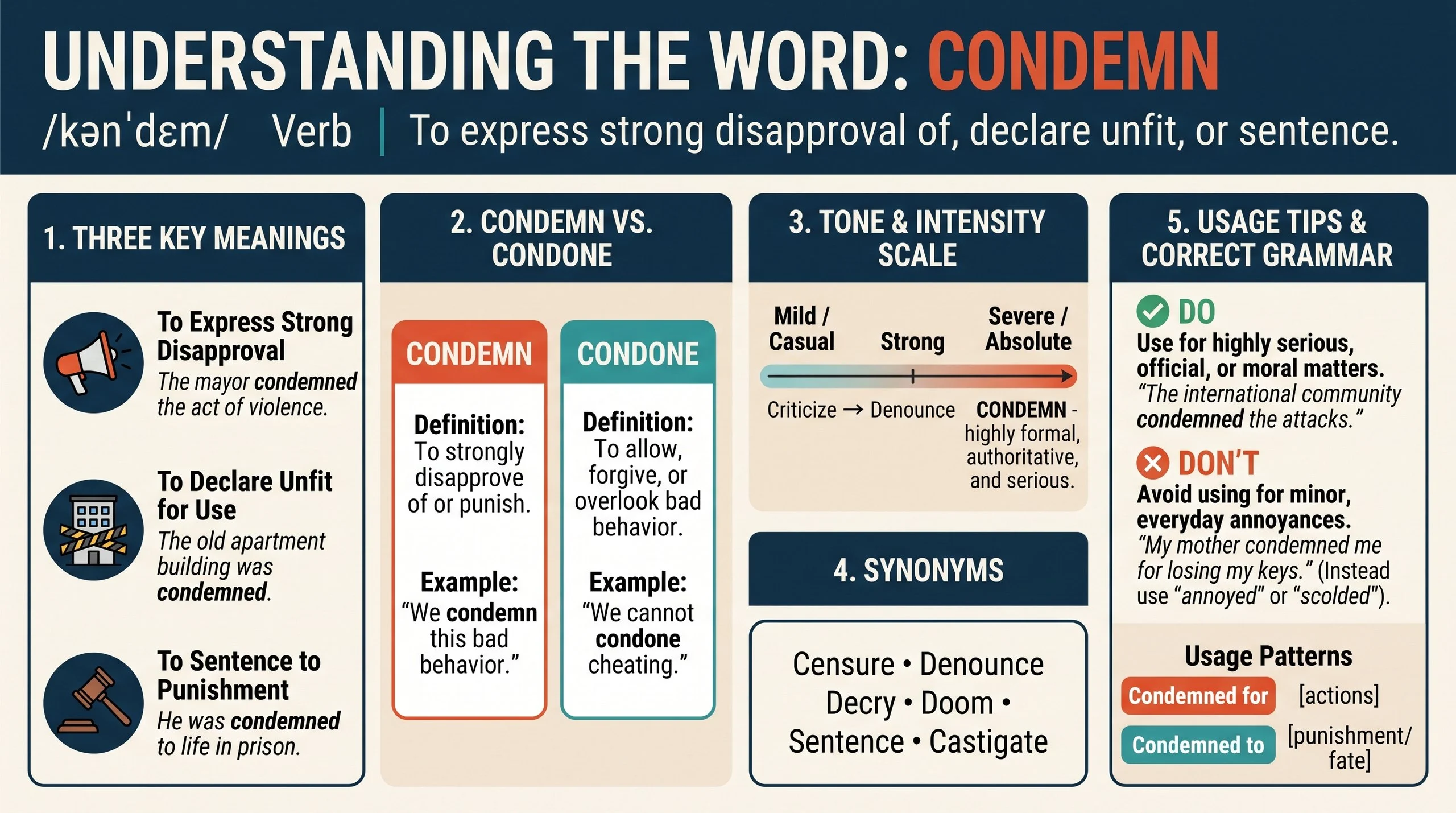
To condemn means to strongly express disapproval of a person, action, idea, or situation. It can also mean to declare something unfit for use, especially a building, or formally sentence someone to punishment.
Condemn meaning refers to expressing strong disapproval of something or someone, usually because it is considered wrong, harmful, unacceptable, or immoral. The word appears often in news reports, formal writing, public statements, legal contexts, and everyday discussions. However, its meaning can change slightly depending on the situation.
For example, a government may condemn an act of violence. A teacher might condemn cheating. A city inspector may condemn an unsafe building. In another context, a court can condemn someone to a particular punishment.
The word therefore carries more weight than simple words such as “dislike” or “criticize.” It often suggests a firm moral, social, legal, or official judgment. Consequently, understanding its tone helps you choose it correctly.
This guide explains the definition, history, grammar, synonyms, examples, conversational uses, online context, common mistakes, and related meanings. It also shows when stronger or softer alternatives may work better.
Quick Answer Box
| Meaning | Context | Primary Platforms | Example | Tone |
| To strongly disapprove or declare unacceptable | Everyday, formal, political, social, moral | News, social media, texting, professional writing | “Leaders condemned the attack.” | Strong, serious |
| To declare something unfit or unsafe | Buildings, property, public safety | Government, real estate, news | “The building was condemned.” | Official |
| To sentence or officially declare punishment | Historical or legal contexts | Legal and historical writing | “He was condemned to death.” | Formal, severe |
What Does Condemn Meaning Mean?
At its core, condemn means to express strong disapproval. If you condemn an action, you clearly communicate that you believe the action is wrong, unacceptable, harmful, or deserving of criticism.
For example:
“The mayor condemned the violent attack.”
This sentence means the mayor publicly expressed strong disapproval of the attack.
The word can apply to people, actions, decisions, behavior, policies, statements, events, or ideas. It usually carries more force than “criticize.”
The Basic Definition
The most common sense is:
Condemn means to strongly disapprove of something or someone, especially because it is considered wrong or harmful.
Consider these examples:
- “The organization condemned discrimination.”
- “Parents condemned the behavior.”
- “The senator condemned the proposal.”
- “The community condemned the vandalism.”
In each example, the speaker communicates firm disapproval.
A Second Important Meaning
Condemn can also describe an official declaration that a building, property, or structure is unsafe or unsuitable for use.
For example:
“The city condemned the abandoned apartment building.”
Here, condemn does not simply mean that officials disliked the building. It means they officially determined that the property could not safely be used, occupied, or maintained under the relevant rules.
This meaning is especially common in American English when discussing buildings.
A Third Meaning
The word can also mean to sentence someone to punishment.
For example:
“The prisoner was condemned to death.”
This construction is formal and often appears in historical or legal writing.
Similarly, a person can be “condemned to prison” in older or highly formal language. Modern English often uses “sentenced to prison” instead.
Why the Word Sounds Strong
Condemn usually communicates more than disagreement. It can suggest moral judgment, public rejection, or official disapproval.
For example, compare:
| Expression | Strength | Typical Meaning |
| I dislike it | Low | Personal preference |
| I disagree with it | Moderate | Different opinion |
| I criticize it | Moderate | Pointing out problems |
| I oppose it | Strong | Active disagreement |
| I condemn it | Very strong | Firm rejection or moral disapproval |
Therefore, using the word casually can sometimes sound more dramatic than intended.
Contextual Dynamics and Nuances of the Term
The exact force of condemnation depends on the subject, speaker, audience, and setting. A journalist, politician, friend, teacher, and government official may all use the word differently.
Moral Condemnation
Moral condemnation happens when someone strongly rejects behavior because it violates ethical standards.
For example:
“The community condemned the abuse of vulnerable people.”
The statement does not merely say that the community disliked the behavior. Instead, it communicates a strong ethical judgment.
Public Condemnation
Public figures frequently use the word in speeches and statements.
For example:
“The president condemned the attack.”
News organizations commonly report such statements because they communicate a clear public position.
Furthermore, public condemnation can signal solidarity with victims or rejection of harmful behavior.
Political Context
Politicians often condemn policies, actions, violence, corruption, or statements.
For example:
“Several lawmakers condemned the proposal.”
The phrase does not necessarily mean every person agrees about the issue. Rather, it indicates that those lawmakers strongly rejected the proposal.
Social Context
People can also condemn behavior in everyday conversations.
For example:
“I completely condemn bullying.”
This sounds serious and somewhat formal. In casual conversation, someone might instead say:
“I really hate bullying.”
Both communicate disapproval, but the first sounds more deliberate and formal.
Professional Context
The term works well in professional statements when an organization needs to communicate firm disapproval.
For example:
“Our company condemns workplace harassment.”
This sounds appropriate in a formal policy or public statement.
However, it may sound too strong for a minor workplace disagreement.
Legal Context
Legal language condemns several specialized meanings. A court may condemn someone to a punishment, while a government authority may condemn property under applicable legal procedures.
Because these meanings involve formal authority, context matters greatly.
Real Life Conversation Examples Using Condemn Meaning
The following examples show how the word can appear naturally in different conversations.
Example 1: Discussing Harmful Behavior
Alex: “Did you see what happened at the event?”
Jordan: “Yes. I completely condemn that kind of behavior.”
Alex: “Same. Nobody should be treated that way.”
Here, the speaker expresses strong moral disapproval.
Example 2: Discussing a Public Statement
Maya: “Why is everyone talking about that statement?”
Chris: “Several organizations condemned it because they considered it offensive.”
Maya: “That makes sense. The wording was pretty serious.”
Here, condemn describes an organized public reaction.
Example 3: Discussing a Building
Sam: “Why is nobody living in that house anymore?”
Taylor: “The city condemned it after inspectors found major structural problems.”
In this conversation, the word has its property related meaning. Officials declared the building unsafe or unsuitable for occupancy.
Example 4: Discussing Cheating
Teacher: “What do you think about students sharing answers during an exam?”
Student: “I condemn cheating because it makes the grading unfair.”
The word expresses strong ethical disapproval.
Example 5: Discussing a Policy
Friend: “Did you read the new proposal?”
You: “Yes. I strongly oppose it, and I condemn the parts that could harm vulnerable people.”
This example shows that condemn can appear alongside a related verb such as oppose.
Platform Specific Breakdown
The word is not inherently internet slang. Instead, social media gives it new conversational settings. Its core meaning remains the same, but the surrounding tone can become more casual.
How It Is Used on Snapchat
Snapchat conversations tend to be informal and quick. Therefore, condemn may sound unusually formal between close friends.
For example:
“I condemn that move 😂”
A speaker might use this playfully to exaggerate their reaction to a harmless situation.
Imagine a friend taking the last slice of pizza:
“You took the last slice? I condemn this behavior.”
The speaker is not making a serious moral judgment. Instead, the formal vocabulary creates humor.
However, the same word can remain serious when discussing genuinely harmful behavior.
The Role of Condemn Meaning on TikTok
TikTok frequently mixes serious commentary with humor. Creators may use formal words dramatically to make a joke or emphasize an opinion.
For example:
“I officially condemn pineapple on pizza.”
The statement sounds deliberately exaggerated.
On the other hand, a serious video about discrimination might use the word in its traditional sense:
“We condemn discrimination in every form.”
The surrounding content determines whether the statement sounds humorous, political, moral, or formal.
Instagram and Texting Dynamics
Instagram captions often use condemn in statements about social issues, public events, or personal values.
For example:
“We condemn violence and stand with those affected.”
This style is formal and suitable for an organization.
In private texting, the word may appear less frequently. Instead, people commonly use expressions such as:
- “I strongly disagree.”
- “That is completely unacceptable.”
- “I really don’t support that.”
- “That is not okay.”
- “I can’t get behind that.”
Still, condemn can be useful when you deliberately want a stronger or more formal tone.
Social Media Tone Can Change the Effect
The same word can have different emotional effects depending on punctuation, capitalization, emojis, and surrounding language.
| Example | Likely Effect |
| “I condemn violence.” | Serious |
| “I strongly condemn this decision.” | Formal and forceful |
| “I condemn your pizza choices 😂” | Humorous |
| “We condemn discrimination.” | Institutional |
| “I condemn that behavior.” | Firm and judgmental |
Therefore, always consider the audience before using it.
Alternative Meanings and NLP Variations of the Phrase
From a language perspective, condemn connects to several semantic ideas. These include rejection, criticism, disapproval, judgment, punishment, and official declaration.
Common Synonyms
The best synonym depends on context.
| Synonym | Meaning | Typical Strength |
| Criticize | Point out faults | Moderate |
| Denounce | Publicly reject strongly | Very strong |
| Reject | Refuse to accept | Strong |
| Oppose | Act against an idea or policy | Strong |
| Disapprove | Express a negative judgment | Moderate |
| Censure | Officially criticize | Strong |
| Rebuke | Express sharp criticism | Strong |
| Deplore | Express strong regret or disapproval | Strong |
| Blame | Hold responsible | Strong |
| Disparage | Speak negatively about something | Moderate |
| Object to | Express disagreement | Moderate |
| Condemn | Strongly reject or disapprove | Very strong |
Condemn vs Criticize
These words overlap, but they are not identical.
To criticize something means to identify faults or express negative opinions. To condemn something usually communicates stronger rejection.
For example:
“The editor criticized the article.”
This could mean the editor found several weaknesses.
“The editor condemned the article.”
This suggests much stronger disapproval.
Condemn vs Denounce
Denounce is one of the closest alternatives.
Both words can describe strong public rejection. However, denunciation often emphasizes public declaration, while condemn can also describe private moral judgment or official decisions.
For example:
“The organization denounced the policy.”
This sounds strongly public.
“She condemned the behavior.”
This can be personal or public.
Condemn vs Disapprove
Disapprove is generally softer.
“My parents disapprove of my decision.”
This communicates disagreement.
“My parents condemn my decision.”
This sounds much stronger and more severe.
Consequently, choosing between these words depends on the emotional force you want.
Condemn vs Oppose
Opposing means to be against something. It often focuses on disagreement or resistance.
Condemn usually carries a stronger evaluative or moral component.
For example:
“I oppose the new policy.”
This means you are against it.
“I condemn the new policy.”
This suggests that you consider the policy seriously wrong or unacceptable.
Misinterpretations: When NOT to Use Condemn Meaning
Although condemn is useful, it can create unintended intensity.
Do Not Use It for Simple Preferences
Saying:
“I condemn vanilla ice cream.”
would normally sound exaggerated.
If you simply dislike vanilla, say:
“I don’t like vanilla ice cream.”
Humorous exaggeration can make the stronger word work online, but literal communication usually benefits from precision.
Avoid It for Minor Disagreements
Suppose your friend chooses a different restaurant.
Saying:
“I condemn your restaurant choice.”
could sound theatrical.
A more natural response would be:
“I’m not a fan of that place.”
Do Not Confuse It With Simple Criticism
Condemnation implies strong disapproval. Therefore, it may not accurately describe mild feedback.
For example:
“The manager criticized the report.”
This could involve ordinary professional feedback.
By contrast:
“The manager condemned the report.”
This sounds severe and possibly public.
Do Not Assume It Always Means Punishment
The word does not always mean that someone receives a legal penalty.
When someone says:
“We condemn violence,”
They are expressing strong disapproval.
They are not necessarily announcing a punishment.
Property Context Requires Care
When a building is described as condemned, the word can have a specific official meaning.
For example:
“The house was condemned.”
This may indicate that an authority formally determined that the property was unsafe or unsuitable for use.
However, exact legal consequences vary by jurisdiction. Therefore, property owners should check local rules rather than assuming that every condemned property must immediately be demolished.
How to Respond in Chat Comfortably
If someone uses condemn during a conversation, first identify whether they are being serious or playful.
If They Are Being Serious
You can respond naturally:
“I understand what you mean.”
Or:
“I agree. That behavior is unacceptable.”
If They Are Being Formal
You might answer:
“That is a strong way to put it.”
This acknowledges the intensity without automatically agreeing.
If They Are Being Playful
Match the humor:
“Wow, harsh judgment 😂”
Or:
“Not the official condemnation!”
This works when the context is clearly lighthearted.
If You Disagree
You can disagree without escalating:
“I see why you feel that way, but I don’t think I would go that far.”
This response is useful because it recognizes the other person’s opinion while maintaining your own.
If You Need Clarification
Ask:
“Do you mean you strongly disagree with it?”
This works especially well when the word appears in an unfamiliar context.
Grammar and Sentence Patterns
Condemn is usually used as a verb.
Active Structure
A common pattern is:
Subject + condemn + object
Examples:
- “Leaders condemned the attack.”
- “The organization condemned discrimination.”
- “The community condemned the decision.”
Passive Structure
Another common pattern is:
Subject + was or were + condemned
Examples:
- “The policy was condemned by critics.”
- “The building was condemned by officials.”
- “The statement was widely condemned.”
The passive structure is common in news reporting, although active sentences often sound clearer.
Condemned to
A separate construction is:
Subject + be + condemned to + punishment or fate
Examples:
- “He was condemned to prison.”
- “The prisoner was condemned to death.”
- “The character was condemned to a life of isolation.”
This construction often sounds formal, historical, or literary.
Condemned As
The word can also appear with “as” when describing how something was judged.
For example:
“The decision was condemned as unfair.”
This means critics strongly judged the decision to be unfair.
Tone Guide: Choosing the Right Word
The emotional strength of your vocabulary matters.
| If You Mean | Better Choice |
| Mild dislike | Dislike |
| Different opinion | Disagree |
| Negative feedback | Criticize |
| Strong resistance | Oppose |
| Strong public rejection | Denounce |
| Strong moral rejection | Condemn |
| Formal official criticism | Censure |
| Strong regret | Deplore |
Therefore, use condemn when the situation genuinely calls for strong disapproval.
Common Mistakes
Mistake 1: Treating Condemn as a Simple Synonym for Dislike
This reduces the strength of the word.
Better:
“I dislike the design.”
Use condemn only when you intend to communicate strong rejection.
Mistake 2: Assuming It Always Has a Legal Meaning
The word appears frequently outside law.
For example:
“The community condemned the behavior.”
No court action is implied.
Mistake 3: Using It Without Understanding the Tone
A serious word can sound sarcastic or humorous in casual conversations.
That is not necessarily wrong. However, the speaker should understand the effect.
Mistake 4: Confusing Condemned With Convicted
These words are different.
Convicted usually refers to a legal finding that someone committed an offense.
Condemned can mean strongly criticized, officially declared unsafe, or sentenced to punishment.
Therefore, they should not be used interchangeably.
Mistake 5: Confusing Condemn With Condone
This is one of the most important vocabulary distinctions.
Condemn means strongly disapprove.
Condone means accept, tolerate, or allow behavior that many people consider wrong.
For example:
“We condemn harassment.”
means:
“We strongly reject harassment.”
Meanwhile:
“We do not condone harassment.”
means:
“We do not accept or tolerate harassment.”
The two words look and sound somewhat similar, but their meanings point in opposite directions.
Condemn vs Condone
| Word | Core Meaning | Example |
| Condemn | Strongly disapprove | “We condemn violence.” |
| Condone | Accept or tolerate | “We do not condone violence.” |
Remember this distinction carefully. It is especially important in professional, academic, legal, and public communication.
Historical and Word Origin
The English word condemn traces back through French and Latin forms connected with the idea of declaring something wrong, judging, or finding fault.
The Latin root is commonly associated with condemnare, meaning to pronounce judgment against or find fault with. Over time, the English word developed several related senses involving judgment, disapproval, punishment, and official declaration.
That history helps explain why the modern word can operate across moral, legal, and official contexts.
However, modern speakers do not need to know its Latin history to use it correctly. Context remains the most important factor.
Why Condemn Appears Frequently in News Writing
News writing often needs concise verbs that communicate public reactions.
Compare:
“The organization said that it strongly disagreed with the attack.”
with:
“The organization condemned the attack.”
The second sentence is shorter and more forceful.
Consequently, journalists often use condemn when reporting statements from governments, institutions, political leaders, advocacy groups, and public figures.
The word can also appear in headlines because it efficiently communicates a strong response.
Use in Academic Writing
The word can work well in academic writing, particularly when discussing ethics, politics, literature, history, law, or social issues.
For example:
“The author condemns corruption through the novel’s central character.”
This sentence indicates that the author strongly presents corruption as wrong.
However, academic writing should distinguish between evidence and interpretation. Do not automatically claim that an author condemns something unless the text supports that interpretation.
Use in Professional Communication
In professional settings, condemn should usually appear when the issue is significant.
For example:
“The company condemns all forms of workplace harassment.”
This communicates a clear organizational position.
However, a softer term may be better for ordinary internal disagreements.
Instead of:
“The company condemns the scheduling error.”
you might write:
“The company recognizes the scheduling error and is taking steps to correct it.”
Precision improves professional communication.
FAQs
What does condemn mean?
It refers primarily to strongly expressing disapproval of someone or something. It can also mean officially declaring property unsafe or sentencing someone to a punishment in formal contexts.
Is condemn a negative word?
Yes. It normally communicates strong disapproval or rejection. The emotional intensity is usually greater than words such as dislike, question, or disagree.
Is condemning the same as criticizing?
Not exactly. Criticism can involve mild or moderate negative feedback. Condemn usually expresses much stronger disapproval and may carry moral, social, or official weight.
Is condemn the same as condone?
No. They have very different meanings. Condemn means strongly disapprove, while condone means accept, tolerate, or allow something that may be considered wrong.
Can I use condemn in casual texting?
Yes, but it may sound formal or dramatic. Friends sometimes use it humorously for harmless situations. For serious topics, the traditional meaning remains strong disapproval.
What does condemned mean when talking about a house?
In property contexts, condemned generally means an authority has officially determined that a building or property is unsafe, unsuitable, or otherwise subject to a legal restriction. Exact rules depend on local law.
What is a strong synonym for condemn?
Denounce is one of the closest strong synonyms. Other options include censure, deplore, reject, and strongly oppose. The best choice depends on context.
Can condemn describe a person?
Yes. A person can condemn another person’s behavior, decision, statement, or action. However, saying that someone “condemns a person” can sound more severe than saying they condemn the person’s behavior.
Does condemn always mean punishment?
No. In many sentences, it simply means strong disapproval. Punishment is only one of its more formal or historical meanings.
How can I use condemn correctly?
Use it when you want to communicate firm rejection, especially when the issue involves serious wrongdoing, harmful behavior, unethical conduct, public controversy, or an official decision.
Conclusion
Condemn is not primarily internet slang. It is an established English verb with strong meanings that remain relevant in modern communication. It can describe moral disapproval, public rejection, official judgment, unsafe property, or formal punishment.
In everyday conversation, the word often sounds stronger than simple alternatives such as dislike or disagree. Therefore, context matters. A serious statement can use condemn to communicate firm rejection, while a social media user may use it humorously to exaggerate a harmless opinion.
The most important distinction to remember is between condemn and condone. Condemn means strongly disapprove, while condone means tolerate or accept.
Once you understand that difference, the word becomes much easier to use accurately in conversations, professional writing, news discussions, academic work, and social media.