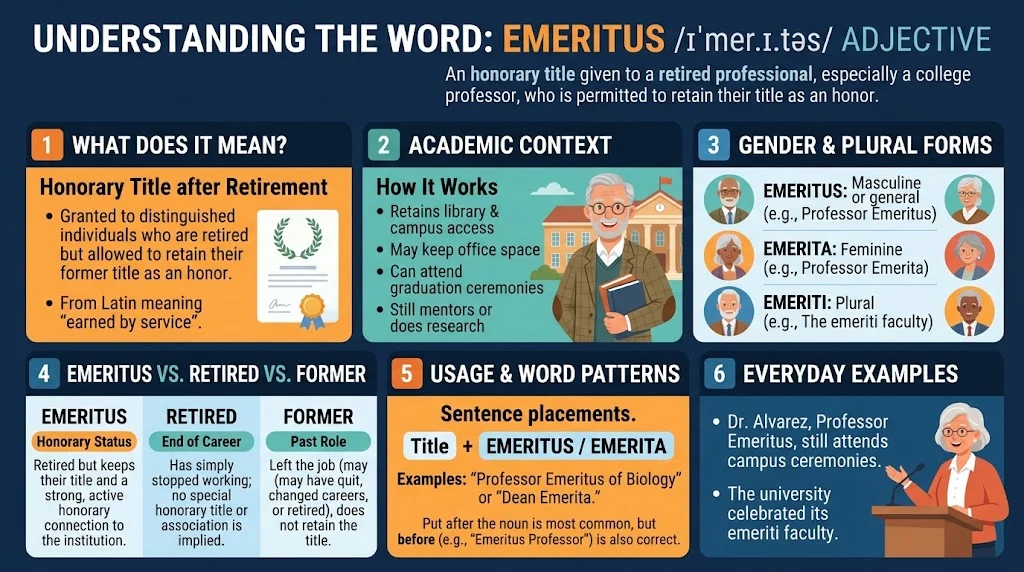
The emeritus meaning refers to a person who has retired from an important professional position but keeps the title as an honor. It commonly describes retired professors, university leaders, judges, clergy, and other respected professionals.
Emeritus meaning describes an honorary status given to someone who has retired from a professional position while retaining the title as a mark of respect. For example, a university may call a retired professor “Professor Emeritus.”
The word often appears in universities, colleges, academic publications, professional organizations, and formal biographies. However, many people encounter it without knowing exactly what it means.
At first glance, emeritus may look like a complicated academic term. In reality, the central idea is simple: someone has officially retired, but the organization continues to recognize that person’s former position or contributions.
For example, a professor might retire after decades of teaching. The university can then appoint that person as professor emeritus. The title recognizes past service without suggesting that the person still holds the same full time job.
The term can also appear outside academia. For example, organizations may use titles such as president emeritus, director emeritus, editor emeritus, or chair emeritus. Therefore, understanding the word helps when reading professional biographies, university websites, news articles, and formal announcements.
It is also important to understand what the word does not mean. Emeritus does not simply mean old, unemployed, inactive, or completely disconnected from an organization. Instead, it describes a respected retired status.
Quick Answer Box
| Meaning | Context | Primary Platforms | Example | Tone |
| Retired person who keeps an honorary professional title | Academic, professional, institutional | Websites, LinkedIn, biographies, formal writing | Professor Emeritus | Formal and respectful |
What Does Emeritus Mean?
The basic emeritus meaning is “retired while retaining an honorary title.” The word traditionally applies to someone who has completed active service in a position but receives continued recognition for that role.
The most familiar example is professor emeritus. A university may grant this title to a professor who has retired after a distinguished career.
The title can communicate several ideas at once:
- The person previously held the position.
- The person has retired from active duties.
- The organization recognizes the person’s contributions.
- The title remains associated with the person’s professional identity.
Consequently, emeritus carries more meaning than the simple word “retired.”
Emeritus in simple English
In simple English, you can understand emeritus as:
A respected retired professional who keeps an honorary version of their former title.
For example:
Dr. Williams is Professor Emeritus at the university.
This usually means Dr. Williams is no longer a regular active professor, but the university continues to honor the person with the professor title.
Where did the word come from?
The word comes from Latin. It is related to emereri, meaning to earn or complete service.
The Latin background helps explain the modern sense. The term developed around the idea of someone who had completed their required service.
Over time, English adopted emeritus as a formal term for retired people who retain an honorary professional title.
Therefore, the word has a strong connection with service, achievement, retirement, and recognition.
Is emeritus a job title?
It can function as a title, but it usually does not describe an active full time position.
For example, “Professor” normally identifies an active academic role. “Professor Emeritus” usually identifies someone who previously served as a professor and now holds an honorary retired status.
However, individual institutions can define emeritus appointments differently. Some retired professors continue research, attend meetings, supervise students, publish work, or use university facilities.
The exact privileges depend on the institution.
Is emeritus the same as retired?
Not exactly.
Someone can be retired without being emeritus. Retirement simply means the person has stopped working in an active position.
Emeritus adds institutional recognition.
For example:
Sarah retired from the university in 2024.
This statement only tells us that Sarah stopped working there.
Now compare it with:
Sarah became Professor Emerita after retiring in 2024.
This statement tells us that the university recognized her former academic role with an honorary title.
The distinction matters because emeritus communicates respect and continued professional recognition.
Contextual Dynamics & Nuances of the Term
The word becomes easier to understand when you examine how organizations use it.
Academic context
Academia is the most common setting.
Universities often award emeritus titles to professors who retire after significant service. The title can recognize teaching, research, leadership, publications, mentorship, or other contributions.
For example:
Professor James Carter is Professor Emeritus of History.
The sentence suggests that Carter previously served as a professor and now holds an honorary retired designation.
Professional organizations
The term can also appear in professional associations.
For example:
The former executive director now serves as director emeritus.
Here, the person no longer performs the same executive duties. However, the organization continues to recognize the person’s former role.
Leadership roles
Organizations sometimes use the term for senior leaders.
Examples include:
| Former Position | Possible Emeritus Title |
| President | President Emeritus |
| Chair | Chair Emeritus |
| Director | Director Emeritus |
| Editor | Editor Emeritus |
| Professor | Professor Emeritus |
| Dean | Dean Emeritus |
These titles can signal long service and institutional respect.
Gender forms
Traditionally, emeritus is masculine and emerita is feminine.
For example:
Professor Emeritus John Smith
and:
Professor Emerita Jane Smith
The plural form is traditionally emeriti.
However, modern English usage varies. Some institutions use emeritus as a general title regardless of gender, while others distinguish between emeritus and emerita.
Therefore, when writing about a specific person, check the institution’s preferred title.
Plural usage
The plural can become confusing because emeritus has Latin forms.
You may see:
Emeritus: traditionally singular masculine.
Emerita: traditionally singular feminine.
Emeriti: traditionally plural masculine or mixed group.
Emeritae: traditionally plural feminine.
Modern institutional style does not always follow these distinctions strictly. Consequently, the safest approach is to follow the person’s official institutional title.
Does emeritus mean the person still works?
Not necessarily.
A person with emeritus status may remain active in professional life. However, the title itself does not automatically mean that the person has regular employment duties.
For example, a professor emeritus might continue publishing research. Another might completely retire from academic work.
The title identifies honorary status, not a specific daily schedule.
Does emeritus mean the person is still employed?
Not automatically.
Employment arrangements differ between institutions. Some emeritus professors receive access to offices, libraries, laboratories, email accounts, or other resources. Others do not.
Therefore, you should not assume that emeritus status equals current employment.
Real Life Conversation Examples Using emeritus meaning
The term usually appears in formal conversations rather than casual texting. Still, people may ask about it after seeing the title on a university page, article, business biography, or social profile.
Example 1: University website
Maya: I saw “Professor Emeritus” next to Dr. Brown’s name. What does that mean?
Alex: It means he retired from his professor position but still has an honorary title from the university.
Maya: So he is not a regular professor anymore?
Alex: Right. He is retired, although he may still do research or other academic work.
This example shows the clearest everyday explanation.
Example 2: Professional biography
Jordan: Why does her biography say “Director Emerita”?
Taylor: She used to be the director and received an honorary title after retiring.
Jordan: So it recognizes her work?
Taylor: Exactly. It highlights her previous leadership and the organization’s respect for her service.
The word adds professional recognition to the biography.
Example 3: Academic conversation
Student: Is Professor Lee still teaching?
Advisor: She is Professor Emerita now.
Student: Does that mean she retired?
Advisor: Yes, although she may still participate in research or university activities.
This conversation demonstrates why emeritus should not automatically be interpreted as completely inactive.
Example 4: Reading a news article
Chris: I keep seeing “president emeritus” in this article. What does it mean?
Morgan: It usually means the person previously served as president and now holds an honorary title.
Chris: So it is basically a recognition of the former position?
Morgan: Yes, although the exact responsibilities can vary by organization.
This interpretation works well for business and nonprofit contexts.
Example 5: Explaining the term simply
Nina: What does emeritus mean?
Sam: Think of it as an honorary retirement title.
Nina: Can you give me an example?
Sam: Sure. A retired professor might become Professor Emeritus.
Nina: That makes sense.
This is a useful explanation for English learners because it avoids unnecessary technical language.
Platform Specific Breakdown
The term does not behave like ordinary internet slang. Instead, it usually appears in formal digital contexts.
That distinction matters because users may search for a definition after encountering the word on a social platform, professional profile, or university website.
How It Is Used on Snapchat
Snapchat is primarily informal and conversational. Therefore, emeritus is unlikely to appear as common Snapchat slang.
Still, someone might encounter the term when discussing a professor, family member, public figure, or professional organization.
For example, a user could post:
My grandfather became Professor Emeritus after forty years at the university.
A friend might reply:
What does emeritus mean?
The correct explanation would be that it describes an honorary retired professional status.
Importantly, you should not interpret the word as a secret Snapchat abbreviation. It is an established English term with a formal institutional meaning.
The Role of emeritus meaning on TikTok
TikTok often turns unfamiliar words into searchable vocabulary topics. A creator might explain academic titles, unusual English words, or professional terminology in a short video.
Someone could ask:
What does professor emeritus mean?
A creator might answer:
It usually means a professor has retired but received an honorary title recognizing their career.
That explanation is accurate and easy to understand.
However, the term itself is not typical TikTok slang. It does not have a special viral meaning simply because it appears in a caption or video.
Instagram and Texting Dynamics
Instagram combines informal communication with professional profiles. As a result, emeritus can appear in biographies, captions, university announcements, or posts celebrating retirement.
For example:
Congratulations to Professor Garcia, now Professor Emerita after an extraordinary academic career.
In ordinary texting, however, most people would simply say:
She retired from the university.
They might use emeritus when discussing the person’s formal title.
The difference comes down to context. Casual conversation favors simple language, while institutional communication often preserves the official title.
LinkedIn and professional profiles
LinkedIn is another environment where the term can appear naturally.
A profile might list:
Professor Emeritus, Department of Economics
This can communicate that the person previously held an academic position and retains an honorary institutional title.
However, profile formatting varies. Some people list emeritus as their current professional designation even after retirement, while others place the role under their past experience.
University websites
University websites are among the most likely places to encounter the term.
Faculty pages may identify retired academics as professors emeriti. These pages can include information about research, publications, awards, teaching history, and institutional service.
Therefore, if you see emeritus on a university page, the academic retirement meaning is usually the safest interpretation.
Alternative Meanings & NLP Variations of the Phrase
There is no major secret slang definition that replaces the standard meaning of emeritus. However, several related expressions can overlap semantically.
Retired
Retiring is the broadest alternative.
It simply indicates that someone has stopped working in an active professional role.
For example:
She is a retired professor.
This does not necessarily imply an honorary title.
Honorary
Honorary means something is granted as an honor rather than as a normal active responsibility.
Therefore, “honorary title” can help explain emeritus, although the words are not perfect synonyms.
Former
Former identifies a previous position.
For example:
He is a former university president.
This tells us he previously held the role. It does not tell us whether he received an honorary title.
Distinguished retired professor
This phrase communicates the general idea in plain English.
However, it lacks the institutional precision of professor emeritus.
Professor Emerita
This is the feminine form traditionally used for a retired female professor who receives the corresponding honorary title.
Professor Emeriti
This traditional plural can refer to multiple professors with emeritus status.
Semantic comparison
| Term | Core Meaning | Honorary Status Implied? | Active Role Implied? |
| Emeritus | Retired person retaining a professional title | Usually | Not necessarily |
| Retired | No longer working actively | No | No |
| Former | Previously held a position | No | No |
| Honorary | Given as recognition | Yes | Not necessarily |
| Professor Emerita | Retired female professor with honorary title | Yes | Not necessarily |
| Former professor | Previously worked as professor | No | No |
The key distinction is institutional recognition.
Misinterpretations: When NOT to Use emeritus meaning
Understanding when not to use the term is just as important as knowing its definition.
Do not use it for every retired person
You should not describe every retired worker as emeritus.
For example, saying:
My retired neighbor is emeritus.
would sound unnatural unless the person actually holds an honorary professional title.
A better statement would be:
My neighbor is retired.
Do not treat it as a synonym for elderly
Emeritus does not mean old.
A relatively young professional could potentially receive emeritus status depending on retirement circumstances and institutional rules.
Therefore, age is not the defining feature.
Do not assume it means unemployed
Retirement and unemployment are different concepts.
A retired professor may have consulting work, research projects, writing commitments, or other professional activities.
Consequently, emeritus should not be interpreted as “without a job.”
Do not assume complete inactivity
Some people with emeritus status remain highly active.
They may publish papers, speak at conferences, mentor researchers, teach occasional courses, or participate in institutional events.
The exact level of activity depends on the person and organization.
Do not use it as casual slang
The term does not normally function like internet expressions such as “lol,” “brb,” or “low key.”
If someone texts:
That’s so emeritus.
The phrase does not have a universally recognized slang interpretation.
Instead, the standard meaning remains tied to retirement and honorary professional status.
Do not confuse it with an honorary degree
An honorary degree recognizes someone through an academic credential. Emeritus status generally recognizes someone who previously held an institutional position.
For example:
Honorary doctorate
and:
Professor Emeritus
are different forms of recognition.
How to Respond in Chat Comfortably
If someone asks you about the term in a casual message, you do not need to give a long academic explanation.
A short response works best.
Simple response
It means someone retired from a professional position but kept the title as an honor.
Very casual response
Basically, it means retired but still officially honored with the old title.
Academic response
It usually describes a retired professor or professional who retains an honorary institutional title.
English learner response
It means a person retired from their job but still has the professional title as an honor.
If someone asks about professor emeritus
You can say:
A professor emeritus is usually a retired professor who keeps an honorary university title.
That answer is concise, accurate, and easy to understand.
If someone asks whether the person still works
You can say:
Not necessarily. They are retired from the active role, but they may still do research, teaching, or other professional work.
If someone asks whether it means “former”
You can say:
They are a former holder of the position, but emeritus adds the idea of an honorary continuing title.
This distinction is particularly useful when explaining professional biographies.
FAQs
What does emeritus meaning refer to?
It refers to a person who has retired from a professional position but retains an honorary title connected to that former role. Universities commonly use it for retired professors.
Is emeritus the same as retired?
Not exactly. Retired describes a person’s work status, while emeritus usually adds institutional recognition through an honorary title.
What does Professor Emeritus mean?
Professor Emeritus usually means a professor has retired from active university service but has received an honorary title recognizing the person’s academic career.
Can women be called emeritus?
Traditionally, emerita is the feminine form. Therefore, a retired female professor may be called Professor Emerita. However, institutional style varies.
Is emeritus a formal word?
Yes. It is a formal term that commonly appears in academic, professional, institutional, and biographical writing.
Can an emeritus professor still teach?
Yes. Some retired professors continue teaching, researching, mentoring, or participating in academic activities. The specific privileges depend on the institution.
Does emeritus mean honorary?
It generally carries an honorary element, but it specifically refers to retired people who retain recognition connected with a former position.
Can a business leader be emeritus?
Yes. Organizations can use titles such as president emeritus, director emeritus, chair emeritus, or editor emeritus.
Is emeritus used in texting?
It can appear in a text when someone is discussing a professional title. However, it is not common texting slang.
What is the easiest way to explain the word?
The simplest explanation is: a respected retired professional who keeps an honorary version of the former title.
Conclusion
The emeritus meaning is much more formal than modern internet slang. It describes a respected professional who has retired from an active position while retaining an honorary title connected with that role.
The term appears most often in academic and professional settings. For example, Professor Emeritus commonly identifies a retired professor who continues to receive institutional recognition.
However, the concept can extend beyond universities. Presidents, directors, editors, chairs, and other senior professionals may receive emeritus titles after retirement.
The most important distinction is simple. Retired describes a work status, while emeritus usually communicates both retirement and continued institutional recognition.
Therefore, when you encounter the word on a university website, professional biography, LinkedIn profile, or formal announcement, think of it as a respectful title connected with completed professional service.
In everyday conversation, you can usually explain it in one sentence: emeritus means retired from a professional position while retaining an honorary title.