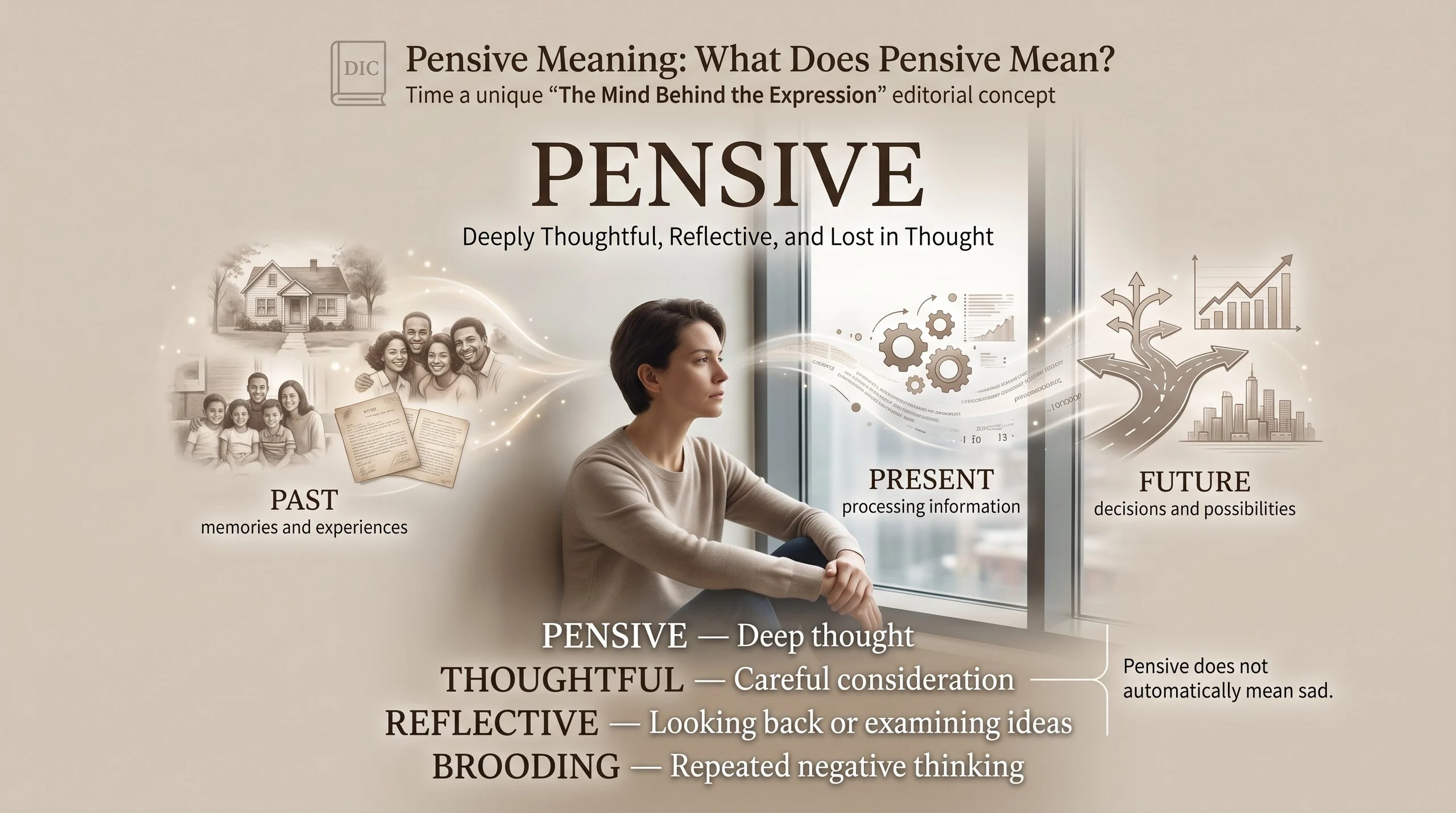
Pensive meaning describes someone who is deeply thoughtful, often because they are considering something serious, emotional, or important. A pensive person may appear quiet, distant, or lost in thought. For example, “She looked pensive during the meeting” means she seemed deeply absorbed in her thoughts.
Pensive meaning is closely connected to deep thought, reflection, and quiet contemplation. When someone is pensive, they are thinking carefully about something rather than focusing on what is happening around them.
The word often describes a person’s facial expression, mood, or behavior. Someone may stare into the distance, remain unusually quiet, or seem mentally absorbed. Their thoughts could involve a decision, memory, problem, relationship, or future plan.
For example:
“He became pensive after hearing the news.”
This means the news caused him to think deeply about something.
The word can sometimes carry a slightly sad, serious, or melancholy tone. However, pensive does not automatically mean sad. A person can be pensive simply because they are concentrating on an important idea.
This guide explains pensive meaning, its pronunciation, synonyms, examples, common contexts, differences from similar words, and how to use it naturally in everyday English.
Quick Answer
| Meaning | Context | Primary Platforms | Example | Tone |
|---|---|---|---|---|
| Deeply thoughtful | Everyday English | Conversations | “She looked pensive.” | Reflective |
| Lost in thought | Personal reflection | Texting, social media | “He seemed pensive today.” | Quiet |
| Thinking about something serious | Emotional situations | Writing, conversation | “The news left him pensive.” | Serious |
| Contemplative | Decisions or ideas | Formal writing | “She sat in a pensive mood.” | Thoughtful |
| Thoughtful with a slight melancholy | Memories or emotions | Literature, captions | “He gave a pensive smile.” | Melancholy |
What Does Pensive Mean?
Pensive means deeply thoughtful or absorbed in serious reflection.
When someone is pensive, their attention is focused inward. They may be thinking about something important rather than actively participating in their surroundings.
For example:
“Maria looked pensive while staring out the window.”
This suggests Maria was deeply absorbed in her thoughts.
The word can describe:
- A person
- A facial expression
- A mood
- A moment
- A look
- A silence
- A state of mind
The central idea is always deep and often serious thought.
Pensive Meaning in Simple English
In simple English:
Pensive means quietly thinking deeply about something.
A pensive person may look serious because their mind is occupied with an idea, memory, problem, or decision.
For example:
“He was pensive after the conversation.”
In simpler words:
“He was quiet and thinking deeply after the conversation.”
What Does It Mean to Be Pensive?
Being pensive means spending time thinking carefully and deeply.
You might become pensive when:
- You are making an important decision.
- You remember something from the past.
- You are worried about the future.
- You are considering someone’s words.
- You are solving a difficult problem.
- You are reflecting on your life.
- You are processing emotional news.
For example:
“She became pensive when the conversation turned to her childhood.”
This suggests that the subject caused her to think deeply about personal memories.
Is Pensive a Positive or Negative Word?
Pensive is generally neutral, but it can carry a slightly serious or melancholy feeling.
The emotional tone depends on the context.
For example:
“He sat in a pensive mood, thinking about his future.”
This sounds thoughtful and reflective.
By contrast:
“She gave him a pensive smile as she remembered their final conversation.”
This may suggest sadness or nostalgia.
Therefore, pensive does not directly mean unhappy. It simply indicates deep thought, although that thought may involve emotional or difficult subjects.
Pensive vs. Thoughtful
Pensive and thoughtful are closely related.
However, they do not always communicate exactly the same idea.
Thoughtful can mean:
- Deeply thinking
- Considerate toward others
- Showing careful consideration
For example:
“He gave me a thoughtful gift.”
Here, thoughtful means considerate, not deeply reflective.
Pensive, however, specifically describes someone who is absorbed in thought.
“He looked pensive during the interview.”
So, pensive = deeply reflective, while thoughtful has several meanings.
Pensive vs. Reflective
Reflective means thinking carefully about something, especially the past or one’s experiences.
Pensive also means deeply thoughtful, but it can have a more visibly serious or inward-looking quality.
For example:
“She was reflective after returning home.”
This suggests she was thinking about her experiences.
“She looked pensive after hearing the question.”
This suggests she appeared deeply absorbed in thought.
The difference is subtle, and the words can often work as synonyms.
Pensive vs. Contemplative
Contemplative means seriously and carefully thinking about something.
Pensive has a similar meaning.
However, contemplative often sounds more deliberate or intellectual.
For example:
“He spent the afternoon in contemplative silence.”
This suggests intentional deep thinking.
“He looked pensive while waiting for the decision.”
This focuses more on his appearance and mood.
Pensive vs. Meditative
Meditative relates to meditation or a calm state of focused reflection.
Pensive simply means deeply thoughtful.
A person can be pensive without meditating.
For example:
“She became pensive after reading the letter.”
She is thinking deeply, but she is not necessarily practicing meditation.
Pensive vs. Sad
Pensive does not mean sad.
This distinction is important.
Someone who is sad feels unhappiness or emotional pain.
Someone who is pensive is deeply absorbed in thought.
The two states can overlap.
For example:
“He looked pensive after hearing the sad news.”
The person may be both thoughtful and sad.
However:
“He looked pensive while planning his future.”
This sentence suggests thoughtfulness without necessarily suggesting sadness.
Pensive vs. Worried
Pensive also does not automatically mean worried.
Worry involves anxiety about possible problems or negative outcomes.
Pensive simply describes deep thought.
For example:
“She looked pensive while considering which college to attend.”
She may be carefully thinking about her options. She does not necessarily feel anxious.
Pensive vs. Serious
Serious describes a person’s attitude, expression, or the importance of a situation.
Pensive specifically emphasizes deep thought.
Someone can look serious because they are angry, concerned, focused, or simply not joking.
A pensive person looks serious because they are absorbed in thought.
Common Pensive Expressions
Several phrases commonly appear with pensive.
Pensive Mood
“He was in a pensive mood.”
This means he was quiet and deeply thoughtful.
Pensive Look
“She gave me a pensive look.”
This suggests her expression showed deep thought.
Pensive Expression
“His pensive expression made me wonder what he was thinking.”
This describes a thoughtful facial expression.
Pensive Silence
“After the question, there was a moment of pensive silence.”
This suggests everyone became quiet while thinking.
Pensive Moment
“She had a pensive moment before answering.”
This indicates a brief period of serious reflection.
Pensive Smile
“He gave a pensive smile.”
This often suggests a thoughtful smile that may carry nostalgia or mixed emotions.
Pensive in a Sentence
Here are natural examples:
- “She looked pensive after the meeting.”
- “He became pensive when I mentioned his old friend.”
- “The question left her in a pensive mood.”
- “He sat quietly with a pensive expression.”
- “She gave a pensive smile.”
- “The long journey gave him plenty of time to become pensive.”
- “He seemed pensive throughout dinner.”
- “She grew pensive while looking through old photographs.”
- “His pensive expression suggested that something was on his mind.”
- “After hearing the story, everyone became pensive.”
Real-Life Conversation Examples Using Pensive Meaning
Example 1: After Important News
Alex: “You have been quiet since the announcement.”
Jordan: “Yeah, I guess I’m feeling a little pensive.”
Alex: “Thinking about what comes next?”
Jordan: “Exactly.”
Here, pensive means deeply thoughtful about the future.
Example 2: Looking at Old Photos
Maya: “Why are you staring at that picture?”
Chris: “It brought back a lot of memories.”
Maya: “You look pensive.”
Chris: “I was just thinking about how much has changed.”
Here, pensive describes a reflective emotional state.
Example 3: Making a Decision
Sam: “Have you decided whether you’re taking the new job?”
Taylor: “Not yet.”
Sam: “You seem pretty pensive about it.”
Taylor: “It’s a big decision.”
In this conversation, pensive means seriously considering the options.
Example 4: During a Quiet Moment
Nina: “Everything okay?”
David: “Yeah. I’m just thinking.”
Nina: “You looked pensive, so I wanted to check.”
David: “I’m fine. Just processing everything.”
Here, pensive describes someone’s outward appearance.
Example 5: After a Difficult Conversation
Emma: “You haven’t said much since the conversation.”
Ryan: “I’m still thinking about what she said.”
Emma: “You seem pensive.”
Ryan: “I need some time to process it.”
This example shows how pensive can describe quiet reflection after an emotional situation.
Pensive in Different Contexts
The meaning stays consistent, but the emotional shade can change depending on the situation.
Pensive in Everyday Conversation
In casual conversation, pensive usually means someone looks unusually thoughtful.
“You seem pensive today.”
This can be a gentle way to ask whether someone is thinking about something.
Pensive in Emotional Situations
The word may suggest sadness, nostalgia, or uncertainty when used around emotional events.
“She became pensive when she heard the song.”
The song may have triggered memories.
Pensive in Professional Settings
In professional writing, pensive can describe someone carefully considering information.
“The manager appeared pensive before announcing the decision.”
The word gives the sentence a polished and descriptive tone.
Pensive in Literature
Writers frequently use pensive to describe characters who are inwardly focused.
“He stood by the window in pensive silence.”
The phrase creates a quiet, reflective atmosphere.
Pensive in Social Media Captions
Pensive can also appear in reflective captions.
Examples:
“A pensive kind of evening.”
“Lost in pensive thoughts.”
“Some moments make you pensive.”
“Just one of those reflective days.”
These uses often create a thoughtful or slightly mysterious mood.
Why Do People Look Pensive?
A person may appear pensive for many reasons.
They could be:
- Making a decision
- Remembering the past
- Thinking about a relationship
- Planning the future
- Processing new information
- Solving a problem
- Considering someone’s advice
- Reflecting on a personal experience
A pensive expression does not reveal exactly what someone is thinking.
It simply suggests that their mind is occupied with deeper thoughts.
Pensive Facial Expression
A pensive expression often includes:
- A distant gaze
- A quiet face
- Slightly lowered eyebrows
- Reduced conversation
- Looking away while thinking
- A thoughtful or serious appearance
However, there is no single facial expression that always indicates pensive thought.
Someone may simply look quiet or distracted.
Therefore, context matters.
Pensive and Body Language
Pensive behavior can sometimes appear through body language.
For example, someone might:
- Look out a window
- Pause before answering
- Rest their chin on their hand
- Stare into the distance
- Become unusually quiet
- Look down while thinking
- Slowly reread something
These behaviors can suggest that a person is thinking deeply.
Still, body language alone cannot tell you exactly what someone feels.
Pensive in Writing
Writers often choose pensive because it adds emotional depth without directly saying that someone is sad, worried, or confused.
Compare:
“She was thinking about her past.”
with:
“She sat by the window, pensive and quiet.”
The second sentence creates a stronger image.
It allows readers to imagine the person’s internal state.
Pensive and Nostalgia
Pensive can work particularly well with nostalgia.
For example:
“He became pensive while looking through his childhood photographs.”
The photographs may cause him to reflect on the past.
The resulting mood could involve:
- Nostalgia
- Warm memories
- Regret
- Gratitude
- Sadness
- Curiosity
The word itself does not specify which emotion is present.
Pensive and Decision-Making
Important decisions often make people pensive.
For example:
“She looked pensive before accepting the offer.”
This means she was seriously considering the decision.
The sentence does not necessarily mean she was unhappy.
Instead, it shows that she was carefully weighing her options.
Pensive and Silence
Silence and pensive thought often appear together.
For example:
“He remained pensive and silent throughout the drive.”
This creates the image of someone thinking deeply rather than talking.
Similarly:
“The room fell into pensive silence.”
This suggests that everyone became quiet and reflective.
Alternative Meanings and NLP Variations of Pensive
From a language perspective, pensive belongs to a semantic group centered on thought, reflection, and introspection.
Related terms include:
- Thoughtful
- Reflective
- Contemplative
- Meditative
- Introspective
- Absorbed
- Preoccupied
- Considerate
- Brooding
- Philosophical
However, these words are not interchangeable in every sentence.
Introspective
Means examining your own thoughts and feelings.
“She became introspective after the experience.”
Preoccupied
Means so focused on something that you may pay less attention to your surroundings.
“He was preoccupied with the upcoming exam.”
Brooding
Means thinking deeply, often about something negative or upsetting.
“He spent the evening brooding over the argument.”
Brooding usually has a more negative tone than pensive.
Pensive Synonyms
Here are useful synonyms and their nuances:
| Synonym | Meaning | Tone |
|---|---|---|
| Thoughtful | Deeply considering something | Neutral |
| Reflective | Thinking about experiences or ideas | Calm |
| Contemplative | Engaged in serious thought | Formal |
| Meditative | Calmly reflective | Peaceful |
| Introspective | Examining one’s inner thoughts | Psychological |
| Absorbed | Completely focused on thought | Neutral |
| Preoccupied | Mentally occupied by something | Sometimes negative |
| Brooding | Deeply thinking about something troubling | Negative |
| Considerate | Thoughtful toward others | Positive |
| Philosophical | Reflecting on broad ideas or life | Intellectual |
When Not to Use Pensive
Avoid using pensive when you simply mean:
- Happy
- Excited
- Angry
- Loud
- Energetic
- Friendly
- Confused
For example, saying:
“He was pensive because he was extremely excited about the party.”
would sound unusual unless the person was quietly reflecting on the experience.
Likewise, pensive is not the best word when someone is simply distracted.
Instead, use distracted or preoccupied when appropriate.
How to Respond When Someone Seems Pensive
If someone appears pensive, you can respond gently.
Try:
“You seem deep in thought. Everything okay?”
Or:
“You look like you’re thinking about something.”
Another natural option is:
“Want to talk about what’s on your mind?”
These responses give the person room to explain without assuming that they are sad.
Is Pensive a Formal Word?
Pensive is moderately formal and literary, but most English speakers can understand it.
It works especially well in:
- Essays
- Articles
- Literature
- Descriptive writing
- Personal reflections
- Thoughtful conversations
In very casual speech, people may more often say:
“You look like you’re thinking.”
rather than:
“You look pensive.”
Still, pensive sounds natural when someone wants a more precise or expressive description.
What Is the Opposite of Pensive?
There is no single perfect opposite of pensive.
Depending on the context, possible contrasts include:
- Carefree
- Unconcerned
- Distracted
- Energetic
- Playful
- Spontaneous
- Outgoing
For example:
“He had been pensive all morning, but became playful once his friends arrived.”
Here, playful provides a clear contrast with his earlier reflective mood.
Pensive vs. Brooding
This distinction is especially useful.
Both words describe deep thought.
However, brooding usually suggests repeatedly thinking about something negative, painful, or frustrating.
Pensive is more neutral.
For example:
“She was pensive while considering her future.”
This sounds neutral.
“He was brooding over the argument.”
This sounds negative and emotionally heavy.
Therefore, use pensive when you want deep thought without automatically suggesting negativity.
Pensive vs. Preoccupied
A preoccupied person is mentally occupied by something.
A pensive person is deeply thoughtful.
For example:
“She was preoccupied with her upcoming presentation.”
This suggests the presentation was occupying her attention.
“She looked pensive after the presentation.”
This suggests she was reflecting on what happened.
Pensive vs. Introspective
Introspective means examining your own thoughts, feelings, or personality.
Pensive is broader.
A person can be pensive about:
- Another person
- A decision
- A problem
- The future
- The past
- An idea
An introspective person specifically turns their attention inward.
How to Remember Pensive Meaning
A simple memory trick is:
Pensive = thinking deeply.
Imagine someone sitting beside a window, quietly looking outside while considering an important question.
That person looks pensive.
Another easy formula is:
Pensive = Quiet + Deep Thought + Reflection
This makes the word easy to remember.
FAQs
What does pensive mean?
Pensive means deeply thoughtful or absorbed in serious reflection. It often describes someone who appears quiet, distant, or focused on their thoughts.
Does pensive mean sad?
No. Pensive means deeply thoughtful, not necessarily sad. However, the word can sometimes suggest sadness or melancholy when the subject is emotional.
What is an example of pensive?
“She looked pensive after reading the letter.” This means she appeared deeply thoughtful after reading it.
What is another word for pensive?
Common alternatives include thoughtful, reflective, contemplative, meditative, introspective, and absorbed.
Is pensive a positive word?
Pensive is generally neutral. It describes deep thought and can have a positive, neutral, or slightly melancholy tone depending on the context.
What is the difference between pensive and thoughtful?
Pensive specifically means deeply absorbed in thought. Thoughtful can also mean considerate toward other people, so it has a broader range of meanings.
What is the difference between pensive and sad?
Sad describes unhappiness, while pensive describes deep thought. Someone can be pensive without being sad.
What is the difference between pensive and contemplative?
Both describe serious thought. Contemplative often suggests deliberate reflection, while pensive commonly describes someone’s mood, expression, or appearance.
Can a person be pensive and happy?
Yes. A person can feel happy while quietly reflecting on a positive memory, important decision, or meaningful experience.
How do you use pensive in a sentence?
You can say, “She looked pensive after the conversation.” This means she appeared deeply thoughtful after the conversation.
Conclusion
Pensive meaning refers to being deeply thoughtful, reflective, or quietly absorbed in one’s thoughts. The word often describes someone who is considering a serious idea, memory, decision, or experience. Although pensive can sometimes suggest sadness or melancholy, it does not automatically mean that someone is unhappy.
In everyday English, pensive works well when you want to describe a thoughtful mood or expression. Words such as thoughtful, reflective, contemplative, and introspective can be similar, but each has a slightly different nuance. For casual conversations, you can simply say someone is “deep in thought,” while pensive adds a more descriptive and polished tone.
Ultimately, understanding pensive meaning helps you describe quiet moments of reflection more precisely. Whether someone is thinking about the past, considering the future, or processing an important experience, calling them pensive shows that their mind is deeply engaged in thought.