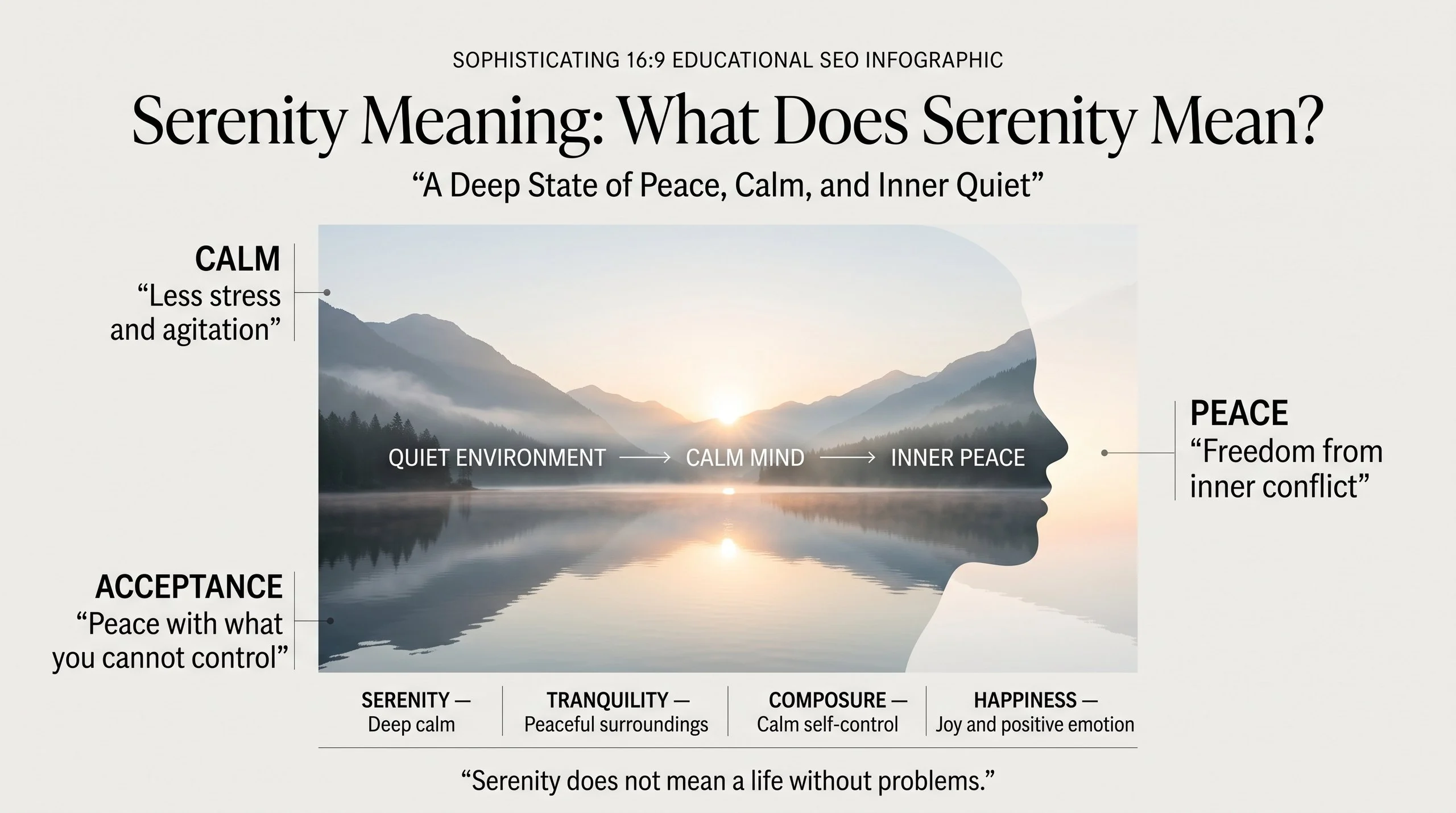
Serenity meaning is a state of calm, peace, and inner quiet. It describes a feeling of being relaxed and undisturbed, even when life is stressful. For example, “She enjoyed the serenity of the mountains” means she enjoyed their peaceful and tranquil atmosphere.
Serenity meaning refers to a deep sense of peace, calmness, and emotional quiet. When someone experiences serenity, they feel free from intense worry, anger, pressure, or disturbance.
The word often describes both an inner emotional state and a peaceful external environment. For example, a person might find serenity while sitting beside a quiet lake. Similarly, someone might maintain serenity during a difficult situation by remaining calm and composed.
You may encounter the word in conversations about mental well-being, nature, meditation, spirituality, literature, relationships, and personal growth. It can describe a peaceful place, a calm person, or a state of mind.
For example:
“The serenity of the garden helped her relax.”
This means the garden created a peaceful and calming atmosphere.
The word can also describe emotional balance:
“He faced the criticism with serenity.”
Here, serenity means he remained calm and undisturbed despite the criticism.
This guide explains serenity meaning, pronunciation, synonyms, examples, related words, common uses, and the difference between serenity and similar concepts such as peace, tranquility, and happiness.
Quick Answer
| Meaning | Context | Primary Platforms | Example | Tone |
|---|---|---|---|---|
| Calm and peaceful state | Emotions | Everyday speech | “She felt a sense of serenity.” | Positive |
| Inner peace | Mental well-being | Conversations | “Meditation brought him serenity.” | Reflective |
| Peaceful atmosphere | Nature | Writing, descriptions | “The lake had a feeling of serenity.” | Calm |
| Freedom from disturbance | Life situations | Formal writing | “She accepted the decision with serenity.” | Mature |
| Tranquility | Places and experiences | Literature, captions | “The garden offered serenity.” | Poetic |
What Does Serenity Mean?
Serenity means a state of peacefulness, calmness, and freedom from disturbance.
It can describe how a person feels internally or how a place feels externally.
For example:
“She felt serenity after spending time in nature.”
The sentence describes an internal feeling of calm.
Meanwhile:
“The serenity of the countryside was breathtaking.”
Here, serenity describes the peaceful quality of the environment.
Therefore, the word has two closely connected uses:
- Inner serenity — a calm and peaceful state of mind.
- Environmental serenity — a quiet, peaceful, and undisturbed atmosphere.
Both meanings revolve around the same central idea:
Peace without disturbance.
Serenity Meaning in Simple English
In simple English:
Serenity means deep calm and peace.
Someone experiencing serenity feels emotionally settled rather than overwhelmed.
A serene place also feels quiet, peaceful, and free from chaos.
For example:
“The quiet beach gave me a sense of serenity.”
This means:
“The quiet beach made me feel peaceful and calm.”
What Does It Mean to Feel Serenity?
To feel serenity means to experience a strong sense of inner peace and calm.
You might feel serenity while:
- Sitting quietly in nature
- Meditating
- Reading
- Praying
- Listening to peaceful music
- Spending time alone
- Walking through a quiet place
- Taking a break from stress
- Accepting something you cannot control
Serenity does not necessarily mean that everything in life is perfect.
Instead, it can mean that you feel calm even when circumstances are imperfect.
Serenity as an Emotional State
Serenity describes a particularly peaceful emotional condition.
Imagine someone receiving disappointing news.
One person might immediately become angry or anxious.
Another person might pause, accept the situation, and respond calmly.
You could describe the second person’s reaction as serene.
For example:
“She responded to the difficult news with serenity.”
The sentence suggests emotional control, acceptance, and calmness.
Serenity and Inner Peace
Inner peace is one of the closest concepts to serenity.
Both describe a calm mental and emotional state.
However, serenity often suggests a particularly quiet, gentle, and undisturbed form of peace.
For example:
“After years of conflict, he finally found serenity.”
This suggests more than simply feeling happy. It suggests reaching a deeper state of emotional calm.
Is Serenity the Same as Happiness?
No.
Serenity and happiness are related, but they describe different emotional experiences.
Happiness
Happiness generally involves:
- Joy
- Pleasure
- Excitement
- Satisfaction
- Positive emotion
Serenity
Serenity involves:
- Calmness
- Peace
- Acceptance
- Emotional balance
- Quiet contentment
A person can experience serenity without feeling excited or joyful.
For example, sitting quietly beside a lake may not make someone feel extremely happy. Instead, it may create a peaceful sense of serenity.
Serenity vs. Peace
Peace is a broad concept.
It can describe:
- A lack of conflict
- A calm environment
- Inner emotional balance
- Harmony between people
Serenity usually emphasizes a deeper sense of calm and stillness.
For example:
“The country entered a period of peace.”
This may refer to the absence of war or conflict.
By contrast:
“She felt serenity while watching the sunset.”
This refers to a personal emotional experience.
Serenity vs. Tranquility
Serenity and tranquility are very close in meaning.
Both describe calmness and freedom from disturbance.
However, tranquility often emphasizes the quietness of a place or situation.
Serenity can describe both an environment and an internal state.
For example:
“The tranquility of the forest was beautiful.”
and:
“He experienced serenity after meditation.”
Both sentences describe calmness, but the second focuses more strongly on the person’s inner state.
Serenity vs. Calmness
Calmness means the absence of agitation, nervousness, or excitement.
Serenity often suggests a deeper and more peaceful form of calmness.
For example:
“She remained calm during the interview.”
This simply means she did not become nervous or agitated.
“She faced the situation with serenity.”
This suggests a deeper sense of peace and acceptance.
Serenity vs. Stillness
Stillness emphasizes a lack of movement, noise, or activity.
Serenity emphasizes peace and emotional calm.
For example:
“The stillness of the morning was beautiful.”
describes the quiet environment.
“The morning gave him a feeling of serenity.”
describes the peaceful emotional response.
The two concepts often appear together.
What Is a Serene Person?
A serene person is someone who appears calm, peaceful, and emotionally composed.
For example:
“Despite the pressure, she remained serene.”
This suggests that she did not allow stress to visibly disturb her.
A serene person is not necessarily emotionless.
Instead, they may simply handle emotions without becoming overwhelmed by them.
What Is a Serene Place?
A serene place is peaceful, quiet, and free from excessive disturbance.
Examples include:
- A quiet beach
- A mountain lake
- A peaceful garden
- A forest at dawn
- A meditation room
- A quiet countryside
- A secluded retreat
For example:
“The garden was a serene place to read.”
The word suggests more than physical silence. It creates an overall feeling of peace.
How Do You Pronounce Serenity?
Serenity is commonly pronounced:
suh-REN-uh-tee
The main stress falls on REN.
A simple pronunciation guide is:
suh-REN-uh-tee
The adjective serene is pronounced:
suh-REEN
So:
serene → serenity
Is Serenity a Noun?
Yes.
Serenity is a noun.
It refers to a state or quality of being peaceful and calm.
For example:
“She enjoyed the serenity of the countryside.”
The adjective is:
serene
For example:
“The countryside was serene.”
Other related forms include:
- Serenely — in a calm or peaceful manner
- Sereneness — the quality of being serene, although less common than serenity
Serenity in a Sentence
Here are natural examples:
- “The lake gave me a feeling of serenity.”
- “She maintained her serenity during the crisis.”
- “I love the serenity of the countryside.”
- “Meditation helps him find serenity.”
- “The garden was filled with serenity.”
- “He spoke with remarkable serenity.”
- “The quiet morning brought a sense of serenity.”
- “She found serenity after leaving the stressful job.”
- “The mountains offered a welcome sense of serenity.”
- “His serenity impressed everyone in the room.”
Serenity in Everyday Conversation
Although serenity sounds somewhat literary, it is still useful in everyday English.
For example:
“I just want some peace and serenity.”
This expresses a desire to escape stress and enjoy a calmer environment.
You might also say:
“This place has such a sense of serenity.”
That means the place feels deeply peaceful.
Serenity in Mental Well-Being
The concept of serenity often appears in discussions about emotional well-being.
People may describe serenity as a state in which they are:
- Less reactive
- More accepting
- Less overwhelmed
- More emotionally balanced
- Comfortable with the present moment
For example:
“She learned to find serenity instead of constantly worrying about the future.”
The sentence suggests developing a calmer relationship with uncertainty.
Serenity does not mean ignoring problems.
Instead, it can involve responding to problems without allowing them to completely control your emotional state.
Serenity and Stress
Stress and serenity are almost opposite experiences.
Stress can involve:
- Pressure
- Worry
- Tension
- Fear
- Overthinking
Serenity involves:
- Calm
- Acceptance
- Peace
- Stillness
- Emotional balance
This is why people often seek serenity during stressful periods.
For example:
“After a stressful week, he needed a little serenity.”
The phrase communicates a desire for rest and emotional calm.
Serenity and Acceptance
Serenity is often associated with acceptance.
When people stop fighting things they cannot control, they may experience greater calm.
For example:
“She accepted what she could not change and found serenity.”
This does not mean giving up on everything.
Instead, it can mean recognizing the difference between what you can control and what you cannot.
The Serenity Prayer
The word serenity is also widely recognized because of the Serenity Prayer, which begins with a request for serenity to accept things that cannot be changed.
The phrase has become culturally familiar beyond its original religious context.
Today, people sometimes refer to the idea of serenity more broadly when discussing:
- Acceptance
- Resilience
- Emotional strength
- Personal growth
- Coping with uncertainty
The central idea remains the same: maintaining peace while dealing with circumstances you cannot fully control.
Serenity in Nature
Nature is frequently associated with serenity.
A quiet natural environment can create a feeling of peace because it often contains fewer distractions and less artificial noise.
For example:
“The serenity of the forest made her forget about the busy city.”
Common descriptions include:
- Serene lake
- Serene beach
- Serene forest
- Serene garden
- Serene landscape
- Serene countryside
- Serene mountains
These phrases emphasize quiet beauty and calmness.
Serenity in Meditation
Meditation is another context where the word appears frequently.
Someone might say:
“Meditation helps me find serenity.”
This means meditation helps the person develop a calmer and more peaceful state of mind.
The word fits naturally because meditation often emphasizes:
- Stillness
- Awareness
- Breathing
- Acceptance
- Reduced distraction
However, serenity does not require meditation.
People can experience it through many different activities and situations.
Serenity in Spirituality
Serenity can have a spiritual dimension.
Different spiritual traditions discuss concepts related to:
- Inner peace
- Acceptance
- Detachment
- Compassion
- Stillness
- Mindfulness
For some people, serenity comes from prayer or spiritual practice.
For others, it comes from nature, reflection, relationships, or personal acceptance.
The word itself does not require a specific religious belief.
Serenity in Literature
Writers often use serenity to create an atmosphere of peace.
For example:
“The village rested in evening serenity.”
This kind of language creates a calm visual and emotional impression.
The word is particularly useful in descriptions of:
- Landscapes
- Quiet rooms
- Peaceful mornings
- Nature
- Emotional transformation
- Characters who remain composed
Because of its gentle tone, serenity is common in poetic and descriptive writing.
Serenity in Relationships
Serenity can also describe a healthy emotional atmosphere in relationships.
For example:
“Their relationship gave her a sense of serenity.”
This suggests that the relationship feels safe, stable, peaceful, and emotionally reassuring.
Similarly:
“He valued serenity over unnecessary conflict.”
This indicates a preference for calm communication rather than constant arguments.
Serenity in the Workplace
Although the word can sound poetic, it can also describe a professional environment.
For example:
“The quiet office created a sense of serenity.”
Or:
“She handled the difficult meeting with serenity.”
In the second example, serenity describes the person’s emotional composure rather than the physical workplace.
Is Serenity a Positive Word?
Yes.
Serenity has a strongly positive and peaceful connotation.
It usually suggests:
- Emotional stability
- Peace
- Calmness
- Contentment
- Relaxation
- Acceptance
Calling someone serene is generally a compliment.
For example:
“She has a serene presence.”
This suggests that being around her feels calming.
Serenity Synonyms
Here are some common synonyms for serenity:
| Synonym | Meaning | Nuance |
|---|---|---|
| Peace | Freedom from conflict or disturbance | Broad |
| Calmness | Lack of agitation | Emotional |
| Tranquility | Quiet and peaceful condition | Environmental |
| Stillness | Lack of movement or noise | Quiet |
| Composure | Calm self-control | Personal |
| Equanimity | Mental balance under pressure | Formal |
| Peacefulness | State of being peaceful | General |
| Repose | Rest or calm | Literary |
| Quietude | State of quietness | Literary |
| Harmony | Agreement and balance | Relational |
The best synonym depends on the sentence.
Serenity vs. Composure
These words overlap but are not identical.
Composure focuses on a person’s ability to remain controlled during pressure.
Serenity focuses more on inner peace and calm.
For example:
“She maintained her composure during the argument.”
This emphasizes self-control.
“She maintained her serenity throughout the difficult period.”
This suggests a deeper sense of peacefulness.
Serenity vs. Equanimity
Equanimity is another related word.
It means maintaining mental and emotional balance, especially during difficult circumstances.
For example:
“He accepted the criticism with equanimity.”
This suggests calm emotional balance.
Serenity sounds softer and more peaceful.
Equanimity often emphasizes steadiness under pressure.
Serenity vs. Contentment
Contentment means being satisfied with what you have or with your current situation.
Serenity means being peaceful and calm.
A person can be content without feeling deeply serene.
Likewise, someone can feel serene without feeling particularly happy or satisfied.
The words overlap, but they emphasize different emotional qualities.
Common Mistakes With Serenity
Mistake 1: Thinking Serenity Means Happiness
Serenity means peace and calm, not necessarily joy or excitement.
Mistake 2: Assuming Serenity Means Silence
A place can be serene even if there are gentle sounds.
Serenity describes the overall peaceful quality, not simply the absence of noise.
Mistake 3: Using Serene Only for Places
You can describe both people and places as serene.
For example:
“She remained serene.”
and:
“The garden was serene.”
Mistake 4: Thinking Serenity Means No Problems
A person can experience serenity while dealing with serious difficulties.
Serenity describes their emotional response, not the absence of problems.
Mistake 5: Confusing Serenity With Boredom
Serenity is peacefulness, not lack of interest.
A calm experience can still be meaningful and enjoyable.
How to Use Serenity Correctly
Use serenity when you want to emphasize a peaceful state or atmosphere.
Natural patterns include:
a sense of serenity
a feeling of serenity
find serenity
experience serenity
maintain serenity
the serenity of nature
inner serenity
Examples:
“She found serenity in the mountains.”
“The room had a wonderful sense of serenity.”
“He maintained his serenity during the crisis.”
These constructions sound natural and clear.
Serenity in Social Media Captions
The word also works well in social media captions because it has a peaceful, reflective tone.
Examples include:
“Finding serenity in the little things.”
“A little serenity goes a long way.”
“Morning light and pure serenity.”
“Nothing but peace and serenity.”
“Finding my serenity.”
These captions usually communicate calmness, relaxation, nature, or self-care.
Serenity as a Baby Name or Personal Name
Serenity is also used as a given name.
As a name, it carries the same general associations:
- Peace
- Calm
- Grace
- Tranquility
- Gentleness
The name became popular partly because of its positive emotional meaning.
However, the dictionary meaning of the word remains a state of peaceful calm.
How to Remember the Meaning of Serenity
A simple memory trick is:
Serenity = serious peace and calm.
Think of a quiet lake at sunrise.
There is no chaos.
There is no pressure.
Everything feels calm.
That atmosphere represents serenity.
Another simple formula is:
Serenity = Peace + Calm + Inner Quiet
FAQs
What does serenity mean?
Serenity means a state of deep peace, calmness, and emotional quiet. It can describe both a person’s inner state and a peaceful environment.
What is an example of serenity?
A quiet lake at sunrise can create a sense of serenity. A person who remains calm during a stressful situation can also demonstrate serenity.
Is serenity the same as happiness?
No. Happiness involves joy or pleasure, while serenity emphasizes calmness, peace, acceptance, and emotional balance.
What is another word for serenity?
Common synonyms include peace, tranquility, calmness, peacefulness, stillness, composure, and equanimity.
What does serenity mean in a person?
In a person, serenity describes a peaceful and emotionally composed state. A serene person appears calm rather than overwhelmed or agitated.
What does serenity mean in a relationship?
Serenity in a relationship suggests a peaceful, stable, and emotionally reassuring connection with little unnecessary conflict or tension.
Is serenity a positive word?
Yes. Serenity has a strongly positive meaning and usually suggests peace, emotional balance, calmness, and contentment.
What is the difference between serenity and tranquility?
Both mean peaceful calm. Tranquility often emphasizes a quiet environment, while serenity can describe both an environment and an inner emotional state.
How do you pronounce serenity?
Serenity is commonly pronounced “suh-REN-uh-tee,” with the main stress on the second syllable.
Can serenity exist during difficult times?
Yes. Serenity does not require a problem-free life. A person can remain peaceful and emotionally balanced while facing difficult circumstances.
Conclusion
The serenity meaning is centered on peace, calmness, and inner quiet.
Serenity can describe a person’s emotional state or the atmosphere of a peaceful place. Someone may find serenity while sitting beside a lake, walking through a quiet forest, meditating, reading, praying, or simply taking a break from daily stress.
The word is closely related to peace, tranquility, calmness, composure, and contentment, but each term has its own nuance. Serenity often suggests a deeper and gentler form of calm that can exist even when life is not perfect.
It is also important to remember that serenity does not mean the absence of problems. A person can experience difficult circumstances and still respond with serenity. In that sense, serenity can involve acceptance, emotional balance, and the ability to remain peaceful during uncertainty.
Whether you use the word to describe a quiet landscape, a peaceful relationship, or a calm state of mind, its central idea remains consistent:
Serenity = deep peace and calm.
Simply put, when something or someone gives you a feeling of quiet, peaceful, undisturbed calm, you can describe that experience as serenity.