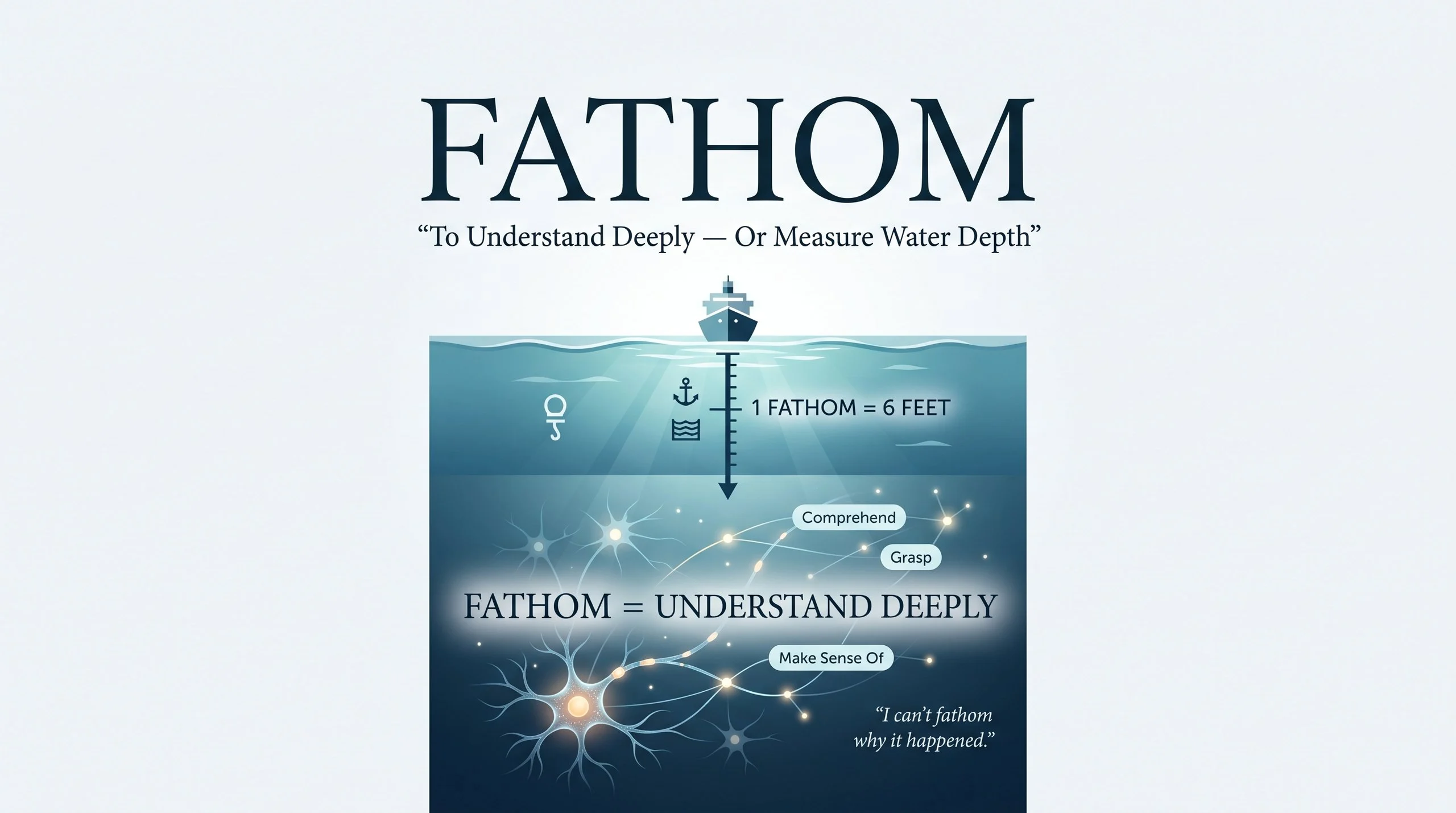
Fathom meaning refers to understanding something deeply or completely, especially when it is difficult to explain or comprehend. As a noun, a fathom is also a unit of water depth equal to six feet, commonly used in maritime contexts.
Fathom meaning can be confusing because the word has two major uses. As a verb, fathom means to understand something deeply or figure out something that seems difficult. As a noun, a fathom is a measurement of depth used mainly for water.
For example, someone might say, “I can’t fathom why she left.” Here, the word means “I can’t understand or imagine the reason.” However, a sailor might say, “The water is twenty fathoms deep.” In that sentence, fathom refers to a unit of measurement.
The verb is especially common in expressions involving difficult ideas, surprising events, complicated situations, or unexpected behavior. It often suggests that ordinary understanding is not enough.
Meanwhile, the measurement sense has a long connection with navigation and maritime language. One fathom equals six feet, or about 1.83 meters.
Therefore, context matters when interpreting the word. This guide explains the fathom meaning, its history, grammatical uses, examples, synonyms, common mistakes, idioms, and differences from related words.
What Does Fathom Mean?
| Meaning | Context | Primary Platforms | Example | Tone |
|---|---|---|---|---|
| To understand something deeply; also a unit of water depth | Everyday English, literature, maritime language | Conversation, writing, books, technical contexts | “I can’t fathom what happened.” | Neutral to expressive |
In simple English, fathom as a verb means to understand something that is difficult to understand. As a noun, it means a unit of depth equal to six feet.
What Does Fathom Mean?
The fathom meaning depends on whether the word functions as a verb or a noun.
Fathom as a Verb
As a verb, fathom means to understand, comprehend, or figure out something deeply.
For example:
“I can’t fathom why he made that decision.”
This means:
“I can’t understand why he made that decision.”
The word often appears when the speaker finds something difficult to explain.
Consider another example:
“Scientists are still trying to fathom the mystery.”
Here, fathom suggests a serious attempt to understand something complicated.
Fathom as a Noun
As a noun, a fathom is a traditional unit of length used to measure water depth.
One fathom equals:
6 feet = 1.8288 meters
For example:
“The ship was sailing through water twenty fathoms deep.”
In modern everyday American English, people usually encounter this meaning in maritime, nautical, historical, or technical contexts.
The Origin of the Word Fathom
The history of fathom helps explain why the word developed its two meanings.
The noun originally related to the span of a person’s outstretched arms. That measurement eventually became associated with the standard nautical unit used for measuring water depth.
The idea of measuring depth later influenced the figurative verb.
To fathom something came to mean going deeply into an idea, problem, or mystery. In other words, the metaphor shifted from physical depth to intellectual depth.
That connection remains visible today.
When someone says:
“I can’t fathom it.”
They are figuratively saying that the idea is too deep or difficult for them to fully grasp.
Fathom Meaning in Different Contexts
The word can communicate slightly different ideas depending on the sentence.
1. Understanding a Difficult Idea
This is one of the most common modern uses.
“I couldn’t fathom the complexity of the problem.”
Here, the speaker could not fully understand the problem.
2. Understanding Someone’s Behavior
The word often describes confusion about another person’s actions.
“I can’t fathom why he would do that.”
This means the person’s decision seems difficult to understand.
3. Understanding an Unexpected Situation
The word can also express surprise.
“She couldn’t fathom what had happened.”
The speaker found the situation difficult to comprehend.
4. Understanding an Abstract Concept
You can use fathom for complicated thoughts or ideas.
“It is hard to fathom the scale of the universe.”
The sentence emphasizes how difficult the concept is to fully comprehend.
5. Measuring Water Depth
The noun appears in nautical contexts.
“The chart shows a depth of twelve fathoms.”
Here, the word has its literal measurement meaning.
Fathom Meaning in Everyday English
In modern conversation, people usually use fathom as a verb.
The phrase:
“I can’t fathom it.”
is particularly common.
It can mean:
- I can’t understand it.
- I can’t figure it out.
- I can’t imagine it.
- I can’t make sense of it.
- I don’t understand how or why it happened.
However, fathom often sounds slightly more expressive than simply saying “understand.”
Compare:
“I don’t understand why he left.”
with:
“I can’t fathom why he left.”
The second sentence suggests stronger confusion or disbelief.
Real-Life Conversation Examples Using Fathom
Example 1: Confusing Decision
Maya: “Did Chris really quit his job?”
Jordan: “Yes. I still can’t fathom why he did it.”
Here, fathom means understand or make sense of.
Example 2: Unexpected Result
Sam: “The project failed despite months of preparation.”
Alex: “I can’t fathom how that happened.”
The speaker is expressing difficulty understanding the result.
Example 3: Difficult Concept
Student: “Do you understand quantum physics?”
Friend: “Some of it, but I can’t fathom the more complicated parts.”
The word refers to deep comprehension.
Example 4: Emotional Situation
Friend: “She suddenly moved across the country.”
Taylor: “I can’t fathom leaving everything behind like that.”
Here, the word suggests that the speaker cannot fully imagine or understand the decision.
Example 5: Maritime Context
Sailor: “How deep is the water here?”
Captain: “The chart shows about fifteen fathoms.”
In this example, fathom is a measurement of water depth rather than a synonym for understanding.
How to Use Fathom in a Sentence
The verb fathom commonly appears with words such as:
- why
- how
- what
- the reason
- the meaning
- the mystery
- the complexity
- the situation
Examples include:
“I can’t fathom why she left.”
“He struggled to fathom the reason.”
“Researchers are trying to fathom the mystery.”
“We couldn’t fathom what had happened.”
“It is difficult to fathom the scale of the project.”
The construction “can’t fathom” is especially common.
Common Phrase: “I Can’t Fathom”
The expression “I can’t fathom” means that something is extremely difficult to understand, explain, or imagine.
For example:
“I can’t fathom why anyone would behave that way.”
This does not necessarily mean the speaker has no information. Instead, the speaker cannot make logical or emotional sense of the situation.
Why Is “Can’t Fathom” So Common?
The expression works well when something seems:
- Confusing
- Surprising
- Unreasonable
- Complicated
- Unbelievable
- Difficult to imagine
Consequently, the phrase often appears in conversations about unusual decisions or unexpected events.
Fathom vs. Understand
These words are close, but they are not always interchangeable in tone.
| Word | Meaning | Typical Feeling |
|---|---|---|
| Understand | Know what something means | Neutral |
| Fathom | Understand something deeply or with difficulty | Stronger or more expressive |
| Comprehend | Understand something intellectually | Formal |
| Grasp | Understand an idea | Neutral |
| Figure out | Find an answer or explanation | Informal |
For example:
“I understand the problem.”
This is straightforward.
“I can’t fathom the problem.”
This suggests that the problem is unusually difficult or confusing.
Therefore, fathom often adds emotional or intellectual depth to the sentence.
Fathom vs. Comprehend
Both words can mean “understand,” but they have different stylistic qualities.
Comprehend often sounds formal or academic.
“The student comprehended the concept.”
Fathom often sounds more expressive.
“I can’t fathom why this happened.”
Thus, comprehend focuses on intellectual understanding, while fathom often emphasizes the difficulty of reaching that understanding.
Fathom vs. Figure Out
These expressions overlap, but they are used differently.
Figure out often means finding a solution or discovering an answer.
“I’ll figure out how to fix the computer.”
Fathom focuses more on understanding something deeply.
“I can’t fathom why the computer suddenly stopped working.”
So, someone can figure out a problem without necessarily fathoming all of its deeper implications.
Fathom vs. Grasp
Grasp and fathom can both refer to understanding.
However, “grasp” is often used for ideas or concepts:
“I finally grasp the concept.”
Meanwhile, “fathom” frequently appears when something remains difficult to understand:
“I can’t fathom the reason for the decision.”
Both are correct, but the emotional tone differs.
Fathom as a Measurement
The noun has a completely different literal meaning.
A fathom is equal to six feet.
Therefore:
- 1 fathom = 6 feet
- 2 fathoms = 12 feet
- 5 fathoms = 30 feet
- 10 fathoms = 60 feet
- 20 fathoms = 120 feet
In metric terms, one fathom equals approximately 1.83 meters.
The measurement is primarily associated with water depth.
Example
“The vessel entered waters that were only three fathoms deep.”
This means the water was approximately 18 feet deep.
Although the unit still appears in nautical language, most people do not use it in everyday measurements.
Fathom in Maritime Language
The nautical sense remains important because sailors and navigators have historically needed precise ways to describe water depth.
For example:
“The map indicates a depth of thirty fathoms.”
A nautical chart may use fathoms to communicate water depth, especially in contexts where traditional maritime terminology remains relevant.
Therefore, when you encounter fathom near words such as:
- Ship
- Ocean
- Sea
- Water
- Depth
- Sailor
- Nautical chart
- Harbor
the measurement meaning is likely intended.
Alternative Meanings & NLP Variations of Fathom
Search engines and language models may associate fathom with several semantic concepts.
Understand
The most common modern synonym.
Comprehend
To understand something intellectually.
Grasp
To understand an idea or concept.
Figure Out
To discover or solve something.
Make Sense Of
To understand the meaning or logic behind something.
Get
An informal way to say “understand.”
Perceive
To recognize or understand something.
Analyze
To examine something carefully in order to understand it.
Explore
To investigate something deeply.
Measure
Relevant to the noun sense involving water depth.
Depth
A related concept because a fathom measures depth and the verb carries a figurative idea of going deeply into understanding.
Synonyms for Fathom
When fathom is used as a verb, suitable synonyms include:
- Understand
- Comprehend
- Grasp
- Figure out
- Make sense of
- Discern
- Perceive
- Analyze
- Interpret
- Decode
The best synonym depends on the sentence.
For example, understand works in almost every context. Figure out sounds more conversational, while comprehend sounds more formal.
When Not to Use Fathom
Although fathom is a useful word, it does not fit every situation.
1. For Simple Information
Saying:
“I can’t fathom what two plus two equals.”
sounds unnatural because the answer is simple.
Instead:
“I don’t know the answer.”
would be more appropriate.
2. For Ordinary Instructions
If someone explains how to open a door, saying:
“I can’t fathom how to open it.”
would sound overly dramatic unless the situation is genuinely confusing.
3. As a General Replacement for “Know”
You should not replace every instance of know with fathom.
“I know his name” does not normally become “I fathom his name.”
The word concerns understanding, not simple possession of information.
4. For Every Type of Emotional Reaction
Fathom can express disbelief or confusion, but it does not directly mean “hate,” “dislike,” “fear,” or “disagree.”
Context determines the intended emotion.
Common Mistakes With Fathom
Mistake 1: Assuming It Only Means Depth
Because the noun refers to water depth, some readers assume the word is always nautical.
However, the verb is common in general English.
Mistake 2: Treating It as Exactly the Same as “Know”
Fathom involves understanding or figuring something out.
It does not simply mean having information.
Mistake 3: Using It for Easy Concepts
The word often works best when the subject involves complexity, mystery, surprise, or difficulty.
Mistake 4: Confusing the Two Parts of Speech
Compare:
“I cannot fathom the decision.”
Here, fathom is a verb.
“The water is ten fathoms deep.”
Here, fathoms is a noun.
Recognizing the grammatical role makes the intended meaning clear.
How to Respond When Someone Says “I Can’t Fathom”
The best response depends on the conversation.
If someone says:
“I can’t fathom why she did that.”
You could respond:
“Maybe she felt she had no other option.”
If someone says:
“I can’t fathom how this happened.”
You might say:
“Neither can I. The situation changed very quickly.”
If they use the phrase jokingly, a casual response can work:
“Honestly, same.”
The expression usually communicates confusion, so a helpful response can provide an explanation or acknowledge the uncertainty.
Fathom in Literature and Formal Writing
The word is especially useful when a writer wants to express intellectual or emotional depth.
For example:
“No one could fathom the consequences of the decision.”
This sounds more expressive than:
“No one could understand the consequences of the decision.”
Similarly:
“The scale of the disaster was difficult to fathom.”
The sentence suggests that the scale was so enormous that ordinary understanding struggled to capture it.
Because of this quality, fathom frequently appears in journalism, essays, literature, speeches, and reflective writing.
Fathom Meaning in Modern Digital Communication
Unlike many internet slang terms, fathom is not primarily a social-media abbreviation.
Still, people may use it in posts, comments, captions, and messages.
For example:
“I genuinely can’t fathom this.”
This could appear as a reaction to surprising news, an unusual decision, or an unexpected situation.
The digital use usually keeps the traditional verb meaning. Social media does not create a separate slang definition for the word.
FAQs
1. What does fathom mean?
Fathom means to understand something deeply, especially when it is difficult, complicated, or surprising. It can also mean a unit of water depth equal to six feet.
2. What does “I can’t fathom” mean?
“I can’t fathom” means “I can’t understand,” “I can’t figure out,” or “I can’t imagine.” It often expresses strong confusion or disbelief.
3. Is fathom a synonym for understand?
Yes. As a verb, fathom can mean understand or comprehend. However, it often suggests that the subject is difficult to understand.
4. What does one fathom equal?
One fathom equals six feet, or approximately 1.83 meters. It is traditionally used to measure water depth.
5. Is fathom a verb or noun?
It can be both. As a verb, it means to understand deeply. As a noun, it refers to a unit of length equal to six feet.
6. What is an example of fathom as a verb?
“I can’t fathom why he made that decision.” Here, fathom means understand or make sense of.
7. What is an example of fathom as a noun?
“The water was ten fathoms deep.” Here, fathoms refers to units of water depth.
8. Is fathom formal or informal?
It is a neutral-to-formal word. It can appear in everyday conversation, especially in the expression “I can’t fathom,” as well as in formal writing.
9. What are common synonyms for fathom?
Common synonyms include understand, comprehend, grasp, figure out, make sense of, and discern.
10. Why does fathom have two different meanings?
The two meanings are historically connected. The original physical idea involved measuring a person’s arm span and later water depth. The verb developed a figurative sense of going deeply into an idea or problem.
Conclusion
The fathom meaning is built around the idea of depth. As a verb, it means to understand, comprehend, or make sense of something that may be difficult or surprising. As a noun, it describes a traditional unit of water depth equal to six feet.
In everyday English, the expression “I can’t fathom” is especially useful when something seems difficult to understand or imagine. Meanwhile, the measurement sense appears mainly in nautical and maritime contexts.
Therefore, context makes the intended meaning easy to identify. When the word describes a mystery, decision, idea, or situation, it usually means understand deeply. When it describes ocean or water depth, it refers to the six-foot nautical measurement.
Understanding both meanings makes fathom a useful example of how English can connect a literal physical concept with a figurative idea of deep understanding.