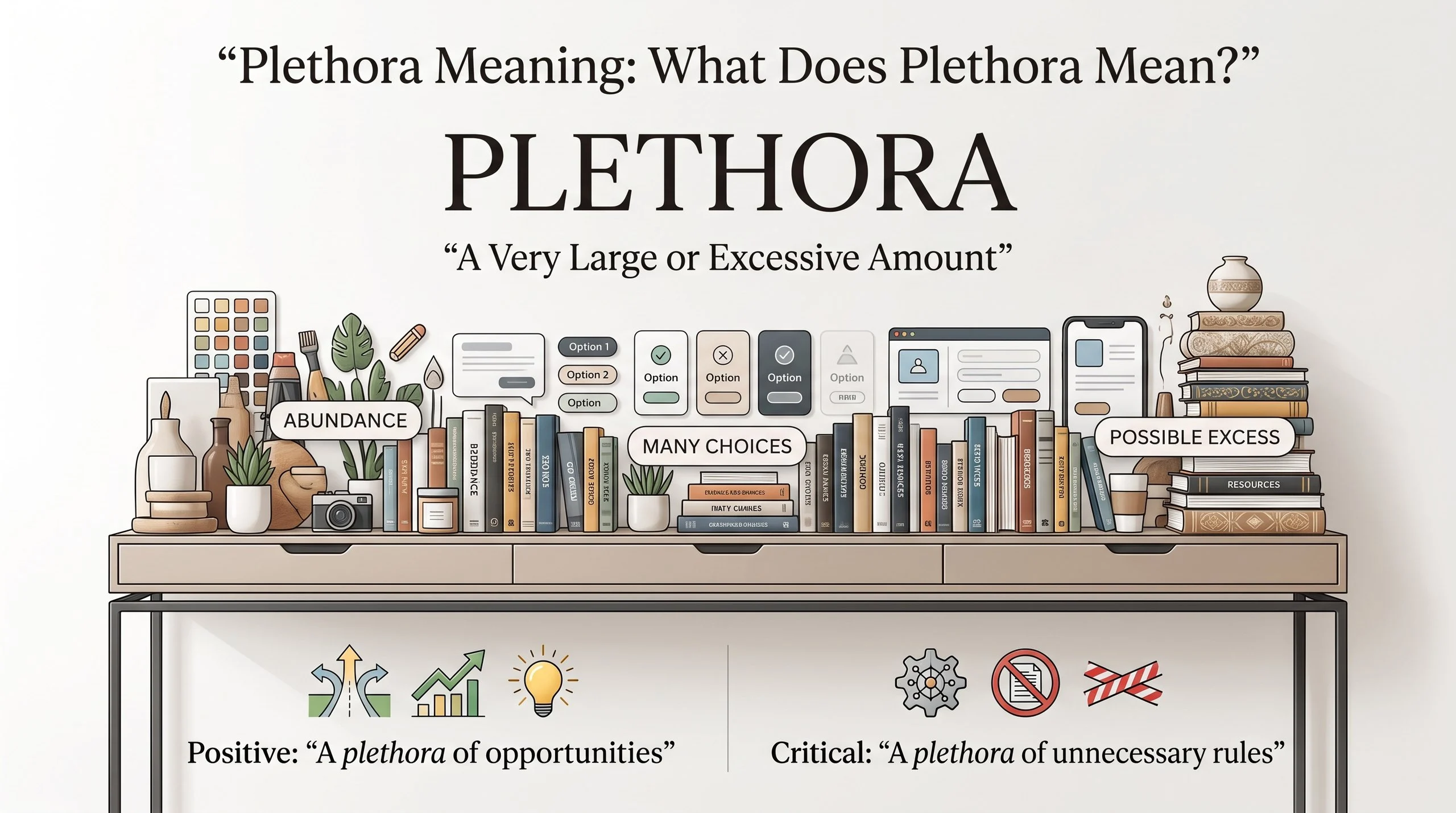
Plethora meaning refers to a large or excessive amount of something. In modern English, it usually describes an abundance or overabundance of people, things, choices, information, or opportunities, often suggesting that there is more than enough.
Plethora meaning is commonly connected with the idea of having a very large amount of something. If someone says there is a plethora of choices, they mean there are many choices available, perhaps even more than necessary.
The word can describe both tangible and intangible things. For example, a store may offer a plethora of products, while a website may contain a plethora of information.
In modern American English, plethora often sounds somewhat formal. It works especially well in professional writing, journalism, academic discussion, and polished conversation. However, people also use it casually when they want to emphasize that something exists in abundance.
The word originally had a more specific medical meaning. Over time, its usage expanded, and today it commonly means a large quantity or excessive amount.
Importantly, plethora can be either neutral or slightly critical depending on context. A “plethora of opportunities” can sound positive, while a “plethora of unnecessary rules” suggests that there are too many.
This guide explains the plethora meaning, its origin, grammatical use, examples, synonyms, common phrases, differences from related words, and natural ways to use it.
What Does Plethora Mean?
| Meaning | Context | Primary Platforms | Example | Tone |
|---|---|---|---|---|
| A very large or excessive amount of something | Everyday, professional, academic, and formal English | Writing, conversation, social media, business | “The website offers a plethora of resources.” | Neutral, positive, or critical |
In simple English, plethora means a very large amount or an abundance of something. Depending on the sentence, it can also suggest that there is more of something than needed.
What Does Plethora Mean?
The plethora meaning is essentially a large amount, abundance, or excess.
For example:
“The library has a plethora of books.”
This means the library has a very large number of books.
Another example is:
“There are a plethora of options available.”
This means there are many options to choose from.
The word does not always mean “too much.” Context determines whether the quantity is simply large or excessive.
Compare these examples:
“The conference offered a plethora of networking opportunities.”
This sounds positive. The many opportunities are presented as useful.
“The company has a plethora of complicated procedures.”
This sounds more critical. The procedures may be unnecessarily numerous.
Therefore, plethora can communicate abundance without automatically expressing approval or criticism.
The Origin of the Word Plethora
The history of plethora gives the word an interesting connection to its modern meaning.
The word comes from Greek and originally referred to fullness or an excessive condition. It entered English through medical terminology, where it was historically associated with an excess of bodily fluids or blood.
Over time, the word moved beyond medicine.
Today, English speakers commonly use plethora for a large quantity of almost anything:
- Information
- Choices
- Products
- Opportunities
- Resources
- Ideas
- Problems
- Services
- Opinions
- Examples
As a result, the modern meaning is much broader than the original medical sense.
Plethora Meaning in Everyday English
In everyday English, plethora is often a more sophisticated alternative to words such as many, lots, or abundance.
For example:
“We have many choices.”
is simple and direct.
Meanwhile:
“We have a plethora of choices.”
sounds more polished and emphasizes the unusually large number of choices.
However, plethora should not be used simply to make every sentence sound formal. Sometimes “many” or “a lot of” is clearer.
The best writing uses the word when the idea of abundance is important.
How to Use Plethora in a Sentence
The most common grammatical pattern is:
a plethora of + plural noun
Examples include:
“She has a plethora of ideas.”
“The store offers a plethora of products.”
“We found a plethora of useful resources.”
“The internet contains a plethora of information.”
“The city provides a plethora of entertainment options.”
This construction is extremely common because plethora functions as a noun referring to a large quantity.
Can Plethora Stand Alone?
Yes, but it is less common in everyday writing.
For example:
“The choices are a plethora.”
This sentence sounds unnatural in modern English.
A much more natural construction is:
“There is a plethora of choices.”
Therefore, learners should remember the common pattern “a plethora of.”
Is Plethora Singular or Plural?
This question often causes confusion.
Plethora is a singular noun.
Therefore, when it functions as the subject, singular agreement is generally appropriate in formal American English.
For example:
“A plethora of options is available.”
The main noun is plethora, not “options.”
However, the phrase can sometimes create uncertainty because “options” is plural. In careful writing, treating plethora as singular avoids ambiguity.
A useful pattern is:
A plethora of + plural noun + singular verb
Example:
“A plethora of resources is available online.”
Real-Life Conversation Examples Using Plethora
Example 1: Shopping
Mia: “Which laptop should I buy?”
Alex: “There’s a plethora of options. Let’s narrow them down by price.”
Here, plethora means a very large number of choices.
Example 2: Studying
Student: “I need sources for my research paper.”
Teacher: “The library has a plethora of academic resources.”
The word emphasizes the large quantity of available material.
Example 3: Travel
Friend: “What can we do in the city?”
Taylor: “There’s a plethora of activities, from museums to outdoor tours.”
The word highlights the wide range of activities.
Example 4: Work
Manager: “Why haven’t you selected a design yet?”
Designer: “There is a plethora of concepts to choose from.”
The speaker has many possibilities.
Example 5: Technology
Friend: “I want to learn graphic design.”
Jordan: “There are a plethora of online courses.”
The phrase means there are many courses available.
Contextual Dynamics & Nuances of Plethora
The emotional effect of plethora depends heavily on what follows it.
Positive Context
The word can describe abundance as a benefit.
“The university provides a plethora of learning opportunities.”
This suggests students have many useful opportunities.
Neutral Context
Sometimes it simply describes quantity.
“The report contains a plethora of statistics.”
The speaker is pointing out that the report contains many statistics.
Negative Context
The word can also suggest excess.
“The application has a plethora of unnecessary features.”
Here, the large number is presented as a problem.
Overwhelming Context
A plethora can also suggest that the quantity makes choosing difficult.
“The website gives users a plethora of choices.”
Depending on context, this may be convenient or overwhelming.
Therefore, plethora does not automatically mean “too much.” The surrounding language provides the attitude.
Plethora vs. Abundance
These words are very similar.
| Word | Meaning | Typical Nuance |
|---|---|---|
| Plethora | A very large or excessive amount | Can imply more than necessary |
| Abundance | A large amount or plentiful supply | Usually positive or neutral |
| Excess | More than needed | Clearly suggests too much |
| Surplus | More than required | Often used for supplies or resources |
| Multitude | A very large number | Often refers to people or things |
For example:
“The garden has an abundance of flowers.”
This usually sounds positive.
“The garden has a plethora of flowers.”
This emphasizes the large quantity but does not necessarily express a strong opinion.
“The garden has an excess of flowers.”
This suggests there are more flowers than needed.
Plethora vs. Multitude
Multitude means a large number or crowd.
For example:
“A multitude of people attended the event.”
The word often works well with people, although it can describe things too.
Plethora, on the other hand, emphasizes abundance and sometimes excess.
“The website contains a plethora of articles.”
Thus, both words indicate a large quantity, but their emphasis differs.
Plethora vs. Surplus
A surplus is specifically an amount that remains beyond what is needed.
For example:
“The farm produced a surplus of wheat.”
The word implies that production exceeded requirements.
Plethora is broader.
“The farm offers a plethora of agricultural products.”
This simply indicates a large selection or variety.
Therefore, do not automatically replace surplus with plethora.
Plethora vs. Excess
These words overlap, but excess has a stronger negative or critical meaning.
“The meal contained a plethora of spices.”
This could simply mean there were many spices.
“The meal contained an excess of salt.”
This clearly suggests that too much salt was used.
Consequently, plethora is more flexible and can be positive, neutral, or mildly critical.
Plethora vs. Abundance vs. Plenty
All three words communicate a large quantity.
Plenty
“Plenty” is informal and natural.
“We have plenty of time.”
Abundance
“Abundance” is neutral and often positive.
“The region has an abundance of natural resources.”
Plethora
“Plethora” is more formal and can imply an unusually large or excessive amount.
“The region has a plethora of natural attractions.”
Choosing between them depends on tone and context.
Synonyms for Plethora
Common synonyms include:
- Abundance
- Excess
- Surplus
- Plenty
- Wealth
- Multitude
- Myriad
- Profusion
- Overflow
- Large number
- Vast quantity
- Wide range
However, these words are not always interchangeable.
For example, myriad often emphasizes a very large number, while surplus specifically suggests more than necessary.
Alternative Meanings & NLP Variations of Plethora
Search engines and language models connect plethora with several related concepts.
Abundance
A plentiful supply of something.
Profusion
A large or excessive amount, often involving something visually or richly present.
Myriad
A very large number.
Multitude
A large number or collection of people or things.
Excess
More than necessary.
Wealth
A large supply or abundance, especially of valuable things.
Overabundance
An amount that is more than needed.
Variety
A collection containing many different types.
Vast Number
A very large quantity of countable things.
Wide Range
Many different choices, types, or possibilities.
When Not to Use Plethora
Although plethora is grammatically useful, it can sound unnatural in certain situations.
1. Very Casual Conversations
If you are talking to a friend, saying:
“I have a plethora of snacks.”
is grammatically correct, but it may sound deliberately formal or humorous.
A more natural sentence would be:
“I have plenty of snacks.”
2. When You Mean One or Two Things
A plethora implies a large amount.
Therefore:
“I have a plethora of two choices.”
does not make sense.
3. When You Mean a Specific Surplus
If you want to emphasize that there is more than required, excess or surplus may be more precise.
4. When Clarity Matters More Than Style
In simple instructions, “many” may be clearer than “plethora.”
For example:
“There are many ways to solve this problem.”
is more direct than:
“There is a plethora of ways to solve this problem.”
Both can work, but the first is simpler.
Common Mistakes With Plethora
Mistake 1: Assuming Plethora Always Means “Too Much”
It can imply excess, but it can also simply mean a large amount.
Mistake 2: Using “Plethoras” Unnecessarily
The standard phrase is usually:
“a plethora of options”
rather than trying to pluralize the noun in ordinary contexts.
Mistake 3: Using It for Small Quantities
A plethora should describe a substantial amount.
Mistake 4: Treating It as an Adjective
Plethora is a noun.
You should say:
“a plethora of choices”
rather than trying to use “plethora” directly as an adjective.
Mistake 5: Assuming It Always Sounds Positive
Context controls the tone.
“A plethora of opportunities” sounds positive.
“A plethora of complications” sounds negative.
Is Plethora a Positive or Negative Word?
It can be either.
The word itself mainly describes quantity. The noun that follows it usually determines the emotional tone.
Positive
“A plethora of career opportunities.”
Neutral
“A plethora of statistics.”
Negative
“A plethora of unnecessary regulations.”
Therefore, it is better to think of plethora as a flexible quantity word rather than a strictly positive or negative term.
Is Plethora Formal or Informal?
Plethora is generally considered a formal or moderately sophisticated word.
It appears frequently in:
- Academic writing
- Professional communication
- Journalism
- Essays
- Business writing
- Presentations
- Formal conversation
Still, it can appear in casual speech, especially when someone wants to emphasize abundance or sound playful.
For example:
“There’s a plethora of pizza at the party.”
The sentence is understandable, but “a ton of pizza” would sound more casual.
How to Respond When Someone Uses Plethora
Because plethora is usually straightforward, you can respond normally.
If someone says:
“There are a plethora of choices.”
You could say:
“That’s exactly why I can’t decide.”
If they say:
“The course offers a plethora of resources.”
You might respond:
“That’s helpful. I’ll start with the beginner materials.”
If someone uses the word in a formal conversation and you are unsure about its meaning, you can interpret it as a large amount or abundance.
Plethora in Writing and Professional Communication
The word can strengthen writing when used precisely.
Compare:
“The report includes many examples.”
with:
“The report includes a plethora of examples.”
The second sentence emphasizes the unusually large number of examples.
However, stronger vocabulary does not automatically make writing better. If “many” communicates the idea clearly, there is no need to replace it.
Good usage depends on context.
For professional writing, plethora works particularly well when you want to emphasize abundance without using a highly informal expression such as “tons of.”
Plethora in Modern Digital Communication
Plethora is not internet slang. Its traditional meaning remains intact across social media, texting, websites, and online discussions.
You might see sentences such as:
“There are a plethora of tutorials on YouTube.”
or:
“The comments have a plethora of opinions.”
On social platforms, the word may sometimes be used humorously because it sounds more formal than everyday alternatives.
For example:
“I have a plethora of tabs open.”
The sentence means the person has a very large number of browser tabs open. The formal word can add a playful tone.
Plethora Meaning in Different Fields
Education
“Students have a plethora of online resources.”
This means students have access to many resources.
Business
“The company offers a plethora of services.”
The company provides a large range of services.
Technology
“Users have a plethora of software options.”
There are many programs or tools available.
Travel
“The city offers a plethora of attractions.”
The destination has many attractions.
Healthcare
“Doctors have a plethora of treatment options.”
There are many possible treatments.
Literature
“The novel contains a plethora of symbolic references.”
The book contains many symbols or references.
Across these contexts, the core meaning remains the same: a large or abundant amount.
FAQs
1. What does plethora mean?
Plethora means a very large amount or abundance of something. Depending on context, it can also suggest that there is more than necessary.
2. What does “a plethora of” mean?
“A plethora of” means a large number or amount of something.
For example:
“A plethora of options” means “many options.”
3. Is plethora positive or negative?
It can be positive, neutral, or negative. The surrounding context determines the tone.
4. Is plethora a synonym for many?
It can communicate a similar idea, but plethora is a noun meaning a large or excessive amount, while many is a determiner used with countable nouns.
5. What is the best synonym for plethora?
Abundance is often the closest general synonym. Depending on context, multitude, profusion, plenty, excess, or surplus may also work.
6. Is plethora formal?
Yes. It generally sounds more formal or sophisticated than “a lot,” “many,” or “plenty.”
7. Is plethora singular or plural?
Plethora is a singular noun. A common construction is “a plethora of options,” with plethora functioning as the main noun.
8. Can plethora mean too much?
Yes, in some contexts. However, it does not always carry a negative meaning. It can simply describe a very large amount.
9. What is an example of plethora in a sentence?
“There are a plethora of resources available online.” This means there are many resources available.
10. What is the difference between plethora and abundance?
Both describe a large amount. Abundance usually has a positive or neutral tone, while plethora can emphasize either abundance or excess.
Conclusion
The plethora meaning is centered on the idea of abundance. In modern English, plethora usually means a very large amount or number of something, and it can sometimes suggest that there is more than necessary.
The word works with many types of nouns, including choices, opportunities, resources, products, ideas, problems, and information. Its tone depends on context. A plethora of opportunities sounds positive, while a plethora of unnecessary rules suggests excess.
Compared with simple words such as “many” or “plenty,” plethora generally sounds more formal and polished. Meanwhile, words such as abundance, multitude, profusion, and surplus can serve as alternatives when their specific meanings fit the sentence.
Ultimately, using plethora effectively means paying attention to both quantity and context. When something exists in a remarkably large amount, the word can provide a precise and expressive way to describe that abundance.