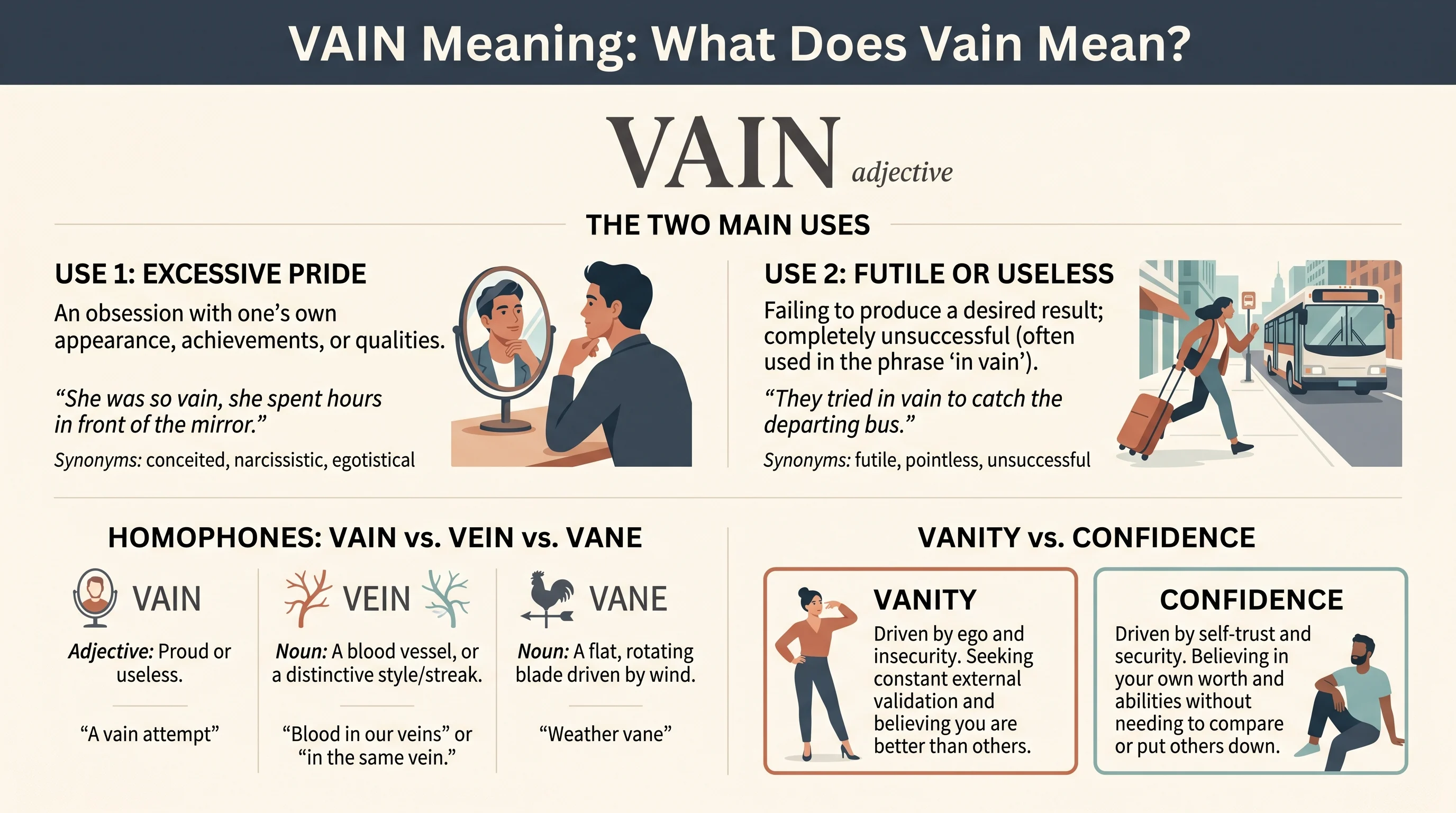
Vain meaning: Vain usually describes someone who is overly concerned with their appearance, abilities, or achievements. It can also mean producing no useful result, as in the phrase “in vain.” The correct meaning depends on context.
Vain meaning is usually connected with excessive pride in appearance, abilities, achievements, or personal qualities. However, the word has another important use. In phrases such as “try in vain,” it means unsuccessful or pointless.
The word appears frequently in everyday American English. You may see it in conversations about selfies, compliments, confidence, ambition, relationships, or unsuccessful efforts. You may also encounter it in books, news writing, school assignments, professional communication, and social media captions.
Context matters greatly. Calling someone “vain” can sound critical because it often suggests excessive self admiration. By contrast, saying that an effort was “in vain” does not describe someone’s personality. It describes an unsuccessful result.
Therefore, understanding the difference between these uses helps you choose the right interpretation. It also prevents confusion between vain, vein, and vane, three words that sound alike but have completely different meanings.
QUICK ANSWER BOX
| Meaning | Context | Primary Platforms | Example | Tone |
| Excessively proud of appearance or abilities | Personality | Texting, Instagram, TikTok | “He is so vain about his looks.” | Usually negative |
| Unsuccessful or pointless | Actions and efforts | Writing, conversation, texting | “We searched in vain.” | Neutral to negative |
| Concerned too much with oneself | Social behavior | Social media and everyday speech | “She can be vain sometimes.” | Critical |
| Futile or without useful result | Formal and literary contexts | Articles, books, speeches | “They tried in vain to change the decision.” | Formal |
What Does vain Mean?
The most common sense describes a person who has an excessively high opinion of their appearance, abilities, intelligence, achievements, or importance.
For example:
“She is vain about her appearance.”
This suggests that she thinks about her looks too much or cares excessively about how others perceive her.
However, vain does not simply mean confidence. Confidence can be healthy and appropriate. Vain behavior usually implies that someone’s self focus has become excessive.
The personality meaning
When vain describes a person, it often points toward self admiration.
Someone might constantly check their appearance, talk about their accomplishments, seek compliments, or become overly concerned about status. Those behaviors can lead someone to describe the person as vain.
For example:
“He is talented, but he can be incredibly vain.”
The sentence does not necessarily say that he lacks talent. Instead, it criticizes the way he views or presents himself.
The unsuccessful effort meaning
A second major use appears in “in vain.”
Here, the word means unsuccessfully, without achieving the desired result, or without useful effect.
For example:
“They tried in vain to repair the old computer.”
The sentence means that they tried to fix it, but their efforts did not succeed.
This meaning is different from the personality meaning. Therefore, you should always examine the surrounding words before interpreting the term.
The origin of the word
The English word vain comes through Old French and ultimately traces back to the Latin vanus, meaning empty, lacking substance, or ineffective.
Over time, English developed several related senses. The ideas of emptiness, worthlessness, excessive self regard, and futility became connected through the word’s history.
That history helps explain why two seemingly different uses exist today. A vain person can be seen as overly focused on something without real substance, while an effort done “in vain” produces no useful result.
Contextual Dynamics and Nuances of the Term
Understanding the word requires more than memorizing one definition. Its emotional effect changes according to the situation.
Vain versus confident
These words are not interchangeable.
A confident person trusts their abilities. A vain person may place excessive importance on their abilities or appearance.
| Word | Core idea | Typical impression |
| Confident | Believes in oneself | Positive or neutral |
| Vain | Excessively self focused | Usually negative |
| Proud | Feels satisfaction about an achievement or quality | Positive or neutral |
| Conceited | Has an exaggerated opinion of oneself | Strongly negative |
| Arrogant | Acts as though superior to others | Negative |
| Self assured | Comfortable with one’s abilities | Usually positive |
For example, “She is confident about her presentation” sounds positive.
“She is vain about her presentation skills” suggests that she thinks too highly of herself.
Vain versus narcissistic
These terms can overlap, but they are not identical.
Vain is an everyday descriptive adjective. It can describe excessive concern with appearance, admiration, status, or personal achievements.
Narcissistic can carry a much stronger psychological meaning. In casual speech, people sometimes use it loosely. However, it should not automatically be treated as a clinical diagnosis.
For ordinary conversation, vain is often the safer and more precise word when you simply mean excessive self admiration.
Vain versus selfish
Selfishness focuses on putting one’s own interests ahead of others.
Vanity focuses more on self admiration and concern about one’s image, appearance, abilities, or importance.
A person can be vain without being selfish. Likewise, someone can be selfish without caring much about appearance.
Vain versus proud
Pride can be positive.
A student might feel proud after earning excellent grades. A parent might feel proud of a child’s accomplishment. An employee might feel proud after completing a difficult project.
Vanity usually introduces an element of excess.
That distinction makes the words emotionally different even when they appear in similar conversations.
Real Life Conversation Examples Using vain meaning
The word appears naturally in casual conversations, but speakers usually choose it when they want to point out excessive self focus or an unsuccessful effort.
Example 1: Talking about appearance
Maya: “Why does Daniel take so many selfies?”
Alex: “He is probably a little vain about his looks.”
Meaning: Alex thinks Daniel may care excessively about his appearance.
Example 2: Discussing confidence
Sam: “I finally feel confident about my presentation.”
Jordan: “That’s good. Confidence is different from being vain.”
Meaning: Jordan distinguishes healthy self confidence from excessive self admiration.
Example 3: Talking about an unsuccessful effort
Lena: “Did you find the missing document?”
Chris: “No. I searched in vain for almost an hour.”
Meaning: Chris searched unsuccessfully.
Example 4: Social media behavior
Taylor: “She spends forever editing every picture.”
Morgan: “Maybe she is just particular, but she could also be a little vain.”
Meaning: Morgan suggests that excessive concern about appearance might explain the behavior.
Example 5: A failed attempt
Manager: “Did the team convince the client to change the deadline?”
Employee: “We tried in vain. They refused.”
Meaning: The team made an unsuccessful attempt.
Platform Specific Breakdown
The word does not have a special technical meaning on major social platforms. Instead, users apply its ordinary English meanings to social situations.
That distinction matters because some internet terms develop platform specific definitions. This one generally does not.
How It Is Used on Snapchat
Snapchat encourages visual communication, so discussions about appearance can naturally involve the word.
Someone might jokingly call a friend vain after they take several selfies, adjust their hair repeatedly, or ask which picture looks best.
For example:
“Bro took 27 selfies. Someone is feeling vain today.”
The tone may be playful rather than genuinely insulting. Friends often soften criticism through humor, emojis, exaggeration, or teasing.
However, context remains important. Calling someone vain during an argument can sound much harsher.
The Role of vain meaning on TikTok
TikTok content often discusses appearance, confidence, fashion, beauty routines, success, and personal branding.
Creators may use the word when criticizing excessive self obsession. They may also use it humorously in captions.
For example:
“Not me checking the mirror again. Maybe I’m vain.”
Here, the speaker is probably making a playful self aware comment.
The same word can sound much more negative in a serious statement:
“His entire personality revolves around his appearance, and he is extremely vain.”
Therefore, tone depends heavily on delivery and surrounding language.
Instagram and Texting Dynamics
Instagram naturally creates situations where appearance and self presentation become conversation topics.
A friend might say:
“You are getting vain with all these outfit photos.”
Depending on the relationship, this could be affectionate teasing or genuine criticism.
Text messages also rely heavily on context. Without facial expressions or vocal tone, a statement can be interpreted differently.
For that reason, adding softening language can help:
“You’re becoming a little vain 😂”
The emoji signals playful intent.
By contrast:
“You are vain.”
sounds much more direct and judgmental.
Alternative Meanings and NLP Variations of the Phrase
Searchers may encounter several related forms when exploring this vocabulary.
Vain
As an adjective, it commonly describes excessive self admiration.
Example: “He is vain about his appearance.”
In vain
This phrase means unsuccessfully, uselessly, or without achieving the desired result.
Example: “They waited in vain for a response.”
Vanity
Vanity is the noun form associated with excessive pride in appearance or achievements.
Example: “Her vanity made her constantly seek compliments.”
Vainly
Vainly is an adverb meaning unsuccessfully or with excessive self importance, depending on context.
Example: “They vainly attempted to reopen the case.”
Vainness
Vainness exists as a noun, but it is less common in ordinary modern conversation. Vanity is usually the more natural choice.
Related semantic terms
Search engines and language models may associate the word with:
| Semantic category | Related terms |
| Appearance | Beauty, looks, attractiveness, image |
| Personality | Conceited, self absorbed, egotistical |
| Confidence | Self assured, confident, proud |
| Futility | Pointless, unsuccessful, ineffective |
| Self image | Vanity, self admiration, self importance |
| Social behavior | Attention seeking, boastful, status conscious |
These words are related, but they are not perfect synonyms. The best choice depends on the specific behavior you want to describe.
Misinterpretations: When NOT to Use vain meaning
Knowing when not to use a word is just as important as knowing its definition.
Do not use it as a simple synonym for confident
If someone feels good about themselves, confidence is usually better.
Less accurate: “She is vain because she knows she is good at her job.”
Better: “She is confident because she knows she is good at her job.”
Use vain when you want to suggest excessive self regard.
Do not use it automatically for someone who dresses well
Fashionable clothing does not prove vanity.
Someone can enjoy fashion without being excessively concerned about appearance.
Therefore, calling someone vain solely because they dress well can sound unfair.
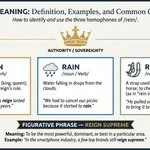
Do not confuse it with vein
Vein refers to a blood vessel or a narrow geological deposit.
Example: “The doctor examined the vein.”
Do not confuse it with vane
A vane is a flat surface or blade that responds to airflow. A weather vane, for example, indicates wind direction.
The three words sound alike in many varieties of English, but their meanings are completely different.
| Word | Meaning | Example |
| Vain | Excessively self focused or unsuccessful | “He is vain.” |
| Vein | Blood vessel or geological layer | “The nurse found the vein.” |
| Vane | Blade or device affected by airflow | “The weather vane moved.” |
Do not use “in vain” when success occurred
The phrase in vain indicates failure or lack of useful effect.
Incorrect:
“She studied in vain and passed the exam.”
The sentence creates a contradiction unless the writer intentionally means that the studying itself did not help.
Better:
“She studied for weeks but still failed.”
Or:
“She tried in vain to pass the exam.”
How to Respond in Chat Comfortably
If someone calls you vain, your response should depend on their tone.
If they are joking
You can answer playfully.
“Maybe a little. Can you blame me?”
This accepts the teasing without becoming defensive.
If you want a confident response
“I prefer confidence, but I’ll allow it.”
This response turns a criticism into a lighthearted statement.
If you disagree
“I don’t think caring about my appearance makes me vain.”
This keeps the conversation calm and explains your position.
If the comment feels insulting
“You can say that, but I don’t agree with the label.”
This establishes a boundary without escalating the situation.
If someone uses “in vain”
You should interpret it differently.
If someone says:
“I tried in vain to contact her.”
They are not describing themselves as vain.
They are saying that their attempt failed.
That distinction is one of the most important points to remember.
FAQs
What does vain mean in simple English?
It usually means caring too much about your appearance, abilities, achievements, or importance. It can also mean unsuccessful when used in the expression “in vain.”
Is being vain the same as being confident?
No. Confidence generally means having reasonable trust in yourself. Vanity suggests excessive concern with yourself or your image.
Is vain a negative word?
Usually, yes. When it describes personality, it often expresses criticism. However, friends may use it playfully when teasing each other.
What does “in vain” mean?
“In vain” means unsuccessfully, uselessly, or without achieving the intended result. For example, “They searched in vain” means they searched but did not find what they wanted.
Is vain the same as conceited?
They are closely related, but not identical. Both can suggest excessive self regard. Conceited often emphasizes an exaggerated opinion of one’s abilities or importance.
Can vain be used as a compliment?
Usually not. However, people can use it jokingly or affectionately. The tone depends on the relationship and situation.
What is the noun form of vain?
The common noun is vanity. For example, “His vanity made him constantly seek attention.”
What is the opposite of vain?
Depending on the intended meaning, possible opposites include humble, modest, selfless, useful, effective, or successful.
The best opposite depends on context. Humble works for excessive self admiration, while successful works better for the “in vain” sense.
How do you use vain in a sentence?
You can use it to describe excessive self admiration: “She is vain about her appearance.” You can also use it in the phrase “in vain”: “He tried in vain to change her mind.”
Why do vain, vein, and vane sound the same?
They are homophones in many varieties of English. They have different spellings and meanings, but their pronunciation is generally the same in standard American English.
Image SEO Architecture
Infographic Featured Image Prompt:
Create a clean modern English vocabulary infographic explaining vain meaning, its two main uses, examples, synonyms, vain versus vein versus vane, and the difference between vanity and confidence. Use simple American English, readable typography, and a professional social media friendly layout.
Conclusion
Understanding vain meaning requires attention to context. The word most commonly describes excessive pride in appearance, abilities, achievements, or personal importance. However, the phrase “in vain” has a different meaning. It describes an unsuccessful or ineffective effort.
Modern social media has made discussions about appearance, confidence, self image, and personal branding more common. As a result, the word can appear in captions, comments, jokes, conversations, and debates. Still, its core English meanings remain stable.
The most important distinction is simple: confidence does not automatically equal vanity. Likewise, “in vain” does not describe a vain person. Once you understand those differences, you can use the word naturally and accurately in everyday American English.