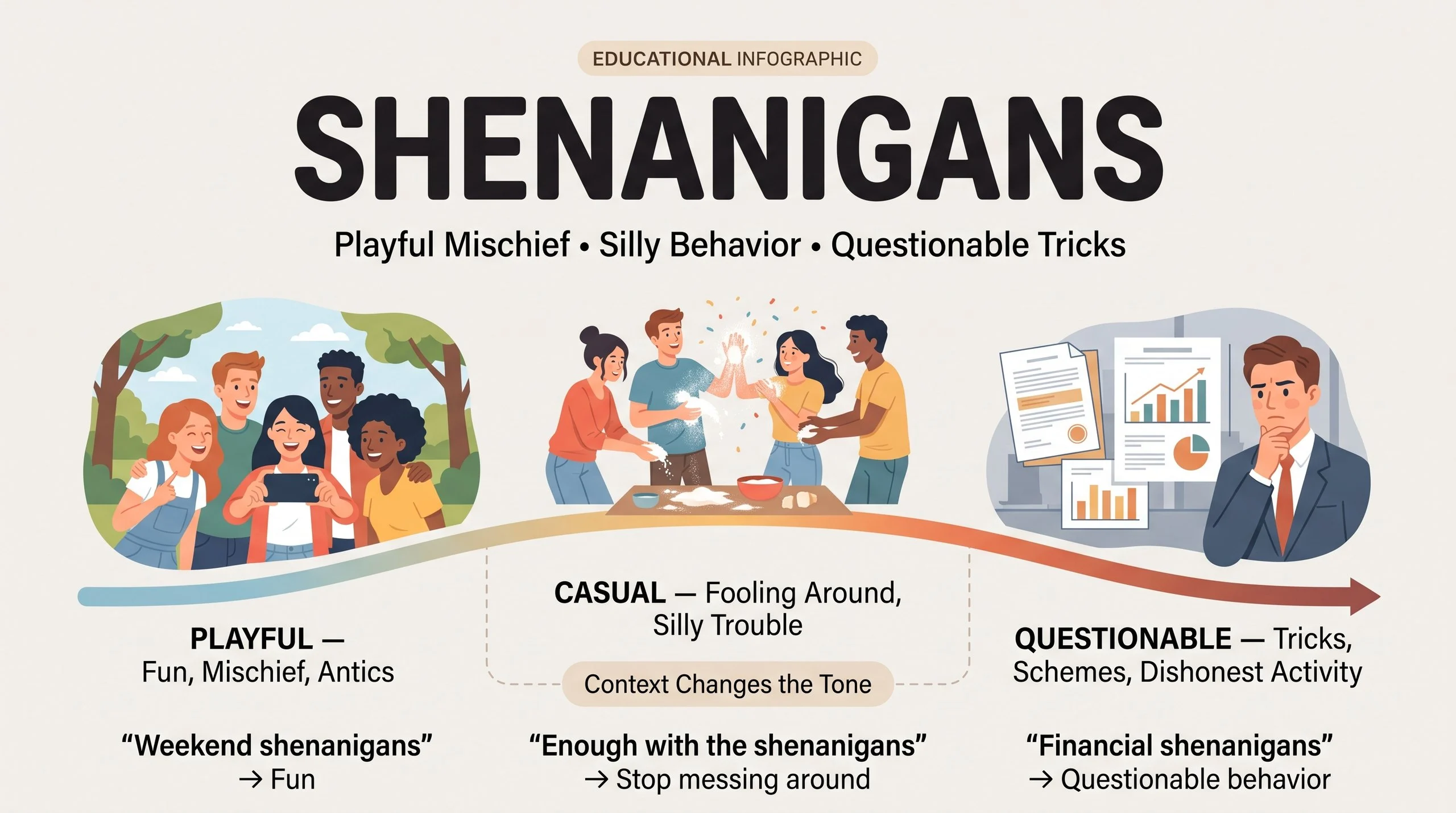
Shenanigans means playful, silly, dishonest, or questionable behavior, depending on context. People often use the word for mischievous actions, tricks, or amusing troublemaking. It can sound humorous and lighthearted, but it may also describe suspicious or dishonest behavior.
Shenanigans meaning usually refers to silly, mischievous, complicated, or questionable behavior. The word often describes actions that cause trouble without sounding extremely serious. For example, someone might say, “Enough with the shenanigans!” when friends are joking around or behaving badly.
The tone of shenanigans depends heavily on context. In a playful situation, it can mean harmless fun, jokes, or mischief. In a more serious situation, it can describe dishonest tricks, suspicious behavior, or attempts to manipulate a situation.
You may hear the word in everyday conversations, workplace discussions, movies, social media posts, sports commentary, and casual texting. Unlike words such as “misconduct” or “deception,” shenanigans often carries a humorous or informal tone.
This guide explains what shenanigans means, where the word comes from, how people use it today, and how to understand its tone in different situations.
Quick Answer
| Meaning | Context | Primary Platforms | Example | Tone |
|---|---|---|---|---|
| Mischievous or playful behavior | Friends and everyday conversation | Texting, social media | “The kids are getting into shenanigans.” | Playful |
| Silly troublemaking | Casual situations | Conversation, group chats | “Enough with the shenanigans!” | Humorous |
| Questionable or dishonest behavior | Arguments, business, politics, competition | Conversation, news, social media | “There were some financial shenanigans.” | Critical |
| Tricks or schemes | Suspicious situations | Online, work, conversation | “I don’t trust these shenanigans.” | Skeptical |
What Does Shenanigans Mean?
Shenanigans is an informal plural noun that describes mischievous, silly, deceptive, or questionable behavior.
The word is flexible because its meaning changes with the situation.
For example:
“The kids were up to their usual shenanigans.”
Here, shenanigans probably means playful troublemaking.
Now consider:
“The company was accused of financial shenanigans.”
This sentence has a much more serious meaning. Here, shenanigans suggests questionable, dishonest, or improper financial behavior.
Therefore, the word can range from harmless mischief to suspicious conduct.
A useful way to understand it is:
Shenanigans = unusual behavior, tricks, mischief, or questionable actions.
The exact meaning depends on the speaker’s tone and the surrounding context.
Is Shenanigans a Positive or Negative Word?
Shenanigans can be either positive, negative, or neutral depending on context.
Positive or Playful
“We had some fun shenanigans at the party.”
Here, the word suggests amusing activities or harmless mischief.
Neutral
“The team got into some shenanigans during the trip.”
The speaker may simply be describing funny or unexpected events.
Negative
“The investigation uncovered some accounting shenanigans.”
Now the word suggests dishonest or suspicious behavior.
Therefore, shenanigans does not automatically mean something bad.
The speaker’s tone provides the important clue.
Shenanigans Meaning in Everyday English
In everyday American English, people often use shenanigans to describe behavior that is silly, chaotic, mischievous, or slightly troublesome.
For example:
“The dog has been causing shenanigans all morning.”
The sentence suggests that the dog has been creating amusing trouble.
Similarly:
“My friends always get into shenanigans when we travel.”
This usually means they do funny, unexpected, or mischievous things.
The word works especially well when the speaker wants to describe trouble without making the situation sound too serious.
Instead of saying:
“My friends behaved irresponsibly.”
Someone might jokingly say:
“My friends got into some shenanigans.”
The second sentence sounds much lighter.
Shenanigans Meaning in Slang
Although shenanigans is not technically modern internet slang, it is a popular informal word.
People use it casually to describe:
- silly behavior
- playful trouble
- jokes
- pranks
- mischief
- unexpected situations
- suspicious activity
- questionable decisions
- elaborate tricks
Online, the word often has a humorous tone.
For example:
“What kind of shenanigans are happening in this group chat?”
This could mean:
“What wild or silly things are everyone doing?”
Similarly:
“No more shenanigans!”
can jokingly mean:
“Stop messing around.”
Shenanigans Meaning in Texting
In texting, shenanigans is usually playful.
Someone might send:
“What are you two up to?”
And receive:
“Just some shenanigans 😂”
The response suggests that the people are doing something silly, mischievous, or entertaining.
Another example:
“I’m staying out of your shenanigans this weekend.”
This could mean:
“I’m not getting involved in whatever trouble you’re planning.”
The word works well in texts because it communicates trouble without sounding overly formal.
How Is Shenanigans Used on Snapchat?
On Snapchat, shenanigans can describe funny or mischievous activities between friends.
For example:
“We’re about to get into some shenanigans.”
The speaker might be planning a joke, adventure, prank, or spontaneous activity.
A friend might also post a Snapchat story with the caption:
“Weekend shenanigans.”
This usually means the person is sharing fun, unusual, or chaotic moments from the weekend.
The word can therefore add personality to a casual caption without explaining everything directly.
The Role of Shenanigans on TikTok
TikTok creators often use shenanigans to describe funny situations, unexpected behavior, or harmless chaos.
For example:
“POV: Your friends start their usual shenanigans.”
The phrase tells viewers to expect silly or chaotic behavior.
Another common style is:
“Just a little weekend shenanigans.”
This gives the content a playful and informal tone.
Because TikTok content often relies on humor and exaggerated situations, shenanigans fits naturally into captions and comments.
Instagram and Texting Dynamics
On Instagram, people may use shenanigans in captions such as:
“Summer shenanigans.”
“Weekend shenanigans with the crew.”
“A little harmless shenanigans.”
The word can make an ordinary activity sound more adventurous.
In direct messages, it may refer to an inside joke, prank, or funny situation.
For example:
“Are you joining the shenanigans tonight?”
That usually means:
“Are you coming along for the fun or mischief?”
Shenanigans in the Workplace
The word can appear at work, although it remains informal.
For example:
“There were some shenanigans with the scheduling system.”
This might suggest unusual, confusing, or questionable behavior.
A manager could also jokingly tell employees:
“No shenanigans while I’m gone.”
In this case, the speaker probably means:
“Don’t cause trouble or mess around.”
However, the word can become more serious when paired with business terms.
Financial Shenanigans
“Financial shenanigans” usually suggests questionable or dishonest financial practices.
For example:
“The audit revealed some financial shenanigans.”
This could refer to accounting tricks, misleading reporting, hidden transactions, or other suspicious practices.
The phrase sounds less formal than “financial misconduct,” but it can still describe serious behavior.
Shenanigans in Sports
Sports commentators and fans sometimes use shenanigans when discussing questionable plays, unusual decisions, or funny incidents.
For example:
“There were some serious shenanigans during the final minutes.”
Depending on context, this could refer to:
- questionable officiating
- unexpected tactics
- unusual player behavior
- controversial decisions
- chaotic events
A fan might also use the word jokingly:
“Here we go with the referee shenanigans again.”
In that example, the speaker may be expressing frustration while keeping the language humorous.
Shenanigans in Politics and Public Discussion
The word can also describe questionable actions in politics or public affairs.
For example:
“Voters are tired of political shenanigans.”
Here, shenanigans suggests questionable, manipulative, dishonest, or frustrating political behavior.
The word is usually less formal than:
- misconduct
- corruption
- manipulation
- deception
- wrongdoing
However, its informal tone can make criticism sound sarcastic or humorous.
Real-Life Conversation Examples Using Shenanigans
1. Friends Planning a Trip
Mike: What are you guys doing tonight?
Jake: Not sure yet.
Mike: Knowing you two, there will be shenanigans.
Jake: Obviously.
Here, shenanigans means playful trouble or mischief.
2. Parents and Children
Mom: Why is there flour all over the kitchen?
Son: It wasn’t me.
Mom: I know you two were up to some shenanigans.
The word keeps the accusation lighthearted.
3. Workplace
Sarah: Why did the schedule change three times?
Tom: I have no idea.
Sarah: Sounds like some scheduling shenanigans.
Here, shenanigans means confusing or questionable activity.
4. Group Chat
Alex: Where are you guys?
Chris: At the mall.
Alex: What are you doing?
Chris: Causing shenanigans.
This clearly suggests harmless fun.
5. Social Media
Emma: Your vacation photos look wild.
Lily: You should have been there.
Emma: Looks like serious shenanigans.
The word describes entertaining or chaotic activity.
Common Phrases With Shenanigans
Several expressions use shenanigans naturally.
“Up to Some Shenanigans”
This means someone is probably doing something mischievous, suspicious, or unusual.
“They’re up to some shenanigans again.”
“No Shenanigans”
This means:
“Don’t cause trouble.”
“I’ll be gone for an hour. No shenanigans.”
The phrase is often humorous.
“Enough With the Shenanigans”
This means:
“Stop messing around.”
“Enough with the shenanigans. We need to finish this.”
“Weekend Shenanigans”
This usually describes fun, chaotic, or unusual weekend activities.
“Ready for some weekend shenanigans?”
“Financial Shenanigans”
This usually refers to questionable or dishonest financial activity.
“The investigation uncovered financial shenanigans.”
“Political Shenanigans”
This suggests questionable or manipulative political behavior.
“People are tired of political shenanigans.”
Shenanigans vs. Mischief
These words are close in meaning, but they have slightly different tones.
Mischief usually means playful trouble or minor wrongdoing.
Shenanigans can mean the same thing, but it often sounds more humorous and informal.
Compare:
“The children were getting into mischief.”
This sounds natural and fairly neutral.
“The children were getting into shenanigans.”
This sounds more playful and humorous.
Shenanigans can also describe more complicated or suspicious behavior, while mischief usually remains relatively harmless.
Shenanigans vs. Nonsense
Nonsense usually refers to foolish words, ideas, or behavior.
Shenanigans specifically suggests actions, tricks, mischief, or questionable behavior.
For example:
“Stop talking nonsense.”
This focuses on what someone is saying.
“Stop the shenanigans.”
This focuses more on what someone is doing.
The two can overlap, but they are not exact synonyms.
Shenanigans vs. Antics
Antics refers to funny, unusual, or playful behavior.
Shenanigans can also describe this type of behavior, but it has a wider range.
For example:
“The children’s antics made everyone laugh.”
This strongly suggests funny behavior.
“The children’s shenanigans kept everyone entertained.”
This suggests funny behavior but may also imply mischief.
Shenanigans can additionally describe questionable or dishonest activity.
Shenanigans vs. Tomfoolery
Tomfoolery means silly or foolish behavior.
It has a humorous, somewhat old-fashioned tone.
Shenanigans is more flexible and common in modern casual English.
For example:
“Enough with the tomfoolery.”
and
“Enough with the shenanigans.”
Both mean something like:
“Stop messing around.”
However, shenanigans can carry a stronger suggestion of tricks or questionable behavior.
Shenanigans vs. Schemes
A scheme is usually a planned idea or strategy, often with a negative implication.
Shenanigans can describe the behavior surrounding such a scheme.
For example:
“They came up with a scheme.”
means they developed a plan.
“They’re pulling some shenanigans.”
means they may be doing something questionable or tricky.
Therefore, schemes are usually more deliberate, while shenanigans can be spontaneous or playful.
Synonyms for Shenanigans
The best synonym depends on the context.
1. For Playful Shenanigans
- mischief
- antics
- fooling around
- horseplay
- tomfoolery
- silliness
- hijinks
- goofing around
2. For Questionable Shenanigans
- tricks
- schemes
- deception
- manipulation
- misconduct
- wrongdoing
- dishonesty
- dirty dealings
3. For Chaotic Shenanigans
- chaos
- antics
- mayhem
- trouble
- misadventures
- hijinks
Among these, mischief, antics, and hijinks are often the closest casual alternatives.
Is Shenanigans a Bad Word?
No. Shenanigans is not a swear word or offensive term.
It is an informal English word.
However, the behavior being described can be positive, harmless, suspicious, or negative.
For example:
“The kids had some harmless shenanigans.”
sounds positive.
Meanwhile:
“The company was involved in financial shenanigans.”
sounds negative.
So, the word itself is not offensive. Its meaning depends on what kind of behavior it describes.
Is Shenanigans a Formal Word?
Shenanigans is generally considered informal.
It works well in:
- casual conversations
- texts
- social media
- humorous writing
- friendly workplace conversations
- entertainment
It is less suitable when you need precise formal language.
For example, instead of writing:
“The investigation found some shenanigans.”
a formal report might say:
“The investigation identified several irregularities.”
Therefore, use shenanigans when the informal or humorous tone fits.
Does Shenanigans Always Mean Mischief?
No.
Mischief is one important meaning, but shenanigans can also refer to tricks, schemes, questionable activity, or dishonest behavior.
Compare:
“The children were causing shenanigans.”
This suggests playful trouble.
“The company was involved in financial shenanigans.”
This suggests questionable financial practices.
The same word covers both situations because its tone depends on context.
Why Does Shenanigans Sound Funny?
Part of the word’s appeal comes from its unusual sound.
“Shenanigans” has a playful rhythm, which makes it useful when someone wants to describe trouble without sounding overly serious.
For example:
“What kind of shenanigans are you planning?”
sounds much more playful than:
“What kind of misconduct are you planning?”
The first sentence could be said jokingly to a friend. The second sounds much more serious.
Misinterpretations: When NOT to Use Shenanigans
Although shenanigans is versatile, it does not fit every situation.
1. Avoid It When Precision Matters
If someone commits a serious crime, shenanigans may sound too playful.
For example, a formal report should not describe serious criminal conduct simply as “shenanigans.”
Use precise terms when the situation requires them.
2. Do Not Assume It Always Means Dishonesty
Sometimes shenanigans simply means fun.
“We had some weekend shenanigans.”
That does not necessarily imply wrongdoing.
3. Do Not Treat It as a Synonym for Chaos in Every Situation
Shenanigans often involve behavior or actions.
A natural disaster, for example, is not normally called shenanigans.
4. Consider Your Audience
The word is informal.
Therefore, it may not fit a highly formal academic, legal, or professional document.
How to Respond When Someone Says “No Shenanigans”
The phrase is usually easy to understand.
Playful Response
“I make no promises.”
This keeps the joke going.
Friendly Response
“Don’t worry. I’ll behave.”
This acknowledges the request casually.
Humorous Response
“Define shenanigans.”
This works well when joking with friends.
Serious Response
“Understood. I’ll keep things professional.”
This works better in a workplace setting.
Common Mistakes With Shenanigans
Mistake 1: Thinking It Always Means Something Bad
It does not. The word often describes harmless fun.
Mistake 2: Using It in Formal Writing
Shenanigans is informal, so precise formal alternatives may work better.
Mistake 3: Assuming It Means Only “Prank”
A prank can be a shenanigan, but the word covers a wider range of behavior.
Mistake 4: Confusing It With “Nonsense”
Nonsense usually involves foolish speech or ideas. Shenanigans usually involves actions or behavior.
Mistake 5: Missing the Tone
The phrase “weekend shenanigans” sounds playful, while “financial shenanigans” sounds suspicious.
The noun stays the same, but the surrounding words change its meaning.
FAQs
1. What does shenanigans mean?
Shenanigans means mischievous, silly, playful, tricky, or questionable behavior. The exact meaning depends on context.
2. Is shenanigans a bad word?
No. Shenanigans is not offensive or profane. It is an informal word that can describe either harmless fun or questionable behavior.
3. Is shenanigans positive or negative?
It can be either. “Weekend shenanigans” sounds playful, while “financial shenanigans” usually suggests dishonest or questionable behavior.
4. What is another word for shenanigans?
Common alternatives include mischief, antics, hijinks, tomfoolery, horseplay, tricks, schemes, and questionable behavior.
5. What does “no shenanigans” mean?
“No shenanigans” usually means “Don’t cause trouble,” “Don’t mess around,” or “Behave yourself.”
6. What does “up to shenanigans” mean?
“Up to shenanigans” means someone is doing, planning, or participating in something mischievous, silly, unusual, or questionable.
7. Is shenanigans slang?
Shenanigans is an informal English word. Although it is often used like slang in casual conversation, it is not strictly modern internet slang.
8. What does financial shenanigans mean?
Financial shenanigans refers to questionable, deceptive, or potentially dishonest financial activities or accounting practices.
9. What does “weekend shenanigans” mean?
“Weekend shenanigans” usually refers to fun, silly, spontaneous, or mischievous activities during the weekend.
10. Is shenanigans formal English?
Shenanigans is standard English, but it has an informal and often humorous tone. More precise words may work better in formal writing.
Key Takeaways
- Shenanigans means playful, mischievous, silly, tricky, or questionable behavior.
- The word is informal and often humorous.
- “Weekend shenanigans” usually means fun or mischievous activities.
- “No shenanigans” usually means “Don’t cause trouble.”
- “Financial shenanigans” usually suggests questionable or dishonest activity.
- Shenanigans can be harmless or serious depending on context.
- Common related words include mischief, antics, hijinks, tomfoolery, and schemes.
- The surrounding words and tone reveal which meaning the speaker intends.
Conclusion
Understanding shenanigans meaning is mainly about recognizing the tone and context. In casual conversations, the word usually describes playful mischief, silly behavior, jokes, or harmless trouble. That is why phrases such as “weekend shenanigans” often sound fun rather than negative.
However, the word can also describe questionable behavior. Expressions such as “financial shenanigans” or “political shenanigans” suggest tricks, schemes, manipulation, or dishonest activity. In those situations, the word carries a more critical tone.
Overall, shenanigans is a flexible informal word that lets speakers describe unusual behavior without always making it sound serious. It can turn a simple story about trouble into something humorous and conversational. At the same time, context can give the word a sharper meaning when the behavior involves deception or wrongdoing.
Whether you encounter it in a text, social media caption, workplace conversation, or everyday speech, look at the words around shenanigans. They usually reveal whether the speaker means harmless fun, chaotic mischief, or something more suspicious.