If you have ever received a wedding invitation, birthday invitation, dinner invitation, or formal event notice, you may have seen RSVP near the bottom. But what does RSVP mean, and what should you do when an invitation asks you to RSVP?
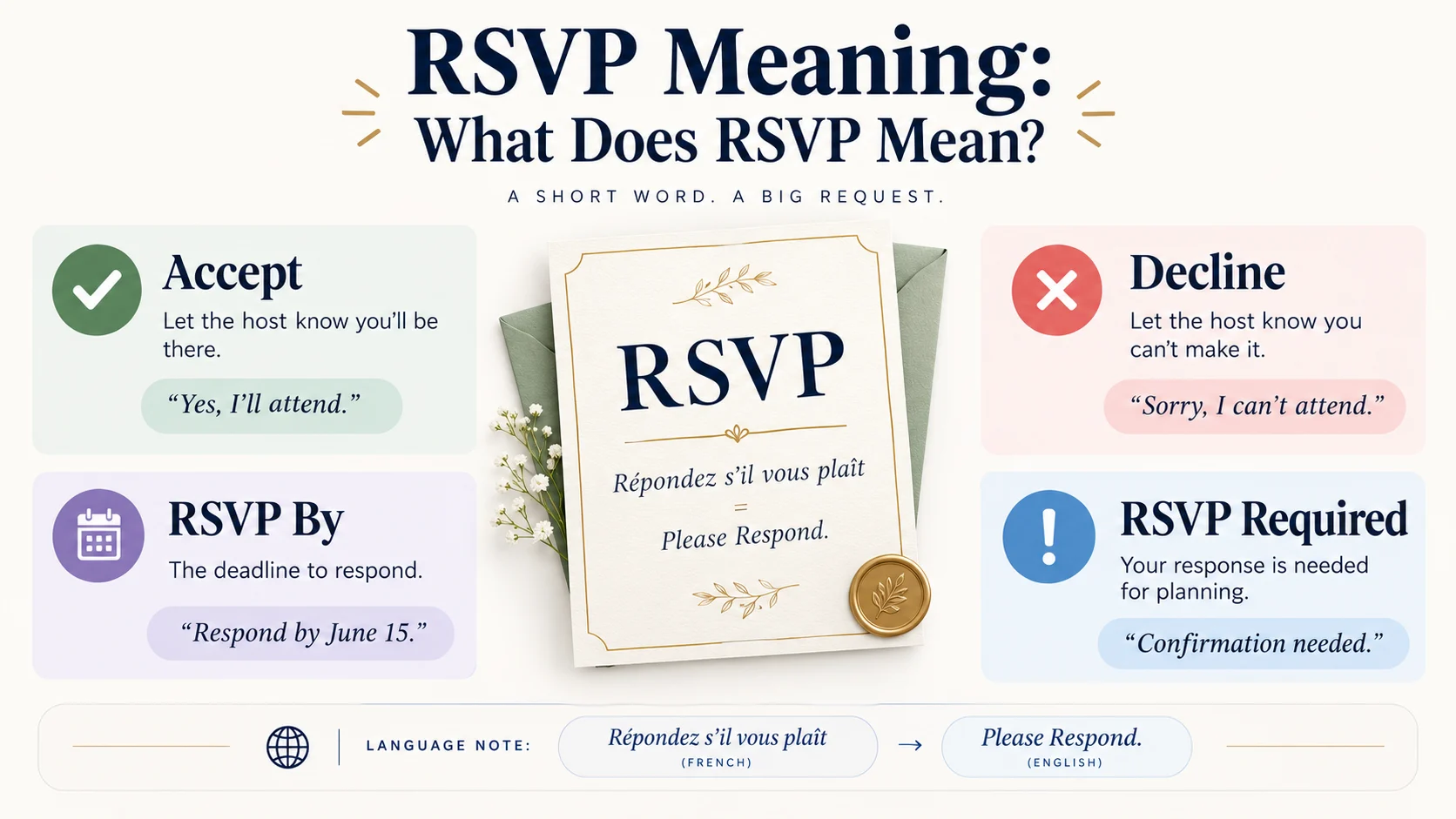
RSVP means “Répondez s’il vous plaît,” a French phrase that means “please respond” in English. When an invitation says “RSVP,” the host wants you to tell them whether you plan to attend the event. Your response helps the host plan seating, food, drinks, activities, and other details.
Today, RSVP appears in both formal and casual invitations. You might see it on wedding cards, party invitations, business events, school functions, restaurant gatherings, and online event pages. In addition, people often use the word as a verb, as in “Please RSVP by Friday.”
Understanding the RSVP meaning is simple once you know its purpose. It is essentially a polite request for an attendance response.
What Does RSVP Mean?
RSVP means “Répondez s’il vous plaît,” which translates to “please respond.” It appears on invitations when the host wants guests to confirm whether they will attend an event.
For example:
RSVP by June 15.
This means:
Please tell us by June 15 whether you will attend.
RSVP does not automatically mean “yes.” You can RSVP yes, no, or sometimes indicate that you are unsure, depending on the event and invitation.
What Is the Meaning of RSVP?
The abbreviation RSVP comes from the French expression “Répondez s’il vous plaît.”
The phrase breaks down roughly as:
- Répondez = respond
- s’il vous plaît = please
Therefore, the literal meaning is “Please respond.”
In English, RSVP has become a standard part of invitations. Although its origin is French, English speakers commonly use it without translating it.
What Does RSVP Mean on an Invitation?
On an invitation, RSVP means that the host wants you to confirm your attendance.
For example:
Wedding Invitation:
“Please RSVP by September 10.”
The host expects you to respond before that date and say whether you will attend.
An invitation might also provide several ways to respond, such as:
- Phone number
- Email address
- RSVP card
- Website
- Online event form
- Text message
The exact response method depends on the event.
What Does RSVP Stand For?
RSVP stands for “Répondez s’il vous plaît.”
The abbreviation comes directly from the first letters of the French phrase:
Répondez
S’il
Vous
Plaît
The English translation is:
“Please respond.”
Even though RSVP is an abbreviation, English speakers usually pronounce it as individual letters:
R-S-V-P
You normally would not pronounce it as a French word.
Why Do Invitations Say RSVP?
Hosts use RSVP requests because they need an accurate guest count.
For example, a wedding planner may need to know how many people will attend before ordering meals. Likewise, a restaurant hosting a private dinner may need a final number before arranging tables.
An RSVP can help with:
- Seating arrangements
- Food and drinks
- Venue capacity
- Party favors
- Transportation
- Event materials
- Guest lists
- Table arrangements
- Budget planning
As a result, responding to an RSVP request is more than simple etiquette. It gives the host information they need to organize the event.
RSVP Meaning in Different Contexts
The basic meaning stays the same, but the way people use RSVP can change depending on the event.
1. RSVP on a Wedding Invitation
Wedding invitations commonly include an RSVP request.
For example:
“Kindly RSVP by August 20.”
The couple needs to know which invited guests will attend so they can plan meals, seating, and the reception.
You may also need to provide information such as:
- Number of guests
- Meal preference
- Dietary restrictions
- Children attending
- Song requests
2. RSVP for a Birthday Party
Birthday parties may use RSVP requests when the host needs an estimated guest count.
For example:
“RSVP to Sarah by Saturday.”
This means Sarah wants invited guests to tell her whether they plan to attend.
For a small children’s party, the RSVP may help the parent order enough food and prepare enough activities or party favors.
3. RSVP for a Business Event
Businesses also use RSVP for meetings, conferences, networking events, dinners, and seminars.
For example:
“Please RSVP before October 5 to reserve your seat.”
Here, RSVP usually means that the organizer needs confirmation before the event.
4. RSVP for a Dinner
Restaurants and private hosts may request an RSVP for dinner events.
For example:
“RSVP required.”
This means you need to confirm your attendance before the event.
5. RSVP for an Online Event
RSVP is not limited to paper invitations.
Online event pages may say:
“Click here to RSVP.”
You may then choose:
- Going
- Not going
- Maybe
In this setting, RSVP still means respond to the invitation.
What Does “Please RSVP” Mean?
“Please RSVP” means “Please respond to the invitation.”
The phrase can sound repetitive because RSVP already contains the idea of responding. However, “Please RSVP” is completely common in modern English.
For example:
“Please RSVP by Friday.”
The intended meaning is:
“Please let us know by Friday if you will attend.”
Similarly, you might see:
“Please RSVP no later than May 1.”
That simply means the host wants your response by May 1.
What Does “RSVP By” Mean?
When an invitation says “RSVP by [date],” it gives you a deadline for responding.
For example:
RSVP by March 15.
You should respond no later than March 15.
The date does not necessarily mean that the event takes place on March 15. Instead, it tells you when the host needs your attendance decision.
Example
Event: July 20
RSVP deadline: July 1
You should tell the host whether you are attending by July 1.
What Does “RSVP Required” Mean?
“RSVP required” means you need to respond to the invitation.
The host may not be able to accommodate people who arrive without confirming first.
For example:
“RSVP required. Seating is limited.”
This tells guests that they should confirm their attendance before coming.
What Does “RSVP Only” Mean?
“RSVP only” usually means attendance is limited to people who have confirmed their attendance.
For example:
“RSVP only. No walk-ins.”
In that situation, you should not assume that you can attend without responding.
How Do You RSVP?
The correct way to RSVP depends on the instructions provided by the host.
If the Invitation Includes an RSVP Card
Fill out the card and return it according to the instructions.
If the Invitation Provides a Phone Number
Call or text the number and clearly state whether you will attend.
If the Invitation Provides an Email Address
Send a short message confirming your attendance or declining the invitation.
If the Invitation Includes a Website
Open the website and complete the RSVP form.
If the Host Requests a Text
Send a simple confirmation such as:
“Hi! Thanks for the invitation. I’d love to attend.”
If you cannot attend, you can say:
“Thank you for inviting me. Unfortunately, I won’t be able to attend.”
How to RSVP Yes
If you plan to attend, give a clear confirmation.
Examples include:
- “Yes, I’ll be there.”
- “I’m happy to confirm my attendance.”
- “Thank you for the invitation. I’ll be attending.”
- “Count me in!”
- “Yes, I’d love to join you.”
For a formal event, use a more polished response.
How to RSVP No
You can politely decline an invitation.
Examples:
- “Thank you for the invitation, but I won’t be able to attend.”
- “Unfortunately, I’m unable to attend.”
- “Thank you for inviting me. I’m sorry I’ll miss the event.”
- “I appreciate the invitation, but I won’t be able to make it.”
You generally do not need to provide a detailed explanation unless you want to.
What If You Are Not Sure Whether You Can Attend?
If the invitation allows a “maybe” response, you can use it.
However, some formal events need a definite answer because the host must order food or reserve seats.
In that case, check the invitation carefully. If it requires a firm response, contact the host and explain your situation.
What If You Miss the RSVP Deadline?
If you missed the deadline, respond as soon as possible.
Do not assume that your silence means “no.”
Instead, contact the host and say something like:
“I’m sorry I missed the RSVP deadline. Is it still possible for me to attend?”
The host may still have room, but the answer depends on the event.
What Happens If You Do Not RSVP?
If an invitation specifically requests an RSVP, ignoring it can create problems for the host.
They may not know:
- Whether to reserve a seat for you
- How much food to prepare
- How many guests will arrive
- Whether you need a meal
- How many tables are necessary
Therefore, responding is generally the polite choice.
RSVP vs. Invitation
An invitation asks you to attend an event.
An RSVP asks you to respond to that invitation.
For example:
“You are invited to our wedding.”
That is the invitation.
“Please RSVP by June 1.”
That is the request for your response.
The two terms are related, but they do not mean the same thing.
RSVP vs. Regrets Only
These phrases communicate different expectations.
| Phrase | Meaning |
|---|---|
| RSVP | Tell the host whether you will attend |
| Regrets Only | Respond only if you cannot attend |
| RSVP Required | A response is expected |
| RSVP By June 10 | Respond no later than June 10 |
| RSVP Only | Attendance requires confirmation |
With “regrets only,” you generally do not need to reply if you plan to attend. You should respond only if you cannot make it.
RSVP vs. Regrets
The word “regrets” can appear on formal invitations.
For example:
“RSVP. Regrets only.”
This means:
If you are attending, no response may be necessary. Contact the host only if you cannot attend.
Always follow the specific instructions on the invitation.
Is RSVP a Verb?
Yes. In modern English, RSVP can function as a verb.
For example:
“Please RSVP by Friday.”
Here, RSVP acts as a verb meaning respond to the invitation.
You may also see:
“Did you RSVP?”
That means:
“Did you respond to the invitation?”
Another example:
“I need to RSVP tonight.”
This means:
“I need to tell the host whether I will attend tonight.”
Is “RSVPed” Correct?
Yes. RSVPed is commonly used as the past tense of RSVP.
For example:
“I RSVP’d yesterday.”
You may also see RSVP’d with an apostrophe because writers sometimes use the apostrophe to make the abbreviation easier to read.
Both forms appear in informal and modern English usage.
Examples
- “I already RSVP’d.”
- “She RSVP’d to the wedding.”
- “Have you RSVP’d yet?”
For formal writing, you can avoid the issue entirely by writing “confirmed my attendance” or “responded to the invitation.”
Common RSVP Mistakes
1. Thinking RSVP Means “Yes”
RSVP does not mean that you must accept the invitation.
It means please respond.
You can accept or decline.
2. Ignoring the RSVP Deadline
A deadline helps the host finalize plans. Therefore, try to respond on time.
3. Bringing an Uninvited Guest
Do not automatically bring a plus-one unless the invitation allows one or the host confirms that you can.
4. Assuming Children Are Included
If the invitation does not clearly include children, check with the host.
5. RSVPing and Then Not Showing Up
If your plans change, let the host know. That gives them a chance to adjust their arrangements.
6. Assuming No Response Means No
Silence does not always communicate your decision clearly. If the invitation asks for an RSVP, provide an actual response.
RSVP Examples in Everyday English
Here are some natural examples:
Invitation:
“Please RSVP by May 10.”
Meaning:
Tell the host by May 10 whether you will attend.
Invitation:
“RSVP required.”
Meaning:
You need to confirm your attendance.
Invitation:
“Kindly RSVP to Jane.”
Meaning:
Respond to Jane about whether you will attend.
Message:
“Have you RSVP’d yet?”
Meaning:
Have you told the host whether you are attending?
Message:
“I forgot to RSVP.”
Meaning:
I forgot to respond to the invitation.
RSVP in Texting and Social Media
Although RSVP traditionally appears on formal invitations, people also use it in texts, emails, group chats, and social media event posts.
For example:
“Hey everyone, please RSVP for Saturday’s dinner.”
This means:
“Please let us know whether you are coming to Saturday’s dinner.”
A friend might also text:
“Did everyone RSVP?”
That means:
“Has everyone confirmed whether they are attending?”
The meaning remains the same even when the setting becomes informal.
RSVP in Email
Businesses and organizations frequently use RSVP in emails.
For example:
“Please RSVP by Friday to reserve your place.”
This tells the recipient to confirm whether they plan to attend.
A simple reply could be:
“Thank you. I’m pleased to confirm that I’ll attend.”
For a decline:
“Thank you for the invitation. Unfortunately, I won’t be able to attend.”
RSVP Pronunciation
RSVP is usually pronounced by saying each letter separately:
“R-S-V-P”
It is not normally pronounced as a single word.
The original French phrase is “Répondez s’il vous plaît.”
However, English speakers generally use the English pronunciation of the abbreviation.
Is RSVP Formal or Informal?
RSVP can be used in both formal and informal situations.
You may find it on:
- Wedding invitations
- Business invitations
- Birthday invitations
- Dinner invitations
- School events
- Charity events
- Conferences
- Online events
- Group chats
The word itself is neutral. The surrounding language determines how formal the invitation feels.
For example:
Formal:
“Kindly RSVP by September 1.”
Casual:
“Please RSVP so we know who’s coming!”
Both communicate the same basic request.
Quick Reference: RSVP Meaning
| Question | Answer |
|---|---|
| What does RSVP mean? | Please respond |
| What does RSVP stand for? | Répondez s’il vous plaît |
| What is the English translation? | Please respond |
| Where is RSVP used? | Invitations and event requests |
| Does RSVP mean yes? | No |
| Can you RSVP no? | Yes |
| Can RSVP be a verb? | Yes |
| How is RSVP pronounced? | R-S-V-P |
| What does RSVP by Friday mean? | Respond by Friday |
| What does RSVP required mean? | You must provide a response |
Frequently Asked Questions
What does RSVP mean in simple words?
RSVP means “please respond.” When you see it on an invitation, the host wants you to confirm whether you will attend.
What does RSVP stand for in English?
RSVP stands for the French phrase “Répondez s’il vous plaît,” which means “please respond.”
Does RSVP mean I have to attend?
No. RSVP means you need to respond. You can accept or decline the invitation.
How do I RSVP?
Follow the instructions on the invitation. You might need to use an RSVP card, phone number, email address, website, or text message.
What does “RSVP by Friday” mean?
It means you should tell the host whether you will attend no later than Friday.
What does “RSVP required” mean?
It means the host expects you to confirm whether you will attend.
What does “RSVP only” mean?
It generally means you should confirm your attendance before attending. The host may not accept unconfirmed guests.
What does “regrets only” mean?
It means you usually respond only if you cannot attend. If you plan to attend, no response may be necessary.
Can I RSVP no?
Yes. RSVP does not mean you have to say yes. You can politely decline.
Is RSVP a French word?
RSVP is an abbreviation of a French phrase: “Répondez s’il vous plaît.” The abbreviation is now widely used in English.
Can RSVP be used as a verb?
Yes. People commonly say “RSVP,” “RSVP’d,” or “RSVPing.”
For example:
“I need to RSVP tonight.”
Is “Please RSVP” grammatically correct?
Yes. Although RSVP already means “please respond,” the phrase “Please RSVP” is standard and widely understood in English.
What does “Have you RSVP’d?” mean?
It means:
“Have you responded to the invitation?”
Usually, the speaker wants to know whether you have confirmed your attendance.
Conclusion
The RSVP meaning is simple: “please respond.” The abbreviation comes from the French phrase “Répondez s’il vous plaît.” On an invitation, RSVP asks you to tell the host whether you plan to attend.
You may see RSVP on weddings, birthday parties, business events, dinners, school functions, and online event pages. In addition, English speakers use RSVP as a verb, such as “Please RSVP by Friday” or “I already RSVP’d.”
Most importantly, RSVP does not mean “yes.” It means that the host wants a clear response. Whether you accept or decline, responding on time helps the host plan the event and shows basic courtesy.

Charlotte Wilson is a language writer passionate about word meanings, synonyms, and clear communication. She creates accurate and engaging content to help readers expand their vocabulary and language skills.








3 thoughts on “RSVP Meaning| What Does RSVP Mean on an Invitation? Definition, Origin, Etiquette & Examples 2026”