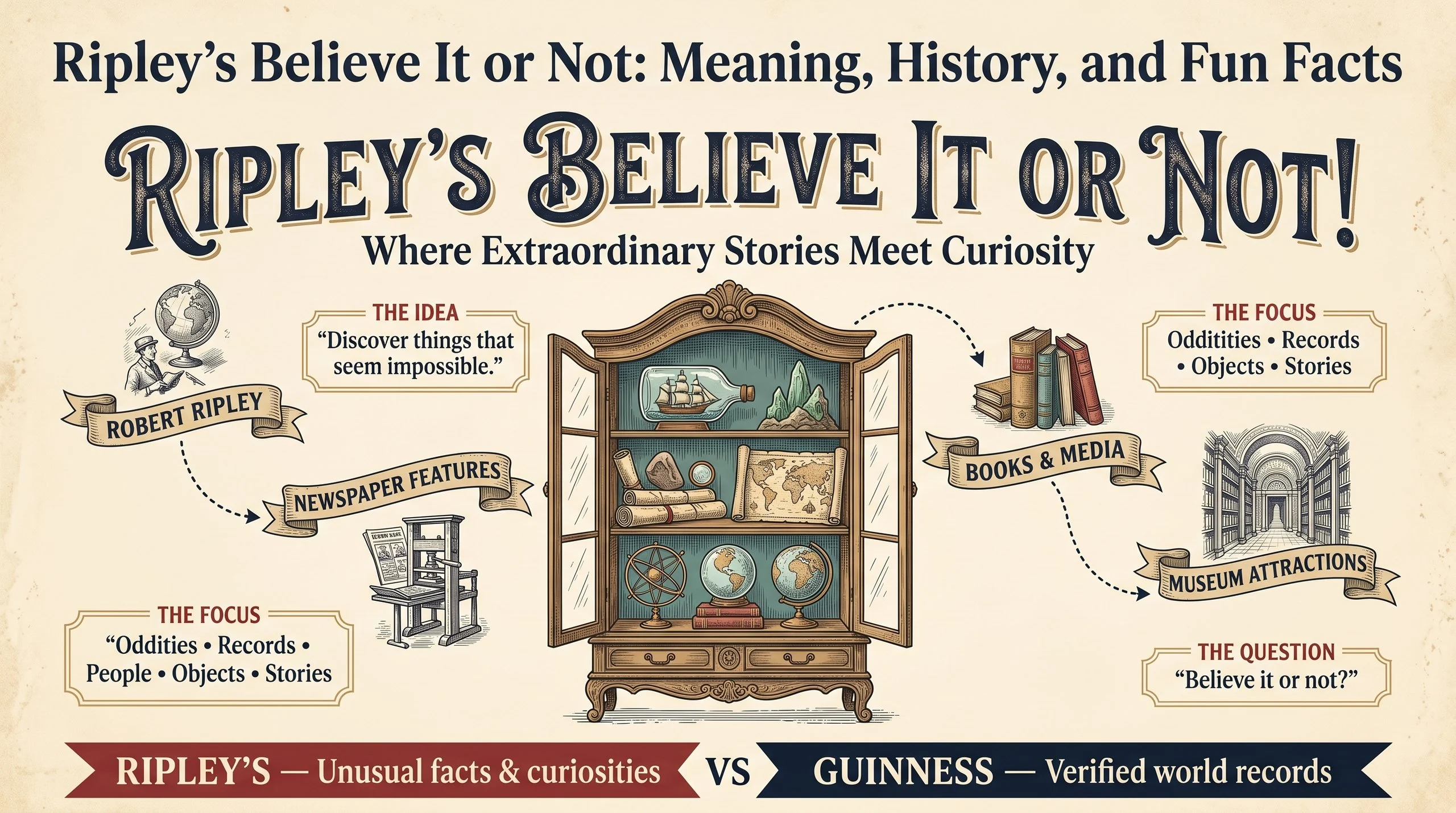
Ripley’s Believe It or Not is a long-running entertainment brand known for presenting unusual facts, strange records, incredible people, bizarre objects, and extraordinary stories from around the world. The name is associated with museums, books, television programs, newspaper features, and other attractions built around the idea of discovering things that seem too unbelievable to be true.
Ripley’s Believe It or Not is a name many people associate with bizarre facts, astonishing records, unusual people, strange objects, and stories that seem almost impossible. Over the years, the phrase has become strongly connected with curiosity and the idea of discovering something extraordinary.
The name began with Robert Ripley, an American cartoonist and explorer of unusual human achievements and cultural curiosities. His work eventually developed into a much larger entertainment brand.
Today, the name can refer to a variety of experiences and media. These include books, newspaper features, television programs, museums, and attractions filled with unusual exhibits.
The appeal is easy to understand. Ordinary facts are everywhere, but extraordinary facts make people stop and ask, “Is that really true?”
That sense of surprise is at the heart of the brand.
Whether you have seen a Ripley’s attraction, encountered the name online, or simply heard someone use the phrase in conversation, understanding its meaning requires looking at both the original creator and the unusual world he helped popularize.
| Meaning | Context | Primary Platforms | Example | Tone |
|---|---|---|---|---|
| An entertainment brand featuring unusual facts, people, objects, and records | Museums, media, books, attractions, popular culture | Museums, books, TV, newspapers, websites | “That fact sounds like something from Ripley’s Believe It or Not!” | Curious, surprising, entertaining |
What Is Ripley’s Believe It or Not?
Ripley’s Believe It or Not is an entertainment and publishing brand centered on unusual facts, extraordinary achievements, bizarre objects, and surprising stories.
Its content has historically focused on things that challenge ordinary expectations.
These subjects can include:
- Unusual human abilities
- Extraordinary physical achievements
- Strange animals
- Unusual traditions
- Rare objects
- Remarkable records
- Unexpected historical events
- Uncommon cultural practices
- Incredible collections
- Human-interest stories
The brand presents these subjects in an entertaining way.
Rather than focusing only on conventional history or science, it highlights things that make people curious.
What Does “Believe It or Not” Mean?
The phrase “Believe It or Not” expresses surprise or disbelief.
When someone says something unusual and follows it with “believe it or not,” they are emphasizing that the statement may sound difficult to believe.
For example:
“Believe it or not, some animals can survive conditions that would be impossible for humans.”
The phrase suggests:
“This sounds unbelievable, but it is presented as true.”
That idea became the foundation of Ripley’s famous presentation style.
Who Created Ripley’s Believe It or Not?
The original creator was Robert Ripley, an American cartoonist and collector of unusual facts.
Ripley became known for presenting strange and extraordinary information through illustrated features.
His work attracted attention because it combined entertainment with curiosity.
Rather than simply reporting ordinary events, he looked for stories that made readers stop and think.
His interests eventually expanded into travel and exploration, allowing him to collect unusual stories and observations from different parts of the world.
Who Was Robert Ripley?
Robert Ripley was born in 1890 in Santa Rosa, California.
He initially pursued a career in illustration and cartooning.
His interest in unusual facts became a defining part of his professional identity.
Ripley traveled extensively and developed a reputation for seeking out remarkable stories, people, places, and objects.
His work eventually became much more than a newspaper cartoon.
It developed into a recognizable entertainment property that continues to use his name.
How Did Ripley’s Believe It or Not Begin?
The concept developed through Ripley’s illustrated newspaper features.
His work became known for presenting unusual claims and fascinating discoveries.
Readers were drawn to the contrast between familiar everyday life and extraordinary examples from around the world.
As interest grew, the concept expanded beyond newspapers.
Books, radio, television, exhibitions, and other forms of entertainment helped bring the idea to larger audiences.
The central formula remained similar:
Find something extraordinary → present it dramatically → make people curious.
Why Is Ripley’s Believe It or Not So Popular?
The concept appeals to a basic human instinct: curiosity.
People naturally want to know whether surprising claims are true.
For example, an unusual historical fact can create immediate curiosity.
A strange object can make someone wonder about its origin.
An extraordinary human achievement can make people ask how it was possible.
That combination of surprise and curiosity gives the brand broad appeal.
It can entertain children, families, tourists, history enthusiasts, and people who simply enjoy unusual facts.
Ripley’s Attractions
One of the most recognizable parts of the brand is its collection of physical attractions.
These attractions generally feature exhibits designed to surprise visitors.
Depending on the location, visitors may encounter:
- Odd artifacts
- Unusual sculptures
- Historical curiosities
- Human-interest exhibits
- Optical illusions
- Cultural displays
- Record-related exhibits
- Strange natural objects
The exact exhibits vary by location.
Some attractions are designed as traditional museums, while others combine museum displays with interactive entertainment.
What Happens at a Ripley’s Attraction?
A typical visit involves walking through themed exhibition areas.
Visitors can examine unusual objects and read explanations about their history or significance.
Some attractions also include interactive elements.
The experience is designed to encourage questions such as:
“How is that possible?”
“Is that really real?”
“How did someone accomplish that?”
This creates a different experience from a traditional museum.
Instead of concentrating on one historical period or artistic movement, the focus is often on variety and surprise.
Ripley’s Believe It or Not Museums
The brand is particularly associated with its Odditorium attractions.
The word “Odditorium” combines the ideas of an auditorium and something odd.
These attractions are designed around unusual exhibits and surprising discoveries.
They often appear in major tourist destinations.
Because each location can have different exhibits, visitors may encounter a different collection of unusual material from one attraction to another.
What Is a Ripley’s Odditorium?
A Ripley’s Odditorium is a museum-style attraction featuring unusual and extraordinary exhibits.
The experience typically focuses on visual curiosity.
Visitors may see strange objects, unusual artistic creations, historical curiosities, or exhibits connected with extraordinary people.
The term itself reinforces the brand’s central idea:
Odd things are worth exploring.
Ripley’s Believe It or Not Books
Books have played an important role in the brand’s history.
Collections of unusual facts allow readers to explore extraordinary stories without visiting a physical attraction.
These books often appeal to readers who enjoy:
- Strange facts
- Trivia
- Records
- History
- Human achievements
- Unusual animals
- Curious discoveries
The format also makes the material accessible to younger readers.
Ripley’s Believe It or Not on Television
The brand has also appeared in television programming.
Television adaptations bring unusual stories to a visual audience.
Instead of simply reading about an unusual person or event, viewers can see demonstrations, interviews, footage, and recreations.
This format fits naturally with the brand because unusual subjects often become more interesting when viewers can see them.
Ripley’s Believe It or Not and Newspaper History
Newspapers were central to the brand’s early development.
Robert Ripley’s illustrated features attracted readers by presenting unusual facts and stories.
Newspaper distribution gave the concept a huge audience.
This helped transform a cartoon feature into a recognizable entertainment brand.
The early success also demonstrated how curiosity could become a powerful form of mass entertainment.
What Kind of Facts Does Ripley’s Feature?
The subjects can vary widely.
Human Achievements
These stories highlight people who accomplish unusual physical or mental feats.
Strange Animals
Some stories involve unusual animal behavior, appearances, or abilities.
Unusual Objects
Rare or unexpected objects can become attractions because of their history or appearance.
Cultural Traditions
Unusual customs and traditions from different societies may also attract attention.
Historical Curiosities
Some stories reveal strange events, forgotten practices, or unexpected historical details.
Records
Extraordinary achievements can become interesting because they push beyond ordinary limits.
Is Ripley’s Believe It or Not Real?
The brand presents itself around unusual claims and extraordinary stories, but individual claims should not automatically be treated as established fact simply because they appear under the Ripley’s name.
This is an important distinction.
Some stories may be well documented.
Others may depend on historical sources, reported accounts, interpretation, or specific definitions.
When a claim sounds extraordinary, checking reliable evidence is still useful.
The phrase itself is designed to create curiosity, not replace critical thinking.
Why Does the Name Suggest Disbelief?
The wording is intentionally provocative.
“Believe it or not” challenges the reader.
It essentially says:
“This may sound impossible, but take a closer look.”
That creates a psychological hook.
Instead of presenting a fact as ordinary information, the phrase makes the reader question it.
This technique is part of what made the original newspaper features memorable.
Ripley’s Believe It or Not vs. Guinness World Records
People sometimes confuse Ripley’s with Guinness World Records, but they are not the same.
| Ripley’s Believe It or Not | Guinness World Records |
|---|---|
| Focuses broadly on unusual facts and curiosities | Focuses specifically on record achievements |
| Includes objects, people, stories, and oddities | Primarily documents record holders and records |
| Known for museums and entertainment attractions | Known for record verification and publications |
| Strong emphasis on surprise and curiosity | Strong emphasis on measurable records |
| Uses a museum and entertainment format | Uses a record-book and verification format |
There can be some overlap.
For example, an unusual world record could fit naturally into both types of content.
However, their central purposes are different.
Ripley’s Believe It or Not vs. a Traditional Museum
A traditional museum may focus on a particular subject.
For example, an art museum might concentrate on paintings.
A natural history museum might focus on animals, fossils, and geology.
A Ripley’s attraction typically takes a broader approach.
Its organizing principle is not one academic field.
Instead, it is unusualness.
That makes the experience more unpredictable.
Why Do People Say “That’s a Ripley’s Believe It or Not Fact”?
In everyday conversation, someone may use the name as a comparison.
For example:
“That sounds like a Ripley’s Believe It or Not fact.”
This means the information sounds extremely unusual or surprising.
The speaker does not necessarily mean that Ripley’s actually published the fact.
They are using the brand name as shorthand for something bizarre or difficult to believe.
Ripley’s Believe It or Not as a Cultural Reference
Over time, the phrase has become part of popular culture.
Someone can use it when discussing an unusual person, strange event, or surprising piece of trivia.
For example:
“Believe it or not, that old building was moved to another location.”
The phrase creates an expectation of surprise.
Similarly, saying something is “straight out of Ripley’s” suggests that it seems unusually strange or extraordinary.
Famous Types of Ripley’s Exhibits
Although exhibits differ by location, several categories fit the brand particularly well.
Unusual Human Bodies
Some exhibits focus on rare physical characteristics or extraordinary human conditions.
Extraordinary Art
Artists sometimes create sculptures and artwork using unexpected materials or unusual techniques.
Historical Objects
Objects with unusual stories can become compelling exhibits.
Optical Illusions
Visual tricks can make visitors question what they are seeing.
Strange Collections
Collections become interesting when the objects are exceptionally unusual or unexpected.
Is Ripley’s Believe It or Not for Kids?
Many Ripley’s attractions and books appeal to children and families.
Kids often enjoy unusual facts because the material is visually interesting and surprising.
However, the exact suitability depends on the attraction and individual exhibits.
Some displays may involve subjects that parents prefer to preview.
Families can check the specific attraction’s information before visiting.
Is Ripley’s Believe It or Not Educational?
It can have educational value, particularly when unusual facts encourage visitors to learn more.
For example, an unusual historical object may lead someone to research the period in which it was created.
A strange animal fact may inspire interest in biology.
An unusual cultural tradition may lead to learning about another society.
The strongest educational value comes from using surprising information as a starting point for deeper learning.
Fun Ways to Use Ripley’s-Style Facts
You do not need to visit an attraction to enjoy unusual facts.
Try creating a trivia game.
Believe It or Not Quiz
Present a surprising statement and ask:
True or false?
Players then vote before seeing the answer.
Strange Fact Challenge
Each person shares the most unusual fact they know.
The group votes on which one sounds least believable.
Fact or Fiction
Mix real unusual facts with fictional statements.
Players must identify which claims are genuine.
These activities work well for classrooms, family gatherings, parties, and online content.
Common Misunderstandings
“Ripley’s Is Only a Museum”
Not exactly.
The brand has existed across multiple forms of media and entertainment, including newspaper features, books, television, and attractions.
“Every Ripley’s Fact Must Be Scientifically Proven”
Not necessarily.
Individual claims should be evaluated according to their evidence and source.
“Ripley’s and Guinness Are the Same”
They are different brands with different primary focuses.
“Believe It or Not Means You Should Believe Everything”
The phrase is designed to create curiosity.
It does not mean that critical evaluation is unnecessary.
Why the Brand Name Works So Well
The name contains a built-in challenge.
Believe it or not.
That wording creates tension between belief and disbelief.
Readers want to know what comes next.
The formula is especially effective for unusual information because extraordinary claims naturally produce questions.
This simple phrase helped create a memorable identity around curiosity.
Frequently Asked Questions
What does Ripley’s Believe It or Not mean?
It refers to an entertainment brand known for unusual facts, strange objects, extraordinary people, remarkable achievements, and surprising stories.
Who created Ripley’s Believe It or Not?
Robert Ripley created the original newspaper feature that developed into the broader brand.
What is a Ripley’s Odditorium?
A Ripley’s Odditorium is a museum-style attraction featuring unusual and extraordinary exhibits.
Is Ripley’s Believe It or Not a museum?
The name is associated with museum-style attractions, but the broader brand also includes books, television, publishing, and other entertainment formats.
What does “believe it or not” mean?
The phrase emphasizes that something may sound surprising or unbelievable but is being presented as true or noteworthy.
Is Ripley’s Believe It or Not the same as Guinness World Records?
No. Ripley’s focuses broadly on unusual facts and curiosities, while Guinness World Records specializes in documenting and verifying records.
Are Ripley’s attractions good for families?
Many attractions are designed for general audiences and families, although specific exhibits can vary by location.
Why is Ripley’s Believe It or Not famous?
Its popularity comes from presenting unusual and surprising stories in an entertaining format that encourages curiosity.
What is a Ripley’s Believe It or Not fact?
In casual speech, the phrase can describe an unusual or astonishing fact. It does not necessarily mean that Ripley’s actually published that specific fact.
Is everything in Ripley’s Believe It or Not true?
Individual claims should be evaluated based on their evidence and sources. The brand’s unusual presentation is intended to spark curiosity, but extraordinary claims still deserve careful examination.
Key Takeaway & Summary
Ripley’s Believe It or Not is a long-running entertainment brand built around unusual facts, extraordinary people, strange objects, remarkable achievements, and surprising stories.
Its name comes from the original work of Robert Ripley, whose illustrated newspaper features brought unusual discoveries to a wide audience. The concept later expanded into books, television, museums, and other attractions.
Today, the phrase can also be used casually to describe something that seems astonishing or difficult to believe.
Conclusion
Ripley’s Believe It or Not has built its identity around one powerful idea: unusual things are worth discovering.
From Robert Ripley’s early newspaper illustrations to modern attractions, books, and television programs, the brand has turned curiosity into entertainment. Its exhibits and stories cover a wide range of subjects, which makes each experience unpredictable.
The phrase also has a broader meaning in everyday language. When someone describes something as “Ripley’s Believe It or Not,” they usually mean that it is unusually strange, surprising, or hard to believe.
At the same time, extraordinary claims should still be examined carefully. Curiosity is valuable, but curiosity becomes even more useful when it leads to research and understanding.
Ultimately, that balance between surprise and discovery explains why the Ripley’s name has remained recognizable for generations.