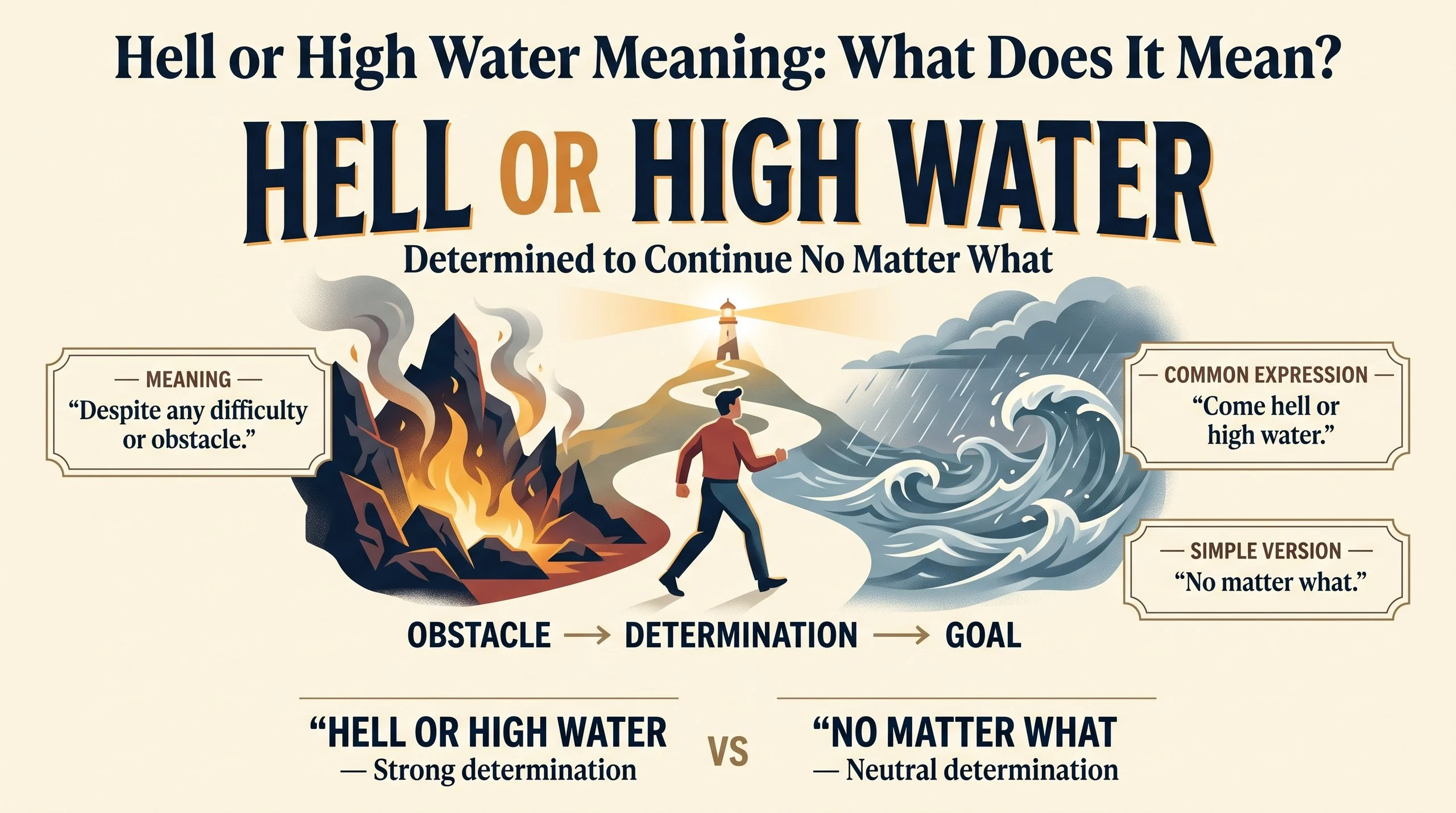
“Hell or high water” means that someone is determined to do something despite serious problems, obstacles, danger, or difficult circumstances. The phrase is often used in the expression “come hell or high water,” meaning that nothing will stop a person from reaching a goal or keeping a promise.
Hell or high water is an English idiom used to describe strong determination in the face of difficulty. When someone says they will do something “come hell or high water,” they mean they intend to do it no matter what problems appear along the way.
The phrase creates a dramatic image. “Hell” represents an extreme or frightening situation, while “high water” suggests a flood or dangerous conditions. Together, the words suggest that a person is prepared to face almost anything rather than give up.
You may hear the expression in conversations about promises, relationships, work, travel, goals, or difficult decisions. For example, someone might say, “Come hell or high water, I’m finishing this project tonight.”
In that sentence, the speaker is not literally expecting hell or a flood. Instead, the phrase emphasizes determination.
Although the wording sounds dramatic, it is commonly used in a figurative way. It can sound serious, humorous, motivational, or slightly exaggerated depending on the situation.
| Meaning | Context | Primary Platforms | Example | Tone |
|---|---|---|---|---|
| Determined to continue despite any obstacle | Everyday speech, promises, goals, challenges | Conversation, texting, social media, writing | “Come hell or high water, I’ll be there.” | Determined, dramatic, confident |
What Does Hell or High Water Mean?
Hell or high water means despite any difficulty, obstacle, danger, or setback.
The complete expression is usually:
“Come hell or high water.”
It means:
- No matter what happens
- Whatever obstacles appear
- Despite serious difficulties
- At any cost
- No matter how difficult things become
- Regardless of the circumstances
For example:
“Come hell or high water, we’re going to finish the job.”
The speaker means:
“We will finish the job even if we face major problems.”
What Does “Come Hell or High Water” Mean?
“Come hell or high water” means that something will happen regardless of the obstacles involved.
It communicates determination.
For example:
“Come hell or high water, I’ll keep my promise.”
This means the speaker intends to keep the promise even if doing so becomes extremely difficult.
The expression can also refer to a planned action:
“We’re going on the trip come hell or high water.”
Here, the speaker means that the trip will happen despite possible problems.
Simple Definition
A simple way to understand hell or high water is:
“No matter what happens.”
Another simple explanation is:
“Despite anything that tries to stop you.”
The phrase usually carries a stronger sense of determination than simply saying “no matter what.”
Hell or High Water Meaning in Simple Words
Imagine someone has an important goal.
They know problems might appear.
They might face:
- Bad weather
- Delays
- Financial problems
- Opposition
- Unexpected setbacks
- Fear
- Difficult decisions
Yet they refuse to give up.
That attitude can be described as:
“Come hell or high water.”
In very simple terms:
“I am doing this no matter what.”
Examples of Hell or High Water
Example 1: Work
“Come hell or high water, I’ll finish the report before Friday.”
The person is determined to complete the report even if problems arise.
Example 2: Travel
“We’re getting to the airport come hell or high water.”
The speaker means they will make every effort to reach the airport despite delays or other problems.
Example 3: Friendship
“I’ll be there for you come hell or high water.”
This expresses strong loyalty and support.
Example 4: Personal Goal
“Come hell or high water, I’m going to finish this marathon.”
The speaker is determined not to give up.
Example 5: Family
“She promised to protect her family come hell or high water.”
The phrase emphasizes her determination.
Hell or High Water in a Sentence
Here are natural ways to use the phrase:
- “Come hell or high water, we’ll get this done.”
- “I’m going to the concert come hell or high water.”
- “He said he would keep his promise come hell or high water.”
- “Come hell or high water, she plans to graduate this year.”
- “We’ll find a solution come hell or high water.”
- “They are determined to win come hell or high water.”
- “I’ll finish what I started come hell or high water.”
- “Come hell or high water, we’re sticking together.”
- “He intends to reach his goal come hell or high water.”
- “She’ll be there come hell or high water.”
Hell or High Water in Texting
In texting, hell or high water usually communicates strong determination.
For example:
Friend: “Are you still coming tonight?”
Reply: “Come hell or high water 😂”
The person means:
“Absolutely. Nothing is stopping me.”
The phrase can be serious or playful depending on context.
Someone might also write:
“We’re getting pizza tonight, come hell or high water.”
That could simply mean they are extremely determined to get pizza.
Hell or High Water on Social Media
The expression can work well in captions, posts, and motivational content.
Examples include:
- “Chasing this dream come hell or high water.”
- “We’re making it happen come hell or high water.”
- “Still moving forward, come hell or high water.”
- “I’ll finish what I started.”
- “Come hell or high water, I refuse to quit.”
On social media, the phrase often carries a motivational tone.
Hell or High Water in Relationships
The expression can communicate loyalty and commitment.
For example:
“I’ll stand by you come hell or high water.”
This means:
“I’ll support you even when things become extremely difficult.”
It can therefore express:
- Loyalty
- Commitment
- Devotion
- Determination
- Emotional support
However, the phrase is quite dramatic. In casual romantic conversations, simpler wording may sound more natural.
Hell or High Water in Work and Business
The phrase can emphasize commitment to a deadline, project, or objective.
For example:
“We need to launch the product come hell or high water.”
The speaker is saying that the launch will happen despite obstacles.
It can sound confident and forceful.
However, in formal business writing, alternatives such as “regardless of the challenges” or “despite any obstacles” may sound more professional.
Hell or High Water in Motivation
The phrase works especially well in motivational language because it emphasizes persistence.
For example:
“Come hell or high water, keep moving forward.”
The message is simple:
Do not let obstacles make you quit.
It can therefore appear in:
- Motivational speeches
- Workout captions
- Personal goals
- Sports conversations
- Career discussions
- Self-improvement posts
Is Hell or High Water Negative?
Not necessarily.
The words themselves sound intense, but the overall meaning is usually about determination.
For example:
“I’ll help you come hell or high water.”
That is positive because it communicates loyalty.
On the other hand:
“We’re going to defeat them come hell or high water.”
This could sound aggressive depending on the context.
So, the tone depends on what the speaker is determined to do.
Is “Hell or High Water” a Slang Phrase?
It is better described as an idiom rather than slang.
An idiom is an expression whose overall meaning is different from the literal meanings of its individual words.
In this case, “hell” and “high water” create an image of extreme conditions.
The phrase does not literally mean that a person expects hell or a flood.
It means:
“No matter how difficult things become.”
Literal vs. Figurative Meaning
Literal Meaning
Taken literally, “hell” and “high water” describe extreme or dangerous conditions.
However, that is not normally what the speaker intends.
Figurative Meaning
The figurative meaning is:
“Despite any obstacle or difficulty.”
For example:
“Come hell or high water, I’ll be there.”
The person is not saying they expect an actual flood.
They are emphasizing their commitment.
Where Did Hell or High Water Come From?
The exact origin of the expression is not completely certain.
The phrase combines two powerful images of hardship.
Hell represents an extreme or terrible situation.
High water suggests flooding or dangerous water levels.
The combination creates the idea of facing one extreme condition or another.
The expression became established in American English and has been used for generations to describe determination in difficult circumstances.
Its exact historical development is less certain than some other English idioms, so claims about one specific person or event creating the phrase should be treated carefully.
Why Does the Phrase Mention High Water?
The “high water” part creates an image of a flood.
Before modern infrastructure and weather forecasting, flooding could pose a serious threat to travel, homes, agriculture, and communities.
High water therefore became a natural symbol of an obstacle that could stop someone from reaching a destination.
Combined with “hell,” it creates an intentionally extreme image.
The message is essentially:
“Even if everything goes terribly wrong, I will continue.”
Hell or High Water vs. No Matter What
These expressions are similar, but they differ in tone.
| Hell or High Water | No Matter What |
|---|---|
| More dramatic | More neutral |
| Strongly emphasizes determination | Simply emphasizes commitment |
| Often informal | Works in many settings |
| Can sound emotional | Usually straightforward |
| More idiomatic | More literal |
Example:
“I’ll be there no matter what.”
This sounds calm.
“I’ll be there come hell or high water.”
This sounds much more intense.
Hell or High Water vs. At All Costs
These expressions can overlap, but they are not always interchangeable.
At all costs suggests that someone is willing to accept almost any sacrifice to achieve a goal.
Come hell or high water focuses more on continuing despite obstacles.
For example:
“I’ll finish the project come hell or high water.”
This emphasizes determination.
“We must win at all costs.”
This can imply extreme measures.
Therefore, come hell or high water is often the safer choice when you want to emphasize persistence rather than sacrifice.
Hell or High Water vs. Come What May
“Come what may” means regardless of what happens.
Both phrases communicate acceptance of uncertainty.
However, they have different emotional tones.
Come what may sounds more calm or poetic.
Come hell or high water sounds more forceful and determined.
Compare:
“I’ll support you, come what may.”
“I’ll support you, come hell or high water.”
The second sentence sounds stronger.
Hell or High Water vs. Through Thick and Thin
These phrases can both express loyalty and persistence.
Through thick and thin usually focuses on staying loyal during both good and bad times.
Come hell or high water emphasizes overcoming obstacles.
For example:
“We’ve been friends through thick and thin.”
This highlights a long-lasting relationship.
“I’ll help you come hell or high water.”
This highlights determination to help despite difficulties.
Common Synonyms and Alternatives
Depending on the context, you can replace hell or high water with:
- No matter what
- Come what may
- Regardless
- Despite everything
- At all costs
- Against all odds
- Whatever happens
- No matter the obstacles
- Through thick and thin
- By any means necessary
However, these alternatives do not always have exactly the same tone.
When Should You Use Hell or High Water?
Use the expression when you want to emphasize strong determination.
It works particularly well when:
- Someone has made a promise.
- A person refuses to quit.
- A goal is difficult.
- Someone expects obstacles.
- A friend promises support.
- A deadline is important.
- A person is determined to follow through.
For example:
“Come hell or high water, I’m going to finish this.”
The phrase makes the speaker’s determination very clear.
When Should You Avoid It?
The expression may not be ideal in very formal writing.
For example, a business report might say:
“We will complete the project despite any obstacles.”
That sounds more professional than:
“We will complete the project come hell or high water.”
The idiom is better suited to:
- Conversation
- Personal writing
- Creative writing
- Social media
- Informal messages
- Speeches
- Motivational content
Common Mistakes
Mistake 1: Taking It Literally
The expression is usually figurative.
It does not normally refer to actual hell or flooding.
Mistake 2: Using It for Every Small Problem
The phrase sounds dramatic.
Using it for something trivial can make the statement humorous or exaggerated.
For example:
“Come hell or high water, I’m getting another cookie.”
This is technically understandable, but the dramatic tone makes it funny.
Mistake 3: Confusing It With “High and Low”
The correct expression is:
“Come hell or high water.”
Not:
“Come hell or high and low water.”
Mistake 4: Assuming It Always Sounds Serious
Context matters.
The phrase can be sincere, motivational, dramatic, or humorous.
Fun Examples of Hell or High Water
1. For Determination
“Come hell or high water, I’m finishing this book.”
2. For Friendship
“I’ll have your back come hell or high water.”
3. For Travel
“We’re reaching the cabin come hell or high water.”
4. For Sports
“Our team is fighting for the win come hell or high water.”
5. For Humor
“Come hell or high water, I’m ordering dessert.”
6. For Personal Goals
“Come hell or high water, I’m sticking to my plan.”
Practice: Choose the Best Meaning
Question 1
“I’ll be at your wedding come hell or high water.”
What does it mean?
- A. The speaker expects a storm.
- B. The speaker is determined to attend.
- C. The speaker dislikes weddings.
Answer: B. The speaker is emphasizing that they will attend despite obstacles.
Question 2
“Come hell or high water, we’re finishing the project.”
What does it mean?
A. The project will be abandoned.
B. The project will continue despite difficulties.
C. The project is about flooding.
Answer: B.
Question 3
“He promised to help her come hell or high water.”
What does the phrase express?
A. Confusion
B. Determination and loyalty
C. Fear
Answer: B.
Frequently Asked Questions
What does hell or high water mean?
It means despite any obstacle, difficulty, or problem. The phrase is usually found in “come hell or high water.”
What does “come hell or high water” mean in simple terms?
It means “no matter what happens” or “I will do it despite anything that gets in my way.”
Is hell or high water an idiom?
Yes. It is an English idiom used to express determination despite difficult circumstances.
Is hell or high water slang?
Not usually. It is better classified as an idiomatic expression rather than slang.
Is “come hell or high water” positive?
It can be positive when it expresses loyalty, persistence, or commitment. However, its intense wording can sound aggressive or dramatic in some contexts.
Can I use hell or high water in texting?
Yes. It works well in casual texts when you want to emphasize determination.
What is another way to say hell or high water?
You can say “no matter what,” “come what may,” “despite everything,” or “against all odds,” depending on the context.
What is the opposite of hell or high water?
An opposite idea would be giving up when difficulties appear or abandoning a goal because of obstacles.
Can hell or high water be used humorously?
Yes. The dramatic wording can make ordinary situations funny.
For example:
“Come hell or high water, I’m getting tacos tonight.”
Is “hell or high water” formal?
It is generally informal. More neutral alternatives include “despite any obstacles” and “regardless of the circumstances.”
Key Takeaway & Summary
Hell or high water expresses determination in the face of obstacles. The most common form, “come hell or high water,” means that someone intends to do something regardless of what difficulties appear.
The phrase is usually figurative. “Hell” and “high water” represent extreme situations, creating a dramatic way to say “no matter what.”
It can describe loyalty, persistence, commitment, ambition, or even a humorous determination to accomplish something ordinary.
Conclusion
Hell or high water is a powerful English idiom for describing determination. When someone says “come hell or high water,” they are making it clear that obstacles will not easily change their plans.
The expression works because its imagery is extreme. Hell represents a terrible situation, while high water suggests a dangerous flood. Together, they create a vivid picture of someone moving forward despite almost anything that could stand in their way.
In everyday conversation, the phrase can sound serious, motivational, loyal, or funny. Its meaning depends heavily on context.
So, if someone tells you, “Come hell or high water, I’ll be there,” they are not predicting disaster. They are making a strong promise:
“Whatever happens, you can count on me.”