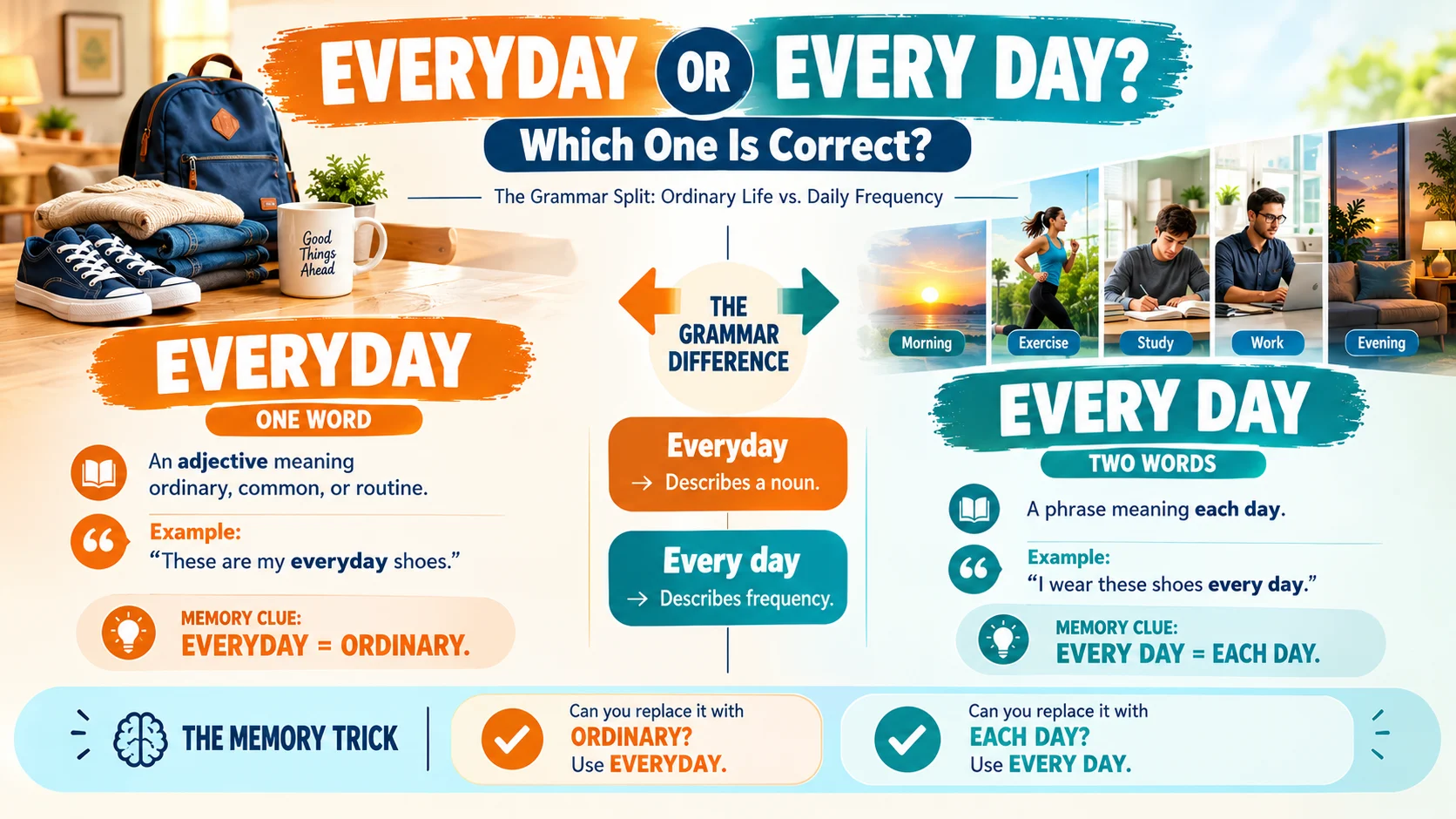
Everyday and every day are both correct, but they have different grammatical uses. Everyday is one word and functions as an adjective meaning ordinary or common, while every day is two words and means each day. For example, “These are my everyday shoes” describes ordinary shoes, whereas “I wear these shoes every day” describes how frequently you wear them.
Have you ever wondered whether to write everyday or every day in a sentence? Although these expressions look and sound almost identical, they have different meanings and grammatical functions. Choosing the wrong form can make your writing confusing or grammatically incorrect.
The main difference is simple: everyday describes something ordinary, common, or routine, while every day refers to something that happens daily. For instance, you might wear everyday clothes to work, but you probably don’t buy new clothes every day. Understanding this small distinction can make a noticeable difference in your writing.
Moreover, both expressions appear frequently in emails, social media posts, school assignments, professional documents, and everyday conversations. Therefore, knowing when to use each form helps you communicate more clearly and confidently.
In this guide, you’ll learn the meaning of both expressions, their grammatical differences, practical examples, common mistakes, and easy tricks to remember the correct spelling. By the end, you’ll know exactly when to write everyday as one word and every day as two words.
Everyday vs Every Day
| Meaning | Context | Primary Platforms | Example | Tone |
|---|---|---|---|---|
| Ordinary or common | Describing nouns | Writing, conversation | These are my everyday shoes. | Neutral |
| Each day | Describing frequency | Emails, texts, writing | I exercise every day. | Neutral |
| Regular or routine | Describing activities | Work, school, lifestyle | Everyday responsibilities can be tiring. | Informal |
| Daily occurrence | Describing repeated actions | Conversation, social media | She calls her mother every day. | Neutral |
What Does Everyday Mean?
Everyday is a single word that functions as an adjective. It describes something ordinary, common, regular, or suitable for normal daily use.
In simple terms, everyday refers to things that are part of an ordinary routine rather than something unusual, special, or extraordinary.
For example:
- I prefer wearing everyday clothes at home.
- Smartphones have become an everyday necessity.
- Cooking is an everyday responsibility in our household.
- She enjoys reading about everyday life.
- These shoes are perfect for everyday use.
In each example, everyday describes a noun, such as clothes, necessity, responsibility, life, or use.
Remember: If you can replace everyday with “ordinary” or “common” without changing the basic meaning, the one-word form is probably correct.
What Does Every Day Mean?
Every day is a two-word phrase that means each day or on a daily basis. It describes how frequently an action happens.
Unlike everyday, this expression does not describe a noun. Instead, it usually functions as an adverbial phrase that explains when or how often something occurs.
For example:
- I walk for thirty minutes every day.
- She practices English every day.
- We drink coffee every day.
- My father reads the newspaper every day.
- They go to the gym every day.
In these sentences, every day tells us how frequently the actions happen.
Remember: If you can replace every day with “each day” and the sentence still makes sense, use the two-word version.
Everyday vs Every Day: Key Differences
Although both expressions contain the same two words, their grammatical roles are different.
| Feature | Everyday | Every Day |
|---|---|---|
| Spelling | One word | Two words |
| Grammar | Adjective | Adverbial phrase |
| Meaning | Ordinary or common | Each day |
| Purpose | Describes a noun | Describes frequency |
| Example | Everyday activities | Exercise every day |
| Similar expression | Ordinary | Each day |
| Common use | Everyday life | Happens every day |
The easiest way to remember the difference is to focus on the meaning rather than the pronunciation.
Furthermore, everyday usually appears before a noun, while every day commonly appears after a verb or at the beginning or end of a sentence.
When to Use Everyday
Use everyday when describing something ordinary, familiar, routine, or commonly used.
Here are the most common situations.
Describing Ordinary Things
Use everyday to talk about objects or experiences that are normal parts of life.
Examples:
- I wear everyday clothes when working from home.
- These are my everyday shoes.
- She prefers everyday jewelry over expensive accessories.
- Everyday problems can sometimes become stressful.
Talking About Daily Life
Everyday also describes common experiences, habits, and situations.
Examples:
- Everyday life can be unpredictable.
- Technology has changed everyday communication.
- We should appreciate the beauty of everyday moments.
- Good relationships require everyday effort.
Describing Regular Activities
You can also use everyday before nouns related to routine responsibilities.
Examples:
- Everyday tasks keep us busy.
- He handles everyday office responsibilities.
- Cooking is an everyday activity for many families.
- Learning is an everyday experience.
Common Expressions With Everyday
Some frequently used combinations include:
| Expression | Example |
|---|---|
| Everyday life | Everyday life can be challenging. |
| Everyday clothes | I prefer comfortable everyday clothes. |
| Everyday use | This bag is designed for everyday use. |
| Everyday activities | Walking is one of my everyday activities. |
| Everyday problems | Everyone faces everyday problems. |
| Everyday routine | My everyday routine starts early. |
| Everyday language | Use everyday language in your writing. |
| Everyday items | The store sells everyday items. |
When to Use Every Day
Use every day when you want to express that something happens each day or occurs daily.
Here are common situations where the two-word expression is appropriate.
Describing Daily Habits
Use every day to describe habits that someone follows regularly.
Examples:
- I brush my teeth every day.
- She drinks plenty of water every day.
- He studies mathematics every day.
- We take our dog for a walk every day.
Talking About Work and Responsibilities
Every day is also useful when describing repeated professional or personal activities.
Examples:
- I check my emails every day.
- She arrives at the office early every day.
- They practice their presentation every day.
- Our team reviews customer feedback every day.
Describing Regular Events
Use every day when an event or action occurs daily.
Examples:
- The bus arrives at this stop every day.
- My favorite show airs every day.
- He calls his parents every day.
- The shop opens at nine every day.
Common Expressions With Every Day
| Expression | Example |
|---|---|
| Every day at work | I learn something new every day at work. |
| Every day of the week | She exercises every day of the week. |
| Almost every day | We talk almost every day. |
| Not every day | You don’t get an opportunity like this every day. |
| Every single day | He practices every single day. |
| Every day after school | The children play outside every day after school. |
Everyday or Every Day in a Sentence
Understanding both forms becomes easier when you compare them in similar sentences.
| Everyday (One Word) | Every Day (Two Words) |
|---|---|
| These are my everyday shoes. | I wear these shoes every day. |
| She enjoys everyday activities. | She exercises every day. |
| Everyday life can be complicated. | Life changes every day. |
| This is an everyday problem. | I face this problem every day. |
| He wears everyday clothing. | He changes his clothes every day. |
| We discuss everyday topics. | We talk every day. |
| These products are for everyday use. | I use these products every day. |
| Everyday responsibilities can be stressful. | I manage these responsibilities every day. |
Notice how the one-word version describes a noun, whereas the two-word version explains how often an action happens.
Easy Tricks to Remember the Difference
If you frequently confuse these expressions, a few simple memory tricks can help.
The Each Day Test
Replace every day with “each day.”
For example:
- I study every day.
- I study each day.
Both sentences communicate the same idea. Therefore, every day is correct.
The Ordinary Test
Replace everyday with “ordinary.”
For example:
- These are my everyday clothes.
- These are my ordinary clothes.
The meaning remains similar. Consequently, everyday is the correct choice.
The Noun Test
Ask yourself whether the word describes a noun.
- Everyday routine: describes the noun routine.
- Everyday experience: describes the noun experience.
- Everyday activities: describes the noun activities.
If it describes a noun and means ordinary or common, use everyday.
The Frequency Test
Ask whether the sentence explains how often something happens.
- I read every day.
- She works every day.
- They practice every day.
If the meaning is “each day,” choose every day.
Common Mistakes to Avoid
Even experienced English writers sometimes confuse these expressions. However, remembering their grammatical roles can prevent most errors.
Writing Everyday Instead of Every Day
Incorrect: I exercise everyday.
Correct: I exercise every day.
Explanation: The sentence describes how frequently someone exercises. Therefore, the two-word expression is correct.
Writing Every Day Instead of Everyday
Incorrect: These are my every day shoes.
Correct: These are my everyday shoes.
Explanation: The phrase describes the shoes as ordinary or suitable for regular use. Therefore, everyday should be one word.
Confusing Daily Habits With Ordinary Things
Incorrect: My every day routine is simple.
Correct: My everyday routine is simple.
Explanation: Here, everyday describes the noun routine.
Using the Wrong Form in Professional Writing
Incorrect: We provide services for every day business needs.
Correct: We provide services for everyday business needs.
Explanation: Everyday describes the noun needs and means ordinary or routine.
Assuming Both Forms Are Interchangeable
Although the expressions sound alike, they cannot always replace each other.
For instance, “I work every day” means you work each day, while “I do everyday work” refers to ordinary or routine work.
Is Everyday One Word or Two?
The answer depends on the meaning.
Everyday is one word when it describes something ordinary, common, or routine.
Example: “She wears everyday clothing.”
Every day is two words when it means each day or daily.
Example: “She exercises every day.”
Therefore, neither spelling is universally correct in every situation. Both are standard English expressions, but they serve different grammatical purposes.
Is Everyday a Noun, Verb, or Adjective?
Everyday is an adjective. It describes nouns by indicating that something is ordinary, familiar, or commonly used.
Examples:
- Everyday activities
- Everyday experiences
- Everyday clothes
- Everyday responsibilities
It is not normally used as a noun or verb.
On the other hand, every day is a two-word phrase that usually functions as an adverbial expression of frequency.
Is Every Day an Adverb?
Every day is not technically a single adverb. Instead, it is a two-word phrase that functions adverbially in a sentence.
For example:
“I read a book every day.”
Here, every day tells us how frequently the person reads.
Similarly:
- She cooks every day.
- He runs every day.
- We communicate every day.
In each example, the expression modifies the action by indicating frequency.
Everyday vs Daily: Are They the Same?
The words everyday and daily have related meanings, but they are not always interchangeable.
Everyday is an adjective meaning ordinary or common. Meanwhile, daily can function as an adjective or an adverb meaning occurring each day.
| Everyday | Daily |
|---|---|
| Everyday clothes | Daily exercise |
| Everyday problems | Daily routine |
| Everyday language | Daily newspaper |
| Everyday activities | Daily schedule |
For example:
- “These are my everyday shoes” means these are my ordinary shoes.
- “I exercise daily” means I exercise each day.
Therefore, daily is closer in meaning to every day when describing frequency.
Everyday vs Every Day vs Every Single Day
These three expressions are related, but their uses differ.
| Expression | Meaning | Example |
|---|---|---|
| Everyday | Ordinary or common | These are my everyday clothes. |
| Every day | Each day | I wear these clothes every day. |
| Every single day | Each day, with emphasis | I practice English every single day. |
Furthermore, every single day adds emphasis to the frequency of an action.
For example, “I think about my goals every single day” sounds more emphatic than “I think about my goals every day.”
Everyday or Every Day: Real-Life Examples
Here are additional examples from common situations to help you understand the distinction.
1. At Home
- Everyday household tasks can take a lot of time.
- I clean my room every day.
- These are my everyday kitchen utensils.
- My family eats dinner together every day.
2. At School
- Everyday school activities help students develop useful skills.
- I study English every day.
- Teachers deal with everyday classroom challenges.
- She practices mathematics every day.
3. At Work
- Everyday office responsibilities require organization.
- I check my work schedule every day.
- These are everyday business decisions.
- Our manager reviews reports every day.
4. On Social Media
- Everyday moments can create beautiful memories.
- She posts pictures every day.
- Everyday fashion is popular on social media.
- I check my notifications every day.
5. In Relationships
- Everyday kindness strengthens relationships.
- They communicate with each other every day.
- Small everyday gestures can mean a lot.
- She sends her best friend a message every day.
Advantages and Disadvantages of Understanding the Difference
Knowing when to use everyday and every day may seem like a small grammar skill. Nevertheless, it can improve the accuracy and clarity of your writing.
Advantages
- Better grammar: You can choose the correct expression in different sentences.
- Clear communication: Your readers can understand whether you mean ordinary or daily.
- Professional writing: Correct usage makes emails, articles, and documents more polished.
- Improved vocabulary: You understand the difference between adjectives and adverbial phrases.
- Greater confidence: You can write without second-guessing these expressions.
Disadvantages of Confusing the Two
- Grammar mistakes: Using the wrong form can make a sentence incorrect.
- Reader confusion: Your intended meaning may become less clear.
- Poor editing quality: Repeated mistakes can affect the professionalism of your content.
- Reduced readability: Incorrect word choices can interrupt the flow of a sentence.
Ultimately, learning this distinction takes very little effort and offers lasting benefits.
Common Synonyms and Alternatives
Depending on the sentence, you can replace these expressions with other words or phrases.
Alternatives to Everyday
- Ordinary
- Common
- Routine
- Regular
- Familiar
- Conventional
- Usual
- Typical
- Day-to-day
- Standard
Example: “Everyday responsibilities can be stressful.”
Alternative: “Ordinary responsibilities can be stressful.”
Alternatives to Every Day
- Daily
- Each day
- Day after day
- On a daily basis
- Every single day
- Day by day (depending on context)
Example: “I practice English every day.”
Alternative: “I practice English daily.”
Exercises: Everyday or Every Day?
Test your understanding by choosing the correct expression in each sentence.
Fill in the blanks:
- I drink water ______.
- These are my ______ shoes.
- She practices singing ______.
- ______ life is full of surprises.
- He checks his emails ______.
- We use these tools for ______ tasks.
- My brother exercises ______.
- ______ problems can sometimes teach valuable lessons.
- They visit their grandparents ______.
- This is an ______ activity for our team.
Answers and Explanations
| Question | Correct Answer | Explanation |
|---|---|---|
| I drink water ______. | Every day | Means each day. |
| These are my ______ shoes. | Everyday | Describes ordinary shoes. |
| She practices singing ______. | Every day | Shows frequency. |
| ______ life is full of surprises. | Everyday | Describes ordinary life. |
| He checks his emails ______. | Every day | Means daily. |
| We use these tools for ______ tasks. | Everyday | Describes routine tasks. |
| My brother exercises ______. | Every day | Describes how often. |
| ______ problems can sometimes teach valuable lessons. | Everyday | Describes common problems. |
| They visit their grandparents ______. | Every day | Means each day. |
| This is an ______ activity for our team. | Everyday | Describes a routine activity. |
Frequently Asked Questions
Is everyday or every day grammatically correct?
Both are grammatically correct. However, everyday is an adjective meaning ordinary or common, while every day is a phrase meaning each day.
Is everyday one word or two?
Everyday is one word when used as an adjective. For example, “These are my everyday clothes.” However, every day is two words when it means each day.
What is the difference between everyday and every day?
Everyday describes something ordinary or routine, whereas every day refers to something that happens daily. For example, “everyday clothes” describes ordinary clothing, while “I wear these clothes every day” describes frequency.
Can I write every day as everyday?
No, not when you mean each day. For example, “I exercise every day” is correct. Writing “I exercise everyday” is incorrect in standard English.
Can everyday be used at the end of a sentence?
Everyday is an adjective, so it normally describes a noun. Therefore, it is uncommon to use it alone at the end of a sentence. Instead, use every day when describing daily frequency.
Is everyday a compound word?
Yes. Everyday is a closed compound word formed from every and day. It functions as an adjective and means ordinary, common, or routine.
Is every day the same as daily?
Yes, in many contexts. Every day means each day, while daily can express the same frequency. For example, “I exercise every day” and “I exercise daily” have the same basic meaning.
Is everyday hyphenated?
No. Everyday is normally written as one word without a hyphen when it functions as an adjective. Every day is written as two separate words when it means each day.
What is the opposite of everyday?
Depending on the context, possible opposites include unusual, extraordinary, exceptional, special, and uncommon.
How do you remember everyday vs every day?
Use the ordinary test. If you can replace the word with ordinary, write everyday. However, if you can replace it with each day, write every day.
Which is correct: everyday life or every day life?
Everyday life is correct because everyday describes the noun life and means ordinary or routine life.
Which is correct: every day use or everyday use?
Everyday use is correct when describing something intended for ordinary or regular use. For example, “This backpack is designed for everyday use.”
Is every day two words in American English?
Yes. American English follows the same distinction: everyday is an adjective, while every day means each day.
Key Takeaways: Everyday or Every Day
Here are the most important points to remember:
- Everyday is one word and functions as an adjective.
- Everyday means ordinary, common, or routine.
- Every day is two words and means each day.
- Everyday usually describes a noun.
- Every day usually explains how frequently an action happens.
- You can replace everyday with ordinary to check its usage.
- You can replace every day with each day to check its usage.
- Both forms are correct, but they are not interchangeable.
Conclusion
Understanding the difference between everyday or every day is a simple but valuable part of improving your English grammar. Although both expressions sound identical, they serve different purposes in a sentence.
Remember that everyday is one word when describing something ordinary, common, or routine. On the other hand, every day is two words when you mean each day or want to describe how frequently something happens.
For example, “I wear everyday clothes every day” demonstrates both expressions correctly in the same sentence. The first everyday describes the clothes, while the second every day explains how often you wear them.
Ultimately, use the ordinary test for everyday and the each day test for every day. With regular practice, you’ll recognize the difference naturally and use both expressions confidently in your writing.