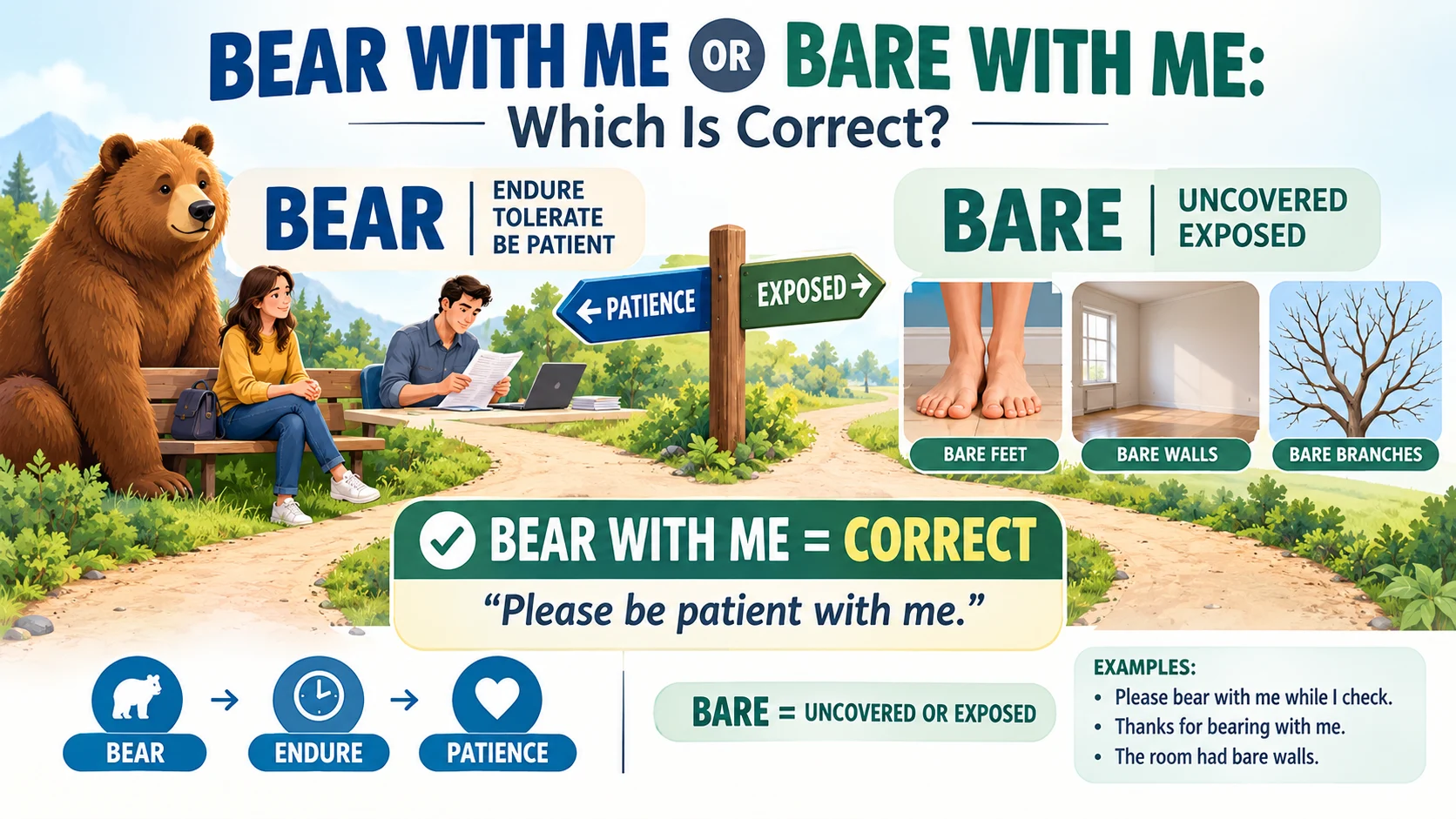
“Bear with me” is the correct phrase when you are asking someone to be patient while you explain, finish, or handle something. Here, bear means to tolerate, endure, or be patient with something. “Bare with me” is usually incorrect because bare means to uncover or expose something.
Bear with me or bare with me is a common English confusion because the two phrases sound exactly alike but have completely different meanings. If you want to ask someone to be patient while you finish a task, explain something, or solve a problem, the correct expression is “bear with me.”
At first, the phrase can seem confusing because bear is commonly associated with the large animal, while bare usually means uncovered or exposed. However, bear has another important meaning as a verb: to tolerate, endure, or deal with something. Therefore, when you say, “Please bear with me,” you are politely asking someone to remain patient.
Meanwhile, “bare with me” normally does not express patience. Instead, it could literally suggest uncovering something with the speaker, although that interpretation is unusual and often humorous. Because of this difference, choosing the right spelling matters in emails, professional communication, customer service messages, academic writing, and everyday conversations.
In this guide, you will learn the difference between bear with me or bare with me, understand why “bear with me” is correct, see practical examples, explore common mistakes, and discover an easy trick for remembering the phrase.
Bear With Me or Bare With Me: Which One Is Correct?
The correct phrase is “bear with me.”
Use bear with me when you want someone to be patient, understanding, or tolerant while you do something.
For example:
- “Please bear with me while I check your account.”
- “Bear with me for a moment while I find the document.”
- “Thanks for bearing with me during the delay.”
- “Please bear with me while I explain what happened.”
On the other hand, bare with me is generally incorrect when your intended meaning is “please be patient with me.”
The confusion happens because bear and bare are homophones. In other words, they sound alike in standard pronunciation, but they have different spellings and meanings.
Therefore, remember:
Bear with me = Please be patient with me.
Bare = Uncover or expose.
What Does “Bear With Me” Mean?
Bear with me means please be patient with me, tolerate the situation, or give me a little time.
The verb bear can mean to tolerate, endure, or handle something difficult. In the phrase “bear with me,” the speaker is essentially asking another person to tolerate a delay, difficulty, explanation, mistake, or inconvenience.
For example:
“Please bear with me while I restart the computer.”
The speaker is not asking the other person to do anything involving an animal. Instead, they are politely asking for patience.
Similarly:
“Bear with me while I explain the situation.”
Here, the speaker expects that the explanation might take some time. Therefore, they are asking the listener to remain patient.
The phrase can sound polite and professional. In fact, it is especially common when someone needs additional time to solve a problem or provide information.
What Does “Bare With Me” Mean?
Bare with me is normally a spelling mistake when someone intends to say “bear with me.”
The word bare means uncovered, exposed, empty, plain, or lacking something.
For example:
- “The walls were bare.”
- “He walked across the bare floor.”
- “The tree had bare branches.”
- “She showed the bare facts.”
- “The room contained only the bare essentials.”
As a verb, bare can mean to uncover or expose something.
For example:
- “The investigation may bare the truth.”
- “The process could bare the underlying problem.”
However, bare with me does not normally mean “be patient with me.”
Consequently, writing “Please bare with me” in a professional email can create an unintended meaning. It may also make the sentence look like a simple spelling error.
Why Is “Bear With Me” Correct?
The phrase comes from the verb bear, which has a long history of meanings connected with carrying, enduring, tolerating, and experiencing something.
When someone says “bear with me,” they are asking another person to tolerate a temporary inconvenience or delay.
Think of it this way:
bear = endure
Therefore:
bear with me = endure this situation with me / be patient with me
That connection makes the phrase easier to understand.
For example:
“Please bear with me while I finish this report.”
This means:
“Please be patient while I finish this report.”
The phrase does not use the animal meaning of bear. Instead, it uses the verb meaning related to enduring or tolerating something.
Bear With Me vs. Bare With Me
The simplest way to compare the two expressions is to look at their meanings.
| Phrase | Correct? | Meaning | Typical Use |
|---|---|---|---|
| Bear with me | Yes | Be patient with me | Delays, explanations, problems |
| Bare with me | Usually no | Expose or uncover with me | Rare or literal interpretation |
| Bear in mind | Yes | Remember or consider | Advice and explanations |
| Bare facts | Yes | Facts without extra details | Writing and discussion |
| Bare essentials | Yes | Only what is necessary | Everyday and professional English |
As you can see, the two words have separate jobs.
Bear often relates to enduring, carrying, or tolerating something. Meanwhile, bare relates to being uncovered, exposed, empty, or lacking.
The Difference Between Bear and Bare
Understanding the individual words will help you avoid this mistake in other situations as well.
Bear as a Verb
As a verb, bear can mean to tolerate, endure, carry, or handle something.
Examples include:
- “I can’t bear the noise.”
- “She could barely bear the pain.”
- “He had to bear the responsibility.”
- “Please bear with me.”
- “They had to bear the consequences.”
In these examples, bear relates to handling or enduring something.
Bear as a Noun
Bear can also refer to the large mammal.
Examples:
- “We saw a bear in the forest.”
- “The bear disappeared into the trees.”
- “That bear was searching for food.”
However, this is not the meaning used in “bear with me.”
Bare as an Adjective
Bare can describe something uncovered, empty, plain, or without its usual covering.
Examples:
- “He walked on the bare floor.”
- “The walls were bare.”
- “The tree had bare branches.”
- “The shelves were almost bare.”
Bare as a Verb
As a verb, bare can mean to uncover or expose.
For example:
- “The discovery may bare the truth.”
- “The investigation could bare previously hidden details.”
Thus, bare has nothing to do with asking someone to be patient.
Easy Trick to Remember “Bear With Me”
One of the easiest memory tricks is:
Bear = Endure
Bare = Expose
Now connect the first one to the phrase:
Bear with me = Endure this with me.
That naturally leads to:
Bear with me = Be patient with me.
You can also remember that bare is related to being uncovered.
For instance:
bare feet = uncovered feet
bare walls = uncovered or empty walls
Therefore, if you are asking for patience, choose bear, not bare.
Examples of “Bear With Me”
Here are several natural examples of bear with me in everyday English.
Example 1: During a Presentation
“Please bear with me while I get the presentation started.”
The speaker is asking the audience to wait patiently.
Example 2: At Work
“Bear with me while I review these numbers.”
The speaker needs some time to check information.
Example 3: During Technical Support
“Please bear with me while I troubleshoot the issue.”
Here, the customer is being asked to remain patient during the troubleshooting process.
Example 4: In an Email
“Please bear with me as I work through the remaining details.”
This sounds professional and polite.
Example 5: During a Conversation
“Bear with me; I’m trying to remember exactly what happened.”
The speaker needs a moment to think.
Example 6: During a Delay
“Thank you for bearing with me while we resolve the delay.”
Here, bearing is the -ing form of bear.
Example 7: While Learning
“Bear with me while I practice this new skill.”
The speaker recognizes that the process may take some time.
Example 8: Explaining Something Complicated
“Bear with me while I walk you through the process.”
This tells the listener that a detailed explanation is coming.
“Bear With Me” in Professional Communication
The phrase bear with me is common in professional settings because it can soften a request for patience.
For example, customer service representatives may say:
“Please bear with me while I look into this issue.”
Similarly, a manager might write:
“Thank you for bearing with us while we update the system.”
A teacher could say:
“Please bear with me while I explain this concept.”
In each case, the expression acknowledges that the other person may have to wait or listen for a while.
However, professional writers should avoid overusing the phrase. If a simple sentence such as “Please give me a moment” works better, it may sound more direct.
Is “Bear With Me” Polite?
Yes, bear with me is generally polite.
It is especially useful when you recognize that someone is waiting for you or dealing with a temporary inconvenience.
For example:
“Please bear with me while I check the information.”
sounds courteous because it acknowledges the listener’s time.
Likewise:
“Thank you for bearing with me.”
shows appreciation after someone has been patient.
However, tone still depends on context. If someone repeatedly causes delays and keeps saying “bear with me,” the phrase may eventually sound less effective. Therefore, when possible, combine the expression with a useful explanation or realistic timeframe.
For example:
“Please bear with me for another minute while I verify the details.”
This is more informative than simply saying:
“Bear with me.”
“Bear With Me” vs. “Be Patient”
These expressions have similar meanings, although their tone can differ slightly.
Be patient is direct.
Bear with me is usually more conversational and situational.
Compare these examples:
- “Please be patient while we investigate the issue.”
- “Please bear with me while I investigate the issue.”
Both are correct. However, the second version focuses more directly on the speaker’s request for the listener to tolerate the delay.
Similarly:
- “Be patient. I’m almost finished.”
- “Bear with me. I’m almost finished.”
The second sounds more personal and conversational.
“Bear With Me” vs. “Hang On”
Hang on can also mean “wait,” but it is generally more informal.
For example:
“Hang on while I check.”
is casual.
Meanwhile:
“Please bear with me while I check.”
sounds more polite and professional.
Therefore, choose based on your audience.
For a friend, “hang on” may sound natural. For a customer, colleague, or formal audience, “bear with me” may be a better choice.
“Bear With Me” vs. “Give Me a Moment”
Give me a moment is another useful alternative.
For example:
“Give me a moment while I find the file.”
This is straightforward and natural.
On the other hand:
“Please bear with me while I find the file.”
adds a stronger sense of patience and understanding.
Consequently, both expressions are useful, but they are not always interchangeable in tone.
Common Mistakes With Bear and Bare
English learners and native speakers alike can occasionally confuse these words.
Mistake 1: “Please Bare With Me”
Incorrect:
“Please bare with me while I check.”
Correct:
“Please bear with me while I check.”
The intended meaning is “please be patient,” so bear is required.
Mistake 2: “Thanks for Baring With Me”
Incorrect:
“Thanks for baring with me.”
Correct:
“Thanks for bearing with me.”
The -ing form of bear is bearing, not baring, when the meaning is tolerating or being patient.
Mistake 3: “I Bare the Delay”
Incorrect:
“I bare the delay.”
Correct:
“I bear the delay.”
When bear means tolerate or endure, its present-tense form remains bear.
Mistake 4: Assuming Bear Always Means the Animal
Some people remember only the noun bear and therefore find “bear with me” strange.
However, English words often have several meanings. In this case, bear can mean to endure or tolerate something.
Bear, Bare, and Baring: A Quick Comparison
These three forms can cause confusion.
| Word | Meaning | Example |
|---|---|---|
| Bear | Endure, tolerate, carry; also an animal | “Please bear with me.” |
| Bare | Uncovered, plain, or expose | “The room had bare walls.” |
| Baring | Exposing or revealing | “She was baring her feelings.” |
| Bearing | Enduring or carrying | “Thank you for bearing with me.” |
This comparison is especially helpful because baring and bearing sound similar in some speech patterns.
Still, their meanings are different.
Bearing with me means tolerating or being patient with me.
Baring something means exposing or revealing it.
Is “Bare With Me” Ever Correct?
Technically, the words bare with me can form a grammatical phrase in a very unusual literal context, but that is not what people normally mean when they use the expression.
For example, if bare were being used as a verb meaning “uncover,” someone could theoretically construct a sentence involving uncovering something together. Yet such a sentence would be unusual and could easily sound humorous or suggestive.
Therefore, if your intended message is:
“Please be patient with me,”
always write:
“Please bear with me.”
This distinction is particularly important in professional writing because “bare with me” can look like an obvious typo.
Bear With Me in Emails
The expression works well in emails when you need to ask someone for patience.
Professional Example
“Please bear with me while I review the information and get back to you.”
Customer Service Example
“Thank you for bearing with us while we work to resolve the issue.”
Workplace Example
“Please bear with me while I confirm the final numbers.”
Casual Example
“Bear with me for a second. I think I know where I saved it.”
Notice that the expression works across different levels of formality.
However, the surrounding language should match the audience.
Alternatives to “Bear With Me”
Sometimes you may want a different expression.
Here are useful alternatives:
- Please be patient.
- Give me a moment.
- Please give me a little time.
- Hang on for a second.
- Please wait a moment.
- Thanks for your patience.
- I appreciate your patience.
- Please allow me a moment.
- Thanks for waiting.
- I appreciate your understanding.
For professional communication, “Thank you for your patience” can be particularly effective because it sounds appreciative rather than demanding.
For casual conversations, “Give me a second” or “Hang on” may sound more natural.
When to Use “Bear With Me”
Use bear with me when:
- You need additional time.
- You are explaining something complicated.
- You are dealing with a temporary problem.
- Someone needs to wait while you complete a task.
- You want to acknowledge another person’s patience.
- You are asking someone to tolerate a temporary inconvenience.
For example:
“Please bear with me while I finish this.”
That sentence is short, clear, and natural.
When Not to Use “Bear With Me”
Although the phrase is useful, it does not fit every situation.
If you are simply asking someone to remember something, use “bear in mind” instead.
For example:
Correct:
“Bear in mind that the deadline is Friday.”
Incorrect meaning:
“Bear with me that the deadline is Friday.”
Likewise, if you mean that something is uncovered, use bare.
For example:
“The walls were bare.”
Here, bare is correct because the walls were uncovered or empty.
Bear With Me or Bare With Me in Text Messages
In texting, the same spelling rule applies.
You should write:
“Bear with me.”
You might see “bare with me” in social media comments, texts, or informal posts. Nevertheless, that spelling is generally a mistake when the person means “please be patient.”
Because autocorrect does not always identify homophone errors, it is worth checking the word manually.
Bear With Me or Bare With Me in Business Writing
Professional writing requires particular attention to this distinction.
Consider these two sentences:
“Please bear with me while I review your request.”
“Please bare with me while I review your request.”
The first is correct and professional. The second contains a word-choice error.
Consequently, always use bear when requesting patience from a customer, manager, employee, client, student, or colleague.
Why Do People Confuse Bear and Bare?
The main reason is pronunciation.
Bear and bare are homophones in standard English. They have different spellings and meanings, but they are pronounced alike.
English contains many such word pairs.
Examples include:
- affect / effect
- there / their / they’re
- your / you’re
- to / too / two
- hear / here
- brake / break
- right / write
- weather / whether
Therefore, the confusion between bear and bare is not unusual.
The best solution is to connect each word with its meaning instead of relying on pronunciation.
Memory Trick: “Bear the Wait”
Here is another simple way to remember the correct phrase.
Think:
Bear the wait.
If someone needs to wait, they have to bear the delay.
Therefore:
Bear the wait → bear with me.
Meanwhile, think:
Bare = uncovered.
You can have:
- bare feet
- bare walls
- bare branches
- bare essentials
However, you do not normally have bare with me when asking for patience.
Bear With Me: Synonyms and Similar Expressions
Depending on context, the following expressions can communicate a similar idea:
- Be patient with me.
- Give me some time.
- Please wait.
- Please allow me a moment.
- Thanks for your patience.
- Please give me a second.
- Hang on.
- Stay with me.
- Please understand.
- I appreciate your patience.
Still, these phrases are not exact synonyms in every situation.
For example, stay with me can mean “continue listening” or “do not leave,” while bear with me specifically emphasizes patience or tolerance.
Examples: Correct and Incorrect
| Incorrect | Correct | Reason |
|---|---|---|
| “Please bare with me.” | “Please bear with me.” | Bear means tolerate or endure. |
| “Thanks for baring with me.” | “Thanks for bearing with me.” | Bearing is the correct -ing form. |
| “Bare with me while I explain.” | “Bear with me while I explain.” | The speaker is requesting patience. |
| “Please bare with me for a moment.” | “Please bear with me for a moment.” | Bare means uncover, not tolerate. |
Mini Practice Exercise
Choose bear, bare, bearing, or baring in each sentence.
- Please ______ with me while I find the information.
- The room had ______ walls.
- Thank you for ______ with us during the delay.
- She was ______ her emotions.
- He could not ______ the pressure.
- The tree had ______ branches.
- Please ______ in mind that plans can change.
- They were ______ the truth during the interview.
Answers
- bear
- bare
- bearing
- baring
- bear
- bare
- bear
- baring
The key is to identify the meaning before choosing the spelling.
If the sentence means tolerate or endure, use bear.
If it means uncovered or expose, use bare.
Bear With Me vs. Bear In Mind
These expressions both use bear, but they have different meanings.
Bear With Me
Means be patient with me.
Example:
“Please bear with me while I check the details.”
Bear In Mind
Means remember or consider something.
Example:
“Bear in mind that the schedule may change.”
Therefore, do not confuse the two expressions simply because they share the word bear.
Bear With Me vs. Hang in There
These expressions are related but not identical.
Bear with me asks another person to be patient with the speaker.
Hang in there usually encourages someone to remain strong during a difficult situation.
For example:
“Bear with me while I finish the report.”
The speaker is asking for patience.
Meanwhile:
“Hang in there. Things will get better.”
The speaker is encouraging someone.
Thus, the direction of the message is different.
Is “Bear With Me” Formal or Informal?
Bear with me works in both casual and professional English.
In casual conversation:
“Bear with me for a second.”
In professional communication:
“Please bear with me while I review the documentation.”
The addition of please often makes the phrase sound more polite.
Similarly, thank you for bearing with me works well when expressing appreciation after a delay.
Common Questions
Is it “bear with me” or “bare with me”?
The correct phrase is “bear with me” when you mean “please be patient with me.”
What does bear with me mean?
Bear with me means please be patient with me or tolerate a temporary delay or difficulty.
Is “bare with me” grammatically correct?
The words can technically appear together in a rare literal construction involving uncovering something, but “bare with me” is incorrect for the common expression asking someone to be patient.
Why is bear used in “bear with me”?
The phrase uses bear in the sense of endure, tolerate, or handle something. Therefore, “bear with me” means to tolerate the situation with the speaker.
Can I use “bear with me” in an email?
Yes. Bear with me is appropriate in professional and casual emails when you need to ask someone for patience.
Is “thanks for bearing with me” correct?
Yes. “Thanks for bearing with me” is correct. It means you appreciate someone’s patience.
What is the opposite of “bear with me”?
There is no single exact opposite. Depending on context, you might say “please go ahead,” “no need to wait,” or “you don’t need to be patient with me.”
Is “bear with me” rude?
No. The phrase is generally polite, especially when used with please or followed by an explanation.
What is an easy way to remember bear with me?
Remember: bear = endure. So, bear with me = be patient with me. Meanwhile, bare = uncovered.
Can “bear with me” mean “wait”?
Yes, depending on context. However, it carries the additional idea of asking someone to be patient or understanding while they wait.
What is the past tense of bear?
The past tense can be bore when bear means endure, carry, or give birth. The past participle is generally borne for many meanings.
For example:
“She bore the responsibility for years.”
However, the expression “bear with me” uses the present form.
Key Takeaway & Summary
The most important point is simple: “bear with me” is the correct phrase when you want someone to be patient with you.
Remember these two meanings:
Bear = endure, tolerate, or handle
Bare = uncovered, exposed, or empty
Therefore:
“Please bear with me while I check.” ✅
“Please bare with me while I check.” ❌
If you remember the connection between bear and endure, you can avoid this common homophone mistake in emails, conversations, schoolwork, and professional writing.
Final Comparison
| Phrase | Meaning | Correct for Asking Patience? | Example |
|---|---|---|---|
| Bear with me | Be patient with me | ✅ Yes | “Please bear with me.” |
| Bare with me | Uncover/expose with me | ❌ Usually no | Not the intended phrase |
| Bear in mind | Remember or consider | ✅ Yes, but different meaning | “Bear in mind the deadline.” |
| Bearing with me | Being patient with me | ✅ Yes | “Thanks for bearing with me.” |
| Baring | Exposing or revealing | ❌ No | “He was baring his feelings.” |
Conclusion
Choosing between bear with me or bare with me becomes much easier once you understand what the two words mean. When you want to ask someone to be patient, tolerate a delay, or give you a little extra time, “bear with me” is the correct expression.
The word bear can mean to endure or tolerate something. Therefore, “bear with me” naturally carries the idea of asking someone to endure a temporary inconvenience with you. By contrast, bare relates to something uncovered, exposed, empty, or without its usual covering.
So, when you write an email, send a message, or speak with someone who is waiting, remember the simple rule:
Bear with me = Be patient with me.
Bare = Uncovered or exposed.
Once you connect bear with endure, this common English mistake becomes much easier to avoid.