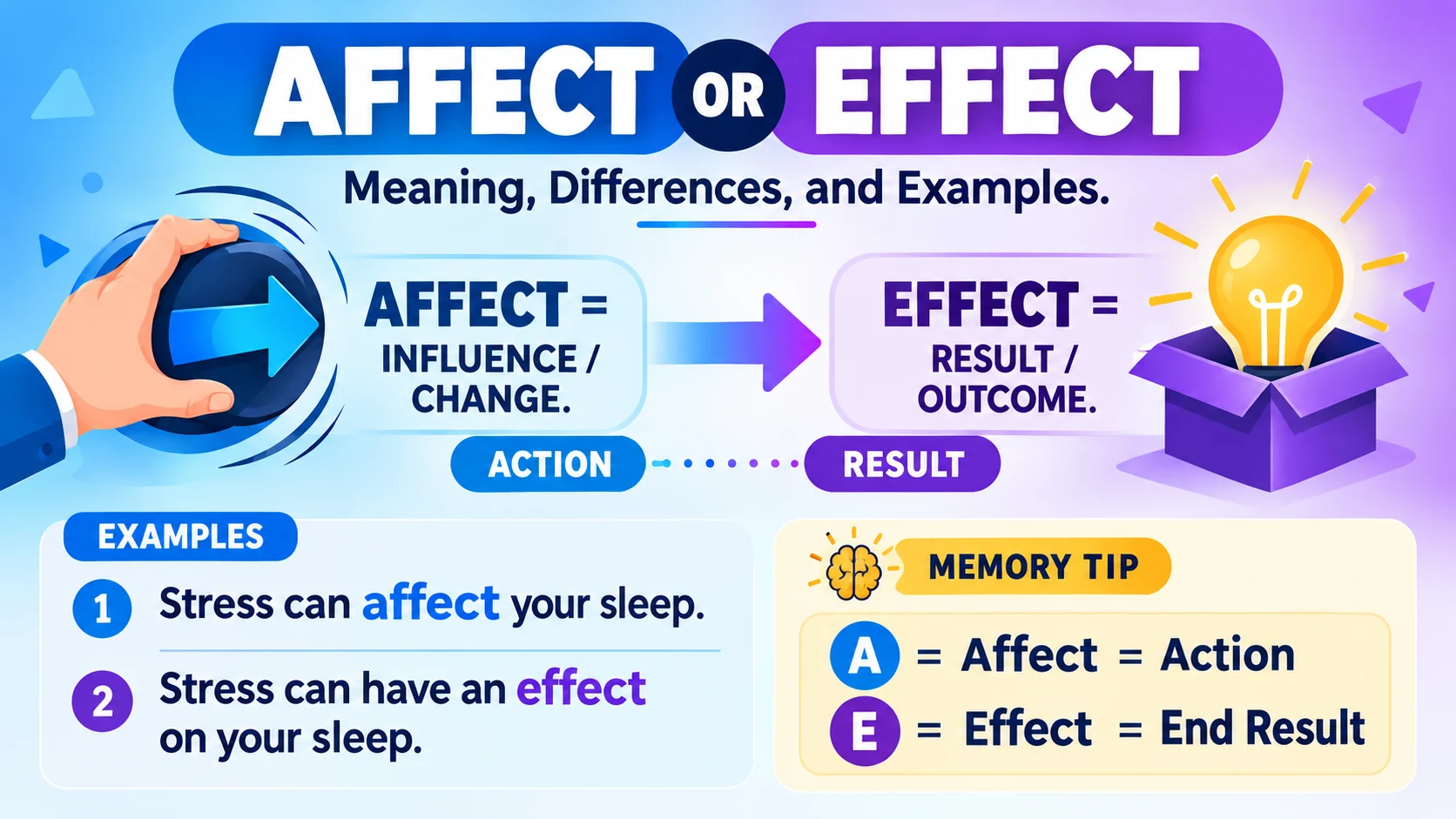
Affect is usually a verb meaning to influence or change something, while effect is usually a noun meaning the result or outcome of something. For example, “Lack of sleep can affect your mood” uses affect because it describes an influence. In contrast, “Lack of sleep can have an effect on your mood” uses effect because it refers to the result.
The difference between affect or effect can be confusing because the two words sound similar and often appear in the same types of sentences. However, they usually perform different grammatical jobs. Affect is most commonly used as a verb, while effect is most commonly used as a noun.
For example, you might say, “Stress can affect your health.” Here, affect means “influence.” On the other hand, you could say, “Stress can have an effect on your health.” In that sentence, effect means “result.”
Although the basic rule looks simple, English has a few exceptions that can make these words harder to master. In particular, affect can occasionally function as a noun, while effect can also work as a verb. Fortunately, these less common uses become easier when you understand the context.
Therefore, learning affect or effect is not simply about memorizing two definitions. It is about recognizing whether a sentence describes an action or influence or a result or outcome. This guide explains the difference with clear definitions, examples, comparison tables, memory tricks, common mistakes, exercises, and frequently asked questions.
Affect or Effect: The Basic Difference
The easiest way to understand these words is to remember their most common grammatical roles.
Affect usually means to influence something or someone.
Effect usually means the result of an action, event, or change.
Consider these two sentences:
- “The weather affected our plans.”
- “The weather had an effect on our plans.”
The first sentence uses affected as a verb. It tells us what the weather did to the plans.
The second sentence uses effect as a noun. It identifies the result that the weather had on the plans.
As a result, a simple memory rule is:
Affect = Action
Effect = End result
This rule will not cover every unusual use of the words, but it works for most everyday writing.
What Does Affect Mean?
Affect usually means to influence, change, or have an impact on something.
It is most commonly used as a verb. Consequently, it often describes an action that changes a person, situation, condition, decision, or outcome.
Simple Definition of Affect
Affect: to influence or change something.
Examples of Affect
- Lack of sleep can affect your concentration.
- The rain affected our travel plans.
- Social media can affect how people communicate.
- The price increase may affect customers.
- Exercise can affect your energy level.
- Her decision affected the entire team.
In each example, affect describes an influence.
For instance, in “The rain affected our travel plans,” the rain caused a change in those plans. Therefore, affected is the correct choice.
Affect as a Verb
Because affect is generally a verb, you will often see it after a subject.
Common patterns include:
Subject + affect + object
Examples:
- Stress affects sleep.
- Noise affects concentration.
- Weather affects travel.
- Experience affects judgment.
Another common structure is:
Something can/may/will + affect + object
Examples:
- The change may affect prices.
- Poor lighting can affect visibility.
- The decision will affect employees.
What Does Effect Mean?
Effect usually means the result, consequence, or outcome produced by something.
Unlike affect, it is most commonly a noun.
Simple Definition of Effect
Effect: the result or consequence of an action, event, or condition.
Examples of Effect
- The new policy had a positive effect.
- Exercise can have a beneficial effect on health.
- The storm had a serious effect on the community.
- The medicine produced an immediate effect.
- Her speech had a powerful effect on the audience.
Here, effect identifies what happened as a result of something else.
For example, “The storm had a serious effect on the community” means the storm produced serious consequences.
Effect as a Noun
Because effect usually works as a noun, it often appears after words such as:
- the
- an
- an important
- a positive
- a negative
- a significant
- a lasting
- a powerful
Examples include:
- the effect
- an effect
- a positive effect
- a negative effect
- a lasting effect
- a significant effect
Moreover, the phrase “have an effect on” is especially common.
For example:
“Stress can have an effect on your sleep.”
Affect or Effect: Quick Comparison
| Word | Most Common Role | Basic Meaning | Example |
|---|---|---|---|
| Affect | Verb | To influence or change | “Noise can affect your focus.” |
| Effect | Noun | A result or outcome | “Noise can have an effect on your focus.” |
| Affect | Less common noun | Emotional expression or observable mood | “The patient showed flat affect.” |
| Effect | Less common verb | To cause or bring about | “The organization hopes to effect change.” |
The first two rows cover the vast majority of everyday situations. Therefore, beginners should master those uses before worrying about the less common grammatical forms.
Affect or Effect: The Easiest Memory Trick
One of the most useful tricks is:
Affect = Action
Both affect and action begin with A.
Think:
A = Affect = Action
If the word describes something doing something to something else, affect is often the correct choice.
Example:
“Cold weather affected the crops.”
The weather influenced the crops. Thus, affected works as the verb.
Effect = End Result
Think:
E = Effect = End result
If the word describes what happened as a result, effect is usually correct.
Example:
“The cold weather had a negative effect on the crops.”
The negative result is the effect.
This simple trick is especially useful for students and English learners.
Affect or Effect in Everyday Sentences
The difference becomes clearer when you compare similar sentences.
Example 1
Affect:
“Loud music can affect your ability to concentrate.”
Effect:
“Loud music can have an effect on your ability to concentrate.”
Both sentences communicate nearly the same idea. However, the grammar changes.
Example 2
Affect:
“The new schedule affected everyone.”
Effect:
“The new schedule had an effect on everyone.”
Again, affected describes the influence, while effect describes the result.
Example 3
Affect:
“Stress affects my sleep.”
Effect:
“Stress has a negative effect on my sleep.”
The meaning remains closely connected, but the grammatical structure differs.
Example 4
Affect:
“The teacher’s feedback affected his confidence.”
Effect:
“The teacher’s feedback had a strong effect on his confidence.”
Consequently, comparing the two forms side by side can make the distinction easier to remember.
Affect or Effect in Different Contexts
The correct word can become easier to identify when you consider the context.
In Health and Wellness
Affect is common when describing an influence:
“Poor sleep can affect your energy.”
Effect is common when describing a result:
“Poor sleep can have a negative effect on your energy.”
In Education
You might say:
“Stress can affect academic performance.”
Or:
“Stress can have a significant effect on academic performance.”
In Business
Affect works well when describing influence:
“Higher costs may affect profits.”
Effect works well when discussing the result:
“Higher costs may have a negative effect on profits.”
In Relationships
You could write:
“Arguments can affect a relationship.”
Alternatively:
“Repeated arguments can have a lasting effect on a relationship.”
In Technology
For example:
“A software update may affect performance.”
Meanwhile:
“The software update had an unexpected effect on performance.”
Thus, the same topic can naturally use either word depending on the sentence structure.
Affect or Effect in Academic Writing
Both words are common in academic writing. However, using them correctly is especially important because academic sentences often discuss causes, influences, and outcomes.
Consider this sentence:
“The study examined how exercise affects memory.”
Here, affects is a verb because the study examines an influence.
Now compare:
“The study examined the effect of exercise on memory.”
Here, effect is a noun because the sentence refers to the outcome or impact.
Academic writing frequently uses structures such as:
- affect behavior
- affect performance
- affect outcomes
- affect results
- effect of stress
- effect of exercise
- effect on performance
- significant effect
- long-term effect
Therefore, recognizing common sentence patterns can reduce mistakes.
When Affect Is a Noun
Although affect is usually a verb, it can also be a noun in psychology and related fields.
As a noun, affect refers to a person’s observable emotional expression or emotional presentation.
For example:
“The patient displayed a flat affect.”
In this context, affect does not mean “influence.” Instead, it describes outward emotional expression.
This use is relatively specialized. Consequently, most everyday writers will encounter affect as a verb much more often.
Examples of Affect as a Noun
- “The patient had a calm affect.”
- “The clinician observed a restricted affect.”
- “His affect appeared noticeably different.”
These sentences use a specialized meaning. Therefore, context is essential.
When Effect Is a Verb
Although effect is usually a noun, it can also function as a verb.
As a verb, effect means to bring about, cause, or make something happen.
For example:
“The new policy could effect significant change.”
Here, effect means “bring about.”
This use is more formal than the everyday noun use of effect. It often appears in professional, academic, legal, or organizational writing.
Examples of Effect as a Verb
- “The new policy effected major changes.”
- “The organization hopes to effect reform.”
- “Leaders must work together to effect meaningful change.”
Notice the difference:
Affect change = influence change.
Effect change = bring about or cause change.
That distinction is subtle but important.
Affect Change vs. Effect Change
This is one of the trickiest areas of affect or effect usage.
Affect Change
To affect change means to influence change.
Example:
“The campaign aims to affect public attitudes.”
The campaign influences attitudes.
Effect Change
To effect change means to bring about or cause change.
Example:
“The new leadership hopes to effect meaningful change.”
The leadership intends to make the change happen.
In ordinary conversation, however, people often use “affect change” when they simply mean “influence change.” Therefore, the surrounding context matters.
Common Phrases With Affect
Several expressions commonly use affect.
- Affect Someone
“The news affected her deeply.”
- Affect Something
“The weather affected the event.”
- Affect Performance
“Stress can affect performance.”
- Affect Behavior
“Environment can affect behavior.”
- Affect Decision-Making
“Emotions can affect decision-making.”
- Affect Results
“Small errors can affect the results.”
These patterns all involve influence or change.
Common Phrases With Effect
Likewise, several common expressions use effect.
Have an Effect On
“Exercise has a positive effect on health.”
Cause an Effect
“The change caused an unexpected effect.”
Side Effect
“The medication may cause a side effect.”
Positive Effect
“The new routine had a positive effect.”
Negative Effect
“The decision had a negative effect.”
Long-Term Effect
“The experience had a long-term effect on him.”
These expressions describe outcomes or consequences.
Affect or Effect: Common Mistakes
Because the words look and sound similar, several mistakes appear frequently in writing.
Mistake 1: Using Effect as a Verb When You Mean Influence
Incorrect:
“The weather effected our plans.”
Correct:
“The weather affected our plans.”
The intended meaning is “influenced,” so affected is correct.
Mistake 2: Using Affect Instead of Effect After “Have”
Incorrect:
“The change had a positive affect.”
Correct:
“The change had a positive effect.”
The phrase “had a positive ___” requires the noun effect.
Mistake 3: Confusing “Effect On”
A common structure is:
“The decision had an effect on the company.”
Do not write:
“The decision had an affect on the company.”
Because the sentence refers to a result, effect is correct.
Mistake 4: Assuming Affect Is Always a Verb
Usually, affect is a verb. However, the specialized noun form exists.
Therefore, the safest rule is “usually” rather than “always.”
Mistake 5: Assuming Effect Is Always a Noun
Again, effect is usually a noun, but it can function as a verb meaning “bring about.”
Context determines the correct usage.
Affect or Effect: How to Choose the Right Word
When you are unsure, follow these steps.
Step 1: Ask What You Mean
Does the word mean influence or change?
If yes, choose affect in most ordinary situations.
“Noise can affect concentration.”
Step 2: Look for a Result
Does the word mean result, consequence, or outcome?
If yes, choose effect.
“Noise can have an effect on concentration.”
Step 3: Check the Grammar
If you need a verb meaning “influence,” use affect.
If you need a noun meaning “result,” use effect.
Step 4: Look at the Sentence Pattern
Phrases such as “have an ___ on” usually require effect.
For example:
“The decision had an effect on sales.”
Meanwhile, a sentence such as:
“The decision affected sales.”
uses affect as a verb.
Affect or Effect Examples
Here are additional examples to reinforce the difference.
- “Lack of sleep can affect your memory.”
- “Lack of sleep can have a negative effect on memory.”
- “The storm affected local businesses.”
- “The storm had a major effect on local businesses.”
- “Noise can affect your concentration.”
- “Noise can have an unwanted effect on concentration.”
- “The decision affected the entire team.”
- “The decision had a significant effect on the team.”
- “Social media can affect consumer behavior.”
- “Social media can have a powerful effect on consumer behavior.”
- “The temperature affected the equipment.”
- “The temperature had an unexpected effect on the equipment.”
- “His words affected her deeply.”
- “His words had a lasting effect on her.”
- “The policy may affect small businesses.”
- “The policy may have an economic effect on small businesses.”
Notice the repeated pattern: affect describes the influence, while effect identifies the resulting impact.
Affect or Effect in Questions
These words also appear naturally in questions.
Questions With Affect
- “How will this change affect students?”
- “Does stress affect your sleep?”
- “Will the weather affect our plans?”
- “How does exercise affect mood?”
Questions With Effect
- “What effect will this change have?”
- “What was the effect of the decision?”
- “Did the treatment have any effect?”
- “What effect did the storm have on the city?”
Therefore, the question itself can provide a useful clue.
Affect or Effect in Professional Writing
Professional communication often requires precise word choice. Fortunately, the basic distinction works well in emails, reports, presentations, and business documents.
Consider:
“The delay may affect the delivery schedule.”
This sentence clearly states that the delay could influence the schedule.
Alternatively:
“The delay may have an effect on the delivery schedule.”
Both are correct.
However, the first version is often more direct and concise. As a result, it may be preferable in professional writing.
Another example is:
“The price increase could affect customer demand.”
This construction is clear and efficient.
Affect or Effect in Social Media
On social media, both words can appear in captions, posts, comments, and discussions.
Examples include:
- “How will this affect your plans?”
- “That experience had a huge effect on me.”
- “Sleep affects everything.”
- “Small choices can have a big effect.”
- “Don’t underestimate how stress affects your body.”
Because social media writing tends to be informal, users sometimes mix up the words. Nevertheless, the standard grammar rules still apply.
Affect or Effect: Synonyms
Understanding synonyms can reinforce the distinction.
Synonyms for Affect
Depending on the context, affect can mean:
- influence
- change
- alter
- impact
- modify
- shape
- touch
- sway
Example:
“The decision affected the outcome.”
You could express the same general idea as:
“The decision influenced the outcome.”
Synonyms for Effect
Depending on the context, effect can mean:
- result
- outcome
- consequence
- impact
- influence
- aftermath
- product
- response
For example:
“The decision had a significant effect.”
This could become:
“The decision had a significant impact.”
However, synonyms are not always interchangeable in every grammatical structure.
Affect vs. Effect vs. Impact
The word impact can sometimes make this distinction even more confusing.
Consider:
“The storm affected the city.”
Here, affected is a verb.
You could also say:
“The storm had an impact on the city.”
Here, impact is a noun.
Similarly:
“The storm had an effect on the city.”
Both effect and impact can refer to the resulting influence.
Therefore:
Affect = influence as a verb
Effect = result or influence as a noun
Impact = influence or effect, depending on grammatical use
Affect or Effect: Related Comparisons
| Expression | Meaning |
|---|---|
| Affect | Influence or change |
| Effect | Result or consequence |
| Impact | Strong influence or effect |
| Cause | Something that produces a result |
| Outcome | What happens as a result |
| Consequence | A result, often negative |
| Influence | Power to change or affect something |
These words overlap in meaning, but they do not always function in the same grammatical way.
When to Use Affect
Use affect when you need a verb that means influence or change.
Use Affect When:
- Something influences a person.
- Something changes a situation.
- Something impacts a result.
- Something alters behavior.
- Something changes performance.
Examples
“Stress affects my concentration.”
“The decision affected the company’s future.”
“Weather conditions affected the flight.”
The common idea is influence.
When to Use Effect
Use effect when you need a noun that means result or consequence.
Use Effect When:
- You are discussing an outcome.
- You are describing a consequence.
- You use “have an effect on.”
- You describe a positive or negative result.
- You talk about a lasting impact.
Examples
“The decision had a positive effect.”
“The storm had a devastating effect on the region.”
“The medicine had an immediate effect.”
The common idea is result.
A Simple Rule for Students
Students can remember this:
Affect = influence
Effect = result
For an even easier memory aid:
Affect acts. Effect ends.
The first phrase reminds you that affect usually describes an action. The second connects effect with the final result.
Although this shortcut is not perfect for every advanced grammatical situation, it is highly useful for ordinary English.
Practice Exercise: Affect or Effect?
Choose affect or effect to complete each sentence.
- Lack of sleep can ______ your mood.
- The new rule had a positive ______ on students.
- How will the weather ______ our plans?
- The storm had a serious ______ on the community.
- Stress can ______ your ability to focus.
- The medication produced an immediate ______.
- Higher prices may ______ customer behavior.
- The experience had a lasting ______ on her.
- Loud noise can ______ your concentration.
- What ______ did the decision have?
Answers
- affect
- effect
- affect
- effect
- affect
- effect
- affect
- effect
- affect
- effect
The pattern is consistent in these examples. Affect describes influence, while effect describes the resulting outcome.
Mini Quiz
Question 1
Which sentence is correct?
A. The weather effected our plans.
B. The weather affected our plans.
Answer: B
Question 2
Which sentence is correct?
A. The change had a positive affect.
B. The change had a positive effect.
Answer: B
Question 3
Which word means “influence”?
A. Affect
B. Effect
Answer: A
Question 4
Which word usually means “result”?
A. Affect
B. Effect
Answer: B
Question 5
Which sentence is correct?
A. Stress can affect your sleep.
B. Stress can effect your sleep.
Answer: A
Common Questions About Affect or Effect
Is affect or effect correct?
Both words are correct, but they have different common meanings. Affect usually means to influence or change something, while effect usually means the result or outcome.
What is the easiest way to remember affect vs. effect?
Remember “Affect = Action” and “Effect = End result.” If you mean influence, affect is usually correct. If you mean a result, effect is usually correct.
Is affect a verb or noun?
Affect is most commonly a verb meaning “to influence.” It can also be a noun in psychology, where it refers to observable emotional expression.
Is effect a verb or noun?
Effect is most commonly a noun meaning “result.” It can also be a verb meaning “to bring about” or “cause,” especially in formal writing.
Is it “affect on” or “effect on”?
The usual phrase is “effect on.”
For example:
“The change had an effect on sales.”
However, affect is normally followed directly by its object:
“The change affected sales.”
Is “positive affect” correct?
Yes, but the meaning depends on context. In ordinary writing, “positive effect” usually means a beneficial result. In psychology, “positive affect” can refer to positive emotional expression or mood.
Is “negative affect” correct?
Yes. In psychology, negative affect can describe negative emotional states or expressions. In ordinary writing, however, people may actually mean “negative effect,” which refers to an undesirable result.
Is “effected” always wrong?
No. Effected can be correct when effect is used as a verb meaning “brought about.”
For example:
“The new policy effected major changes.”
However, if you mean “influenced,” use affected.
Can affect and effect be used in the same sentence?
Absolutely.
For example:
“Stress can affect your health and have a negative effect on your sleep.”
Here, affect is the verb and effect is the noun.
Which word is more common?
Both are common, but effect frequently appears as a noun, while affect is frequently used as a verb. Their frequency can vary depending on the topic and writing style.
Affect or Effect: Final Comparison
| Feature | Affect | Effect |
|---|---|---|
| Most common grammar | Verb | Noun |
| Basic meaning | Influence or change | Result or outcome |
| Easy memory | Action | End result |
| Example | “Noise affects sleep.” | “Noise has an effect on sleep.” |
| Common phrase | Affect behavior | Effect on behavior |
| Less common use | Noun in psychology | Verb meaning bring about |
| Common mistake | Using effect for influence | Using affect for result |
The key distinction is simple: affect usually describes what something does, while effect usually describes what happens because of it.
Why the Difference Matters
Using the correct word can make your writing clearer and more professional. Although many readers can understand a sentence even when affect and effect are confused, the mistake can still make academic, professional, or formal writing appear less polished.
For example:
“The policy had a positive affect on employees.”
The intended meaning is clear, but the standard word is:
“The policy had a positive effect on employees.”
Similarly:
“The policy effected employee morale.”
is usually incorrect if the intended meaning is “influenced.”
The better sentence is:
“The policy affected employee morale.”
Therefore, mastering this small distinction can improve everything from school assignments to business reports.
Key Takeaway
The easiest way to remember affect or effect is to connect each word with its most common role. Affect is usually a verb meaning to influence or change, while effect is usually a noun meaning the result or outcome.
For example:
“The noise affected my concentration.”
Here, affected means influenced.
“The noise had an effect on my concentration.”
Here, effect means result or impact.
When you’re unsure, ask yourself whether you are describing an action or influence or a result. That simple question will solve most everyday cases.
Conclusion
Understanding affect or effect becomes much easier once you focus on their most common meanings. Affect usually functions as a verb and means to influence or change something. Effect, meanwhile, usually functions as a noun and refers to the result, consequence, or outcome.
The most useful memory trick is “Affect = Action” and “Effect = End result.” While this shortcut does not cover every advanced use, it works for most everyday conversations, school assignments, professional documents, and online writing.
Additionally, remember that both words have less common grammatical uses. Affect can be a noun in psychology, while effect can be a verb meaning to bring about change. However, you do not need to memorize every exception immediately. Start with the basic distinction, practice it in real sentences, and then learn the specialized uses as they become relevant.
Ultimately, choosing between affect and effect comes down to understanding what you want the word to express. If you mean influence or change, choose affect in most ordinary situations. If you mean result or outcome, choose effect. With that distinction in mind, you can use these commonly confused words with much greater confidence.