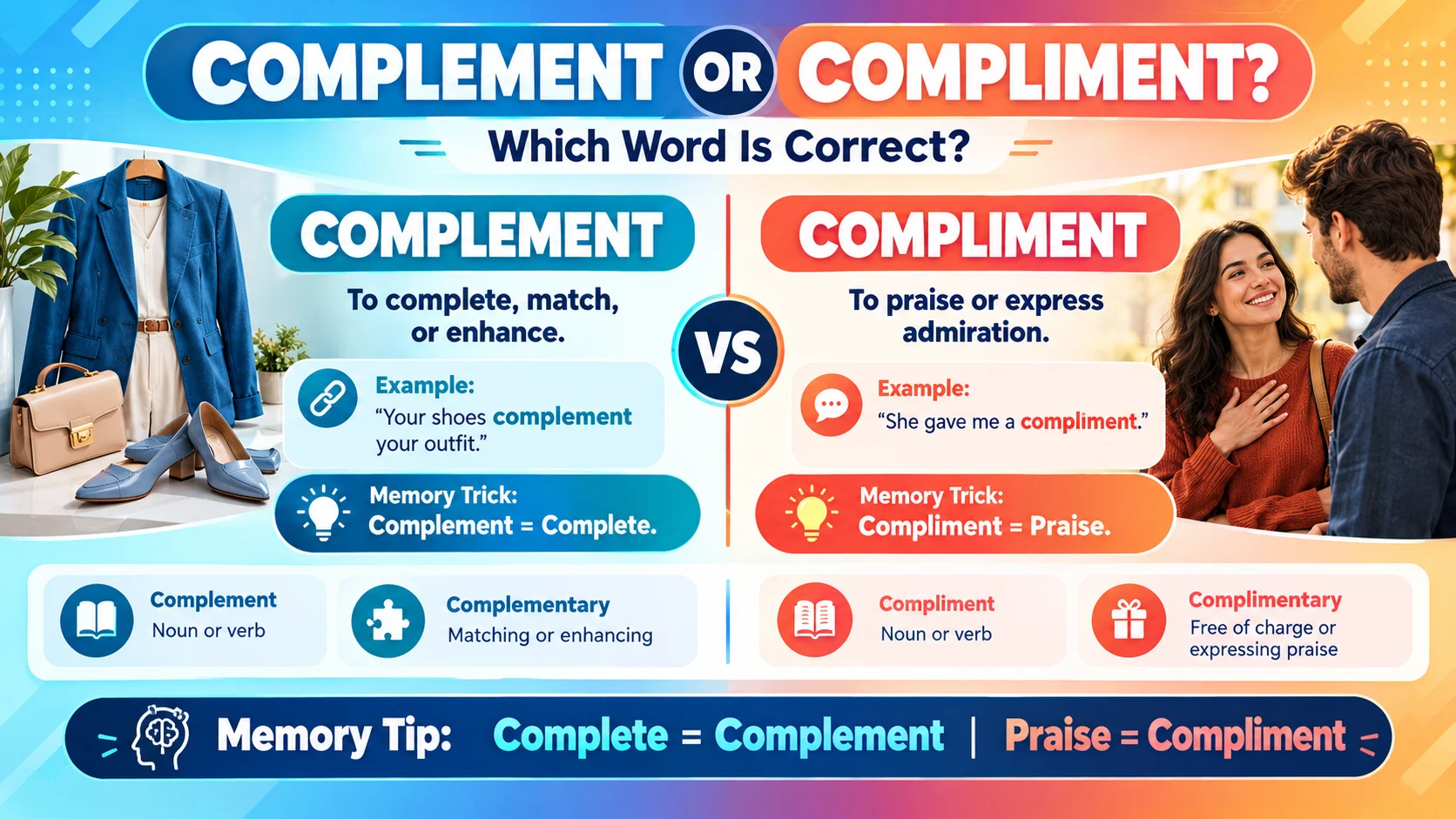
Complement and compliment are two commonly confused English words with different meanings. Complement means something that completes, improves, or goes well with something else. In contrast, compliment means a kind or positive remark that expresses admiration or praise. For example, “The blue tie complements your suit” describes a good match, while “She gave me a compliment” refers to praise.
Have you ever wondered whether to write complement or compliment when describing something that looks good together or expressing appreciation for someone? Although these words sound almost identical, they have different meanings and uses. Mixing them up can change the meaning of your sentence, especially in professional writing, school assignments, emails, and everyday conversations.
The main difference is simple: complement refers to something that completes, enhances, or matches another thing, while compliment refers to praise or a positive statement about someone or something. However, their similar pronunciation and nearly identical spelling often make them confusing for English learners and native speakers alike.
Fortunately, you don’t need complicated grammar rules to remember the difference. A simple memory trick, a few practical examples, and an understanding of their everyday uses can help you choose the correct word confidently. In this guide, you’ll learn both definitions, pronunciation, spelling differences, synonyms, common mistakes, and practical exercises to master these two words.
Complement vs. Compliment
| Word | Meaning | Part of Speech | Example | Context |
|---|---|---|---|---|
| Complement | Something that completes or enhances another thing | Noun or verb | This sauce complements the meal. | Matching or improving |
| Compliment | An expression of praise or admiration | Noun or verb | She gave me a lovely compliment. | Appreciation or praise |
Easy rule: Use complement when talking about completing or matching something. Use compliment when talking about praising someone.
What Does Complement Mean?
Complement means something that completes, improves, or enhances another thing. It can describe two or more things that work well together and make the overall result better.
For example, a blue shirt might complement a pair of black trousers. Similarly, a good side dish can complement a main course by adding flavor and variety.
The word can function as both a noun and a verb.
Complement as a Noun
As a noun, a complement is something that completes or improves another thing.
Examples:
- The red curtains are a perfect complement to the white walls.
- Fresh flowers make a beautiful complement to the dining room.
- Her skills are an excellent complement to the team.
- The sauce is a delicious complement to the grilled chicken.
In each example, the word describes something that adds value, balance, or completeness.
Complement as a Verb
As a verb, complement means to complete, enhance, or go well with something.
Examples:
- Your shoes complement your outfit.
- The artwork complements the modern furniture.
- Her experience complements his technical knowledge.
- This necklace complements your dress beautifully.
Therefore, when two things work well together, complement is usually the correct choice.
What Does Compliment Mean?
Compliment means to express admiration, appreciation, or approval through kind words. It can also refer to a positive statement that makes someone feel valued.
For example, telling someone that their presentation was excellent is a compliment. Likewise, praising a friend’s new hairstyle is another way to use this word.
Unlike complement, this word focuses on appreciation rather than completion.
Compliment as a Noun
As a noun, a compliment is a kind or positive remark about someone or something.
Examples:
- She received a compliment about her beautiful dress.
- His teacher gave him a compliment for his excellent work.
- Your kind words were the nicest compliment I received today.
- He appreciated the compliment from his manager.
Here, the word identifies the praise itself.
Compliment as a Verb
As a verb, compliment means to praise or express admiration for someone or something.
Examples:
- I want to compliment you on your hard work.
- She complimented her friend on the new hairstyle.
- The manager complimented the employees for their dedication.
- He complimented the chef on the delicious meal.
As a result, whenever you are giving someone praise, use compliment.
Complement or Compliment: Key Differences
Although the two words sound alike, their meanings are quite different. Understanding their differences makes it easier to use them correctly.
| Difference | Complement | Compliment |
|---|---|---|
| Basic meaning | Completes or enhances | Praises or admires |
| Main idea | Compatibility or improvement | Appreciation or approval |
| Noun usage | Something that completes another thing | A positive remark |
| Verb usage | To improve or complete | To praise someone |
| Example | The colors complement each other. | She complimented my outfit. |
| Related word | Complete | Praise |
Remember: Complement is about how things work together, whereas compliment is about saying something nice.
Complement vs. Compliment Pronunciation
Both words have almost identical pronunciations in standard American English. This similarity makes them homophones, meaning they sound alike but have different spellings and meanings.
- Complement: KOM-pluh-ment
- Compliment: KOM-pluh-ment
The first syllable receives the main stress in both words.
Because pronunciation cannot reliably distinguish them, you need to understand the sentence’s meaning before choosing the spelling.
For example:
- “Your jacket complements your shoes.” (The items match.)
- “I complimented you on your jacket.” (I praised your jacket.)
Thus, context is more important than pronunciation when deciding which word to write.
Easy Tricks to Remember Complement or Compliment
You can remember the difference with a few simple spelling and meaning associations.
Connect Complement With Complete
The word complement contains the word complete with the same beginning letters.
Think of it this way:
- Complement = Complete
- Complement = Enhance
- Complement = Match
For example, a missing piece might complement a larger design by making it complete.
Connect Compliment With Praise
Think of the letter I in compliment as a reminder of saying something nice to someone.
You can use this simple association:
- Compliment = Praise
- Compliment = Appreciation
- Compliment = Kind words
For instance, “I complimented my friend” means I praised my friend.
Use the Sentence Test
Before writing either word, ask yourself one question:
Am I talking about something matching or improving another thing, or am I expressing praise?
- If you mean matching, completing, or enhancing, choose complement.
- If you mean praising or appreciating, choose compliment.
This quick test works in most everyday situations.
When to Use Complement
Use complement when something completes, balances, matches, or improves another thing.
Here are common situations where this word fits naturally.
Fashion and Appearance
When clothing, accessories, or colors look good together, use complement.
Examples:
- Your black shoes complement your formal suit.
- The handbag complements her elegant dress.
- These colors complement your skin tone.
Food and Cooking
Use complement when one flavor or ingredient improves another.
Examples:
- Garlic complements the flavor of the pasta.
- This sauce complements grilled fish.
- Fresh vegetables complement the main dish.
Work and Skills
The word also describes people, abilities, and resources that work well together.
Examples:
- Her communication skills complement his technical knowledge.
- Their different experiences complement each other.
- The new employee complements the existing team.
Design and Decoration
When colors, furniture, or decorative elements create a balanced appearance, complement is appropriate.
Examples:
- The wooden floor complements the modern furniture.
- Soft lighting complements the room’s design.
- The artwork complements the overall decoration.
When to Use Compliment
Use compliment when you want to praise someone, appreciate their work, or express admiration.
Here are some everyday situations.
Personal Conversations
Compliments can make people feel appreciated and respected.
Examples:
- I love your new haircut.
- You have a beautiful smile.
- Your outfit looks amazing.
These are all compliments because they express admiration.
Workplace Communication
You can use compliments to recognize someone’s effort or achievements.
Examples:
- The manager complimented her presentation.
- I want to compliment you on your professionalism.
- Your hard work deserves a compliment.
School and Education
Teachers, students, and classmates often exchange compliments.
Examples:
- The teacher complimented his writing skills.
- She received a compliment for her science project.
- My classmates complimented my presentation.
Social Media
People frequently give compliments through comments and messages.
Examples:
- “Your photos look amazing!”
- “You have great style!”
- “This is such a creative idea!”
Each statement expresses praise, so compliment is the correct word when describing it.
Complement or Compliment: Real-Life Examples
The following examples show how these words work in everyday American English.
| Complement Example | Compliment Example |
|---|---|
| Your shoes complement your dress. | I complimented your shoes. |
| The sauce complements the chicken. | The chef received a compliment. |
| Her skills complement his experience. | Her manager complimented her skills. |
| The colors complement each other. | She gave me a compliment about the colors. |
| The music complements the movie. | He complimented the musician. |
| This design complements the room. | The designer received a compliment. |
| The new feature complements the software. | I complimented the developer. |
| Her necklace complements her outfit. | Someone complimented her necklace. |
Notice how the first column focuses on matching or enhancing something. Meanwhile, the second column focuses on praise and appreciation.
Complement and Compliment in Sentences
Let’s explore more examples to make the distinction even clearer.
Sentences With Complement
- The curtains complement the color of the walls.
- Her personality complements his sense of humor.
- A fresh salad is a perfect complement to this meal.
- The new software complements our existing system.
- His leadership skills complement the team’s abilities.
- This painting complements the room’s modern style.
- The additional training will complement your existing knowledge.
- The two ingredients complement each other perfectly.
Sentences With Compliment
- She gave me a compliment about my presentation.
- I would like to compliment you on your excellent work.
- His teacher complimented him on his progress.
- She smiled after receiving a compliment.
- The customer complimented the staff on their service.
- He complimented his colleague’s creative ideas.
- Your kind compliment made my day.
- The director complimented the actors after the performance.
Common Expressions With Complement and Compliment
Both words appear in familiar English expressions. Learning these phrases can help you recognize their correct usage.
Common Expressions With Complement
- Perfect complement: Something that completes or improves another thing.
- Complement each other: Two things work well together.
- Complementary colors: Colors that create a strong visual contrast when paired.
- Complementary skills: Different abilities that work well together.
- Full complement: The complete number of people or things required.
Common Expressions With Compliment
- Pay someone a compliment: Say something nice about someone.
- Accept a compliment: Respond positively when someone praises you.
- Return a compliment: Give praise in response to praise.
- Backhanded compliment: A remark that sounds positive but contains an insult.
- Complimentary remarks: Positive statements expressing appreciation.
These expressions are useful in conversations, professional writing, and everyday communication.
Complementary vs. Complimentary: What’s the Difference?
Another common source of confusion is the difference between complementary and complimentary.
Although these adjectives sound alike, they have different meanings.
Complementary Meaning
Complementary means completing, enhancing, or working well with something else.
Examples:
- The two colors are complementary.
- Their skills are complementary.
- The complementary ingredients create a balanced flavor.
Complimentary Meaning
Complimentary means given free of charge or expressing praise.
Examples:
- The hotel offers complimentary breakfast.
- Guests received complimentary tickets.
- She made complimentary remarks about his performance.
Easy rule: Complementary means matching or enhancing, while complimentary means free or expressing praise.
Synonyms of Complement
Depending on the context, several words can replace complement.
| Synonym | Meaning | Example |
|---|---|---|
| Complete | Make something whole | This final piece completes the design. |
| Enhance | Improve quality or value | The lighting enhances the room. |
| Supplement | Add something extra | The course supplements your education. |
| Improve | Make something better | These changes improve the system. |
| Match | Go well with something | Your shoes match your outfit. |
| Accompany | Go together with something | Rice accompanies the main dish. |
| Balance | Create harmony | The colors balance the design. |
Keep in mind that these synonyms are not interchangeable in every sentence. Choose the word that best expresses the intended meaning.
Synonyms of Compliment
When you want to express praise or admiration, consider these alternatives.
| Synonym | Meaning | Example |
|---|---|---|
| Praise | Express approval | The teacher praised her work. |
| Admiration | Respect or appreciation | He expressed admiration for her talent. |
| Appreciation | Recognition of value | She showed appreciation for his effort. |
| Flattery | Excessive or flattering praise | His words sounded like flattery. |
| Approval | Positive judgment | The manager gave his approval. |
| Commendation | Formal recognition | She received a commendation. |
| Acclaim | Public praise | The performance received acclaim. |
For everyday conversations, praise, appreciation, and admiration are especially useful alternatives.
Advantages and Disadvantages of Using These Words Correctly
Understanding the difference between complement and compliment offers several benefits.
Advantages
- Clear communication: You express the exact meaning you intend.
- Better writing: Correct spelling makes emails, essays, and articles more professional.
- Improved vocabulary: You learn how similar-sounding words function differently.
- Fewer grammar mistakes: You avoid confusing praise with enhancement.
- Greater confidence: You can use both words naturally in conversations.
Disadvantages of Confusing Them
There are no real disadvantages to learning these words. However, using them incorrectly can create misunderstandings.
- Confusing meaning: Readers may misunderstand your message.
- Unprofessional writing: Spelling mistakes can affect the quality of business communication.
- Reduced clarity: A sentence may communicate a different idea than intended.
- Grammar confusion: Repeated mistakes can make learning English more difficult.
Therefore, understanding their meanings is a simple way to improve everyday writing.
Common Mistakes to Avoid
Even experienced English speakers sometimes confuse these words. However, recognizing common mistakes can help you avoid them.
Using Complement When You Mean Praise
Incorrect: I want to complement you on your excellent presentation.
Correct: I want to compliment you on your excellent presentation.
Why? You are praising someone’s work, not completing or improving it.
Using Compliment When You Mean Matching
Incorrect: Your shoes compliment your outfit.
Correct: Your shoes complement your outfit.
Why? The shoes go well with the outfit, so complement is appropriate.
Confusing Complimentary With Complementary
Incorrect: The hotel provides complementary breakfast.
Correct: The hotel provides complimentary breakfast.
Why? The breakfast is free of charge, not something that completes another thing.
Assuming Both Words Are Interchangeable
Incorrect: She gave me a complement about my appearance.
Correct: She gave me a compliment about my appearance.
Why? A positive remark is a compliment.
Ignoring the Sentence’s Context
The spelling alone cannot tell you which word is correct. Instead, consider the meaning of the entire sentence before choosing.
For example:
- “The colors complement each other.” (They work well together.)
- “She complimented the colors.” (She praised them.)
Related Comparisons: Words People Also Confuse
English contains many words that sound similar but have different meanings. Learning these comparisons can improve your vocabulary and spelling.
| Word Pair | Main Difference |
|---|---|
| Affect or Effect | Affect usually means influence; effect usually means result. |
| Advice or Advise | Advice is a noun; advise is a verb. |
| Accept or Except | Accept means receive; except means exclude. |
| Principal or Principle | Principal means main or a school leader; principle means a rule or belief. |
| Their or There | Their shows possession; there refers to a place or introduces something. |
| Stationary or Stationery | Stationary means not moving; stationery means writing materials. |
| Allusion or Illusion | Allusion is an indirect reference; illusion is a misleading appearance. |
| Lose or Loose | Lose means fail to keep; loose means not tight. |
Similarly, understanding complement and compliment becomes easier when you pay attention to meaning instead of spelling alone.
Practice Exercises: Complement or Compliment?
Test your understanding with these sentences. Choose the correct word to complete each one.
Fill in the Blanks
Choose complement or compliment for each sentence.
- The blue curtains ______ the white walls.
- She received a lovely ______ from her teacher.
- I want to ______ you on your excellent performance.
- This sauce will ______ the grilled chicken.
- His manager gave him a wonderful ______.
- The two colors ______ each other perfectly.
- She always ______ her friends on their achievements.
- Fresh flowers are a beautiful ______ to the dining table.
- He received a ______ about his new haircut.
- Her experience will ______ the team’s existing skills.
Answers With Explanations
1. Complement
The curtains enhance or match the white walls.
2. Compliment
The teacher gave her a positive remark.
3. Compliment
The sentence describes praising someone’s performance.
4. Complement
The sauce improves the flavor of the chicken.
5. Compliment
The manager expressed appreciation.
6. Complement
The colors work well together.
7. Compliments
The sentence uses the verb meaning to praise. The correct form is compliments because the subject is singular.
8. Complement
The flowers add beauty to the dining table.
9. Compliment
The statement refers to praise about his haircut.
10. Complement
Her experience adds value to the team’s skills.
Multiple-Choice Questions
Which word means a kind statement of praise?
A. Complement
B. Compliment
C. Complementary
D. Complete
Correct Answer: B. Compliment
Which sentence uses complement correctly?
A. She gave me a complement.
B. I want to complement your hard work.
C. Your jacket complements your shoes.
D. He received a complement from his teacher.
Correct Answer: C. Your jacket complements your shoes.
What does complimentary breakfast mean?
- A. Breakfast that completes a meal
- B. Breakfast given free of charge
- C. Breakfast that receives praise
- D. Breakfast with extra ingredients
Correct Answer: B. Breakfast given free of charge.
Frequently Asked Questions
Is it complement or compliment?
Both spellings are correct, but they have different meanings. Complement means to complete, improve, or match something. Compliment means to praise or express admiration.
What is the easiest way to remember complement vs. compliment?
Connect complement with complete. Both words begin with the same letters. Meanwhile, remember that compliment means praise or saying something nice to someone.
Is a compliment positive or negative?
A compliment is generally positive because it expresses appreciation, admiration, or approval. However, a backhanded compliment can contain an indirect insult.
Can complement be used as a verb?
Yes. Complement can function as a verb meaning to complete, improve, or enhance something.
Example: “The blue tie complements his gray suit.”
Can compliment be used as a verb?
Yes. Compliment can function as a verb meaning to praise someone or express admiration.
Example: “I complimented her on her excellent presentation.”
What is a complementary color?
A complementary color is a color that creates a strong contrast with another color on the color wheel. For example, blue and orange are complementary colors.
What does complimentary mean?
Complimentary generally means free of charge or expressing praise.
For example, a hotel may offer complimentary breakfast, meaning guests do not have to pay separately for it.
Is it a compliment to say someone looks good?
Yes. Telling someone that they look good is a compliment because you are expressing admiration or appreciation.
Do complement and compliment sound the same?
Yes. In standard American English, both words have almost identical pronunciations. Therefore, they are homophones.
Which word should I use in a professional email?
Use compliment when praising someone’s work or achievement. Use complement when describing how skills, ideas, products, or resources work well together.
For example:
- “I would like to compliment you on your excellent work.”
- “Your experience complements the team’s existing expertise.”
What is the difference between complimentary and complementary?
Complementary means completing, matching, or enhancing something. Complimentary means free of charge or expressing praise.
For example, complementary colors work well together, while complimentary hotel services are provided free of charge.
Is it correct to say “pay someone a complement”?
No. The correct expression is pay someone a compliment because it means to praise or appreciate someone.
What is the opposite of a compliment?
An insult is generally the opposite of a compliment. While a compliment expresses praise, an insult expresses disrespect or criticism.
Can I use compliment for clothes?
Yes. You can compliment someone on their clothes by praising their appearance.
Example: “I complimented her on her beautiful dress.”
However, when describing how two clothing items look together, use complement.
Example: “Her shoes complement her dress.”
Key Takeaways and Summary
The difference between complement or compliment becomes easy once you understand what each word communicates.
- Complement: Something that completes, matches, or enhances another thing.
- Compliment: A kind remark that expresses praise or admiration.
- Complement as a noun: Something that adds completeness or value.
- Complement as a verb: To enhance or complete something.
- Compliment as a noun: An expression of praise.
- Compliment as a verb: To praise or appreciate someone.
- Complementary: Related to matching, completing, or enhancing.
- Complimentary: Related to praise or something provided free of charge.
The simplest memory trick is to connect complement with complete and compliment with praise.
Ultimately, both words are useful in everyday English. Once you recognize their different purposes, you’ll have no trouble choosing the correct spelling.
Conclusion
Understanding complement or compliment doesn’t have to be difficult. Although these words sound almost identical, their meanings are completely different. Use complement when something completes, matches, or improves another thing. On the other hand, use compliment when you want to praise someone or express appreciation.
Remember the simple trick: complement means complete, while compliment means praise. This small distinction can help you avoid spelling mistakes in conversations, schoolwork, professional emails, and online writing.
With regular practice and attention to context, you’ll be able to use both words naturally and confidently. Next time you write about a beautiful outfit or say something nice to a friend, you’ll know exactly which word to choose.