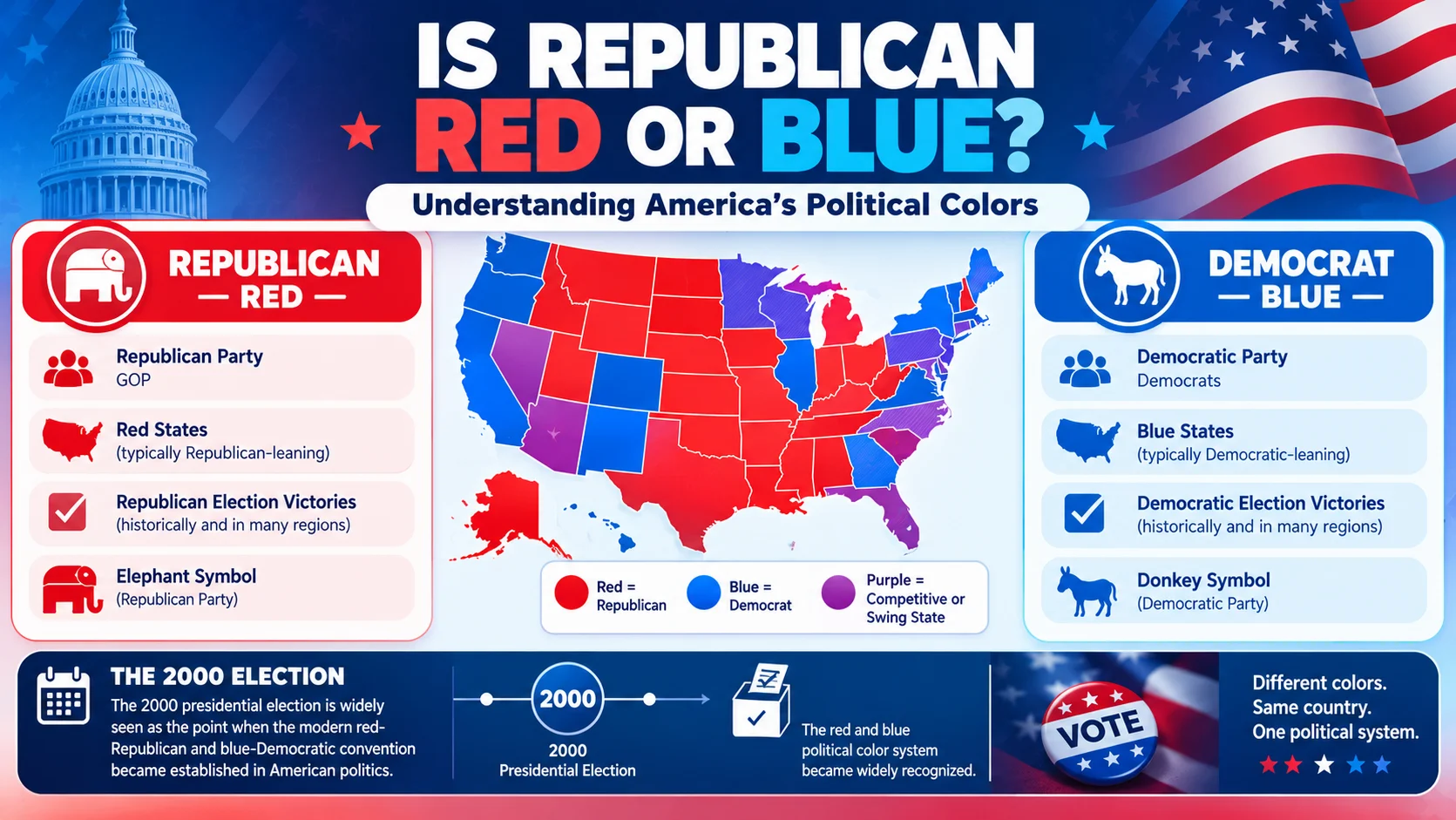
Republican is red, while Democrat is blue in American politics. The Republican Party is commonly represented by the color red, and the Democratic Party is represented by blue. These colors became widely established during the 2000 US presidential election and are now commonly used in election maps, news coverage, political graphics, and campaign discussions.
Have you ever looked at a US election map and wondered why some states appear red while others appear blue? If so, understanding the meaning of these political colors can make American politics much easier to follow. The answer to is Republican red or blue is simple: Republicans are represented by red, while Democrats are represented by blue.
These colors help television networks, newspapers, websites, and voters identify political parties during elections. For example, a red state generally refers to a state that tends to vote Republican in presidential elections. Similarly, a blue state usually supports Democratic candidates.
However, the connection between these colors is relatively modern. Before the 2000 presidential election, American news organizations did not consistently use the same colors for each political party. Over time, red and blue became familiar symbols of the country’s two major political parties.
In this guide, you’ll discover which color represents Republicans, why Democrats are associated with blue, how these traditions developed, and what red and blue states mean. You’ll also explore election examples, common misconceptions, and frequently asked questions about American political colors.
Is Republican Red or Blue?
The Republican Party is red in the United States.
The Democratic Party, on the other hand, is blue.
These color associations are widely recognized across American political media. Whenever you see a typical US presidential election map, red usually identifies states won by Republican candidates, while blue identifies states won by Democratic candidates.
For example:
- Red represents the Republican Party.
- Blue represents the Democratic Party.
- Red states generally lean Republican.
- Blue states generally lean Democratic.
- Purple or swing states have competitive support for both parties.
Therefore, remembering this simple distinction makes election coverage easier to understand.
Although these colors are strongly associated with the parties today, they are not official requirements for party membership. Instead, they are widely established conventions used by media organizations, political campaigns, and the public.
What Does Republican Red Mean?
Republican red is the color commonly used to represent the Republican Party, one of the two major political parties in the United States.
The party is often called the GOP, which stands for Grand Old Party. Its candidates, supporters, and political campaigns frequently use red in their visual materials.
During elections, red appears on maps to identify states won by Republican presidential candidates. Likewise, television graphics and political websites use red to distinguish Republican results from Democratic results.
The color has also become part of everyday American political language.
For example, people commonly use expressions such as:
- Red state
- Red county
- Red voters
- Red America
- Republican stronghold
These expressions generally refer to Republican political support or areas where Republican candidates perform well.
However, a red state does not mean every resident supports the Republican Party. Instead, it describes the overall voting pattern or political leaning of that state.
What Does Democrat Blue Mean?
Democrat blue is the color commonly associated with the Democratic Party.
The Democratic Party is another major political party in the United States. Its candidates and campaigns often use blue in advertisements, election materials, websites, and political events.
During presidential elections, blue identifies states won by Democratic candidates. Consequently, states that regularly support Democratic candidates are commonly called blue states.
You may also encounter expressions such as:
- Blue state
- Blue county
- Blue voters
- Blue America
- Democratic stronghold
These terms help people discuss political patterns without repeatedly mentioning party names.
Furthermore, blue has become a recognizable symbol of Democratic political identity in the United States. However, just like Republican red, this color association is a political convention rather than an official membership requirement.
Why Are Republicans Red and Democrats Blue?
The association between Republicans and red and Democrats and blue became widely established during the 2000 US presidential election.
Before that election, American television networks and newspapers did not consistently assign the same colors to each political party. Some organizations used red for Democrats and blue for Republicans, while others used different combinations.
As a result, viewers could encounter different colors depending on the news organization covering an election.
The 2000 presidential election changed this pattern.
During the closely contested election between Republican George W. Bush and Democrat Al Gore, major television networks used color-coded maps to show which states each candidate had won.
Many influential broadcasts and news graphics displayed Republican victories in red and Democratic victories in blue. The unusual length and intensity of the election coverage helped make these colors familiar to American viewers.
Eventually, the convention became widely accepted.
Today, most Americans recognize Republican red and Democratic blue without needing an explanation.
It is important to understand that the 2000 election did not create the colors from nothing. Rather, it helped standardize an association that had previously varied between news organizations.
History of Republican Red and Democrat Blue
The history of American political colors is more complicated than many people realize.
For much of the twentieth century, news organizations did not follow one consistent system for representing political parties on election maps.
Some networks used red for Democratic candidates and blue for Republicans. Others switched between colors depending on the election or graphic design.
Therefore, the modern color system was not always familiar to American voters.
Before the 2000 Presidential Election
Before 2000, political maps often used different colors to identify winning candidates.
Television networks generally selected colors based on their own graphic preferences. Consequently, viewers could see different representations of the same election.
There was no universally accepted rule that Republicans had to be red and Democrats had to be blue.
The 2000 Presidential Election
The 2000 presidential election played a major role in establishing today’s color system.
Republican George W. Bush competed against Democrat Al Gore in one of the most closely contested presidential elections in modern American history.
Because the election results were disputed in Florida, news coverage continued for weeks. Television networks repeatedly displayed maps showing red Republican states and blue Democratic states.
As Americans watched the election unfold, the colors became increasingly familiar.
After the 2000 Election
Following the election, newspapers, television networks, websites, and political organizations increasingly adopted the same color convention.
Republican red and Democratic blue became standard visual references in American political coverage.
Today, the colors appear in presidential election maps, political debates, opinion polls, campaign graphics, and educational materials.
What Is a Red State?
A red state is a US state that generally supports Republican candidates in elections.
The term is especially common during presidential elections, when maps show which candidate wins each state’s electoral votes.
For instance, Texas is commonly considered a Republican-leaning state because Republican presidential candidates have won it consistently in recent presidential elections.
Other states often described as red include:
- Alabama
- Oklahoma
- Wyoming
- Idaho
- Tennessee
- South Carolina
However, political preferences can change over time.
A state that strongly supports Republicans in one election may become more competitive in another. Additionally, some counties and cities within red states may strongly support Democratic candidates.
Therefore, the label describes a general voting pattern rather than the political beliefs of every resident.
What Is a Blue State?
A blue state is a US state that generally supports Democratic candidates.
These states often vote for Democratic presidential candidates and may have strong Democratic support in statewide elections.
For example, California is commonly considered a blue state because Democratic presidential candidates have won it consistently in recent presidential elections.
Other states often described as blue include:
- New York
- Massachusetts
- Vermont
- Hawaii
- Maryland
- Oregon
Nevertheless, a blue state does not mean every resident is a Democrat.
Many blue states contain Republican communities, independent voters, and politically competitive areas.
Similarly, political trends can shift as populations, voter preferences, and election issues change.
What Is a Purple State?
A purple state is a state where Republican and Democratic candidates have relatively competitive levels of support.
The term comes from combining the political colors red and blue.
In a simplified color illustration:
- Red represents Republicans.
- Blue represents Democrats.
- Purple represents a mixture of red and blue.
Purple states are often called swing states or battleground states because either major political party may have a realistic chance of winning them.
Examples of states that have been important battlegrounds in recent presidential elections include:
- Pennsylvania
- Wisconsin
- Michigan
- Georgia
- Arizona
- Nevada
However, their political status can change between elections.
A state that is competitive in one presidential election may become more favorable to one party in another.
Republican Red vs. Democrat Blue: Quick Comparison
| Feature | Republican Party | Democratic Party |
|---|---|---|
| Political Color | Red | Blue |
| Common Symbol | Elephant | Donkey |
| Common Abbreviation | GOP | Democratic Party |
| Election Map Color | Red | Blue |
| Common State Label | Red state | Blue state |
| Competitive State Term | Red-leaning | Blue-leaning |
| Political Identity | Republican | Democrat |
Both parties are major political organizations in the United States. However, their policies, priorities, and voter coalitions differ across many political issues.
Republican Red or Blue in Everyday Language
The expressions red and blue appear frequently in American conversations, particularly when people discuss elections, government, and political preferences.
Understanding these expressions can help you follow news reports and everyday discussions.
Red State
A red state generally supports Republican candidates.
Example: “Texas is often described as a red state.”
Blue State
A blue state generally supports Democratic candidates.
Example: “California is commonly considered a blue state.”
Red Wave
A red wave describes a major electoral victory for Republican candidates.
Example: “Political analysts predicted a red wave before the election.”
Blue Wave
A blue wave describes a major electoral victory for Democratic candidates.
Example: “The Democrats hoped for a blue wave in the midterm elections.”
Turning Red
Turning red means a place is becoming more supportive of Republican candidates.
Example: “The county has been turning red over the past few elections.”
Turning Blue
Turning blue means a place is becoming more supportive of Democratic candidates.
Example: “The traditionally Republican district is slowly turning blue.”
Examples of Republican Red and Democrat Blue
Here are some natural examples that show how Americans use these political color expressions.
Example 1: Understanding Election Maps
“The red areas represent Republican victories, while the blue areas show Democratic victories.”
Example 2: Discussing States
“My friend lives in Texas, which is generally considered a red state.”
Example 3: Talking About California
“California is a blue state because Democratic presidential candidates have consistently won there.”
Example 4: Following Election News
“The news channel displayed a red and blue map to explain the election results.”
Example 5: Discussing Swing States
“Pennsylvania is an important purple state because both parties compete for its electoral votes.”
Example 6: Talking About Political Trends
“Some traditionally red areas have become more competitive in recent elections.”
Example 7: Understanding Political Support
“Red counties and blue counties can exist within the same state.”
Example 8: Discussing National Politics
“Republican red and Democratic blue make American election maps easier to understand.”
Where Are Republican Red and Democrat Blue Used?
Political colors appear in many places throughout American society.
Although election maps are the most familiar examples, the colors are also used in news coverage, educational resources, and campaign materials.
Election Maps
Election maps use red and blue to show which political party wins different states, counties, or voting districts.
Television News
News networks use these colors in election graphics, political discussions, and voting result presentations.
Newspapers and Websites
Online news platforms and newspapers frequently use red and blue to explain election outcomes and political trends.
Social Media
People use red and blue in political posts, discussions, graphics, and election-related hashtags.
Educational Materials
Teachers and educational websites use political colors to help students understand American elections and party differences.
Political Campaigns
Republican and Democratic campaigns commonly incorporate their associated colors into advertisements, banners, websites, and other promotional materials.
Is Republican Red or Blue on Election Maps?
Republicans are represented by red on standard American election maps.
During presidential elections, states won by Republican candidates generally appear red. Meanwhile, states won by Democratic candidates appear blue.
For example, imagine a presidential election in which a Republican candidate wins Texas and Oklahoma while a Democratic candidate wins California and New York.
The map would show:
- Texas in red
- Oklahoma in red
- California in blue
- New York in blue
However, election maps can show different information depending on the graphic.
Some maps display the winning candidate in each state, while others show the percentage of Republican or Democratic votes. Therefore, it is important to check the map’s title and legend before interpreting its colors.
Do Red and Blue States Always Vote the Same Way?
No. Red and blue states do not always vote for the same political party.
The labels describe general political tendencies rather than permanent voting behavior.
For example, a state that usually supports Republican presidential candidates may become more competitive when voter preferences change. Similarly, a traditionally Democratic state may experience stronger Republican support in certain elections.
Several factors can influence these changes:
- Population growth
- Economic conditions
- Voter turnout
- Candidate popularity
- Local political issues
- Demographic changes
- National political events
Moreover, presidential elections and state-level elections can produce different results.
A state may vote for a Republican presidential candidate while electing a Democratic governor. Consequently, political labels should not be treated as fixed descriptions of every election.
Advantages and Disadvantages of Political Color Labels
Using red and blue to represent political parties makes election information easier to understand. However, these labels also have some limitations.
Advantages
Easy Recognition: Red and blue help viewers identify Republican and Democratic results quickly.
Simple Election Maps: Color-coded maps make complicated election results easier to follow.
Better Communication: News organizations can discuss political trends using familiar expressions such as red states and blue states.
Educational Value: These colors help students and new voters understand American political terminology.
Visual Consistency: A widely recognized color system makes political graphics easier to interpret.
Disadvantages
Oversimplification: A single color cannot represent the political opinions of every resident in a state.
Political Stereotypes: Some people may incorrectly assume that everyone in a red state is Republican or everyone in a blue state is Democratic.
Changing Trends: Political preferences can change, making older descriptions less accurate.
Limited Information: A red or blue map does not always show the actual percentage of votes received by each party.
Misinterpretation: Without reading the map legend, viewers may misunderstand what the colors represent.
Common Mistakes About Republican Red and Democrat Blue
Although the color system is simple, people sometimes misunderstand what it represents.
Here are some common mistakes to avoid.
Mistake: Thinking Republicans Are Blue
The correct association in modern American politics is Republican red.
Remember that Democratic blue is the other major party color.
Mistake: Assuming Every Republican Lives in a Red State
Republicans live throughout the United States, including states that usually vote Democratic.
A state’s color represents its general election outcome, not every resident’s political affiliation.
Mistake: Thinking Blue States Have No Republicans
Blue states also have Republican voters, elected officials, and communities.
Therefore, the label does not mean that everyone in the state supports Democrats.
Mistake: Assuming Purple Is an Official Political Party
Purple is generally used to describe political competition between Republicans and Democrats.
It does not represent a third major national political party.
Mistake: Believing the Color System Has Always Existed
The modern Republican-red and Democratic-blue convention became widely established around the 2000 presidential election.
Before that, news organizations used different color combinations.
Mistake: Confusing Party Colors With Official Government Colors
Red and blue are common political conventions, not official colors required by the US Constitution.
Republican Red or Blue: Related Comparisons
Understanding these related terms can make American political language easier to follow.
Republican vs. Democrat
A Republican is a member or supporter of the Republican Party, while a Democrat is a member or supporter of the Democratic Party.
Their commonly associated colors are red and blue, respectively.
Red State vs. Blue State
A red state generally votes Republican, whereas a blue state generally votes Democratic.
These labels describe broader political voting patterns.
Purple State vs. Swing State
A purple state is politically competitive between Republicans and Democrats. A swing state is a state where either party has a realistic chance of winning an election.
The expressions are closely related and are often used interchangeably.
Republican vs. GOP
Republican refers to a member or supporter of the Republican Party.
GOP stands for Grand Old Party, a traditional nickname for the Republican Party.
Democrat vs. Democratic Party
A Democrat is a person who belongs to or supports the Democratic Party.
The Democratic Party is the political organization itself.
How to Remember Republican Red and Democrat Blue
If you frequently forget which political party uses which color, a few simple memory tricks can help.
Remember R for Red and Republican: Both words begin with the letter R.
Remember B for Blue: Blue is the familiar color associated with the Democratic Party.
Think About Election Maps: Picture a typical US election map with red Republican states and blue Democratic states.
Practice With Political News: Whenever you watch American election coverage, notice how news organizations use red and blue to identify party results.
With a little practice, remembering the difference becomes effortless.
Exercises: Test Your Understanding
Try these questions to check whether you understand American political colors.
Choose the correct answer.
Question: Which color represents the Republican Party?
A. Blue
B. Red
C. Green
D. Yellow
Question: Which color represents the Democratic Party?
A. Red
B. Orange
C. Blue
D. Purple
Question: What does a red state generally mean?
A. It usually supports Republican candidates.
B. It has no elections.
C. It always supports Democrats.
D. It has no political parties.
Question: What is a purple state?
A. A state without voters.
B. A state where political competition between the major parties is strong.
C. A state controlled by a third major national party.
D. A state that does not hold elections.
Question: When did the modern red-Republican and blue-Democratic convention become widely established?
A. 1776
B. 1860
C. 2000
D. 2020
Answers
- Question 1: B. Red
- Question 2: C. Blue
- Question 3: A. It usually supports Republican candidates.
- Question 4: B. A state where political competition between the major parties is strong.
- Question 5: C. 2000
Key Takeaways and Summary
Here are the most important points to remember about American political colors:
- Republican = Red: The Republican Party is commonly represented by red.
- Democrat = Blue: The Democratic Party is commonly represented by blue.
- Red State: A state that generally supports Republican candidates.
- Blue State: A state that generally supports Democratic candidates.
- Purple State: A politically competitive state where both major parties have significant support.
- Historical Background: The modern color convention became widely established during the 2000 presidential election.
- Common Usage: Red and blue appear in election maps, television coverage, newspapers, websites, and political discussions.
The easiest way to remember the answer is simple: Republicans are red, and Democrats are blue.
FAQs
Is Republican red or blue?
Republican is red in American politics. The Republican Party uses red as its commonly recognized political color, while the Democratic Party uses blue.
Is Democrat red or blue?
Democrat is blue in American politics. Democratic candidates and election results are commonly represented by blue on US political maps.
Why is the Republican Party red?
The Republican Party became widely associated with red through American election coverage. The modern color convention became established during the closely contested 2000 presidential election.
Why is the Democratic Party blue?
Blue became the commonly recognized color for the Democratic Party as major news organizations standardized their election graphics around the 2000 election.
When did Republicans become red and Democrats become blue?
The modern association became widely established during the 2000 presidential election between George W. Bush and Al Gore. Before then, news organizations used different color combinations.
Is Texas a red or blue state?
Texas is generally considered a red state because Republican presidential candidates have consistently won it in recent presidential elections. However, Democratic voters also live throughout the state.
Is California a red or blue state?
California is generally considered a blue state because Democratic presidential candidates have consistently won it in recent presidential elections. Nevertheless, the state also has Republican voters and communities.
What does a purple state mean?
A purple state is a politically competitive state where Republican and Democratic candidates both have significant support. These states are often called swing states or battleground states.
What does a red wave mean in politics?
A red wave describes a major electoral victory for Republican candidates. The expression is often used when Republicans win more seats or elections than expected.
What does a blue wave mean in politics?
A blue wave describes a major electoral victory for Democratic candidates. It usually refers to a strong performance by Democratic candidates across multiple elections.
Are red and blue the official colors of American political parties?
They are widely recognized political conventions rather than official colors required by law. Both parties and news organizations commonly use these colors in their political materials.
Can a red state become blue?
Yes. A state’s political preferences can change over time because of population shifts, economic conditions, voter turnout, candidate popularity, and other factors.
Does a red state mean everyone supports Republicans?
No. Red states also contain Democratic voters, independent voters, and people with different political opinions. The label describes the state’s overall voting pattern rather than every resident’s beliefs.
What is the easiest way to remember Republican and Democrat colors?
Remember the simple association: R stands for Republican and Red, while Blue represents Democrats. This quick trick can help you recognize the parties on American election maps.
Conclusion
So, is Republican red or blue? The answer is red. In American politics, the Republican Party is represented by red, while the Democratic Party is represented by blue.
These colors became widely recognized during the 2000 presidential election and are now an important part of American political communication. They help voters understand election maps, identify political victories, and follow discussions about red states, blue states, and purple swing states.
Although political preferences can change over time, the basic color association remains consistent in modern US election coverage. Therefore, whenever you see red on a standard American election map, think Republican. When you see blue, think Democrat.
Remember this simple rule: Republican is Red, and Democrat is Blue.