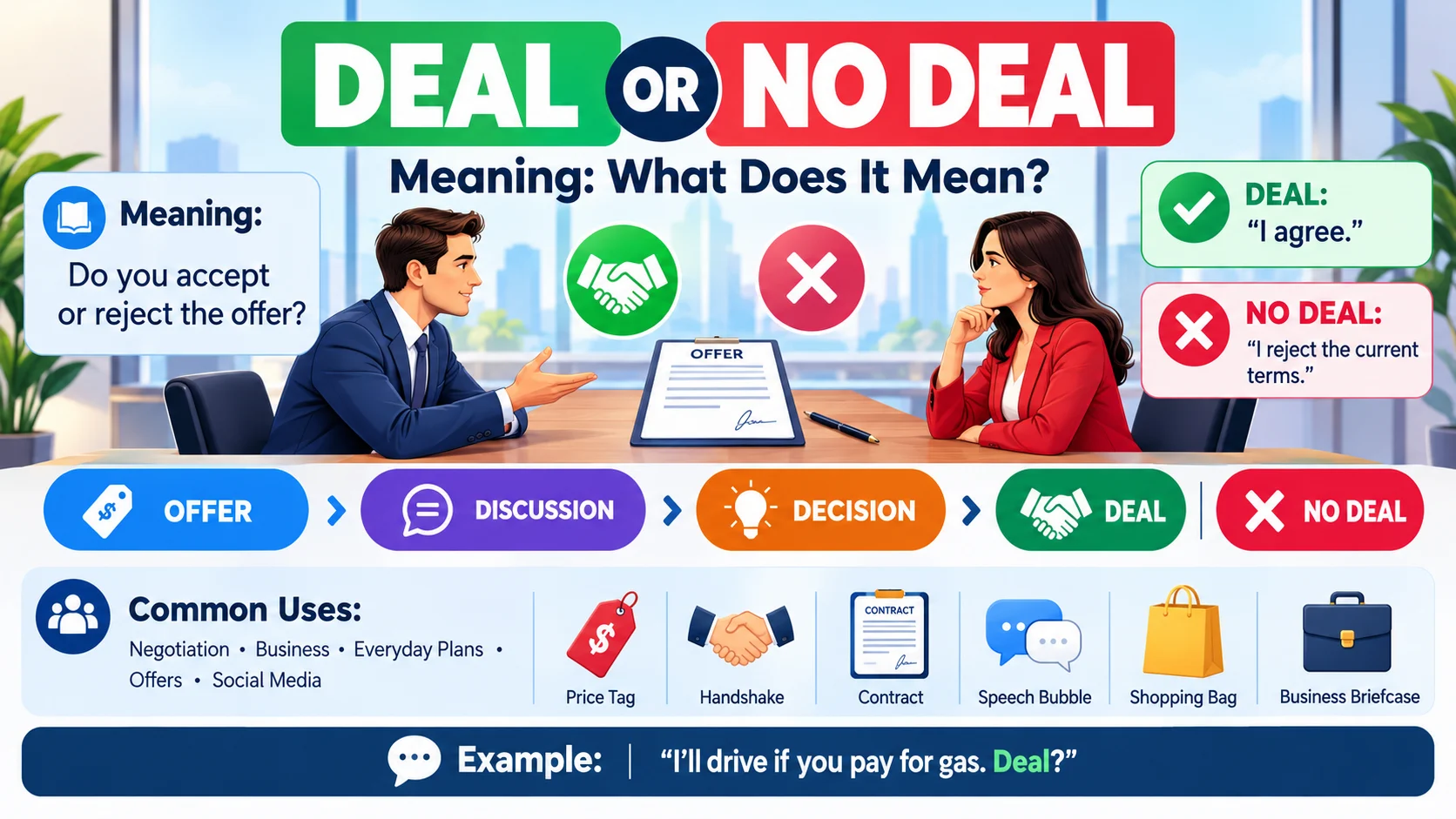
Deal or no deal is a phrase used to ask whether someone accepts or rejects an offer, agreement, proposal, or arrangement. It can mean “Do we have an agreement, or not?” and often appears during negotiations, decisions, or playful conversations. Depending on the context, the phrase can sound serious, confident, direct, or humorous.
The deal or no deal meaning centers on a simple but important choice: accept an offer or reject it. People use this phrase when they want a clear decision about an agreement, proposal, bargain, or opportunity. In everyday conversations, it can make a situation sound more direct because it reduces the choice to two possibilities.
For example, someone selling a used phone might say, “I can lower the price to $300. Deal or no deal?” Here, the speaker wants the other person to decide whether the offer is acceptable. Similarly, a friend might jokingly offer to trade chores and ask, “I cook dinner if you wash the dishes. Deal or no deal?”
However, the phrase is not limited to buying and selling. It can also appear in negotiations, business discussions, relationships, games, social media posts, and casual jokes. Moreover, its tone can change significantly depending on the situation.
The phrase became especially recognizable through the international television game show Deal or No Deal, where contestants decide whether to accept offers from the mysterious “banker.” Even so, the expression existed as ordinary language before the show and continues to have a broader meaning.
In this guide, you will learn what deal or no deal means, how to use it naturally, what its tone suggests, how it differs from similar expressions, and why people use it when they want a clear answer.
Quick Answer
| Meaning | Context | Primary Platforms | Example | Tone |
|---|---|---|---|---|
| Accept or reject an offer | Negotiation | Everyday conversation | “I’ll do it for $50. Deal or no deal?” | Direct |
| Agree or disagree | Plans and arrangements | Texting, conversation | “You pick the movie, and I’ll get snacks. Deal or no deal?” | Casual |
| Finalize an agreement | Business | Workplace, negotiations | “We’ve discussed everything. Deal or no deal?” | Professional |
| Make a clear choice | General decisions | Social media, conversation | “One last chance. Deal or no deal?” | Dramatic |
| Create playful pressure | Jokes and games | Social media, texting | “You give me the last slice, and I’ll buy dessert tomorrow. Deal?” | Playful |
What Does Deal or No Deal Mean?
At its most basic level, deal or no deal means “Do you accept the offer, or do you reject it?”
The phrase presents a straightforward choice. If the other person says deal, they accept the proposed arrangement. If they say no deal, they reject it or want different terms.
For example:
“I’ll sell you the bike for $200. Deal or no deal?”
A response of “Deal” means the buyer accepts the offer. On the other hand, “No deal” means the buyer does not accept the terms.
Because of this simple structure, the phrase works especially well in negotiations. It creates a sense of finality and encourages the other person to make a decision.
Nevertheless, the phrase does not always involve money. Someone might use it for almost any agreement.
For instance:
- “You drive, and I’ll pay for gas. Deal or no deal?”
- “You choose the restaurant, and I’ll choose the movie. Deal?”
- “I’ll finish your part of the presentation if you help me tomorrow. Deal?”
- “We leave at eight sharp. Deal or no deal?”
Therefore, the expression can describe anything from a serious business agreement to a completely harmless joke between friends.
Deal or No Deal in Simple Words
In simple English, deal or no deal means:
“Are you agreeing to this, or not?”
It can also mean:
- “Do we have an agreement?”
- “Do you accept my offer?”
- “Are you willing to make this arrangement?”
- “Yes or no?”
- “Are we agreed?”
- “Do we have a deal?”
The exact wording changes, but the basic idea remains the same.
For example, imagine that two friends are planning a road trip. One says, “You choose the destination, and I’ll drive.” Then the other replies, “Deal!”
Here, deal simply means “I agree.”
Similarly, if someone says, “I can give you $100, but that’s my final offer. Deal or no deal?” they are asking for a firm decision.
Is Deal or No Deal a Slang Phrase?
Deal or no deal can be informal, but it is not strictly slang.
The expression uses ordinary English words and follows a common conversational structure. However, its short and dramatic style makes it especially popular in casual speech, texting, social media, and informal negotiations.
For example, a person might post:
“You bring the pizza, and I’ll bring the drinks. Deal or no deal?”
That usage is casual rather than formal.
In a professional setting, however, a person might say:
“Are these terms acceptable to you?”
That version sounds more formal and less conversational.
Therefore, deal or no deal is best understood as an informal expression that can also be used in serious situations when the speaker wants to emphasize a clear decision.
The Meaning of “Deal”
The word deal has several meanings in English. In this expression, however, it refers to an agreement or arrangement between people.
When someone says:
“Deal!”
they usually mean:
“I agree.”
The word can communicate acceptance without requiring a long response.
For example:
Person A: “I’ll pick you up at seven if you bring coffee.”
Person B: “Deal.”
The agreement is now clear.
Likewise, a customer might accept a seller’s final offer by saying, “Deal.”
Because the word is short and decisive, it works particularly well when both sides already understand the terms.
The Meaning of “No Deal”
No deal means that the proposed agreement has not been accepted.
It can communicate rejection, disagreement, or a desire to negotiate further.
For example:
“I’ll pay $50, but I need delivery included.”
If the seller responds:
“No deal.”
the seller is rejecting those terms.
Importantly, no deal does not always mean the conversation is completely finished. Sometimes it simply means that the current proposal does not work.
A person might say:
“No deal at that price. I can do $60.”
In this case, the speaker rejects the first offer but provides another possibility.
Deal or No Deal as a Negotiation Phrase
One of the most common uses of deal or no deal is negotiation.
Negotiation happens when two or more people discuss terms to reach an agreement. Those terms might involve money, time, responsibilities, services, products, or other conditions.
The phrase can appear at the end of a negotiation because it asks for a clear response.
For example:
“I can finish the project by Friday for $500. Deal or no deal?”
The speaker has presented specific terms. Now, the other person must decide.
However, effective negotiations often require more discussion before reaching that point. Therefore, using the phrase too early can sound aggressive or impatient.
For example, saying “Deal or no deal?” immediately after presenting an unreasonable offer may make the conversation uncomfortable.
Instead, a more natural approach might be:
“Those are the terms I can offer. What do you think?”
Then, once both sides have discussed the details, deal or no deal can provide a clear closing question.
Deal or No Deal in Business
In business, the phrase can refer to an important decision about a proposed agreement.
For example, two companies might negotiate pricing, delivery dates, responsibilities, or contract terms. Once both sides understand the proposal, someone might informally ask:
“So, are we at a deal?”
The exact phrase deal or no deal can also appear in business conversations, although formal business writing usually uses more professional wording.
For instance, instead of writing:
“Deal or no deal?”
a formal email might say:
“Please confirm whether you agree to these terms.”
Even so, executives, entrepreneurs, salespeople, and negotiators may use the shorter phrase during spoken conversations.
Deal or No Deal in Everyday Conversation
The expression is also common in ordinary conversations because it makes small agreements sound fun and decisive.
For example:
“You pick the movie, and I’ll order dinner. Deal?”
This does not involve a formal contract. Instead, the speaker is making a friendly arrangement.
Likewise:
“I’ll help you study tonight if you help me tomorrow. Deal or no deal?”
The phrase adds a playful sense of negotiation.
As a result, friends and family members can use it without any serious financial or legal meaning.
Deal or No Deal in Texting
Text messages often favor short expressions. Therefore, deal or no deal fits naturally into digital conversations.
Someone might text:
“I’ll bring snacks if you bring the drinks. Deal?”
Another person can simply respond:
“Deal 😂”
or:
“No deal. I want pizza too.”
The expression works particularly well in texting because the meaning is immediately understandable.
Additionally, people sometimes shorten the phrase to simply deal?
For example:
“Meet at 7?”
“Deal.”
That tiny exchange can communicate complete agreement.
Deal or No Deal on Social Media
On social media, people often use deal or no deal as a playful engagement phrase.
For example, a creator might post:
“You get free coffee every Friday, but you have to wake up at 5 a.m. Deal or no deal?”
The question encourages people to comment with their choice.
Similarly, a brand might use the structure when presenting a promotion, although professional advertising usually uses more polished wording.
The phrase can also appear in memes and humorous posts.
For example:
“I cook dinner. You wash every dish. Deal or no deal?”
Such posts use negotiation language to make an ordinary situation entertaining.
Deal or No Deal and the TV Game Show
The phrase Deal or No Deal is strongly associated with the internationally known television game show of the same name.
The format centers on a contestant choosing from sealed briefcases or boxes containing different amounts of money. During the game, a “banker” makes offers to the contestant.
The contestant then faces a major decision:
Deal — accept the banker’s offer.
No deal — reject the offer and continue playing.
This format made the phrase highly recognizable around the world.
However, the everyday meaning of deal or no deal is broader than the television show. People can use it without referring to the program at all.
For instance, someone negotiating the price of a car might say, “Deal or no deal?” without making any connection to the game show.
Examples of Deal or No Deal
Here are several natural examples showing how the phrase works in different situations.
Example 1: Buying Something
“I’ll sell you the desk for $75. Deal or no deal?”
Here, the seller wants the buyer to accept or reject the price.
Example 2: Making Plans
“You choose the restaurant, and I’ll drive. Deal?”
The speaker proposes a simple arrangement.
Example 3: Friends
“I’ll share my fries if you give me the last chicken wing. Deal?”
This is a playful agreement.
Example 4: Business
“We can deliver the order by Monday at this price. Deal or no deal?”
The phrase creates a direct negotiation point.
Example 5: School
“I’ll help you with math if you help me with English tomorrow. Deal?”
The speakers are exchanging favors.
Example 6: Sports
“You let me choose the teams, and you choose the field. Deal?”
The phrase creates a fair arrangement.
Example 7: Travel
“You book the hotel, and I’ll book the flights. Deal?”
The speakers divide responsibilities.
Example 8: Social Media
“Unlimited pizza but no dessert for a month. Deal or no deal?”
Here, the phrase creates a humorous hypothetical choice.
When Should You Use Deal or No Deal?
You can use deal or no deal when you want someone to respond to a proposal clearly.
It works especially well when:
- You have already explained the offer.
- The other person understands the terms.
- You want a direct answer.
- The situation is informal.
- The decision involves negotiation.
- You are joking about a simple arrangement.
For example, after negotiating the price of an item, asking “Deal or no deal?” can sound natural.
However, the phrase may not be appropriate in every situation.
For a formal contract, legal agreement, or sensitive discussion, more precise language is usually better.
When Not to Use Deal or No Deal
Although the phrase is widely understood, it can sometimes sound too casual.
For example, you would generally avoid saying:
“Deal or no deal?”
to someone who is discussing a serious personal problem.
Similarly, a formal business letter should usually avoid overly conversational language.
Instead, use phrases such as:
- “Please confirm your agreement.”
- “Do these terms work for you?”
- “Are you willing to proceed?”
- “Please let me know whether you accept the proposal.”
- “Can we finalize the agreement?”
These alternatives communicate the same basic idea while matching a more professional tone.
Deal or No Deal vs. Take It or Leave It
These expressions are similar, but they are not exactly the same.
Deal or no deal asks whether someone accepts an agreement or offer.
Take it or leave it often sounds more forceful. It suggests that the offer is final and will not be changed.
For example:
“I can sell it for $100. Deal or no deal?”
This sounds like a direct question.
Meanwhile:
“$100 is my final price. Take it or leave it.”
This sounds firmer and more confrontational.
Therefore, deal or no deal can feel more neutral, while take it or leave it often creates stronger pressure.
Deal or No Deal vs. Do We Have a Deal?
These phrases are very close in meaning.
Do we have a deal? asks whether both people agree.
Deal or no deal? presents the choice more dramatically.
For example:
“I’ll finish the work by Friday. Do we have a deal?”
This sounds natural and conversational.
On the other hand:
“Friday delivery at this price. Deal or no deal?”
This sounds more decisive.
Consequently, the second phrase can create more urgency.
Deal or No Deal vs. Yes or No
Both expressions ask for a decision, but they emphasize different things.
Yes or no is a broad request for an answer.
Deal or no deal specifically relates to an offer, agreement, or arrangement.
For example:
“Can you come tomorrow? Yes or no?”
This asks about availability.
However:
“I’ll pick you up at six and drive you home. Deal or no deal?”
This proposes an arrangement.
Thus, deal or no deal has a stronger connection to negotiation.
Common Mistakes With Deal or No Deal
Mistake 1: Assuming It Always Involves Money
The phrase does not necessarily involve money.
It can describe a favor, plan, trade, promise, or agreement.
Mistake 2: Treating It as Formal Business Language
Although businesspeople may say it aloud, the expression is generally conversational.
A formal document should use precise contractual language instead.
Mistake 3: Assuming No Deal Means the Conversation Is Over
“No deal” can simply reject the current proposal.
The speaker may still be willing to negotiate.
Mistake 4: Using It Without Explaining the Offer
The other person needs to understand what they are accepting.
For example, saying “Deal or no deal?” without context can sound confusing.
Mistake 5: Using It in Sensitive Situations
The phrase can sound playful or forceful. Therefore, it may be inappropriate when someone needs empathy rather than negotiation.
Tone of Deal or No Deal
The tone of deal or no deal depends heavily on context.
Casual
“Pizza tonight? Deal or no deal?”
This sounds friendly.
Playful
“You give me the remote, and I’ll share the snacks. Deal?”
This sounds humorous.
Confident
“That is my final offer. Deal or no deal?”
This sounds assertive.
Dramatic
“One last chance. Deal or no deal?”
This creates tension.
Professional
“Those are the terms we can offer. Deal or no deal?”
This can sound businesslike, although it remains relatively informal.
Therefore, the surrounding words determine how the phrase feels.
Positive and Negative Connotations
Deal or no deal can have positive or negative associations.
On the positive side, it can communicate:
- Confidence
- Clarity
- Decisiveness
- Cooperation
- Fair negotiation
- Excitement
On the negative side, it can sometimes suggest:
- Pressure
- Impatience
- Aggression
- Ultimatums
- Manipulation
For example, a friend saying “Deal?” may sound friendly. Conversely, a salesperson repeatedly demanding “Deal or no deal?” may make the customer feel pressured.
Related Expressions
Several English expressions share a similar meaning.
Do We Have a Deal?
This asks whether both sides agree.
Are We Agreed?
This sounds slightly more formal.
Sounds Good
This is a casual way to accept a proposal.
I’m In
This means the speaker agrees to participate.
Count Me In
This expresses agreement or willingness to participate.
Take It or Leave It
This presents a firm final offer.
Make a Deal
This means to reach an agreement.
Shake on It
This traditionally refers to confirming an agreement with a handshake.
Agreed
This is a direct way to show acceptance.
Synonyms for Deal or No Deal
Depending on the context, possible alternatives include:
- Accept or reject
- Agree or disagree
- Yes or no
- Do we agree?
- Are we agreed?
- Do we have an agreement?
- Do we have a deal?
- Accept the offer or decline it
- Take it or leave it
- Are you in?
- Are you willing to proceed?
However, these alternatives do not always have exactly the same tone.
How to Respond to Deal or No Deal
If you agree, you can respond with:
- “Deal!”
- “We have a deal.”
- “Agreed.”
- “Sounds good.”
- “I’m in.”
- “Absolutely.”
- “That works for me.”
- “You’ve got a deal.”
If you disagree, you can say:
- “No deal.”
- “That doesn’t work for me.”
- “I’ll pass.”
- “I can’t agree to that.”
- “Can we negotiate?”
- “I need different terms.”
- “How about $100 instead?”
Therefore, you do not always have to answer with the exact words “deal” or “no deal.”
Is Deal or No Deal Rude?
Usually, deal or no deal is not inherently rude.
However, the phrase can sound demanding if the speaker uses it aggressively or repeatedly.
For example:
“I can do $50. Deal?”
sounds fairly normal.
But:
“I already told you the price. Deal or no deal?”
can sound impatient.
Therefore, tone of voice and context matter.
Adding polite language can make the interaction friendlier:
“Would that work for you?”
or:
“What do you think? Can we make a deal?”
These alternatives are useful when you want to negotiate without creating pressure.
Why People Like the Phrase
The popularity of deal or no deal comes partly from its simplicity.
First, the phrase is easy to understand. Second, it creates a clear choice. Third, it adds a small amount of drama to an ordinary negotiation.
Moreover, people naturally enjoy situations involving choices and uncertainty. That is one reason the phrase works so well in games, entertainment, social media, and everyday conversation.
The expression also feels decisive. Instead of discussing a proposal indefinitely, it asks whether the two sides are ready to move forward.
Deal or No Deal in Modern Internet Language
Online communication has made short decision-based expressions even more popular.
People often turn ordinary situations into mock negotiations. For example:
“I will send you the recipe, but you have to make it for me next time. Deal?”
Similarly, someone might create a poll:
“Free concert tickets, but you have to sit in the front row. Deal or no deal?”
The phrase works well online because it encourages interaction. Users can answer quickly, vote, comment, or share their own version.
Additionally, the expression can be used ironically. Someone may describe a completely insignificant decision as though it were a major business negotiation.
For example:
“You get the window seat if I get the aisle seat next time. Deal?”
The exaggerated seriousness makes the exchange funny.
Deal or No Deal as a Caption
The phrase can also work as a short social media caption.
Examples include:
- “New challenge. Deal or no deal?”
- “One more chance. Deal.”
- “Coffee for life? Deal.”
- “Big decision today. Deal or no deal?”
- “You bring dessert. I’ll bring dinner. Deal?”
Because the phrase is short, it can create curiosity without requiring a long caption.
Exercises: Test Your Understanding
Exercise 1
Choose the best meaning:
“I’ll sell the laptop for $400. Deal or no deal?”
A. Do you like laptops?
B. Do you accept my offer?
C. Where did you buy it?
D. Is the laptop new?
Answer: B. Do you accept my offer?
Exercise 2
What does “Deal!” mean?
A. I disagree.
B. I am confused.
C. I agree.
D. I want to leave.
Answer: C. I agree.
Exercise 3
Which expression sounds more forceful?
A. Do we have a deal?
B. Take it or leave it.
Answer: B. Take it or leave it.
Exercise 4
Complete the sentence:
“I’ll drive if you pay for parking. ______?”
Answer: Deal?
Exercise 5
Does “no deal” always mean negotiations are permanently finished?
Answer: No. It can simply mean that the current proposal is unacceptable.
Deal or No Deal: Key Takeaways
The most important points are easy to remember:
- Deal or no deal asks whether someone accepts or rejects an offer.
- Deal usually means agreement or acceptance.
- No deal usually means rejection of the current proposal.
- The phrase can involve money, but it does not have to.
- It is commonly used in negotiations and casual conversations.
- The expression can sound serious, playful, confident, or dramatic.
- The phrase is informal rather than strictly formal business language.
- Its meaning depends strongly on context and tone.
- It is closely associated with the television game show Deal or No Deal.
- Similar expressions include “Do we have a deal?” and “Take it or leave it.”
Frequently Asked Questions
What does deal or no deal mean?
Deal or no deal means “Do you accept this offer or agreement?” It is commonly used when someone wants a clear decision about a proposal.
What does “deal” mean in a conversation?
In a conversation, deal usually means “I agree” or “I accept the proposed arrangement.”
What does “no deal” mean?
No deal means that someone rejects the current offer or does not agree to the proposed terms.
Is deal or no deal slang?
It is an informal expression rather than strict slang. People commonly use it in casual conversation, negotiations, texting, and social media.
Can deal or no deal be used without money?
Yes. People can use it for plans, favors, trades, responsibilities, promises, and other arrangements.
Is deal or no deal rude?
Not necessarily. However, it can sound demanding if used aggressively or in a sensitive situation.
What is another way to say deal or no deal?
Depending on the situation, you can say “Do we have a deal?”, “Are we agreed?”, “Do you accept?”, or “Are these terms acceptable?”
What does “you’ve got a deal” mean?
“You’ve got a deal” means “I agree to your proposal.” It is a friendly and common way to confirm an agreement.
Is Deal or No Deal a game show?
Yes. Deal or No Deal is the name of a television game-show format in which contestants make decisions about offers while trying to maximize their winnings.
What is the opposite of a deal?
In this context, the opposite of a deal is generally no agreement, rejection, or no deal.
Can I use deal or no deal in a professional setting?
You can use it in spoken professional conversation, especially during informal negotiations. Nevertheless, more formal wording is usually preferable in contracts and official correspondence.
Why does deal or no deal sound dramatic?
The phrase creates a binary choice between acceptance and rejection. Consequently, it can make even a simple decision feel more urgent or important.
Conclusion
The deal or no deal meaning is simple: it asks whether someone accepts or rejects an offer, proposal, or arrangement. Although the phrase can be connected with serious negotiations, people also use it casually when making plans, trading favors, joking with friends, or creating playful social media content.
A deal indicates agreement, while no deal indicates that the current terms are not acceptable. However, “no deal” does not always end a negotiation. In many situations, it simply opens the door to another offer or a revised agreement.
Furthermore, the phrase can carry different tones. It may sound friendly when used between friends, confident during a negotiation, or dramatic when used to create suspense. Therefore, context is essential when interpreting it.
Ultimately, deal or no deal is a concise way to ask for a decision. Whether you are discussing a price, making weekend plans, negotiating business terms, or joking about who gets the last slice of pizza, the expression communicates one central question: Are we agreed?