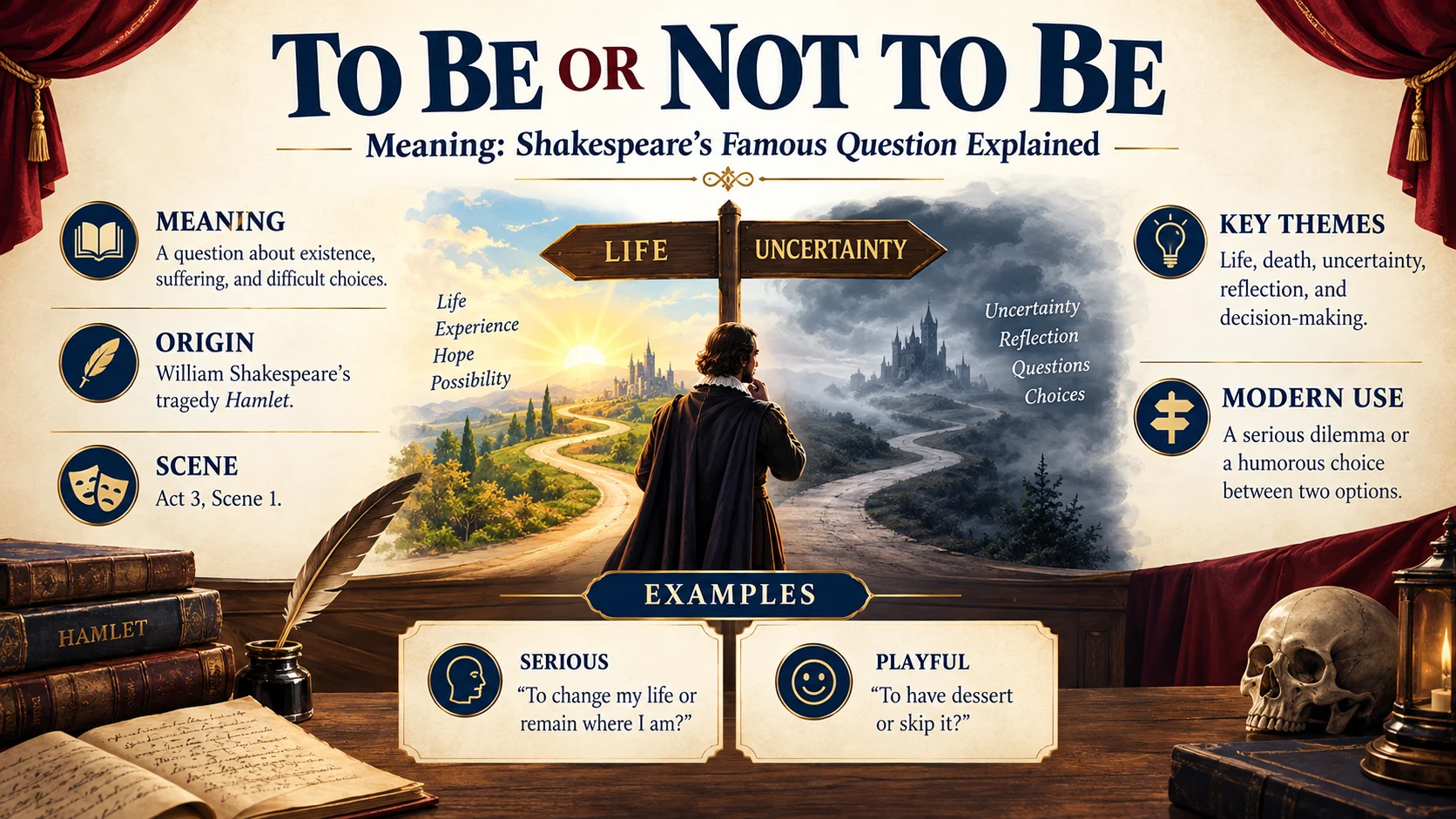
To be or not to be is a famous phrase from William Shakespeare’s play Hamlet. It expresses a deep question about existence, life, suffering, and whether to continue living despite life’s difficulties. More generally, people use the phrase to describe an important decision between two opposing choices, especially when the consequences feel serious or life-changing.
The to be or not to be meaning centers on one of life’s most profound questions: whether to continue existing or choose otherwise. Although the expression is best known from William Shakespeare’s tragedy Hamlet, it has become a familiar phrase in modern English. Today, people use it to discuss difficult decisions, philosophical questions, personal struggles, and moments when they must choose between two very different possibilities.
Originally, the phrase appears in a soliloquy delivered by Prince Hamlet in Act 3, Scene 1 of Hamlet. During this famous speech, Hamlet reflects on suffering, injustice, fear, death, and the uncertainty of what comes after life. Rather than offering a simple answer, he examines the complicated thoughts that make human decisions difficult.
However, the expression has a broader meaning beyond Shakespeare’s play. In everyday conversation, someone might jokingly ask, “To be or not to be a coffee drinker?” when deciding whether to try coffee. Similarly, a writer might use the phrase to introduce a serious question about identity, purpose, or the future.
Understanding this expression helps you appreciate its literary origins while recognizing how people use it today. In this guide, you’ll discover its definition, historical background, philosophical significance, practical examples, related expressions, common mistakes, and answers to frequently asked questions.
To Be or Not to Be
| Meaning | Context | Primary Platforms | Example | Tone |
|---|---|---|---|---|
| A question about existence | Philosophy and literature | Books, classrooms, discussions | “To be or not to be is a question about existence.” | Philosophical |
| A question about life and death | Shakespeare’s Hamlet | Theater, literature, education | “Hamlet wonders whether enduring life’s suffering is worthwhile.” | Serious |
| A difficult decision | Everyday conversation | Social media, conversations | “To move abroad or stay home? That is my to-be-or-not-to-be moment.” | Reflective |
| A choice between two options | Humor and casual writing | Memes, captions, blogs | “To order pizza or not to order pizza?” | Playful |
| A question about identity or purpose | Personal reflection | Essays, speeches, discussions | “To follow my dream or choose a safer career?” | Thoughtful |
What Does To Be or Not to Be Mean?
The expression to be or not to be literally presents a contrast between existence and nonexistence. In Shakespeare’s Hamlet, it introduces a serious reflection on whether life should be endured when it brings pain, disappointment, injustice, and uncertainty.
The word be refers to existing or being alive. Meanwhile, not to be suggests the opposite of existence. Within the play, Hamlet considers the hardships of life and the uncertainty associated with death.
Nevertheless, the phrase is not limited to its original literary meaning. In contemporary English, it can describe almost any important dilemma involving two contrasting possibilities.
For example, imagine a person deciding whether to leave a comfortable job to pursue a long-held ambition. They might jokingly describe the decision as their own “to be or not to be” moment. In this situation, the phrase emphasizes the seriousness of the choice rather than referring literally to life and death.
The expression can therefore communicate several ideas:
- Existence: Questions about what it means to live or exist.
- Uncertainty: Difficulty deciding which path to follow.
- Reflection: Taking time to consider the consequences of a decision.
- Identity: Thinking about who you are and who you want to become.
- Choice: Facing two possibilities that appear to lead in different directions.
Ultimately, the context determines whether the expression sounds philosophical, dramatic, humorous, or deeply personal.
Where Does To Be or Not to Be Come From?
The phrase originates in Hamlet, a tragedy written by William Shakespeare around the turn of the seventeenth century. The play follows Prince Hamlet of Denmark as he struggles with grief, betrayal, revenge, and uncertainty after the death of his father.
Hamlet discovers that his uncle Claudius has become king and married Hamlet’s mother, Gertrude. After encountering his father’s ghost, Hamlet learns of an alleged murder and begins considering how to respond. As the story develops, his grief and uncertainty become central to the tragedy.
The famous phrase appears in Act 3, Scene 1, during a soliloquy. A soliloquy is a speech in which a character speaks their thoughts aloud, allowing the audience to understand their inner conflict.
During this speech, Hamlet reflects on whether it is better to endure life’s hardships or escape them through death. He considers the pain people experience, the fear of the unknown, and the uncertainty that makes decisive action difficult.
Importantly, the speech does not provide a simple answer. Instead, it reveals Hamlet’s complicated thought process and the emotional struggle behind his hesitation.
Over time, the opening phrase became one of Shakespeare’s most recognizable expressions. It is now frequently referenced in literature, theater, films, education, and everyday conversation.
What Is the Meaning of the Phrase in Hamlet?
To understand the expression fully, it helps to examine what Hamlet is actually considering.
The Struggle Between Living and Dying
At the beginning of the soliloquy, Hamlet considers whether it is better to continue living through suffering or to escape that suffering through death. His question is not merely abstract because he feels overwhelmed by grief, betrayal, and the difficulties surrounding him.
However, Hamlet does not treat death as an uncomplicated solution. He recognizes that death involves uncertainty, which makes the decision more frightening.
The Burden of Human Suffering
Hamlet reflects on the injustices people endure, including humiliation, heartbreak, oppression, disappointment, and mistreatment. These experiences contribute to his questioning of life’s value.
In this sense, the speech explores a universal human concern: why people continue through hardship when life can be painful.
Fear of the Unknown
Another important theme is uncertainty about what happens after death. Hamlet wonders whether death brings peace or introduces an unknown experience that may be worse than the suffering he already understands.
Consequently, the fear of uncertainty becomes an obstacle to decisive action. Even when someone feels dissatisfied with their circumstances, the unknown future can make change difficult.
The Difficulty of Making Decisions
The speech also demonstrates how excessive reflection can prevent action. Hamlet considers multiple possibilities, examines their consequences, and struggles to reach a conclusion.
Therefore, the phrase can symbolize indecision as well as existential reflection.
In the play, these themes contribute to Hamlet’s characterization as a thoughtful but conflicted person. More broadly, they explain why the expression continues to resonate with audiences centuries after Shakespeare wrote it.
The Philosophical Meaning of To Be or Not to Be
Beyond literature, the phrase raises questions about existence, purpose, freedom, and the choices people make throughout life.
What Does It Mean to Exist?
Existence involves more than simply being physically present. People often wonder what gives their lives meaning, whether their actions matter, and how they should spend their time.
For instance, someone might ask whether they are living according to their own values or merely following expectations established by family, society, or work.
This interpretation connects the phrase to existential philosophy, which explores questions about human existence, freedom, responsibility, and meaning.
Why Do People Fear Change?
The phrase also reflects the tension between familiar circumstances and uncertain alternatives.
A person may dislike their current situation yet hesitate to change it because the future feels unpredictable. As a result, they can remain caught between wanting something different and fearing the consequences.
Although this situation is not identical to Hamlet’s dilemma, it reflects a related struggle between competing possibilities.
How Do Choices Shape Identity?
Every significant decision can influence a person’s future direction. Choosing a career, ending a relationship, moving to a new country, or pursuing a creative ambition may affect how someone understands themselves.
Accordingly, the phrase can represent a moment when a person must decide what kind of life they want to build.
Does Life Need One Definite Purpose?
Not everyone approaches existence in the same way. Some people find meaning through family, others through creativity, faith, learning, relationships, service, or personal achievement.
Therefore, the phrase can encourage reflection without requiring a single universal answer. Its enduring appeal comes partly from its ability to invite different interpretations.
To Be or Not to Be in Modern English
Today, people often adapt the expression to ordinary situations. Sometimes they use it seriously, while at other times they use it humorously to exaggerate a relatively small decision.
For example, someone deciding whether to accept a new job might say, “To take the opportunity or not to take it?” The structure resembles Shakespeare’s famous question, even though the decision is about employment rather than existence.
Similarly, a social media user might write, “To buy the shoes or not to buy the shoes?” This playful adaptation turns an everyday choice into a dramatic dilemma.
The expression can appear in several settings:
- Education: Students discuss Shakespeare’s themes and literary techniques.
- Writing: Authors introduce a conflict or philosophical question.
- Social media: Users create captions about choices, dilemmas, and personal decisions.
- Entertainment: Comedians exaggerate ordinary decisions for dramatic effect.
- Personal reflection: People consider their values, goals, and future direction.
- Public speaking: Speakers introduce a question that encourages an audience to think.
Nevertheless, context matters. In a serious discussion about Shakespeare, the phrase carries literary and philosophical significance. In a humorous caption, it may simply add drama to an everyday choice.
Examples of To Be or Not to Be in Sentences
The following examples demonstrate how the phrase can be used in different situations.
1. Literary Example
“While studying Hamlet, our class discussed what Shakespeare meant by ‘to be or not to be.'”
Here, the phrase refers directly to the famous soliloquy and its exploration of existence.
2. Philosophical Example
“Her question about the purpose of life became a personal version of ‘to be or not to be.'”
In this example, the expression introduces a reflection on existence and meaning.
3. Career Decision
“To remain in a secure position or pursue a risky dream—that was his to-be-or-not-to-be moment.”
The phrase emphasizes a difficult decision between two different futures.
4. Humorous Example
“To eat another slice of cake or not to eat another slice? That is the question.”
This playful variation imitates Shakespeare’s dramatic style to describe a simple choice.
5. Relationship Example
“She spent the weekend wondering whether to continue the relationship or move on.”
Although the sentence does not quote the expression directly, it describes the kind of dilemma that people sometimes associate with it.
6. Social Media Caption
“To travel the world or stay comfortable at home? My biggest dilemma this year.”
This caption uses the same contrast between two possibilities without repeating the original wording.
7. Personal Growth Example
“To keep making excuses or finally work toward my goals—that is my question.”
The speaker frames a decision about personal responsibility in a dramatic, reflective way.
8. Academic Example
“The essay explains how the soliloquy reveals Hamlet’s fear of uncertainty and his struggle to act.”
Here, the literary reference is discussed through its themes rather than through a direct quotation.
9. Creative Writing Example
“To reveal the truth or protect the secret? The protagonist faced a decision that would change everything.”
The example demonstrates how writers can adapt the expression’s underlying structure to create suspense.
10. Everyday Conversation
Friend 1: “Are you going to apply for the scholarship?”
Friend 2: “I’m still deciding. To take the chance or not to take the chance!”
This conversation illustrates an informal adaptation of the phrase.
To Be or Not to Be: Common Situations and Uses
The expression can fit many situations, but its tone changes depending on the subject.
When Facing a Major Life Decision
People may use it when deciding whether to change careers, move to a different city, return to school, or pursue a personal ambition.
For example, “To leave my hometown or build my future here?” captures the tension between two meaningful options.
When Discussing Literature
Teachers and students use the phrase to explore Shakespeare’s language, characterization, and themes.
In this context, it is important to consider the entire soliloquy rather than interpret the opening words in isolation.
When Making a Joke
The expression can make a minor decision sound unnecessarily dramatic.
For instance, “To watch one more episode or go to sleep?” turns an ordinary evening choice into a humorous dilemma.
When Reflecting on Identity
A person might use the phrase metaphorically when considering whether to remain the same or embrace change.
For example, someone who wants to become more confident may ask whether to continue hiding their abilities or begin sharing their work.
When Writing About Philosophy
Writers may use the phrase to introduce questions about consciousness, mortality, freedom, and the nature of existence.
Because the wording is widely recognized, it can create an immediate connection with readers familiar with Shakespeare.
Is To Be or Not to Be a Question or an Idiom?
The expression is grammatically a question, even though its structure differs from an ordinary question such as “Should I stay or leave?”
It presents two contrasting possibilities: being and not being. In Shakespeare’s play, these possibilities relate to existence and death.
In modern English, however, the phrase can also function as a literary allusion or an idiomatic-style expression. People often use it without explaining its original source because the reference is widely recognizable.
Strictly speaking, the original wording is a famous literary quotation rather than an ordinary idiom with one fixed everyday definition. Its meaning depends on whether the speaker is discussing Shakespeare, philosophy, or a more casual dilemma.
For example:
- Direct literary reference: “We analyzed the ‘to be or not to be’ soliloquy.”
- Figurative adaptation: “To launch the business or not to launch it?”
- Humorous reference: “To order dessert or not to order dessert?”
Thus, the phrase is flexible enough to work in both serious and lighthearted contexts.
What Does To Be or Not to Be Reveal About Human Nature?
The expression remains meaningful because it touches on experiences that many people recognize.
People Want to Avoid Suffering
When circumstances become difficult, people naturally look for ways to reduce pain, stress, or disappointment. Hamlet’s reflections explore the tension between enduring hardship and seeking escape.
People Fear Uncertainty
Even when change appears attractive, its consequences may remain unknown. Consequently, people sometimes delay decisions because they cannot predict what will happen next.
People Think About the Future
Major decisions often involve imagining different possible outcomes. A person may compare what life could look like if they act with what might happen if they remain where they are.
People Search for Meaning
Questions about purpose, identity, and belonging appear in different cultures and historical periods. The phrase provides a memorable way to introduce these concerns.
People Can Become Trapped in Overthinking
Careful reflection can improve decision-making. However, endlessly analyzing every possible outcome can also make it harder to take action.
Together, these themes help explain why Shakespeare’s question continues to appear in contemporary discussions. It offers a concise way to express a complicated inner conflict.
Common Misinterpretations of To Be or Not to Be
Although the phrase is famous, people sometimes misunderstand its meaning or use it in ways that overlook its original context.
Mistake 1: Assuming It Only Means Making a Simple Choice
The phrase can be adapted to ordinary decisions, but its original meaning is much deeper. In Hamlet, it concerns existence, suffering, and death rather than choosing between two everyday products.
Mistake 2: Treating It as a Motivational Slogan
Some modern uses frame the expression as encouragement to take risks or make bold choices. Although this can work as a creative adaptation, it does not fully capture Hamlet’s uncertainty and distress.
Mistake 3: Believing Shakespeare Provides a Clear Answer
The soliloquy explores conflicting ideas rather than offering a straightforward solution. Hamlet’s uncertainty is central to the speech’s meaning.
Mistake 4: Confusing the Phrase With the Entire Soliloquy
“To be or not to be” is the famous opening phrase. The soliloquy itself continues to explore suffering, fear, death, and the consequences of uncertainty.
Mistake 5: Using It Without Considering the Tone
The expression may sound humorous in a casual caption, but it can feel insensitive if used flippantly in a conversation about serious suffering. Therefore, consider your audience and the situation before using it.
To Be or Not to Be vs. Similar Expressions
Several English expressions describe decisions, uncertainty, or difficult circumstances. However, they do not all carry the same literary or philosophical meaning.
| Expression | Meaning | Main Difference |
|---|---|---|
| To be or not to be | A question about existence or a difficult dilemma | Strong literary and philosophical associations |
| To do or die | A situation requiring a determined effort to succeed | Emphasizes urgent action and high stakes |
| Make or break | A decisive moment that may lead to success or failure | Focuses on the consequences of a particular event |
| Now or never | An opportunity that must be taken immediately | Emphasizes timing and urgency |
| Sink or swim | Having to succeed independently or face failure | Emphasizes adapting to a challenging situation |
| Stay or go | A choice between remaining and leaving | Usually describes a practical decision |
| Yes or no | A choice between two direct answers | Usually requires a straightforward response |
Although these expressions share the idea of contrasting alternatives, to be or not to be is especially associated with existential questions and Shakespeare’s Hamlet.
Related Phrases and Expressions
If you are interested in the meaning of this famous phrase, the following expressions may also be useful.
Do or Die
This phrase describes a situation in which someone must make a determined effort because the outcome is extremely important.
Example: “It is do or die for the team in tonight’s final.”
Make or Break
This expression describes something that may determine whether a person, project, or opportunity succeeds.
Example: “The final interview could be a make-or-break moment for her career.”
Now or Never
This phrase emphasizes that an opportunity may disappear if someone does not act immediately.
Example: “If you want to apply, it is now or never.”
Sink or Swim
This expression describes a situation in which someone must adapt and succeed without much assistance.
Example: “Starting the new job felt like sink or swim during the first week.”
To Each Their Own
This phrase acknowledges that different people have different preferences and opinions.
Example: “Some people enjoy city life, while others prefer the countryside—to each their own.”
These expressions can help you describe different types of choices without relying on the same phrase every time.
How to Use To Be or Not to Be in Writing
Writers can use the phrase to introduce a dilemma, create dramatic tension, or establish a philosophical theme.
However, the best approach depends on the type of writing.
In Academic Writing
When discussing Shakespeare, identify the play and explain the context of the soliloquy. Avoid assuming that the quotation alone proves a particular interpretation.
Example: “The ‘to be or not to be’ soliloquy explores Hamlet’s reflections on suffering, mortality, and uncertainty.”
In Creative Writing
The phrase can introduce a character’s inner conflict. Alternatively, you can adapt its structure to create a memorable question.
Example: “To reveal the secret or protect the family? She knew that either decision would change her future.”
In Social Media Captions
A humorous adaptation can make a caption engaging, particularly when the decision is familiar to your audience.
Example: “To start the workout or stay in bed? The morning dilemma continues.”
In Speeches
The expression can provide a recognizable literary reference before introducing a difficult question.
For example, a speaker might discuss whether a community should preserve old traditions or embrace new ideas.
Writing tip: Use the phrase purposefully. Since it is one of the most recognizable lines in English literature, it can feel clichéd if inserted into every discussion about making a choice.
Benefits and Limitations of Using the Phrase
Benefits
- Instant recognition: Many readers recognize its connection to Shakespeare.
- Emotional depth: It can introduce serious questions about existence, uncertainty, and purpose.
- Versatility: Writers can adapt it to formal essays, creative writing, jokes, and captions.
- Memorable wording: Its contrast makes the phrase easy to remember.
- Discussion starter: It invites readers to consider difficult questions rather than accept a simple answer.
Limitations
- Potential overuse: Frequent repetition can make the phrase feel predictable.
- Serious original meaning: Casual adaptations may overlook the weight of its literary context.
- Possible ambiguity: Readers may not understand whether a writer intends a philosophical reference or a joke.
- Strong literary association: In some contexts, a simpler phrase may communicate the intended idea more clearly.
Ultimately, the phrase works best when its dramatic tone supports the message rather than distracting from it.
Practice Exercises: To Be or Not to Be
Test your understanding with these short exercises.
Exercise 1: Choose the Best Meaning
What does the phrase primarily explore in Shakespeare’s Hamlet?
A. How to become a successful actor
B. Questions about existence, suffering, and death
C. How to win a political election
D. Why people prefer one season over another
Answer: B. The soliloquy examines existence, suffering, mortality, and uncertainty.
Exercise 2: Identify the Figurative Use
Which sentence uses the phrase’s structure in a humorous, everyday way?
A. “Hamlet delivers the soliloquy in the play.”
B. “To order pizza or not to order pizza?”
C. “Shakespeare wrote many plays.”
D. “The theater opened last night.”
Answer: B. It adapts the famous structure to a minor decision for humorous effect.
Exercise 3: Complete the Sentence
The phrase “to be or not to be” is most famously associated with which Shakespeare play?
Answer: Hamlet.
Exercise 4: Explain the Difference
How does “to be or not to be” differ from “now or never”?
Answer: The former is associated with existence, philosophical reflection, and difficult dilemmas. The latter emphasizes acting before an opportunity disappears.
Exercise 5: Write Your Own Example
Create a sentence using the phrase’s structure to describe a choice between two possibilities.
Sample answer: “To study tonight or wake up early tomorrow? That is my dilemma.”
Your answer may differ as long as it clearly presents two contrasting choices.
Frequently Asked Questions
1. What does to be or not to be mean in simple words?
It means questioning whether to exist or continue living, especially in the context of suffering and uncertainty. In everyday language, it can also describe a difficult choice between two possibilities.
2. Who said to be or not to be?
The phrase is spoken by Prince Hamlet, the central character in William Shakespeare’s tragedy Hamlet. It opens one of the most famous soliloquies in English literature.
3. What play is to be or not to be from?
The expression comes from Hamlet, a tragedy by William Shakespeare. It appears in Act 3, Scene 1.
4. What does to be or not to be mean in Hamlet?
In the play, Hamlet considers whether it is better to endure the suffering of life or escape it through death. He also reflects on the uncertainty of what may follow death, which complicates his thinking.
5. Is to be or not to be a question?
Yes. Grammatically, it presents a choice between being and not being. In Shakespeare’s play, it functions as the opening question of a soliloquy.
6. Is to be or not to be an idiom?
It is primarily a famous literary quotation. Nevertheless, people often use it as an idiomatic-style expression when describing difficult decisions or contrasting options.
7. What does to be or not to be mean on social media?
On social media, it often describes a dilemma, either seriously or humorously. For example, “To travel this weekend or stay home?” uses the familiar structure to frame an everyday decision.
8. Why is to be or not to be so famous?
Its memorable wording, philosophical depth, and connection to Shakespeare’s Hamlet have made it one of the most widely recognized lines in literature. It also raises questions that remain relevant across generations.
9. What is the difference between to be or not to be and do or die?
“To be or not to be” is associated with existence, suffering, and difficult choices. By contrast, “do or die” usually describes a high-stakes situation that demands determined action.
10. Can I use to be or not to be in a casual conversation?
Yes. You can use it humorously or figuratively to describe a dilemma. For example, “To buy the new phone or not to buy it?” adapts the expression to an everyday decision.
11. Does to be or not to be mean giving up?
Not necessarily. In its original context, the phrase explores whether life should be endured despite suffering. In modern usage, it may simply introduce a difficult choice and does not automatically mean surrender or defeat.
12. What is the main theme of the to be or not to be soliloquy?
Its major themes include existence, mortality, suffering, fear of the unknown, and the difficulty of taking action. The speech also reveals Hamlet’s internal conflict and tendency to reflect deeply on possible outcomes.
13. Is to be or not to be still relevant today?
Yes. People continue to face questions about purpose, identity, uncertainty, and difficult decisions. Although modern uses may be more casual than Shakespeare’s original speech, the phrase remains a powerful way to introduce these ideas.
14. How do you use to be or not to be in a sentence?
You can use it directly when discussing Shakespeare or adapt its structure to a dilemma. For example, “To accept the promotion or remain in my current role? That is my to-be-or-not-to-be moment.”
15. What is another way to say to be or not to be?
Depending on the context, you could say “whether to exist,” “a difficult dilemma,” “stay or leave,” “make a choice,” or “face an important decision.” However, these alternatives do not carry exactly the same literary significance.
Conclusion
The to be or not to be meaning extends far beyond a famous quotation. Originating in William Shakespeare’s Hamlet, the phrase introduces a profound reflection on existence, suffering, uncertainty, and the difficult decisions people face. Its original context reveals Hamlet’s inner conflict as he considers life’s hardships and the unknown nature of death.
Today, the expression also appears in ordinary conversations, creative writing, social media captions, and philosophical discussions. People may use it to describe an important life decision or humorously exaggerate a simple choice. Nevertheless, its deeper literary meaning remains connected to questions about human existence and the challenges of making decisions when the future is uncertain.
Ultimately, the phrase continues to matter because it captures a familiar human experience: standing between two possibilities and wondering which path to choose. Whether you encounter it in a Shakespearean play, an academic essay, or a playful online caption, understanding its context helps you appreciate both its original significance and its modern uses.