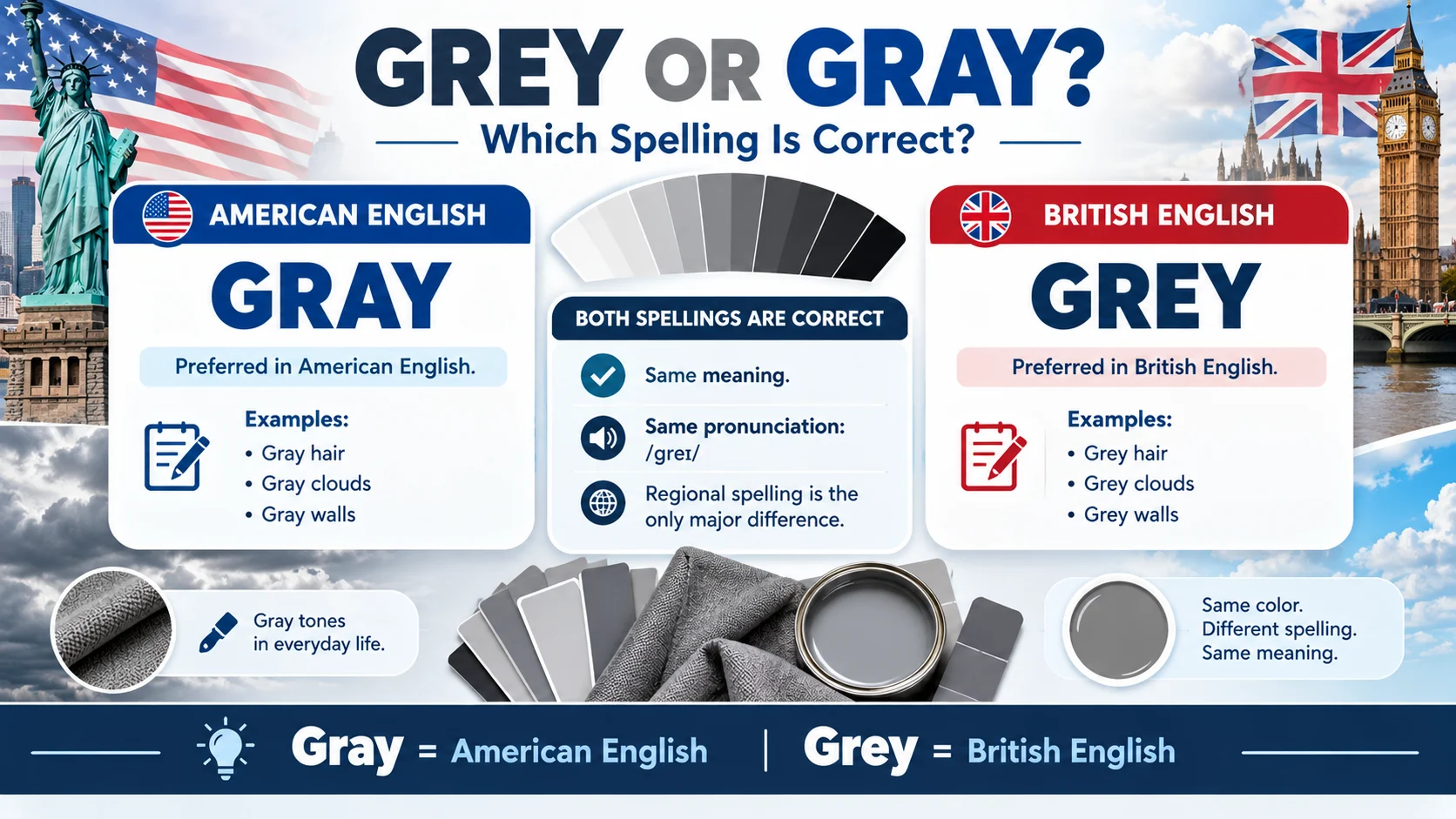
Both grey and gray are correct spellings of the same color. However, gray is the standard spelling in American English, while grey is more common in British English. Both words describe a color between black and white, and they have the same pronunciation and meaning. Therefore, your choice depends mainly on your preferred English spelling style and audience.
Have you ever wondered whether to write grey or gray when describing a cloudy sky, a beautiful outfit, or the color of someone’s hair? Both spellings are correct, but choosing the right one can sometimes be confusing, especially when writing for different English-speaking audiences.
The main difference between grey and gray is regional spelling. American English generally uses gray, whereas British English, Australian English, and many other varieties of English commonly use grey. Nevertheless, both words refer to exactly the same color and have the same pronunciation.
Although the difference seems small, using the appropriate spelling can make your writing more consistent and professional. For example, an American writer would normally describe a shirt as gray, while a British writer would typically call it grey.
In this guide, you’ll discover the meaning of both spellings, their origins, pronunciation, regional differences, and practical examples. Additionally, you’ll learn when to use each version, explore common mistakes, and understand how to remember the correct spelling.
What Does Grey or Gray Mean?
Grey or gray refers to a neutral color that falls between black and white. It is commonly associated with clouds, stones, metal, ash, smoke, and many everyday objects.
The word can function as both a noun and an adjective. As a noun, it identifies the color itself. As an adjective, it describes something that has a gray or grey appearance.
For example:
- The walls are painted gray.
- She wore a beautiful grey dress.
- Dark gray clouds covered the sky.
- His hair has turned grey.
Importantly, there is no difference in meaning between the two spellings. Both describe the same color, and neither is more correct than the other in every variety of English.
However, regional writing conventions determine which version is preferred.
Grey vs Gray: What Is the Difference?
The difference between grey and gray is primarily geographical. Both words have identical meanings, pronunciations, and grammatical functions.
| Feature | Gray | Grey |
|---|---|---|
| Meaning | Color between black and white | Color between black and white |
| American English | Preferred | Less common |
| British English | Less common | Preferred |
| Canadian English | Both are used | Both are used |
| Australian English | Less common | Preferred |
| Pronunciation | /ɡreɪ/ | /ɡreɪ/ |
| Part of speech | Noun and adjective | Noun and adjective |
| Correct spelling | Yes | Yes |
Therefore, the easiest way to remember the difference is to associate gray with America and grey with Britain.
Nevertheless, regional preferences are not absolute rules for every publication or individual. Some people and organizations use one spelling consistently regardless of location.
When to Use Gray
Use gray when writing in American English. It is the standard spelling in the United States and appears in American dictionaries, newspapers, educational materials, and professional publications.
For example, American writers generally use gray when describing clothing, furniture, weather, animals, and other objects.
Common examples of gray:
- Gray hair
- Gray clouds
- Gray sweater
- Gray paint
- Gray walls
- Gray suit
- Gray eyes
- Light gray background
- Dark gray furniture
- Gray matter
Gray in American English Sentences
Here are some natural examples showing how Americans use gray in everyday writing.
- The sky turned gray before the storm.
- My grandfather has beautiful gray hair.
- She bought a gray jacket for winter.
- The living room has light gray walls.
- A gray cat was sleeping near the window.
- He prefers gray shoes over black ones.
- The artist used different shades of gray in the painting.
- Dark gray curtains would look perfect in this room.
Additionally, gray is used in several common American expressions.
Gray area: A situation that is unclear or difficult to classify.
Example: The new policy has a gray area that needs clarification.
Gray matter: The brain tissue involved in processing information.
Example: Reading and learning keep your gray matter active.
Gray market: A market involving goods sold through distribution channels that are not officially authorized by the manufacturer.
Example: The company is investigating unauthorized gray-market sales.
When to Use Grey
Use grey when writing in British English. It is also the preferred spelling in many Australian and other British-influenced English publications.
The word appears in everyday descriptions, literature, newspapers, educational writing, and professional communication.
Common examples of grey:
- Grey hair
- Grey sky
- Grey clouds
- Grey dress
- Grey coat
- Grey walls
- Grey eyes
- Light grey paint
- Dark grey trousers
- Grey stone
Grey in British English Sentences
The following examples demonstrate how British English speakers commonly use grey.
- The sky looks grey this morning.
- My grandmother has lovely grey hair.
- He bought a new grey coat.
- The bedroom walls are painted light grey.
- A small grey bird landed on the fence.
- She prefers grey shoes for formal occasions.
- The old building has beautiful grey stone walls.
- Dark grey trousers are suitable for the meeting.
Similarly, British English uses expressions such as:
Grey area: Something that is uncertain or not clearly defined.
Example: The rules contain a grey area that confuses many employees.
Grey matter: Brain tissue involved in information processing.
Example: The documentary explains how grey matter supports brain functions.
Grey market: A market involving goods sold through unofficial distribution channels.
Example: The company is monitoring grey-market products.
Is Gray American or British English?
Gray is the standard American English spelling.
In the United States, dictionaries and educational institutions generally recognize gray as the preferred form.
For example, an American newspaper would typically write:
- The gray sky looked beautiful.
- He has short gray hair.
- The building has gray walls.
However, gray is not exclusive to American English. It is also accepted in other English-speaking regions, including Britain.
Nevertheless, if you are writing specifically for an American audience, gray is the safest choice.
Is Grey British or American English?
Grey is the standard British English spelling.
In the United Kingdom, grey is traditionally preferred in everyday writing and formal publications.
For instance:
- The grey clouds brought heavy rain.
- She wore a grey dress.
- His hair is turning grey.
However, grey is also understood and accepted in American English. It simply appears less frequently than gray in standard American writing.
Therefore, British writers generally choose grey, while American writers normally choose gray.
Is It Grey or Gray in Canada and Australia?
English spelling conventions can vary between countries. Consequently, it is useful to understand how these two spellings are used outside the United States and the United Kingdom.
Canadian English
Both grey and gray are used in Canada. Although grey is traditionally common in Canadian English, gray also appears in Canadian publications and everyday writing.
The best approach is to follow the spelling used by your publication, school, or organization.
Australian English
Australian English generally follows British spelling conventions. Therefore, grey is the more common spelling in Australia.
For example:
- The grey sky looked gloomy.
- She bought a grey handbag.
- His hair has started turning grey.
Other English-Speaking Countries
Many countries influenced by British English commonly use grey. However, American spelling also appears in international communication, digital content, and commercial writing.
Ultimately, consistency matters more than choosing one spelling for every country.
How to Pronounce Grey and Gray
Both grey and gray have exactly the same pronunciation.
The phonetic pronunciation is:
/ɡreɪ/
It sounds like the word day, but begins with the consonant sound /ɡ/.
You pronounce both words as:
GRAY
Here is a simple pronunciation breakdown:
- G: A hard G sound, as in go.
- R: The English R sound.
- AY: The long A sound, as in day.
For example:
- Gray hair = /ɡreɪ heər/
- Grey sky = /ɡreɪ skaɪ/
- Gray eyes = /ɡreɪ aɪz/
Therefore, changing the spelling does not change how you say the word.
What Is the Origin of Grey and Gray?
The words grey and gray have historical roots in Old English and developed through earlier Germanic forms.
Both spellings emerged over time as English spelling conventions evolved. Historically, spelling was less standardized than it is today. As a result, different written forms remained in use.
Eventually, American and British English developed different preferences.
American English standardized gray, while British English generally retained grey.
Interestingly, the difference is not based on separate meanings or different colors. Instead, it reflects the development of regional spelling traditions.
Today, both spellings remain fully accepted English words.
Different Shades of Grey and Gray
Although grey and gray are alternative spellings, the color itself comes in many different shades.
These shades are used in fashion, interior design, photography, painting, and digital graphics.
Here are some common examples:
| Shade | Description | Common Uses |
|---|---|---|
| Light gray | A pale, soft gray | Walls and backgrounds |
| Dark gray | A deep, darker gray | Clothing and furniture |
| Charcoal gray | A rich, nearly black gray | Suits and interior design |
| Silver gray | A metallic-looking gray | Jewelry and decoration |
| Slate gray | A cool gray with blue undertones | Paint and design |
| Ash gray | A muted, soft gray | Clothing and hair |
| Dove gray | A gentle, light gray | Interior decoration |
| Steel gray | A cool, metallic gray | Industrial and modern designs |
| Warm gray | Gray with subtle brown or beige undertones | Home interiors |
| Cool gray | Gray with blue or green undertones | Modern graphic design |
Importantly, these shades can be described using either spelling.
For example, American writers use charcoal gray, while British writers commonly use charcoal grey.
Grey or Gray Hair: Which Is Correct?
Both grey hair and gray hair are correct.
However, the spelling depends on your regional writing style.
- American English: Gray hair
- British English: Grey hair
Both expressions describe hair that has lost some of its natural pigmentation, resulting in a gray or grey appearance.
For example:
- My father has beautiful gray hair.
- Her grandmother has naturally grey hair.
- He started getting gray hair in his thirties.
Interestingly, people sometimes use the expression going gray or going grey to describe the process of developing gray hair.
Both forms are correct.
Grey or Gray Eyes: Which Spelling Should You Use?
Both spellings are correct when describing eye color.
Gray eyes and grey eyes refer to the same eye color. The spelling simply follows the regional English convention.
Examples:
- She has beautiful gray eyes.
- His grey eyes look bright in the sunlight.
- Gray eyes can appear different under various lighting conditions.
Therefore, American writers generally choose gray eyes, while British writers usually prefer grey eyes.
Is It Light Gray or Light Grey?
Both expressions are correct.
The difference depends on the spelling convention you follow.
| American English | British English |
|---|---|
| Light gray | Light grey |
| Dark gray | Dark grey |
| Medium gray | Medium grey |
| Warm gray | Warm grey |
| Cool gray | Cool grey |
| Charcoal gray | Charcoal grey |
For example, an American interior designer might recommend light gray walls, while a British designer might describe the same color as light grey.
The meaning remains unchanged.
Common Expressions Using Grey or Gray
Both spellings appear in several everyday expressions. However, the spelling should remain consistent with your chosen English variety.
Gray or Grey Area
This expression describes something unclear, uncertain, or difficult to classify.
Example: The company policy has a gray area that needs further explanation.
Gray or Grey Matter
This expression refers to the brain’s gray-colored tissue.
Example: Solving puzzles can challenge your gray matter.
Gray or Grey Market
This expression describes the sale of products through distribution channels that are not officially authorized by the manufacturer.
Example: The business is trying to control gray-market sales.
Gray or Grey Zone
A gray zone refers to an uncertain situation or an area that does not fit clearly into established rules.
Example: The legal situation falls into a gray zone.
Gray or Grey Skies
This expression describes cloudy, dull, or overcast weather.
Example: We woke up to gray skies and light rain.
Synonyms for Grey or Gray
Although grey and gray are color words, several other terms can describe similar shades.
However, these alternatives are not always exact replacements because they may refer to slightly different colors.
| Synonym | Meaning |
|---|---|
| Silver | A light, shiny metallic gray |
| Ashen | Pale gray, often associated with ash |
| Slate | A cool gray shade |
| Charcoal | A deep, dark gray |
| Smoky | A soft gray resembling smoke |
| Pewter | A muted metallic gray |
| Steel | A cool, metallic gray |
| Dusky | A dark or muted shade |
| Cloudy | A soft gray resembling clouds |
| Lead-colored | A heavy, dark gray shade |
For example, silver might describe shiny gray jewelry, while charcoal is more appropriate for a dark gray suit.
Antonyms of Grey or Gray
There is no single exact opposite of gray because it is a neutral color rather than a word with a direct opposite.
Nevertheless, certain colors can create strong visual contrast with gray.
Common contrasting colors include:
- White
- Black
- Yellow
- Orange
- Blue
- Red
For example, a bright yellow shirt creates a noticeable contrast against gray trousers.
Advantages and Disadvantages of Using Grey or Gray
Choosing between these spellings is simple once you understand the regional differences. However, using the wrong version for a particular audience can sometimes make your writing inconsistent.
Advantages
- Both spellings are grammatically correct.
- They have identical meanings.
- They are pronounced exactly the same.
- You can use either spelling depending on your audience.
- Both versions are widely understood.
- They work as nouns and adjectives.
Disadvantages
- The regional difference can confuse English learners.
- Mixing spellings can make an article look inconsistent.
- Some style guides prefer only one version.
- Writers targeting American audiences may need to replace grey with gray.
- British publications may prefer grey over gray.
Therefore, choosing one spelling style and following it throughout your writing is the best approach.
Common Mistakes When Using Grey or Gray
Even though the difference is simple, writers sometimes make avoidable mistakes.
Assuming One Spelling Is Incorrect
A common mistake is believing that grey is wrong or that gray is incorrect.
However, both are standard English spellings.
Incorrect assumption: Grey is always a misspelling.
Correct understanding: Grey is preferred in British English, while gray is preferred in American English.
Mixing Both Spellings in One Article
Using gray in one paragraph and grey in another can create unnecessary inconsistency.
For example:
Inconsistent: The gray sky looked beautiful, and she wore a grey coat.
Consistent American English: The gray sky looked beautiful, and she wore a gray coat.
Consistent British English: The grey sky looked beautiful, and she wore a grey coat.
Thinking They Have Different Meanings
Some learners assume that grey and gray describe different shades.
However, both words have the same meaning.
Pronouncing Them Differently
Another mistake is assuming that the spelling changes the pronunciation.
In reality, both words sound exactly alike.
Forgetting Regional Writing Conventions
Writers sometimes ignore their target audience.
For example, if you are preparing an article for American readers, gray is generally the better choice.
Grey or Gray: Which One Should You Use?
The best spelling depends on your audience and the English style you follow.
Here is a simple guide:
| Your Audience | Recommended Spelling |
|---|---|
| United States | Gray |
| United Kingdom | Grey |
| Australia | Grey |
| Canada | Grey or gray |
| American academic writing | Gray |
| British academic writing | Grey |
| International English content | Follow your chosen style guide |
For American websites, blogs, and educational articles, gray is usually the safest option.
Meanwhile, British publications generally prefer grey.
Most importantly, maintain consistency throughout your content.
How to Remember the Difference Between Grey and Gray
If you frequently forget which spelling to use, a simple memory trick can help.
Gray = America
Both words have the letter A in their spelling: gray and America.
Grey = British English
Both words have the letter E in their spelling: grey and England.
This is an easy way to remember the regional preference.
However, remember that this is only a memory trick, not a strict spelling rule for every English-speaking country.
Another useful tip is to remember that American English generally prefers simpler or different spelling conventions in several words, such as color instead of colour and center instead of centre.
Practice Exercises: Grey or Gray?
Test your understanding with these simple questions.
Choose the correct spelling for each sentence based on the specified English variety.
Fill in the blanks:
- The sky looks _____ today. (American English)
- My grandfather has _____ hair. (British English)
- She bought a _____ sweater. (American English)
- The old building has _____ stone walls. (British English)
- He prefers _____ shoes. (American English)
- The cat has beautiful _____ fur. (British English)
- We painted the bedroom light _____. (American English)
- The weather was cold and _____. (British English)
Choose the correct answer:
Which spelling is standard in American English?
A. Grey
B. Gray
C. Both are incorrect
Which spelling is preferred in British English?
A. Grey
B. Gray
C. Neither
Do grey and gray have different meanings?
A. Yes
B. No
Do both spellings have the same pronunciation?
A. Yes
B. No
Exercise Answers
- Gray
- Grey
- Gray
- Grey
- Gray
- Grey
- Gray
- Grey
- B. Gray
- A. Grey
- B. No
- A. Yes
Related Comparisons: Other Commonly Confused Words
English contains many words with different regional spellings or similar meanings. Learning these differences can improve your writing and vocabulary.
Here are some useful comparisons:
- Color or Colour: American English uses color, while British English prefers colour.
- Favorite or Favourite: Favorite is American, while favourite is British.
- Honor or Honour: American English uses honor, while British English uses honour.
- Center or Centre: Center is the American spelling, while centre is British.
- Theater or Theatre: Theater is preferred in American English, while theatre is common in British English.
- Canceled or Cancelled: Canceled is generally preferred in American English, while cancelled is common in British English.
- Organize or Organise: American English generally uses organize, while British English commonly accepts both forms, with organise traditionally preferred in some style guides.
- Analyze or Analyse: Analyze is standard in American English, while analyse is preferred in British English.
Understanding these spelling variations helps you write more confidently for different English-speaking audiences.
Frequently Asked Questions
Is grey or gray correct?
Both grey and gray are correct English spellings. Gray is preferred in American English, whereas grey is more common in British English.
Is gray American or British?
Gray is the standard American English spelling. However, it is also recognized and used in other English-speaking countries.
Is grey British or American?
Grey is the preferred British English spelling. Nevertheless, Americans also recognize and occasionally use it.
Why are there two spellings of gray?
The two spellings developed through historical changes in English spelling. Over time, American and British English adopted different regional preferences.
Do grey and gray mean the same thing?
Yes. Both words describe the same color between black and white. There is no difference in their definitions.
Are grey and gray pronounced the same?
Yes. Both spellings are pronounced /ɡreɪ/, just like the word day with a different beginning sound.
Is it gray hair or grey hair?
Both are correct. American English generally uses gray hair, while British English typically uses grey hair.
Is it gray eyes or grey eyes?
Both expressions are correct. Gray eyes is preferred in American English, while grey eyes is common in British English.
Is it dark grey or dark gray?
Both are correct. Use dark gray for American English and dark grey for British English.
Is grey a color or a shade?
Grey is a color that can appear in many different shades, including light grey, dark grey, charcoal grey, and silver grey.
Which spelling should I use for SEO content?
Choose the spelling that matches your target audience. For American readers, gray is generally preferable. For British readers, grey is usually the better option. Additionally, use your chosen spelling consistently in headings, body text, image descriptions, and metadata.
Is grey an incorrect American spelling?
No. Grey is recognized in American English, but gray is the more common and preferred American spelling.
Can I use grey and gray in the same sentence?
You can, but it is usually better to maintain one spelling style throughout your writing. Consistency makes your content easier to read and more professional.
Which spelling is more popular worldwide?
Both spellings are widely recognized. However, their popularity varies by region, publication, and English writing conventions. British-influenced regions generally favor grey, while the United States strongly favors gray.
Key Takeaways: Grey or Gray
Here are the most important points to remember:
- Both grey and gray are correct English spellings.
- Gray is the preferred spelling in American English.
- Grey is the preferred spelling in British English.
- Both words describe the same color.
- Their pronunciation is identical.
- Neither spelling is universally more correct than the other.
- Australian English generally prefers grey.
- Canadian English uses both forms.
- Choose the spelling that matches your target audience.
- Maintain consistency throughout your writing.
Conclusion
So, should you write grey or gray? The answer depends on the English variety you are using. Both spellings are correct, and neither changes the meaning or pronunciation of the word.
If you are writing for an American audience, choose gray. On the other hand, if your readers are primarily from the United Kingdom or Australia, grey is generally the better choice.
Ultimately, the most important thing is consistency. Once you choose a spelling style, use it throughout your writing to maintain clarity and professionalism.
Remember this simple rule: Gray is American, and grey is British. With this distinction in mind, you’ll never have to wonder which spelling to use again.