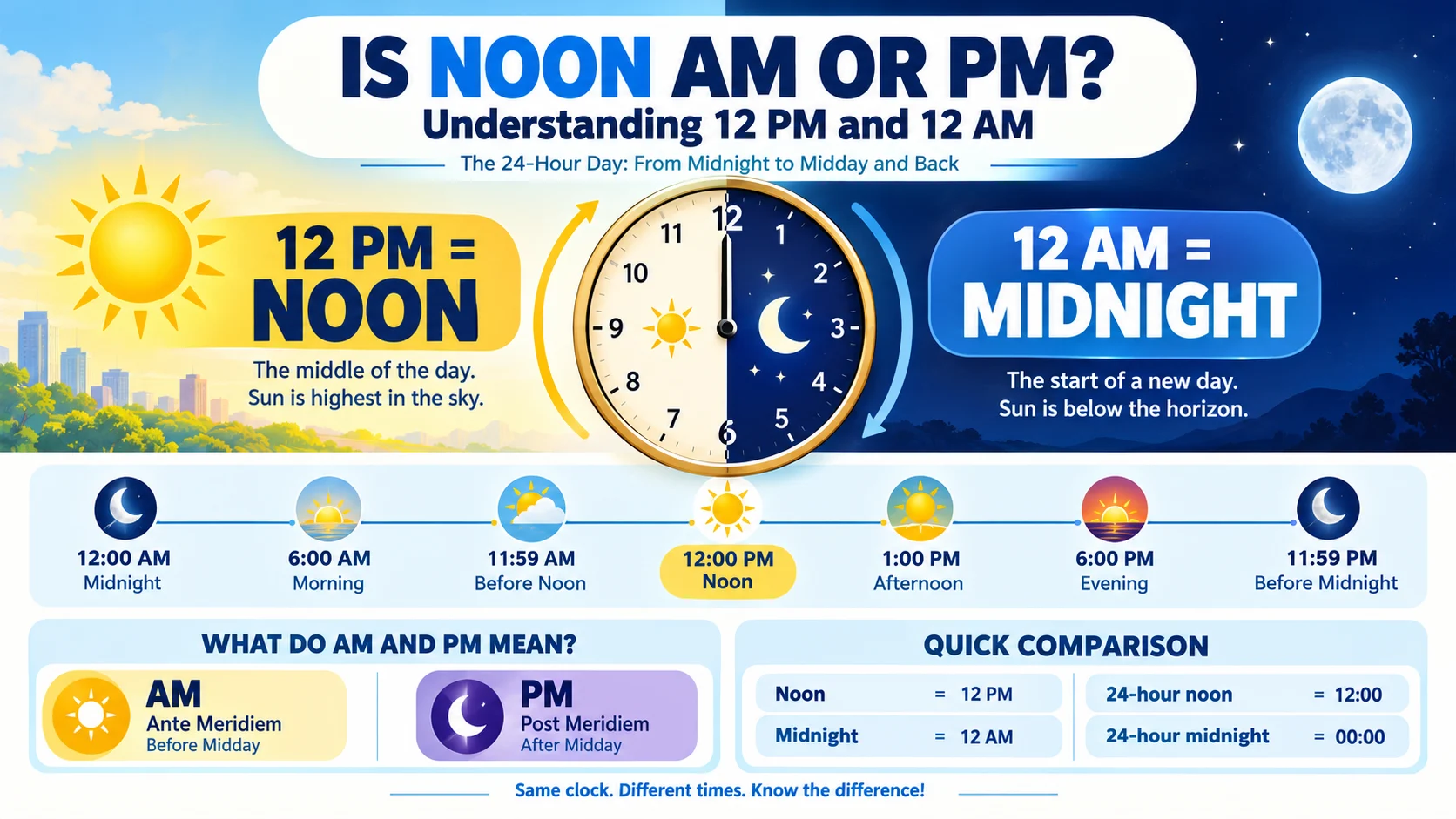
Noon is 12 PM, not 12 AM. It represents the middle of the day, exactly 12 hours after midnight. In the 12-hour clock system, 12 PM means noon, while 12 AM means midnight. Therefore, if you schedule a meeting for 12 noon, the correct time is 12:00 PM.
Is noon AM or PM? This is a common question because the 12-hour clock system can make midday and midnight confusing. Although both times use the number 12, they represent two completely different moments of the day. Knowing the difference helps you avoid mistakes when scheduling appointments, setting alarms, booking flights, or writing important deadlines.
In simple terms, noon is 12 PM, while midnight is 12 AM. Noon marks the middle of the day, when the morning ends and the afternoon begins. Meanwhile, midnight marks the beginning of a new calendar day. However, many people still mix up these abbreviations because AM and PM do not work like ordinary numbers.
Fortunately, understanding this time distinction is easier than it seems. Once you learn what AM and PM stand for and how the 12-hour clock works, you can identify the correct time without confusion. In this guide, you’ll discover whether noon is AM or PM, explore real-life examples, learn common mistakes, and understand how noon works in both 12-hour and 24-hour time formats.
Is Noon AM or PM?
| Meaning | Correct Time | Description | Example |
|---|---|---|---|
| Noon | 12 PM | Middle of the day | Lunch at 12 PM |
| Midnight | 12 AM | Beginning of a new day | New Year’s Day at 12 AM |
| Morning | AM | Midnight through the time before noon | Breakfast at 8 AM |
| Afternoon | PM | Noon through the time before midnight | Meeting at 3 PM |
What Does Noon Mean?
Noon means 12 o’clock in the daytime. It is the point when the Sun is generally highest in the sky at a particular location, although the exact solar noon can vary depending on geography, time zones, and daylight saving time.
In everyday timekeeping, noon represents the transition between morning and afternoon. It is written as 12:00 PM in the 12-hour clock system.
For example, when someone says, “I’ll meet you at noon,” they mean 12:00 PM, not midnight.
People commonly use the word noon when discussing:
- Lunch breaks
- Business meetings
- School schedules
- Appointments
- Work deadlines
- Travel arrangements
- Daily routines
- Events and celebrations
Moreover, noon is a convenient way to communicate midday without needing to specify AM or PM.
Why Is Noon 12 PM Instead of 12 AM?
The distinction comes from the Latin expressions behind AM and PM.
AM stands for ante meridiem, which means “before midday.”
PM stands for post meridiem, which means “after midday.”
Since noon marks midday, it is commonly represented as 12 PM in the conventional 12-hour clock system.
However, there is a small technical complication. Exactly 12:00 is the dividing point between the two periods, so neither “before midday” nor “after midday” describes that exact instant perfectly. Nevertheless, standard everyday and scheduling conventions identify noon as 12 PM and midnight as 12 AM.
Here is an easy way to remember:
- 12 AM = Midnight
- 12 PM = Noon
- 1 AM = One hour after midnight
- 1 PM = One hour after noon
Therefore, when you see 12 PM on a clock or schedule, you should understand it as midday.
What Does AM Mean?
AM is an abbreviation of the Latin phrase ante meridiem, meaning “before midday.”
It describes the period beginning at midnight and continuing until the moment before noon.
In everyday life, AM is associated with nighttime, early morning, and the morning hours.
Examples include:
- 12:30 AM – Half an hour after midnight
- 3:00 AM – Early morning
- 6:00 AM – Early morning
- 8:00 AM – Morning
- 10:00 AM – Late morning
- 11:59 AM – One minute before noon
For example, if your alarm rings at 7:00 AM, it means you need to wake up in the morning.
What Does PM Mean?
PM comes from the Latin phrase post meridiem, which means “after midday.”
It covers the period from noon through the hours leading up to midnight.
Therefore, PM is used for afternoon, evening, and late-night times.
Examples include:
- 12:00 PM – Noon
- 1:00 PM – Early afternoon
- 3:00 PM – Afternoon
- 6:00 PM – Evening
- 9:00 PM – Night
- 11:59 PM – One minute before midnight
For instance, if your appointment is scheduled for 2:00 PM, you should arrive in the afternoon.
Noon vs. Midnight: What’s the Difference?
- Noon and midnight both occur at 12 o’clock, but they represent opposite points in the daily time cycle.
- Noon is the middle of the daytime period, whereas midnight marks the transition into a new calendar day.
| Feature | Noon | Midnight |
|---|---|---|
| Correct Time | 12 PM | 12 AM |
| Meaning | Middle of the day | Beginning of a new day |
| Period | Daytime | Nighttime |
| Calendar Position | Middle of the day | Start of a calendar date |
| Common Activities | Lunch and meetings | Sleeping and late-night activities |
| Example | Lunch at 12 PM | New Year’s Day begins at 12 AM |
For example, if today is Monday, Monday at 12:00 PM is Monday at noon. However, Monday at 12:00 AM is the very beginning of Monday.
This difference is particularly important when scheduling appointments and deadlines.
AM vs. PM: Understanding the 12-Hour Clock
The 12-hour clock divides a complete 24-hour day into two periods.
The first period uses AM, while the second uses PM. Each period contains 12 hours.
Here is how the system works:
| Clock Time | Meaning |
|---|---|
| 12:00 AM | Midnight |
| 1:00 AM | Early morning |
| 6:00 AM | Morning |
| 9:00 AM | Morning |
| 11:00 AM | Late morning |
| 12:00 PM | Noon |
| 1:00 PM | Afternoon |
| 4:00 PM | Afternoon |
| 7:00 PM | Evening |
| 10:00 PM | Night |
| 11:59 PM | One minute before midnight |
As you can see, the clock starts a new 12-hour cycle at both midnight and noon.
However, the AM and PM labels tell you which half of the day you are referring to.
Noon in the 24-Hour Clock System
The 24-hour clock is another way to represent time. Unlike the 12-hour system, it does not use AM or PM.
Instead, it counts the hours from 00:00 to 23:59.
In this format, noon is written as 12:00, while midnight is written as 00:00 at the start of a new day.
| 12-Hour Format | 24-Hour Format |
|---|---|
| 12:00 AM | 00:00 |
| 1:00 AM | 01:00 |
| 6:00 AM | 06:00 |
| 9:00 AM | 09:00 |
| 11:00 AM | 11:00 |
| 12:00 PM | 12:00 |
| 1:00 PM | 13:00 |
| 3:00 PM | 15:00 |
| 6:00 PM | 18:00 |
| 9:00 PM | 21:00 |
| 11:00 PM | 23:00 |
The 24-hour system is widely used in aviation, healthcare, transportation, military operations, and international scheduling.
Consequently, learning both formats can make reading schedules much easier.
Is 12 Noon AM or PM?
12 noon is PM.
It is the exact point when the morning period ends and the afternoon period begins.
For example:
- A school lunch break at 12 noon means 12:00 PM.
- A business meeting at 12 noon means 12:00 PM.
- A restaurant reservation at 12 noon means 12:00 PM.
- A delivery scheduled for 12 noon means 12:00 PM.
Remember that noon is never conventionally written as 12 AM.
Is 12 Midnight AM or PM?
12 midnight is AM.
It marks the beginning of a new calendar day in the conventional 12-hour clock system.
For example, if a new day begins on Tuesday, Tuesday at 12:00 AM is the first moment of Tuesday.
Here are some everyday examples:
- A birthday begins at 12:00 AM.
- A new calendar day starts at 12:00 AM.
- A deadline of Tuesday at 12:00 AM means the beginning of Tuesday.
- New Year’s Day begins at 12:00 AM on January 1.
However, midnight deadlines can cause confusion. Therefore, using “midnight at the start of Tuesday” or specifying the exact date and time is often clearer.
Real-Life Examples of Using Noon Correctly
Understanding the definition is useful, but practical examples make the difference even easier to remember.
Lunch Appointment
Correct: “Let’s have lunch at 12 PM.”
Incorrect: “Let’s have lunch at 12 AM.”
Why? Lunch usually takes place during the daytime, so 12 PM is the correct choice.
Business Meeting
Correct: “The meeting starts at noon.”
Digital format: 12:00 PM.
Why? Noon represents midday, which is commonly used for daytime meetings.
School Schedule
Correct: “The students have lunch at 12:00 PM.”
Why? The lunch break takes place around the middle of the day.
Flight Schedule
Suppose your flight departs at 12:00 PM.
This means your flight leaves at noon, not midnight.
Therefore, checking AM and PM carefully is essential when making travel arrangements.
Online Meeting
Correct: “The video conference begins at 12:30 PM.”
Why? The meeting starts 30 minutes after noon.
Work Deadline
Correct: “Please submit your report by 12:00 PM.”
This means the deadline is noon. However, because deadline interpretations can vary, it is better to write “by noon” or provide an explicit date and time.
Common Mistakes People Make With Noon and Midnight
Even though the distinction is simple, people frequently make mistakes when writing or reading 12-hour times.
Writing 12 AM for Noon
This is one of the most common errors.
Incorrect: “The appointment is at 12 AM.”
Correct: “The appointment is at 12 PM.”
Remember, 12 AM represents midnight.
Writing 12 PM for Midnight
Some people assume that PM always means nighttime. However, PM begins at noon.
Incorrect: “The new day starts at 12 PM.”
Correct: “The new day starts at 12 AM.”
Confusing Noon With 12 O’Clock at Night
Noon refers to the middle of the day, whereas midnight refers to the middle of the night.
Therefore, always consider the context before interpreting a 12 o’clock schedule.
Forgetting AM or PM
Writing only “12:00” can create confusion when using a 12-hour clock.
Instead, write “12:00 PM” for noon or “12:00 AM” for midnight.
Misunderstanding Midnight Deadlines
A deadline of 12:00 AM can be particularly confusing because it marks the beginning of a date, not the end of that date.
For clarity, use a specific date and time, such as “11:59 PM on Monday” when Monday is the final day for submission.
How to Remember Whether Noon Is AM or PM
If you frequently confuse AM and PM, these simple memory tricks can help.
Remember AM as Before Midday: AM covers the hours before noon, starting at midnight.
Remember PM as After Midday: PM covers the hours beginning at noon and continuing until midnight.
Use the Lunch Rule: If the time refers to lunch or a midday activity, it is usually 12 PM.
Use the New Day Rule: If the time marks the beginning of a new calendar day, it is 12 AM.
Remember This Simple Pair:
12 AM = Midnight
12 PM = Noon
Once you memorize this pair, the rest of the 12-hour clock becomes much easier to understand.
Advantages and Disadvantages of the 12-Hour Clock
The 12-hour clock is familiar and convenient for everyday communication. Nevertheless, it can create confusion when people forget to include AM or PM.
Advantages
- Easy to understand: Most people use the 12-hour clock in daily conversations.
- Familiar format: It is common in homes, schools, workplaces, and everyday schedules.
- Simple communication: Saying “three in the afternoon” feels natural in conversation.
- Widely recognized: AM and PM are familiar abbreviations in many English-speaking countries.
Disadvantages
- Noon confusion: People sometimes mistake 12 PM for midnight.
- Midnight confusion: A 12 AM deadline can be misunderstood.
- Extra labels: AM and PM are necessary to identify the correct half of the day.
- Scheduling mistakes: Incorrect labels can lead to missed appointments or travel arrangements.
Therefore, the 24-hour clock can be a better option when precise scheduling is important.
Noon vs. Midday vs. Afternoon
These three expressions are related, but they are not completely interchangeable.
| Word | Meaning | Example |
|---|---|---|
| Noon | 12 o’clock in the daytime | Lunch begins at noon. |
| Midday | The middle part of the day, usually around noon | The temperature rises around midday. |
| Afternoon | The period following noon and before evening | I have a meeting in the afternoon. |
Although people sometimes use noon and midday interchangeably, afternoon usually refers to a broader period.
For example, 2 PM is in the afternoon, but it is not noon.
Is Noon the Same Time Every Day?
In standard civil timekeeping, noon is always 12:00 PM on the local clock.
However, actual solar noon does not necessarily occur at exactly 12:00 PM.
Solar noon is the moment when the Sun reaches its highest position in the sky for a particular location on a given day.
Its clock time can change because of:
- Your geographical location
- Your time zone
- Daylight saving time
- The Earth’s orbit around the Sun
- The Earth’s axial tilt
For example, the Sun may reach its highest position at 12:15 PM in one location and 12:40 PM in another.
Nevertheless, everyday noon remains 12:00 PM according to the local clock.
Where Is AM and PM Commonly Used?
AM and PM appear in many everyday situations.
- At Home: People use them when setting alarms, preparing meals, and planning daily routines.
- At School: Students and teachers use them to understand class schedules, lunch breaks, and school activities.
- At Work: Employees use AM and PM when arranging meetings, shifts, and appointments.
- During Travel: Airlines, hotels, and transportation services may display times using the 12-hour clock.
- Online: Websites, social media platforms, and digital calendars use AM and PM to show event times.
- In Healthcare: Appointment schedules may use the 12-hour format, although medical professionals may also use the 24-hour clock to reduce ambiguity.
As a result, understanding noon and midnight is useful in almost every part of daily life.
Practice Exercises: Is Noon AM or PM?
Test your understanding with these simple questions.
Exercise: Choose the Correct Answer
Question: Is 12 noon AM or PM?
- A. AM
- B. PM
Correct Answer: B. PM
Question: What does 12 AM represent?
- A. Noon
- B. Midnight
Correct Answer: B. Midnight
Question: What time is one hour after noon?
- A. 1 AM
- B. 1 PM
Correct Answer: B. 1 PM
Question: What time is one hour before noon?
- A. 11 AM
- B. 11 PM
Correct Answer: A. 11 AM
Question: Which time represents the beginning of a new calendar day?
- A. 12 AM
- B. 12 PM
Correct Answer: A. 12 AM
Question: A meeting is scheduled for midday. What time should you arrive?
- A. 12:00 AM
- B. 12:00 PM
Correct Answer: B. 12:00 PM
Question: What is 12 PM in the 24-hour clock?
- A. 00:00
- B. 12:00
Correct Answer: B. 12:00
Frequently Asked Questions
Is noon 12 AM or 12 PM?
Noon is 12 PM. It represents the middle of the day, while 12 AM represents midnight.
Is 12 PM considered morning or afternoon?
12 PM is considered noon, marking the transition from morning to afternoon. In everyday usage, it is associated with the start of the afternoon period.
Does 12 AM mean midnight?
Yes. 12 AM represents midnight, which marks the beginning of a new calendar day.
Is 12 noon the same as 12 PM?
Yes. Both expressions refer to exactly the same time: midday.
Is 12 PM daytime or nighttime?
12 PM is daytime. It represents noon, not midnight.
What is 12 PM in military time?
12 PM is written as 1200 hours or 12:00 in the 24-hour clock system.
What is 12 AM in military time?
12 AM is written as 0000 hours or 00:00 in the 24-hour clock system.
Is 11:59 AM before or after noon?
11:59 AM is one minute before noon. Therefore, it is still part of the morning.
Is 12:01 PM afternoon?
Yes. 12:01 PM is one minute after noon, so it falls within the afternoon period.
Is 11:59 PM considered midnight?
No. It is one minute before midnight. Midnight occurs at 12:00 AM.
Should I write noon or 12 PM?
Both are correct. However, writing “noon” can be clearer in ordinary communication because it avoids confusion between AM and PM.
Why do people confuse 12 AM and 12 PM?
People often confuse them because both periods begin with the number 12. Additionally, the Latin meanings of AM and PM can make the exact dividing point seem confusing. Memorizing that 12 AM is midnight and 12 PM is noon solves the problem.
Is noon always at 12:00 PM?
Yes, according to standard local civil timekeeping, noon is 12:00 PM. However, solar noon may occur at a different clock time depending on location and date.
What does 12 PM to 12 AM mean?
It means a period beginning at noon and ending at midnight. This covers 12 hours.
What does 12 AM to 12 PM mean?
It means a period beginning at midnight and ending at noon. This also covers 12 hours.
Conclusion
So, is noon AM or PM? The correct answer is 12 PM. Noon represents the middle of the day, while 12 AM represents midnight and the beginning of a new calendar day.
Although the 12-hour clock can sometimes create confusion, remembering this simple distinction makes everyday scheduling much easier. AM means before midday, and PM means after midday. Therefore, when someone asks you to meet at noon, you should arrive at 12:00 PM.
Whether you are arranging a lunch date, scheduling a business meeting, setting an alarm, or checking a travel itinerary, using the correct time format can help you avoid unnecessary mistakes.
Key Takeaway: 12 PM = Noon (Midday). 12 AM = Midnight.