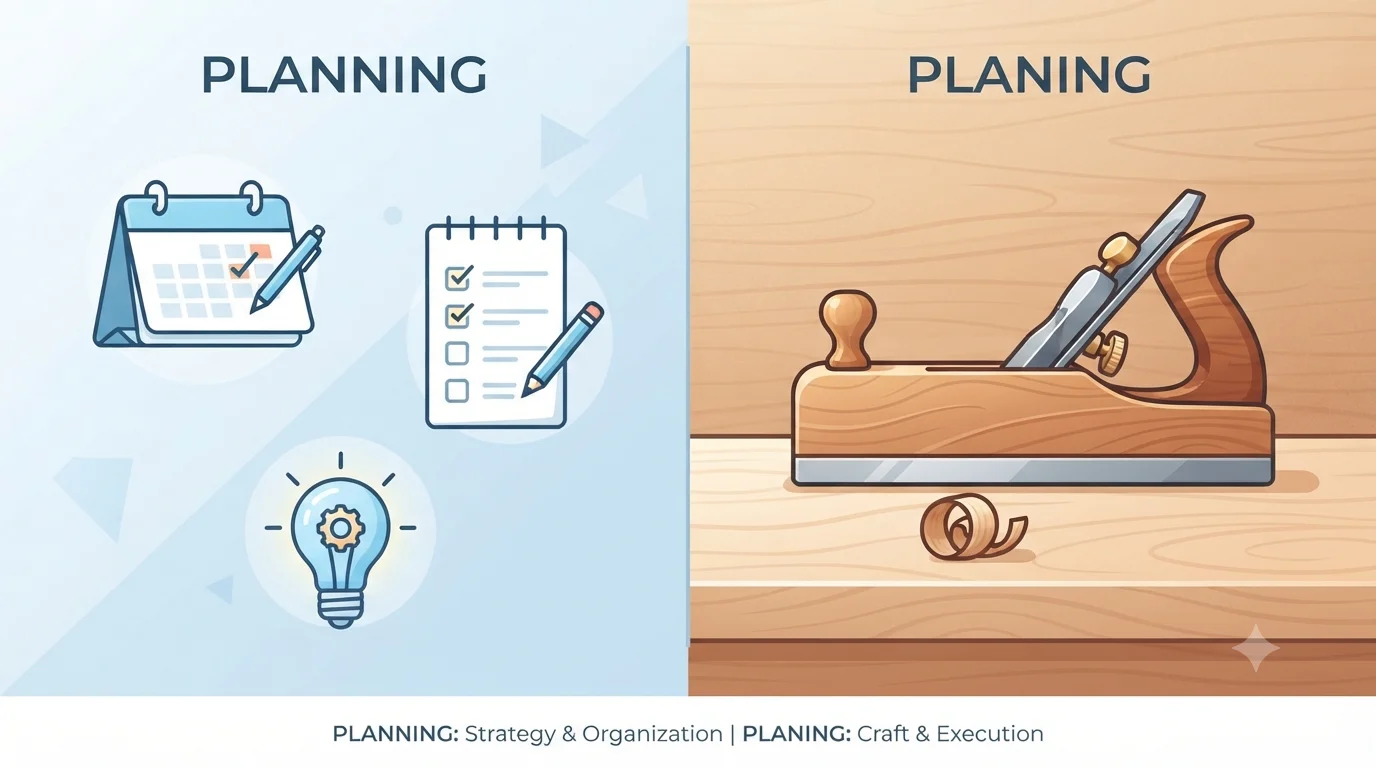
Planning with two “n”s refers to the process of making preparations or designing a strategy. Conversely, planing with one “n” describes the act of smoothing or leveling a surface, typically wood, using a tool called a plane.
Do you ever struggle with the spelling of planning or planing? Many writers find these two words confusing because they look almost identical. One extra letter changes the meaning of the word entirely. Using the wrong spelling in a professional report or a casual message can distract your reader. You deserve to feel confident every time you put words on a page. This guide will help you understand when to use each term correctly. We will break down the rules so that you never have to guess again. By learning the simple logic behind these spellings, you will improve your writing skills instantly. Let us explore the differences between these two common English words together. You might be surprised at how easy it is to remember the correct choice once you know the context.
The core distinction lies in the root word and the suffix rule. Planning comes from the word “plan,” where you double the final consonant because it follows a single vowel. Planing comes from the tool “plane,” where you drop the silent “e” before adding the suffix. Remembering the specific activity—organizing a schedule versus smoothing a piece of lumber—is the best way to keep them separate.
Definition and Explanation
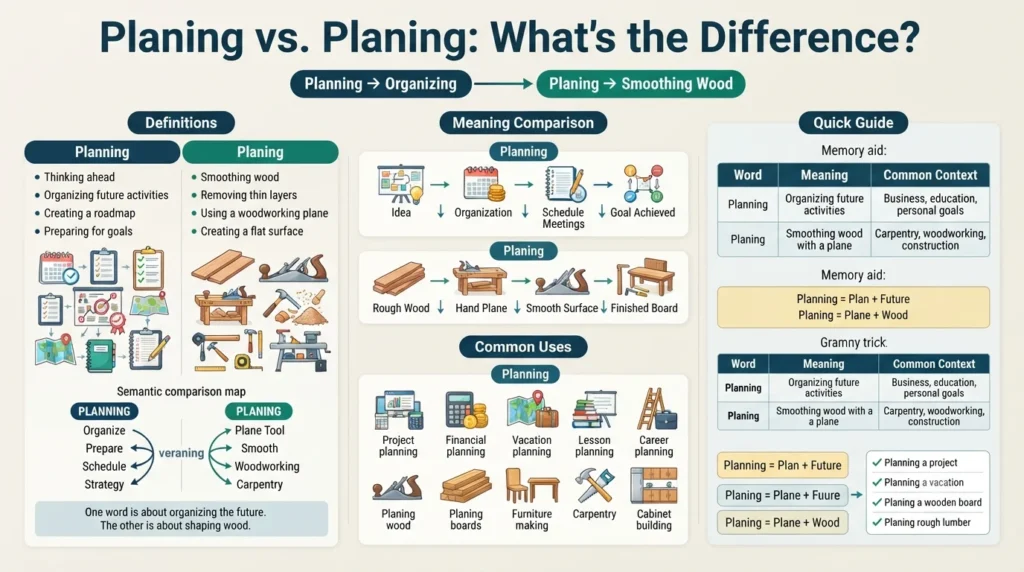
Understanding the definitions ensures you select the correct word every time. Context remains the most reliable indicator for choosing between these two terms.
The Meaning of Planning
Planning serves as a noun or a verb participle related to the act of thinking about, designing, and organizing future activities. It involves creating a roadmap to reach a specific goal. Whether you are working on a project, a vacation, or a career move, you are engaged in the act of planning.
The Meaning of Planing
Planing serves as the verb participle for the word “plane.” A plane is a specialized tool used by carpenters and woodworkers to shave thin layers off a surface. This process makes the wood flat, smooth, and even. Therefore, if you are working with lumber or surfaces, you are planing.
Advantages and Disadvantages of Accurate Spelling
Maintaining high standards in your spelling influences how others perceive your professional output. While it seems like a minor detail, precision creates significant benefits.
| Feature | Using Correct Spelling | Using Incorrect Spelling |
| Professionalism | Enhances credibility and trust | Suggests a lack of attention |
| Clarity | Ensures the reader understands | Creates confusion in technical tasks |
| Efficiency | Reduces time spent on corrections | Requires extra time for editing |
| Communication | Delivers the intended message | Changes the meaning entirely |
Real-World Examples
Seeing these words in action clarifies their specific roles in daily life and professional industries.
Examples of Planning
- Business: The management team spent all week planning the new marketing strategy.
- Logistics: Successful planning ensures that all products reach customers on time.
- Personal: I enjoy planning my weekend errands on Friday night.
Examples of Planing
- Construction: The carpenter is planing the door to ensure it closes properly without sticking.
- DIY Projects: After gluing the table top, he began planing the surface to make it perfectly level.
- Technical: This machine is responsible for planing large oak beams for furniture production.
Regional and Global Usage
English spelling standards remain consistent across major regions. Whether you reside in the United States, the United Kingdom, or Australia, the distinction between planning and planing stays the same. The double “n” rule for planning and the dropped “e” rule for planing apply globally. This uniformity benefits international business communication. Writers can rely on these standard rules regardless of the target audience’s location.
Common Mistakes
The most common mistake involves confusing the spelling rules for suffixes. Many people accidentally write “planing” when they mean “planning,” or vice versa.
The “Double N” Error
People often forget that “plan” ends with a single consonant after a short vowel. This necessitates doubling the “n.”
The “Silent E” Oversight
Writers sometimes keep the “e” when adding the suffix to “plane.” Writing “planeing” is a frequent error. Always drop the “e” when the word ends in a silent “e” and the suffix starts with a vowel.
Quick Fixes
- Check the root: If the word comes from “plan,” use two “n”s.
- Check the root: If the word comes from “plane,” drop the “e.”
Exercises with Answers
Practice these exercises to master the spelling differences.
Exercise 1: Choose the correct word
- We are _______ (planning / planing) the office move for next month.
- The artisan is _______ (planning / planing) the edge of the cedar plank.
- Proper _______ (planning / planing) prevents poor performance.
Answers:
- planning
- planing
- planning
Exercise 2: Identify the error
- “The team is planeing the schedule.”
- “He is planning the wood smooth.”
Answers:
- Incorrect. Use “planning” because it refers to a schedule.
- Incorrect. Use “planing” because it refers to smoothing wood.
Related Concepts and Synonyms
Exploring synonyms helps you replace these words when you want to avoid repetition or when you need more descriptive language.
Synonyms for Planning
- Strategizing: Ideal for business environments.
- Preparing: A great general-purpose term.
- Organizing: Focuses on order and structure.
- Scheduling: Focuses on time management.
Synonyms for Planing
- Smoothing: Focuses on the texture of the surface.
- Leveling: Focuses on creating an even plane.
- Shaving: Focuses on removing thin layers.
FAQs
What is the main difference between planning and planing?
Planning refers to organizing a project or future action. Planing refers to the physical act of smoothing a surface with a tool.
How do I remember to double the n in planning?
Think of the word “plan.” Since it ends in a single consonant preceded by a single vowel, you must double the “n” before adding “ing.”
Is planing spelled with an e?
No, the root word is “plane.” You drop the “e” when adding the suffix “ing.”
Can I use planning for woodworking?
No, that would be incorrect. Use planing for woodworking tasks involving smoothing or leveling.
Does planning ever have one n?
No, the standard spelling for the process of organizing is always planning.
Is planing used in business?
Rarely. Unless you are specifically discussing the physical process of smoothing surfaces, you should use terms like planning or strategizing.
Are there other words like this?
Yes, many English words follow these suffix rules, such as “running” or “hoping.”
Do autocorrect tools catch these errors?
Most spellcheckers will catch these errors, but you should always verify the context to ensure the software chose the right version for your specific sentence.
How can I improve my overall spelling?
Consistent reading and writing are the best ways to improve. Pay attention to how words are formed in professional publications.
Can planning be a noun?
Yes, “The planning of the event was extensive” uses the word as a noun.
Conclusion
Distinguishing between planning and planing requires only a brief moment of focus on your intent. When you aim to organize, prepare, or structure your future, remember to double the “n” and use planning. When your focus involves the tactile work of a carpenter smoothing a surface, remember to drop the “e” and use planing. Mastering these small spelling nuances significantly boosts the clarity and professionalism of your writing.
We recommend proofreading your work by checking the context of these specific words, as they often slip past basic spellcheckers if they are spelled correctly as words themselves, even if the usage is wrong. By integrating these rules into your daily writing habits, you will save time and communicate with greater authority. Start applying these strategies today to see how quickly your confidence in English spelling grows. Precision in language is a powerful tool in any professional setting, and you are now equipped to handle these terms with ease.

Jack Murphy is a language writer with a passion for word meanings, synonyms, and effective communication. He creates informative and easy to understand content to help readers enhance their vocabulary and language skills.


4 thoughts on “Planning or Planing| Correct Spelling and Usage Guide”