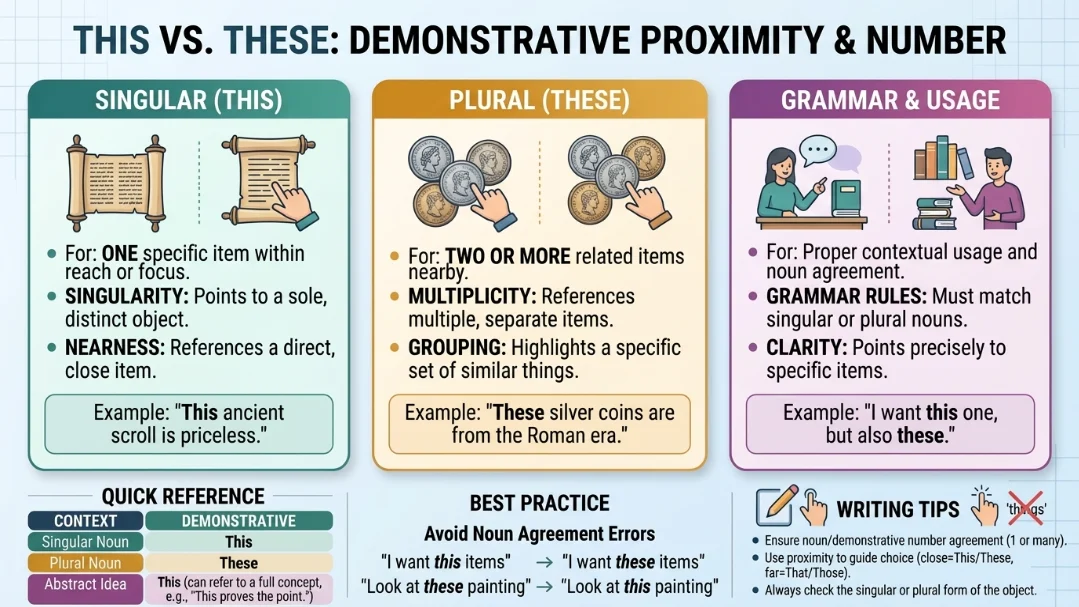
“This” is a singular demonstrative pronoun and determiner used to point out one person, place, thing, or idea close at hand. Conversely, “these” serves as the plural counterpart, pointing out multiple items or people nearby. Mastering the correct choice between these terms ensures absolute clarity in both written and spoken communication.
Do you ever look at a sentence and wonder whether to use this or these? Choosing the right demonstrative word matters a lot for clear daily communication. Writers frequently mix up singular and plural forms when dealing with objects close to them. Correct grammar builds immediate trust with your audience. People judge professional writing based on basic sentence structure. Fixing this confusion takes just a few minutes of focused practice. Clear language helps everyone understand your ideas much faster every single day.
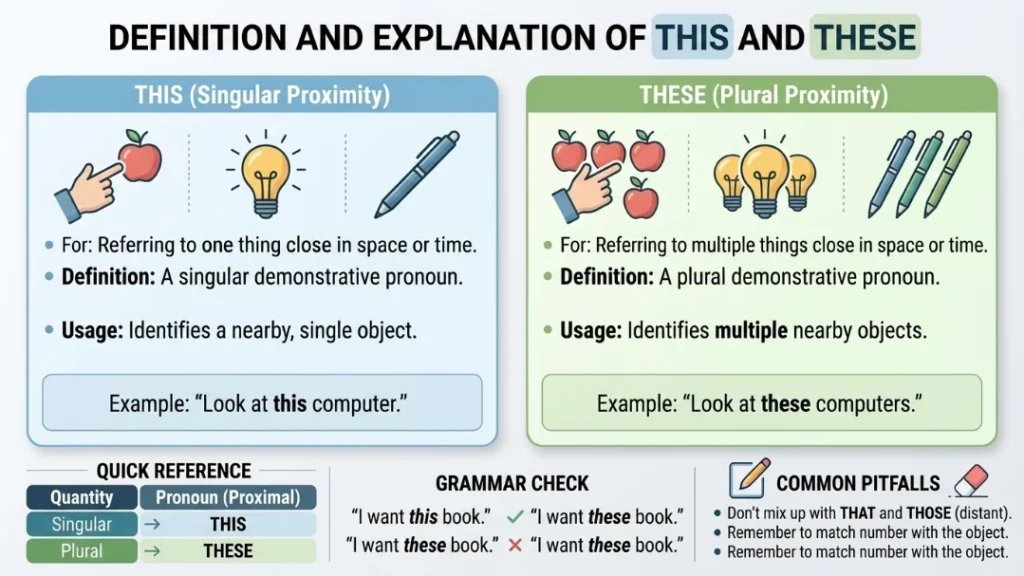
- This points to a single person, object, or concept located close by.
- These points to multiple people, objects, or concepts located close by.
- Singular nouns always require singular modifiers like this during sentence construction.
- Plural nouns always require plural modifiers like these during sentence construction.
- Regular proofreading helps catch pronoun agreement errors before publishing documents.
Definition and Explanation
What is This?
The word functions as a singular demonstrative pronoun and determiner. Writers use it to identify one specific item close in time or physical space. For example, pointing to a single book on a desk involves saying that this book looks interesting.
What is These?
The word functions as the plural demonstrative pronoun and determiner. Writers use it to identify multiple items close in time or physical space. For example, pointing to a stack of books on a desk involves saying that these books look interesting.
Advantages and Disadvantages
| Feature | Using This (Singular) | Using These (Plural) |
| Grammar Status | Correct for single items | Correct for multiple items |
| Clarity | Direct focus on one object | Direct focus on multiple objects |
| Agreement | Matches singular noun forms | Matches plural noun forms |
| Professionalism | Conveys precision in writing | Conveys accuracy in grouping |
Real World Examples
Professionals use demonstrative words across many different industries daily. Software developers test single applications by stating that this program runs smoothly. Retail managers evaluate multiple products by noting that these items sell quickly. Teachers grade student work by mentioning that this essay displays excellent research. Office workers organize supplies by declaring that these folders need labels. Each scenario demonstrates the exact distinction between singular and plural proximity.
Regional and Global Usage
English speakers worldwide follow the exact same rules for demonstrative pronouns. Whether you write in American, British, Canadian, or Australian English, singular and plural forms remain identical. Global communication standards rely heavily on proper pronoun agreement to prevent ambiguity. Professional translators prioritize accurate singular and plural mapping across international languages. Writers everywhere benefit from understanding these core grammatical foundations.
Common Mistakes
Many writers accidentally pair plural nouns with singular modifiers. Using “this computers” instead of “these computers” creates an immediate grammatical error. Another frequent mistake involves temporal references, such as mixing up past and present proximity. Writers must check noun numbers carefully before selecting a demonstrative word.
Exercises with Answers
Exercise One
Fill in the blank with the correct word: Look at ________ magnificent painting on the wall.
Exercise Two
Fill in the blank with the correct word: Please hand me ________ files from the cabinet.
Exercise Three
Identify if the sentence is correct or incorrect: This shoes hurt my feet during the long walk.
Answers
- Answer One: this (The sentence refers to a single painting, requiring the singular form.)
- Answer Two: these (The sentence refers to multiple files, requiring the plural form.)
- Answer Three: Incorrect (The plural noun “shoes” requires the plural modifier “these” instead of “this”.)
Related Concepts and Comparisons
| Term | Grammatical Number | Proximity | Example Sentence |
| This | Singular | Near | This chair is comfortable. |
| These | Plural | Near | These chairs are comfortable. |
| That | Singular | Far | That star shines brightly. |
| Those | Plural | Far | Those stars shine brightly. |
Frequently Asked Questions
What is the main difference between this and these?
The primary difference is grammatical number, where “this” modifies singular nouns and “these” modifies plural nouns.
Can this be used for plural nouns?
No, matching a singular demonstrative with a plural noun creates a direct grammatical error.
How do I know whether to use this or these?
Count the items you are discussing; single items require this, while multiple items require these.
Are these words also used for time references?
Writers frequently use these terms to describe timeframes, such as this week versus these past few weeks.
Do other languages have similar demonstrative rules?
Most languages distinguish between singular and plural physical proximity when using demonstrative adjectives.
How does proper pronoun agreement affect readability?
Correct agreement prevents cognitive friction, allowing readers to process information smoothly without confusion.
What is the plural form of this?
The exact plural equivalent of the singular demonstrative pronoun “this” is “these.”
Can these be used without a noun?
Pronoun usage allows “these” to stand alone when the context clearly identifies the objects in question.
Conclusion
Mastering basic demonstrative pronouns elevates the overall quality of your written communication. Writers achieve clarity by matching singular and plural nouns with appropriate modifiers. Practice checking your work before submission to build lasting writing habits. Clear attention to detail sets exceptional writers apart from the crowd. Apply these lessons today to ensure every sentence you write shines with confidence and accuracy.