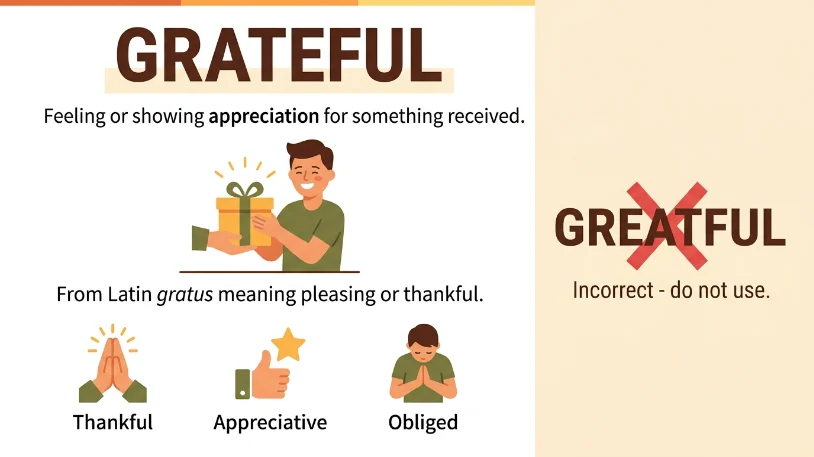
The correct spelling is always “grateful,” which means feeling or showing appreciation for something received. “Greatful” is a common misspelling and should never be used in professional writing.
Have you ever paused while writing a thank-you note, unsure whether to type “greatful” or “grateful”? If this uncertainty sounds familiar, you are certainly not alone. This single-letter difference represents one of the most persistent spelling errors in the English language. The mistake appears everywhere, from casual text messages to formal business correspondence, and it can easily undermine the professionalism of your writing. Understanding the root of this confusion is quite straightforward. The word “great” is such a common term that people naturally want to add a “t” to words that sound similar. However, the correct spelling comes from a different root word entirely. This comprehensive guide will clarify the distinction between greatful and grateful once and for all. By using simple explanations, real-world examples, and helpful memory tricks, you will learn to choose the right spelling with absolute confidence every single time.
Key Takeaway
The most crucial point to remember from this entire discussion is simple. There is only one correct spelling: “grateful.” This word means feeling thankful or showing appreciation. The common misspelling “greatful” is simply incorrect. Since “grateful” has no connection to the word “great,” you should never write it with a “t.” When you want to express thanks or appreciation, always choose “grateful.” Therefore, if you are unsure which to use, the only correct choice is “grateful.”
Definition and Explanation
To use this word correctly, it helps to understand its definition and grammatical roots thoroughly.
Grateful
“Grateful” is an adjective that describes a feeling of thankfulness or appreciation. When you are grateful, you feel warm and thankful toward someone who has helped you or given you something. The word can also describe actions, such as a grateful smile or a grateful heart. The pronunciation is key as well. Say the word aloud. It sounds like “grate-full,” where the first part rhymes with “gate.”
Greatful
Greatful” is a common misspelling of “grateful.” It has no official meaning or recognition in standard English dictionaries. People make this error because they associate gratitude with something “great” and assume the word contains the same “t.” However, this assumption is incorrect.
The Root of Grateful
The etymology of “grateful” explains why it lacks a “t.” The word comes from the Latin “gratus,” which means pleasing or thankful. This same root gives us other words like “gratitude” and “gratify.” You will notice none of these words contain a “t.” The connection to “great” is a complete misconception.
Grateful vs. Great
A helpful way to remember the correct spelling is to understand the difference between these two words.
- Grateful: An adjective meaning thankful or appreciative.
- Great: An adjective meaning very good, large, or important.
These two words have entirely different meanings and origins. Greatness has nothing to do with thankfulness. This understanding will help you avoid the greatful vs grateful confusion.
Advantages and Disadvantages
While it might seem unusual to consider “advantages” and “disadvantages” for a spelling rule, understanding these can help reinforce the lesson.
Correct Usage
The primary advantage of using “grateful” correctly is clarity. When you write “grateful,” your reader immediately understands that you are expressing thankfulness or appreciation. The word is universally recognized and respected in this context. It also enhances your professional credibility. Careful spelling demonstrates attention to detail and respect for your reader. A disadvantage arises when “grateful” is misspelled as “greatful.” This mistake can cause confusion. The reader might pause, question your meaning, or simply judge your writing as careless. In professional settings, such errors can damage your reputation.
Incorrect Usage
The main advantage of knowing that “greatful” is wrong is that you can avoid making an embarrassing mistake. Understanding the correct spelling saves you from appearing uneducated or careless. However, there is no advantage to using the incorrect spelling. The disadvantage is significant. Using “greatful” marks you as someone who has not mastered basic English spelling. This can be particularly harmful in job applications, business communications, and academic writing.
Real-World Examples
Seeing the correct usage of grateful in common contexts makes the distinction easier to grasp.
Grateful in Action
- Personal Relationships: “I am deeply grateful for your support during this difficult time.”
- Professional Settings: “We are grateful for the opportunity to work with such talented clients.”
- Everyday Situations: “She gave me a grateful smile as I held the door open for her.”
- Formal Occasions: “The organization is grateful to all its volunteers for their hard work.”
- Expressing Thanks: “I feel truly grateful for the kindness that strangers have shown me.”
Greatful in Action
These examples show how “greatful” appears incorrectly in everyday writing.
- Incorrect: “I am so greatful for your help.”
- Correct: “I am so grateful for your help.”
- Incorrect: “We are greatful to have you on our team.”
- Correct: “We are grateful to have you on our team.”
- Incorrect: “She gave me a greatful look.”
- Correct: “She gave me a grateful look.”
Regional and Global Usage
The usage of grateful is consistent across all English-speaking regions, from the United States and Canada to the United Kingdom, Australia, and beyond. There is no regional variation in spelling. The word remains the same everywhere. This uniformity makes it easier for global communication. When you write “grateful,” people from any English-speaking country will understand it perfectly. Conversely, “greatful” is recognized as a spelling error in every region. No English-speaking country accepts it as a valid variation.
Global Acceptance
The consistency of “grateful” across the globe is a testament to its importance. It is one of those foundational words that learners of English master early. Its universal acceptance means that using the correct spelling immediately communicates professionalism and education, regardless of where your audience resides.
Common Mistakes and Corrections
The most frequent mistake is using “greatful” when “grateful” is the intended word. Here are the common errors and their fixes.
| Common Mistake | Correction | Explanation |
| “I am so greatful for your help.” | “I am so grateful for your help.” | The context is about thankfulness, not greatness. |
| “We are greatful to receive this award.” | “We are grateful to receive this award.” | This expresses appreciation, not size or quality. |
| “She gave me a greatful hug.” | “She gave me a grateful hug.” | This describes a thankful action, not a great one. |
| “I would be greatful if you could help.” | “I would be grateful if you could help.” | This is a polite request for assistance. |
| “He seemed greatful for the opportunity.” | “He seemed grateful for the opportunity.” | This expresses thankfulness for the chance provided. |
Why People Make This Mistake
People often confuse these spellings because of the word “great.” Since “grateful” begins with “grate,” which sounds exactly like “great,” it is easy to assume they are related. However, they come from completely different roots. “Grateful” comes from Latin, while “great” comes from Old English. Understanding this difference helps eliminate the error.
Exercises with Answers
Practice makes perfect. Test your knowledge with these exercises.
Fill-in-the-Blanks
- I am so _______ for all your support and encouragement.
- We would be _______ if you could attend our wedding.
- She felt truly _______ for the gift she received.
- The team was _______ to have such a wonderful coach.
- I am _______ to be alive and healthy today.
- He gave me a _______ smile before leaving the room.
- We are _______ for the generous donation to our charity.
- I would be _______ if you could send me the report.
- The students were _______ for the extra study session.
- She is _______ for the opportunity to travel abroad.
Answer Key
- grateful (Expressing thanks for support)
- grateful (Polite request in a formal context)
- grateful (Showing appreciation for a gift)
- grateful (Thankfulness for having a coach)
- grateful (Appreciation for life and health)
- grateful (Describing a thankful expression)
- grateful (Expressing thanks for a donation)
- grateful (Formal request for a report)
- grateful (Appreciation for extra study time)
- grateful (Thankfulness for an opportunity)
Correct or Incorrect
- I am greatful for your help today.
- She was grateful to receive the scholarship.
- We are greatful that the weather improved.
- He seemed grateful for our advice.
- I would be greatful if you could reply soon.
Answer Key
- Incorrect (Should be “grateful”)
- Correct (Proper spelling of thankful)
- Incorrect (Should be “grateful”)
- Correct (Proper spelling of thankful)
- Incorrect (Should be “grateful”)
Rewrite the Sentences
Rewrite each sentence using the correct spelling of greatful or grateful.
- I am very greatful to my parents.
- She was greatful for the opportunity.
- We are greatful to have such a good team.
Answer Key
- I am very grateful to my parents.
- She was grateful for the opportunity.
- We are grateful to have such a good team.
Multiple Choice
Choose the correct word to complete each sentence.
- I am (greatful/grateful) for your kindness.
- We are (greatful/grateful) to welcome you.
- She felt (greatful/grateful) and happy.
Answer Key
- grateful
- grateful
- grateful
Related Concepts and Comparisons
Understanding grateful in the context of related words enhances your overall vocabulary.
Grateful vs. Thankful
Many people wonder about the difference between grateful and thankful. While they are often used interchangeably, subtle distinctions exist. “Thankful” typically focuses on acknowledging a specific act of kindness or a particular benefit received. “Grateful” often implies a deeper, more enduring appreciation that can extend beyond a single event. However, in everyday usage, these words overlap considerably.
Grateful vs. Appreciative
“Grateful” and “appreciative” are also closely related. “Appreciative” focuses more on recognizing the value or worth of something. It emphasizes understanding the importance of what has been given or done. “Grateful” emphasizes the feeling of thankfulness itself. For example, you might be appreciative of someone’s expertise but grateful for their help.
Synonyms and Antonyms
Expanding your vocabulary with synonyms and antonyms helps you express yourself more precisely.
Synonyms for Grateful:
- Thankful
- Appreciative
- Obliged
- Indebted
- Pleased
Antonyms for Grateful:
- Ungrateful
- Thankless
- Unappreciative
- Ingrateful (a rare but correct word)
Phrases and Idioms
Several common phrases use “grateful.” Learning these can help you remember the correct spelling.
- “Grateful for small mercies”
- “Eternally grateful”
- “Deeply grateful”
- “Grateful dead” (the band, which has an interesting spelling story)
- “I would be grateful if…”
FAQs
Is it greatful or grateful?
The correct spelling is always “grateful.” “Greatful” is a common misspelling and should never be used. If you are expressing thanks or appreciation, you are feeling “grateful.”
What is the difference between greatful and grateful?
There is no difference in meaning because “greatful” is simply a spelling error. “Grateful” is the only correct form of the word. The confusion arises because “grateful” sounds like it might contain the word “great.”
Why do people spell grateful as greatful?
People often add a “t” because they associate gratitude with something “great” or good. The word “great” has a similar sound to the start of “grateful.” This leads to the common misspelling. However, the words have completely different origins.
How do you spell grateful?
You spell it g-r-a-t-e-f-u-l. It does not contain a “t” after the “r.” A simple way to remember is that “great” has a “t” but “grateful” does not.
What does grateful mean?
“Grateful” is an adjective that means feeling or showing appreciation for something received or experienced. It is about thankfulness and recognition of kindness.
How do you use grateful in a sentence?
You can use “grateful” as an adjective. For example, “I am grateful for your support.” You can also use it to modify a noun, as in “She gave me a grateful look.”
Is it greatful or grateful in British English?
In British English, the correct spelling is also “grateful.” There is no regional variation. “Greatful” is considered incorrect in all forms of English.
What is another word for grateful?
Common synonyms include “thankful,” “appreciative,” “obliged,” “indebted,” and “pleased.” Each carries a slightly different nuance, but they all express a sense of appreciation.
Why does grateful have no t?
The word “grateful” comes from the Latin root “gratus,” which means pleasing or thankful. Since the Latin root has no “t,” the English word does not either. It has no connection to the word “great.”
Is gratefull a word?
No, “gratefull” is also incorrect. The correct spelling is “grateful.” Adding an extra “l” at the end is another common mistake to avoid.
Conclusion
The choice between greatful and grateful is a surprisingly common hurdle. Yet, as this guide has shown, it is a simple distinction to master. The correct spelling is always “grateful,” which means feeling or showing appreciation and thankfulness. “Greatful” is nothing more than a frequent spelling error that has no place in proper writing. By understanding the Latin root “gratus,” you can remember that grateful has no “t.” Professional writing demands accuracy and attention to detail.
Choosing the correct spelling of grateful is a small but significant step toward maintaining a credible and polished voice. When you write a thank-you note, a business email, or any expression of appreciation, always use “grateful.” Next time you are about to type “greatful,” pause for a second and ask yourself if you mean “grateful.” The answer is almost certainly yes. Commit the correct spelling to memory, and you will never face this confusion again.