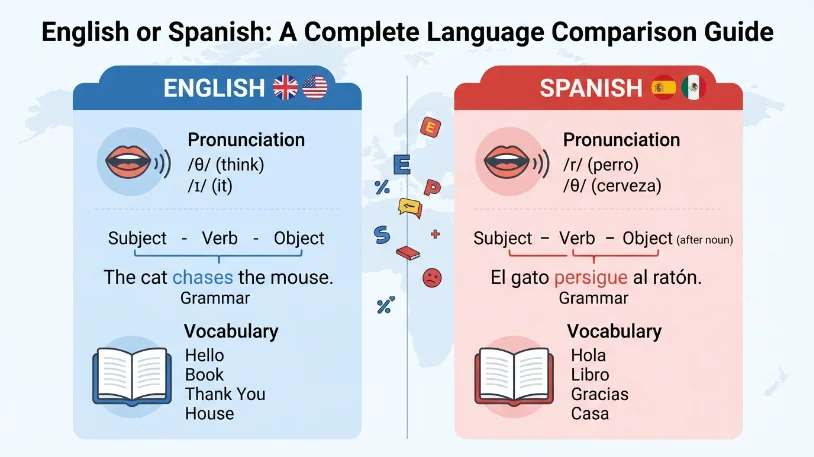
The main difference between English and Spanish lies in their linguistic roots and structures. English is a Germanic language with heavy Romance influence, while Spanish is a Romance language with Latin origins. Understanding these differences helps learners navigate pronunciation, grammar, and vocabulary more effectively.
Have you ever wondered why learning Spanish feels so different from learning English? Or why native speakers of one language often struggle with specific aspects of the other? These two languages are among the most spoken in the world, yet they come from very different linguistic families.
English and Spanish share a surprising connection through history. Both languages have influenced each other over centuries. However, their core structures remain distinctly different. This creates both challenges and opportunities for learners.
Many people assume that because both use the Latin alphabet, they must be similar. This common confusion leads to frustration when learners discover the real differences. For instance, English has 12 vowel sounds while Spanish has only 5. This single difference explains many pronunciation challenges Spanish speakers face when learning English .
We will explore these differences in detail. You will learn about pronunciation, grammar, vocabulary, and cultural usage. Whether you are a beginner or an advanced learner, understanding these distinctions will improve your language skills. We will also cover common mistakes and provide practical exercises to help you practice.
What Do “English” and “Spanish” Mean?
Before comparing the languages, it helps to understand what each term truly means.
Defining the English Language
English is a Germanic language belonging to the Indo-European family . It originated from the dialects brought to Britain by Germanic tribes. These tribes included the Angles, Saxons, and Jutes around 500 AD. The name “English” comes from the Angles, who called their language “Englisc”.
The language has evolved through several stages. Old English gave way to Middle English after the Norman Conquest in 1066. This event introduced many French words into the language. Modern English emerged around the 15th century.
Today, English is the official or co-official language in more than 45 countries . It is the most widely used language in international business. About half of all business deals are conducted in English. Two thirds of scientific studies are written in English. Over 70% of emails are written in English. These facts show why English is often called a global language.
Defining the Spanish Language
Spanish is a Romance language that evolved from Vulgar Latin. The Romans brought Latin to the Iberian Peninsula over 2,000 years ago. Over time, this Latin evolved into what we now call Spanish.
Spanish belongs to the Ibero-Romance group of languages. It shares many features with Portuguese, Italian, and French. However, it has its own distinct characteristics.
Today, Spanish is the second most spoken language in the world after Chinese . It is the official language of 20 countries. Most of these are in Latin America, but Spain itself is the origin. Spanish is also widely spoken in the United States. In fact, more English-speaking people live in China than in the United States .
English or Spanish: A Comparison of Key Differences
Understanding the differences between these languages helps learners know what to expect.
Pronunciation Differences
Pronunciation is one of the most noticeable differences between English and Spanish.
Vowel Systems
English has about 12 pure vowels and 8 diphthongs . Spanish only has 5 pure vowels. These are /a/, /e/, /i/, /o/, and /u/. This difference creates significant challenges for Spanish speakers learning English.
Many Spanish learners struggle to distinguish between English vowel pairs. For example, they may confuse /ɪ/ and /i/ sounds. This creates confusion between words like “sit” and “seat”. They might also struggle with /ʊ/ and /u/ as in “full” and “fool”. Another common challenge involves /æ/ and /ɛ/ as in “cat” and “bed” .
Spanish speakers also often add an “e” sound before words starting with “s” plus a consonant. This is why “school” becomes “escuela” in Spanish and “eschool” in pronunciation.
Consonant Differences
Consonants present another set of challenges. Spanish does not differentiate between /v/ and /b/. This leads to substitutions like “van” becoming “ban” .
The English /h/ sound is often omitted by Spanish speakers. This is because the letter “h” is silent in Spanish. So “house” may become “ouse” .
Perhaps the most famous challenge is the English “th” sound. The sounds /θ/ as in “think” and /ð/ as in “this” do not exist in many Spanish dialects. Learners tend to substitute /t/ or /d/ instead. For example, “think” becomes “tink” .
Spanish also has a rolled “r” sound that does not exist in English. This sound requires practice for English speakers learning Spanish.
Stress and Intonation
Stress patterns differ between the two languages. In English, stress can fall on any syllable and changes meaning. In Spanish, stress follows more predictable rules. Spanish has written accent marks to show when stress deviates from the norm.
The Spanish word “inglés” has an accent mark over the final “e”. This mark indicates that the stress falls on the last syllable . This is why the word is pronounced “een-GLEHS” rather than “EEN-glehss”.
Grammar and Sentence Structure
The grammar of English and Spanish differs in several important ways.
Word Order
English uses a strict Subject-Verb-Object (SVO) word order. For example, “I eat an apple.” Spanish is more flexible. It can use SVO but also allows other orders for emphasis.
Spanish often omits the subject pronoun because the verb ending shows who performs the action. For example, “hablo” means “I speak” without needing to say “yo” (I) . This is impossible in English, which requires a subject pronoun.
Gender
Spanish has grammatical gender for all nouns. Every noun is either masculine or feminine. English generally does not assign gender to nouns. This concept is confusing for English speakers starting Spanish.
For example, “the book” is “el libro” (masculine) in Spanish. “The house” is “la casa” (feminine). Adjectives change form to match the gender and number of the noun .
Auxiliary Verbs
English has many auxiliary verbs like “will”, “would”, “may”, “might”, “shall”, “should”, “must”, and “ought” . Spanish has fewer auxiliary verbs. Spanish speakers express similar meanings through verb conjugations and expressions like “tener que” (to have to) .
Tense Usage
English tenses and Spanish tenses do not always match. Spanish uses the subjunctive mood extensively. This mood expresses wishes, doubts, and hypothetical situations. English uses the subjunctive much less often.
Spanish also has two past tenses: the preterite and the imperfect. English has one simple past tense. This distinction is challenging for English learners of Spanish.
The Connection Between English and Spanish
Despite their differences, these languages share fascinating connections.
Shared History and Vocabulary
English and Spanish are part of the Indo-European language family. This means they share a distant common ancestor. The connection is more recent than that, however.
The Norman Conquest of England in 1066 brought French to England. French itself is a Romance language like Spanish. This introduced thousands of Romance words into English. Today, about 30% of English vocabulary comes from French. Many of these words have Spanish cognates.
For example, “animal” is the same in both languages. “Family” is “familia” in Spanish. “Triumph” is “triunfo” in Spanish. These cognates help learners quickly build vocabulary.
Spanish has also borrowed words from English. Modern words like “internet”, “email”, and “software” are used in Spanish. Words like “béisbol” and “fútbol” come from English “baseball” and “football”.
How to Say “English” in Spanish
Understanding how to say “English” in Spanish is important for learners.
The Noun Form
The word for “English” as a language is “inglés” . It is a masculine noun. You can remember this because nouns ending in “-és” are usually masculine in Spanish. This includes other language names like “francés” (French) and “japonés” (Japanese).
The accent mark on the “e” is important for pronunciation. It indicates that the stress falls on the final syllable . Without the accent, the word would be pronounced differently.
Common phrases using “inglés” include:
- “Hablar inglés” – to speak English
- “Estudiar inglés” – to study English
- “Aprender inglés” – to learn English
- “¿Habla usted inglés?” – Do you speak English?
- “Mis padres no hablan inglés” – My parents do not speak English
The Adjective Form
When “English” describes a person or thing, it changes form. The word must agree in gender and number with the noun it modifies .
| Form | Use | Example |
| Inglés | Masculine singular | “El té inglés” (English tea) |
| Inglesa | Feminine singular | “La cultura inglesa” (English culture) |
| Ingleses | Masculine plural | “Los estudiantes ingleses” (English students) |
| Inglesas | Feminine plural | “Las tradiciones inglesas” (English traditions) |
English nationalities are not capitalized in Spanish. This is different from English rules .
The Plural Noun for People
To refer to English people, use “los ingleses” . This is a masculine plural noun. For example, “Muchos ingleses tienen un sentido del humor seco” (Many English people have a dry sense of humor) .
Navigating “Or” Between English and Spanish
The small word “or” causes many translation issues.
Spanish Translations of “Or”
The most common translation of “or” is “o” . This word connects possibilities just like in English.
However, Spanish has a special rule for “o”. When the following word starts with “o” or “ho”, the word changes to “u”. For example, “uno u otro” means “one or another”. This change avoids the awkward double “o” sound.
Spanish also uses “ni” to mean “nor” in negative statements . This is different from English, which often uses “or” in negative contexts. For example, “The child never smiles or laughs” becomes “El niño nunca sonríe ni se ríe” .
The “Either…or” Mistake
A common mistake Spanish speakers make is translating Spanish word order directly into English . In Spanish, “or…or” works naturally. But in English, this sounds wrong.
The correct English structure uses “either…or” . Here are examples to illustrate this:
| Incorrect (Spanish structure) | Correct (English structure) |
| “We can have the meeting or Tuesday or Wednesday” | “We can have the meeting either Tuesday or Wednesday” |
| “You can call me or in the morning or in the afternoon” | “You can call me either in the morning or in the afternoon” |
The word “either” prepares the listener for two options. The “or” connects them clearly . This small change makes your English sound more natural and professional.
The rule is simple: place “either” just before the first option. For example:
- Either A or B
- Either this week or next week
- Either you or me
Pronouns: Comparing English and Spanish
Pronouns work very differently in these two languages.
Personal Pronouns
Both languages have personal pronouns that can be subjects. Spanish actually has three times fewer demonstrative pronouns than English . This means English has more choices for pointing out specific things.
The pronoun “it” does not exist in Spanish. Spanish speakers use “él” (he) or “ella” (she) for objects. This often leads to confusion when Spanish speakers learn English. They may say “he” for a book or “she” for a table.
Here are personal pronouns in both languages :
| English | Spanish |
| I | Yo |
| You (informal) | Tú |
| You (formal) | Usted |
| He | Él |
| She | Ella |
| It | Ello (rarely used) |
| We | Nosotros |
| You (plural informal) | Vosotros |
| You (plural formal) | Ustedes |
| They | Ellos |
English does not have a formal “you” pronoun like Spanish does. Instead, English uses the same word for formal and informal situations.
Possessive Pronouns
Possessive pronouns show ownership. English and Spanish express possession differently .
The main difference is that Spanish possessive pronouns must agree with the noun they replace. They must match in gender and number. English possessive pronouns do not change form.
English possessive adjectives include “my”, “your”, “his”, “her”, “its”, “our”, and “their”. Spanish equivalents include “mi”, “tu”, “su”, “nuestro”, and “vuestro”. The Spanish forms change to show gender .
Pronunciation Challenges for Spanish Learners
Spanish speakers learning English face specific pronunciation challenges.
Vowel Challenges
As mentioned earlier, English has many more vowel sounds than Spanish. This creates several problems for Spanish speakers.
The /ɪ/ and /i/ distinction is difficult. Words like “bit” and “beat” sound the same to many Spanish speakers. Similarly, /ʊ/ and /u/ cause trouble. “Full” and “fool” become confused.
The /æ/ sound does not exist in Spanish. This is why Spanish speakers might say “bed” when they mean “bad”. They use a sound closer to /ɛ/ instead of /æ/.
Consonant Challenges
The /v/ and /b/ distinction is another major challenge . Spanish only has the /b/ sound. So “berry” and “very” often sound identical.
The English /h/ sound is tricky because Spanish “h” is silent . Spanish speakers might say “ello” when they mean “hello”. They forget to pronounce the initial “h”.
The “th” sounds are completely absent from Spanish . Learners substitute other sounds. “Think” becomes “tink”. “This” becomes “dis”. This substitution can make speech difficult to understand.
Consonant clusters at the end of words are also problematic . Spanish does not allow certain consonant groups at the end of words. So learners add a vowel sound. For example, “past” becomes “pasta”. “Text” becomes “texta”.
Stress and Intonation
English stress patterns differ from Spanish patterns. English word stress is less predictable and can change the meaning. For example, “record” as a noun and “record” as a verb are stressed differently.
Spanish stress follows more regular rules. The accent mark is used to mark exceptions. This is why Spanish speakers often struggle with English stress patterns.
The Global Importance of Both Languages
Understanding why these languages matter helps motivate learning.
The Global Spread of English
English is the world’s most widely used language . It is the official or co-official language in more than 45 countries. These include the United Kingdom, the United States, Canada, Australia, and South Africa.
English dominates several key areas. It is used for about half of all business deals. Two thirds of scientific papers are written in English. Over 70% of all emails are written in English .
The internet runs largely on English. Most programming languages use English keywords. International aviation uses English as its standard. Diplomacy also frequently employs English.
There are more English speakers in China than in the United States . This shows how important English has become worldwide.
The Global Reach of Spanish
Spanish is the second most spoken language in the world . It is the official language of 20 countries. Most Spanish speakers live in Latin America. Spain itself has about 47 million speakers.
Spanish is also widely spoken in the United States. It is the most common non-English language in the US. The Spanish-speaking population continues to grow.
Spanish is important in international business. Many major companies operate in Spanish-speaking markets. It is also an official language of the United Nations.
Spanish culture has global influence. Spanish literature, film, and music are enjoyed worldwide. Spanish cuisine is celebrated globally.
Common Mistakes When Learning English or Spanish
Understanding common mistakes helps learners avoid them.
Common Mistakes Spanish Speakers Make in English
Pronunciation Mistakes
- Confusing /ɪ/ and /i/ in words like “sit” and “seat”
- Confusing /v/ and /b/ in words like “van” and “ban”
- Omitting the /h/ sound as in “house” becoming “ouse”
- Substituting “th” sounds with /t/ or /d/
- Adding a vowel to final consonant clusters like “past” becoming “pasta”
Grammar Mistakes
- Using “or…or” instead of “either…or”
- Omitting subject pronouns like “I” or “you”
- Overusing the present tense for future meaning
- Mixing up “make” and “do”
- Using “since” instead of “for” with durations
Vocabulary Mistakes
- Translating false cognates incorrectly. For example, “embarazada” means “pregnant” not “embarrassed”
- Using “actually” when they mean “currently”
- Mixing up “sensible” (English) and “sensible” (Spanish which means “sensitive”)
Common Mistakes English Speakers Make in Spanish
Pronunciation Mistakes
- Pronouncing “j” like English “j” instead of the Spanish “h” sound
- Failing to roll the Spanish “r”
- Ignoring accent marks and stressing the wrong syllable
- Pronouncing “c” and “z” incorrectly
Grammar Mistakes
- Overusing subject pronouns like “yo” and “tú”
- Using the wrong gender for nouns
- Forgetting adjective agreement in gender and number
- Mixing up “ser” and “estar” (both mean “to be”)
- Using the wrong past tense
Vocabulary Mistakes
- Using false cognates incorrectly. For example, “asistir” means “to attend” not “to assist”
- Confusing “constipado” (with a cold) with “constipated”
- Using “éxito” (success) when they mean “exit”
Practical Exercises with Answers
Practice helps reinforce what you have learned.
Exercise 1: Choose the Correct Form
Choose the correct Spanish word for “English” in each sentence.
- _____ (English) is a difficult language to learn.
- I am studying _____ (English) at university.
- The _____ (English) students are visiting today.
- She is an _____ (English) woman.
Answers:
- El inglés (the language)
- inglés (the subject)
- ingleses (masculine plural adjective)
- inglesa (feminine singular adjective)
Exercise 2: Using “Either…or”
Correct these sentences that use “or…or” incorrectly.
- “We can meet or Monday or Tuesday.”
- “You can pay or cash or credit card.”
- “She will be or at home or at work.”
Answers:
- “We can meet either Monday or Tuesday.”
- “You can pay either cash or credit card.”
- “She will be either at home or at work.”
Exercise 3: Pronunciation Practice
Practice distinguishing these English vowel pairs:
- sit / seat
- full / fool
- cat / bed
- ship / sheep
- pot / port
Answers:
Listen carefully to the vowel sounds. The first word in each pair has a shorter vowel sound. Practice saying both words aloud several times.
Exercise 4: Gender Agreement in Spanish
Choose the correct adjective form:
- El hombre _____ (English)
- La mujer _____ (English)
- Los libros _____ (English)
- Las casas _____ (English)
Answers:
- inglés (masculine singular)
- inglesa (feminine singular)
- ingleses (masculine plural)
- inglesas (feminine plural)
Related Concepts and Comparisons
Understanding related concepts helps build a complete picture.
English and Spanish in Historical Context
English belongs to the Germanic branch of Indo-European languages. Spanish belongs to the Romance branch. These language families split thousands of years ago.
The Germanic tribes that brought English to Britain came from modern-day Denmark and northern Germany . They displaced the Celtic-speaking inhabitants. These Celts moved to Wales, Cornwall, and Scotland. Some migrated to Brittany in France.
The Norman Conquest in 1066 brought French (a Romance language) to England. This heavily influenced English vocabulary. French became the language of the nobility. English remained the language of the common people.
This created the dual vocabulary system English still has today. Words for animals are often Germanic. Words for the meat from those animals are often French . For example, “ox”, “cow”, “calf”, “sheep”, and “swine” are Germanic. “Beef”, “veal”, “mutton”, “pork”, and “bacon” are from French .
Spanish in Historical Context
Spanish began as Vulgar Latin in the Iberian Peninsula. The Roman Empire brought Latin to Spain over 2,000 years ago. This Latin evolved differently in different regions.
The Visigoths briefly ruled Spain and added some Germanic words. The Muslim conquest in 711 AD brought Arabic influence. Many Spanish words beginning with “al-” come from Arabic. Examples include “algodón” (cotton) and “alfombra” (carpet).
The Reconquista gradually pushed Muslims out of Spain. By 1492, Spanish had become the dominant language. That same year, Columbus reached the Americas. Spanish then spread throughout the New World.
The Relationship Between Spelling and Pronunciation
Spanish spelling is highly regular. Words are written as they are pronounced. This makes Spanish easier to read and spell. Once you learn the rules, you can pronounce almost any word.
English spelling is highly irregular. The same letters can have different sounds in different words. For example, “though”, “through”, and “thought” all have different pronunciations. The “ough” spelling is pronounced differently in each word.
This difference affects learning. Spanish learners can focus on pronunciation rules. English learners must memorize the pronunciation of many words individually.
Frequently Asked Questions
What is the Spanish word for English?
The Spanish word for English is “inglés” . It is used as a noun for the language and as an adjective meaning “from England” .
How do you say “Do you speak English?” in Spanish?
You say “¿Habla usted inglés?” . This is the formal version. For informal situations, you can say “¿Hablas inglés?”.
Is it “ingles” or “inglés”?
It is “inglés” with an accent mark over the “e” . This accent shows that the stress falls on the final syllable. Writing “ingles” without the accent changes the pronunciation.
Why is English called “inglés” in Spanish?
The word comes from the English word “English” itself. It was adapted to follow Spanish pronunciation and spelling rules. The “-és” ending is common for language names in Spanish.
What is the biggest challenge for Spanish speakers learning English?
Pronunciation is often the biggest challenge . English has many more vowel sounds than Spanish. Spanish speakers also struggle with consonant sounds that don’t exist in Spanish like /v/ and “th”.
What is the biggest challenge for English speakers learning Spanish?
Grammatical gender is often difficult for English speakers. Spanish nouns are all either masculine or feminine. Adjectives must agree with the noun in gender and number. Verb conjugations are also more complex in Spanish.
What is the difference between “or” and “either…or” in English?
“Or” connects two or more possibilities. “Either…or” emphasizes that you have exactly two options. The “either” prepares the listener that choices are coming . Using “either…or” sounds more natural in English than using “or…or” .
Why does Spanish use “ni” instead of “or” in negative sentences?
In Spanish, “ni” means “nor”. It is used after negative verbs to connect two or more items that are both not happening . This is similar to using “nor” in English, but Spanish uses it more consistently.
Do English and Spanish have similar vocabulary?
Yes, they share many cognates. About 30% of English vocabulary comes from French, which is a Romance language like Spanish. Words like “animal”, “family”, and “future” are similar in both languages. However, be careful of false cognates.
Which language is harder to learn: English or Spanish?
The difficulty depends on your native language. For native English speakers, Spanish is generally considered easier because of its regular spelling and pronunciation. For native Spanish speakers, English is often more challenging due to its irregular spelling, complex pronunciation, and large vowel system.
Conclusion
Understanding the differences between English and Spanish opens up many opportunities. Both languages serve as bridges to different cultures and communities worldwide.
Pronunciation stands out as the most significant difference. English has many more vowel sounds than Spanish. This creates challenges for learners of either language. Spanish speakers need to master sounds like /ɪ/, /æ/, /v/, and the “th” sounds. English speakers need to master the rolled “r” and vowel purity of Spanish.
Grammar also presents distinct challenges. Spanish requires gender agreement for all nouns. English requires strict word order. Learning these rules helps build accurate language skills.
The vocabulary connections between these languages are fascinating. They share thousands of cognates. Yet false cognates can trip up learners.
Practical learning strategies include practicing pronunciation regularly. Listen carefully to native speakers. Record yourself and compare. Use language learning apps for daily practice. Find a conversation partner for speaking practice.
Remember that learning a language takes time. Be patient with yourself. Celebrate your progress. Each new word and phrase expands your ability to communicate.
Whether you are learning English or Spanish, understanding their differences makes the journey easier. Focus on the areas that challenge you most. Practice consistently. Soon, you will find yourself communicating more confidently in your chosen language.