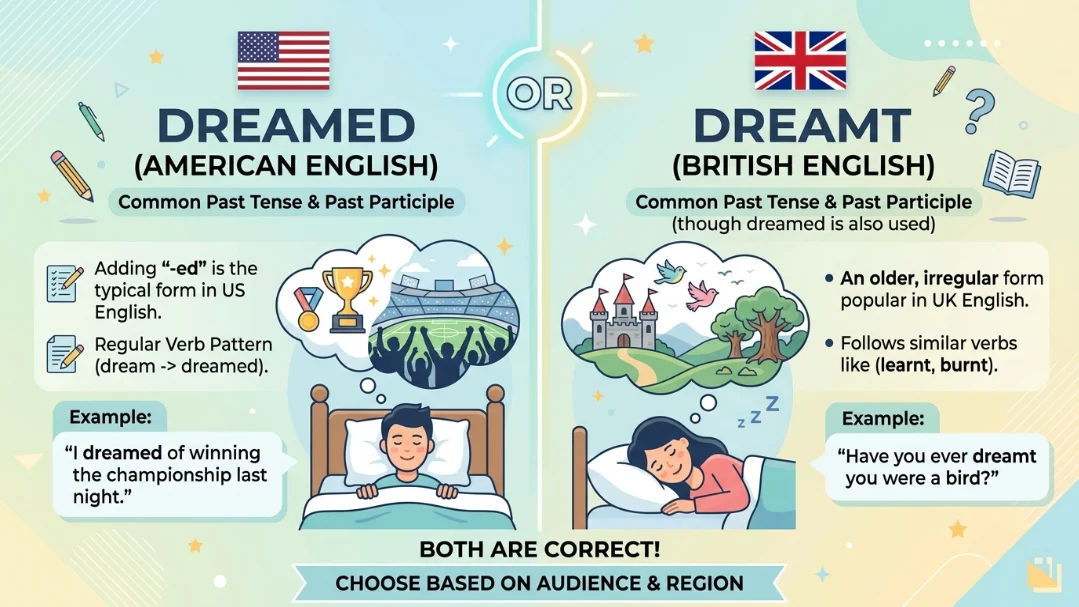
The difference between dreamt and dreamed is simple. Both are past tense forms of the verb dream. Dreamed is the regular past tense form, while dreamt is an irregular variant. Both are correct, though dreamed is more common in American English and dreamt appears more often in British English.
Have you ever written a sentence about a dream and paused, unsure whether to type dreamt or dreamed? This small difference confuses many writers. Both forms are technically correct, but they have different patterns of usage. Choosing the wrong one for your context can make your writing seem out of place.
This confusion matters because these words appear frequently in both spoken and written English. You will need them when telling stories, writing personal narratives, or describing experiences. Getting them right shows attention to detail and awareness of language conventions. It also helps you match your writing style to your audience.
The challenge comes from the fact that both forms are acceptable. Unlike many grammar rules, there is no single right answer here. The choice depends on your audience, your location, and your personal style. Many people simply do not know the difference or which one to prefer.
This article clears up the confusion once and for all. You will learn the definitions, see real examples, and discover the regional patterns that guide this choice. By the end, you will know exactly which form to use in any situation. Good writing depends on making informed choices about these small details.
The main takeaway is that dreamed and dreamt are both correct past tense forms of dream. Dreamed is the regular form and is more common in American English. Dreamt is the irregular form and appears more frequently in British English. You can use either form, but you should be consistent within a single piece of writing. The choice often depends on regional preference and personal style.
Definitions and Explanations
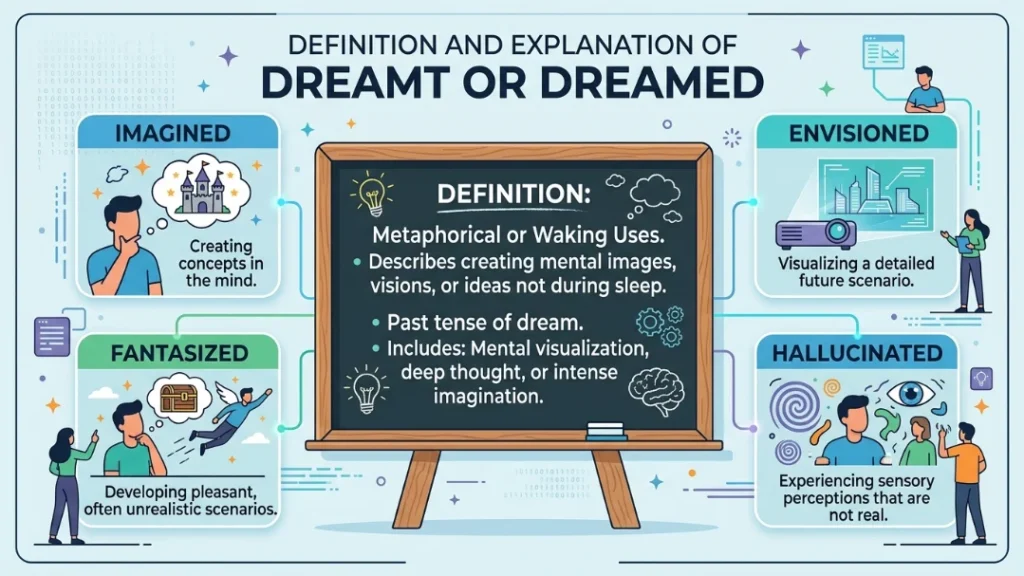
What Does “Dreamed” Mean?
Dreamed is the regular past tense and past participle form of the verb dream. It follows the standard English pattern of adding “-ed” to form the past tense. This is the most common form in modern English, especially in American English.
For example, “I dreamed about flying last night” uses dreamed as the past tense. “She has dreamed of becoming a doctor since childhood” uses dreamed as the past participle. In both cases, dreamed describes a past experience of dreaming.
Dreamed is pronounced as “dreemd.” It has one syllable and rhymes with “seemed” and “teamed.” The pronunciation is straightforward and follows the regular pattern.
| Feature | Description |
| Part of speech | Verb (past tense, past participle) |
| Meaning | To have experienced a dream in the past |
| Pronunciation | dreemd (rhymes with “seemed”) |
| Pattern | Regular (-ed) |
What Does “Dreamt” Mean?
Dreamt is the irregular past tense and past participle form of the verb dream. It follows an older pattern of forming the past tense by changing the vowel sound. This form is less common in modern English but still appears frequently.
For example, “I dreamt about flying last night” also uses dreamt as the past tense. “She has dreamt of becoming a doctor since childhood” uses dreamt as the past participle. The meaning is exactly the same as dreamed.
Dreamt is pronounced as “dremt.” It has one syllable and rhymes with “tempt” and “cleft.” The pronunciation is slightly different from dreamed, with a shorter vowel sound.
| Feature | Description |
| Part of speech | Verb (past tense, past participle) |
| Meaning | To have experienced a dream in the past |
| Pronunciation | dremt (rhymes with “tempt”) |
| Pattern | Irregular (vowel change) |
The Core Difference Explained
The difference between dreamed and dreamt is purely a matter of form, not meaning. Both words mean exactly the same thing. They are both past tense forms of the same verb. The only difference is how they are formed and how commonly they are used.
- Dreamed = regular form (add -ed)
- Dreamt = irregular form (change vowel)
| Form | Pattern | Region | Commonality |
| Dreamed | Regular (-ed) | American English | Very common |
| Dreamt | Irregular (vowel change) | British English | Less common |
The Etymology and Origin
Understanding where these forms come from helps explain why both exist.
- Dreamed: This follows the regular pattern of English verbs. Most verbs in English form their past tense by adding “-ed.” This pattern became dominant over time.
- Dreamt: This follows an older pattern of English verbs. Some verbs form their past tense by changing the vowel. Examples include sleep/slept, keep/kept, and feel/felt. This pattern is older and comes from the Germanic roots of English.
The *-t* ending for past tense verbs comes from an older English form. It appears in several common verbs:
- Burn → Burnt (or burned)
- Learn → Learnt (or learned)
- Spell → Spelt (or spelled)
- Dream → Dreamt (or dreamed)
These verbs all have both regular (-ed) and irregular (-t) forms. The irregular forms are older and more traditional.
| Verb | Regular Past | Irregular Past |
| Burn | Burned | Burnt |
| Learn | Learned | Learnt |
| Spell | Spelled | Spelt |
| Dream | Dreamed | Dreamt |
Advantages and Disadvantages
Both forms have their advantages and disadvantages depending on context and audience.
Advantages of Using “Dreamed”
- Widely accepted: Dreamed is the standard form in American English. It is also common in British English. You will not be wrong using it anywhere.
- Regular pattern: It follows the standard “-ed” pattern. This makes it easier to remember and spell.
- Consistent: If you use regular forms for all verbs, dreamed fits the pattern.
- Modern: Dreamed feels more modern and contemporary in many contexts.
- No confusion: Most readers will recognize dreamed immediately.
Disadvantages of Using “Dreamed”
- Less poetic: Some writers feel dreamed lacks the poetic quality of dreamt.
- More syllables?: No, both have one syllable, but dreamed has a longer vowel sound.
Advantages of Using “Dreamt”
- Traditional: Dreamt is an older, more traditional form.
- Poetic quality: Many writers feel dreamt sounds more literary and poetic.
- Regional authenticity: In British English, dreamt sounds more natural and authentic.
- Variety: Using dreamt adds variety to your writing.
- Slightly shorter: It has a shorter pronunciation.
Disadvantages of Using “Dreamt”
- Less common: Dreamt is less common in American English.
- Can seem outdated: In some contexts, dreamt might seem old-fashioned.
- Regional confusion: American readers might find dreamt unusual.
- Spelling difficulty: The “-t” ending can be harder to remember.
| Aspect | Dreamed | Dreamt |
| American English | Very common | Less common |
| British English | Common | Common |
| Regularity | Regular | Irregular |
| Modern feel | More modern | More traditional |
| Poetic quality | Less poetic | More poetic |
Real-World Examples
Seeing these words used correctly in real-world contexts helps solidify the difference.
Examples of “Dreamed” in Action
- “I dreamed about you last night.” This uses dreamed as the past tense.
- “She has dreamed of traveling the world since she was a child.” This uses dreamed as the past participle.
- “He dreamed that he was flying over the city.” This describes a past dream.
- “We dreamed of a better future for our children.” This expresses a past hope.
- “The inventor dreamed of creating a flying machine.” This describes a past aspiration.
- “I never dreamed I would win the lottery.” This expresses surprise about a past event.
Examples of “Dreamt” in Action
- “I dreamt about you last night.” This uses dreamt as the past tense.
- “She has dreamt of traveling the world since she was a child.” This uses dreamt as the past participle.
- “He dreamt that he was flying over the city.” This describes a past dream.
- “We dreamt of a better future for our children.” This expresses a past hope.
- “The poet dreamt of a world without war.” This describes a past aspiration.
- “I never dreamt I would see you again.” This expresses surprise about a past event.
Contrasting Examples
| Sentence with “Dreamed” | Sentence with “Dreamt” |
| “I dreamed a beautiful dream.” | “I dreamt a beautiful dream.” |
| “She dreamed of success.” | “She dreamt of success.” |
| “He dreamed all night.” | “He dreamt all night.” |
| “They dreamed of the future.” | “They dreamt of the future.” |
Common Phrases with “Dreamed”
- “I dreamed a dream”: A famous phrase from literature.
- “He dreamed big”: He had ambitious goals.
- “She dreamed of fame”: She aspired to fame.
- “We dreamed together”: We shared a dream.
Common Phrases with “Dreamt”
- “I dreamt a dream”: The alternative form of the famous phrase.
- “He dreamt big”: He had ambitious goals.
- “She dreamt of fame”: She aspired to fame.
- “We dreamt together”: We shared a dream.
Regional and Global Usage
The choice between dreamed and dreamt depends significantly on geography and audience.
American English Usage
In American English, dreamed is the dominant form. Most American writers and speakers use dreamed by default. Dreamt appears occasionally, but it is less common.
American style guides generally recommend dreamed as the standard form. The Chicago Manual of Style and other American guides prefer the regular “-ed” form.
| Source | Preferred Form |
| American dictionaries | Dreamed (primary) |
| American style guides | Dreamed |
| American media | Dreamed (predominant) |
| American education | Dreamed (taught as standard) |
British English Usage
In British English, both forms are common. Dreamt is more traditional and appears frequently in British writing. Dreamed is also used and is becoming more common.
British style guides generally accept both forms. They often prefer dreamt for its traditional quality but also accept dreamed as equally correct.
| Source | Preferred Form |
| British dictionaries | Both (dreamed and dreamt) |
| British style guides | Both accepted |
| British media | Both used |
| British literature | Dreamt (more traditional) |
Canadian, Australian, and Other English
These English varieties generally follow the British pattern. Both forms are accepted, but dreamt is often preferred.
- Canadian English: Both forms used, with slight preference for dreamed due to American influence.
- Australian English: Both forms used, with slight preference for dreamt due to British influence.
- New Zealand English: Similar to Australian English.
| Region | Dominant Form | Notes |
| United States | Dreamed | Strong preference |
| United Kingdom | Both | Dreamt more traditional |
| Canada | Both | Slight preference for dreamed |
| Australia | Both | Slight preference for dreamt |
| New Zealand | Both | Slight preference for dreamt |
Global Business and Professional Writing
In global business writing, dreamed is often preferred. This is because American English dominates international business communication. Using dreamed ensures your writing is understood by a global audience.
However, dreamt is also acceptable in international contexts, especially if you are writing for a British or Commonwealth audience.
| Context | Recommended |
| American audience | Dreamed |
| British audience | Both |
| International audience | Dreamed (safer) |
| Literary writing | Both |
Common Mistakes
This section highlights the most frequent errors people make with these words.
Mistake 1: Thinking One Form Is Incorrect
The most common mistake is thinking that one form is wrong. Some people believe that dreamt is incorrect or outdated. Others believe that dreamed is wrong. In reality, both forms are correct and accepted.
Correction: Understand that both dreamed and dreamt are correct. The choice depends on context and audience.
Mistake 2: Inconsistent Usage
Some writers use both forms in the same document. This inconsistency can look unprofessional. It also suggests the writer does not know which form to use.
Correction: Choose one form and stick with it throughout your writing. Consistency is important for professional communication.
Mistake 3: Using “Dreamt” in Formal American Contexts
Using dreamt in formal American English can seem unusual. In legal documents, business reports, and academic papers in the US, dreamed is more appropriate.
Correction: For formal American writing, use dreamed. For British or international contexts, either form is acceptable.
| Form | American Formal | American Informal | British Formal | British Informal |
| Dreamed | Recommended | Common | Acceptable | Acceptable |
| Dreamt | Not recommended | Rare | Common | Common |
Mistake 4: Pronunciation Confusion
Some people pronounce dreamt incorrectly. They might say “dreemed” (like dreamed) or “drehmpt.” The correct pronunciation is “dremt,” with a short “e” sound.
Correction: Practice saying dreamt correctly. It rhymes with “tempt” and “cleft.” The vowel is short, not long.
Exercises
Test your knowledge with these exercises.
Exercise 1: Fill in the Blank
Choose dreamed or dreamt to complete each sentence.
- I _________ about you last night.
- She has _________ of becoming a writer since childhood.
- He _________ that he was flying.
- We _________ of a better world.
- They _________ about winning the championship.
- I never _________ I would see you again.
- The poet _________ of love and beauty.
- She _________ a wonderful dream.
Exercise 2: Identify the Region
For each sentence, identify whether it is more likely American or British English.
- “I dreamt about you last night.”
- “She dreamed of becoming a doctor.”
- “He has dreamt of success.”
- “They dreamed of a better future.”
Exercise 3: Correct the Inconsistency
Each sentence has an inconsistency. Correct it.
- “I dreamed about you last night, and I also dreamt about your sister.”
- “She has dreamed of traveling, and he has dreamt of exploring.”
Answer Key
Answers of Exercise 1:
- Dreamed or Dreamt (both acceptable)
- Dreamed or Dreamt (both acceptable)
- Dreamed or Dreamt (both acceptable)
- Dreamed or Dreamt (both acceptable)
- Dreamed or Dreamt (both acceptable)
- Dreamed or Dreamt (both acceptable)
- Dreamed or Dreamt (both acceptable)
- Dreamed or Dreamt (both acceptable)
Exercise 2 Answers:
- British (more common in UK)
- American (more common in US)
- British (more common in UK)
- American (more common in US)
Exercise 3 Corrections:
- “I dreamed about you last night, and I also dreamed about your sister.” (Choose one form)
- “She has dreamed of traveling, and he has dreamed of exploring.” (Choose one form)
Related Concepts and Comparisons
Understanding how these words relate to other concepts helps build a complete picture.
Dream vs. Daydream
These are related but different concepts.
- Dream: A sequence of images and sensations occurring during sleep.
- Daydream: A pleasant fantasy or reverie occurring while awake.
| Term | Timing | Experience |
| Dream | During sleep | Unconscious experience |
| Daydream | While awake | Conscious fantasy |
Dreamed vs. Dreamt in Literature
In literature, the choice between forms often depends on the author’s style and intended effect.
- Dreamed: Often used in modern, straightforward narratives.
- Dreamt: Often used in poetic, traditional, or literary works.
| Author | Style | Preferred Form |
| Modern American authors | Contemporary | Dreamed |
| British literary authors | Traditional | Dreamt |
| Poets | Poetic | Dreamt (often) |
| Children’s authors | Accessible | Dreamed (often) |
Other Irregular Past Tense Pairs
Many English verbs have both regular and irregular past tense forms.
| Verb | Regular Past | Irregular Past |
| Burn | Burned | Burnt |
| Learn | Learned | Learnt |
| Spell | Spelled | Spelt |
| Smell | Smelled | Smelt |
| Spill | Spilled | Spilt |
| Dream | Dreamed | Dreamt |
FAQs
What is the difference between dreamed and dreamt?
There is no difference in meaning. Both are past tense forms of the verb dream. Dreamed is the regular form, and dreamt is the irregular form. The choice depends on regional preference and personal style.
Is dreamed or dreamt correct?
Both are correct. Dreamed is more common in American English. Dreamt is more common in British English. You can use either form in most contexts.
Which is more common: dreamed or dreamt?
Dreamed is more common overall, especially in American English. Dreamt appears more frequently in British English but is still less common than dreamed globally.
When should I use dreamed?
Use dreamed for American audiences, formal American writing, and international contexts. It is the safer choice for global communication. It is also the preferred form in most style guides.
When should I use dreamt?
Use dreamt for British or Commonwealth audiences, especially in literary or traditional contexts. It is also appropriate for poetic writing. However, dreamed is also acceptable in these contexts.
Is dreamt a word?
Yes, dreamt is a word. It is a valid past tense form of dream. It appears in all major dictionaries and is widely used in English, especially in British English.
Why does English have both dreamed and dreamt?
English has both forms due to its history. The regular “-ed” form follows a newer pattern. The irregular “-t” form follows an older pattern from the Germanic roots of English. Both forms survived in modern English.
Can I use both dreamed and dreamt in the same document?
It is better to be consistent. Using both forms in the same document can look unprofessional. Choose one form and stick with it throughout your writing.
How do you pronounce dreamt?
Dreamt is pronounced “dremt.” It rhymes with “tempt” and “cleft.” The vowel sound is short. It does not sound like “dreemed.”
Is dreamt British or American?
Dreamt is more common in British English but is also used in American English. It is considered a British variant, but it appears in American writing as well.
What is the past tense of dream?
The past tense of dream can be either dreamed or dreamt. Both are correct. The choice depends on your audience and personal preference.
Is “dreamt” the only English word ending in “mt”?
No, dreamt is not the only English word ending in “mt.” However, it is one of the few. Other examples include tempt, exempt, and attempt. The “mt” ending is relatively rare in English.
Conclusion
This guide has clarified the difference between dreamed and dreamt. Both forms are correct. Dreamed is the regular form and is more common in American English. Dreamt is the irregular form and appears more frequently in British English. The choice depends on regional preference, audience, and personal style.
The best practical advice is to be consistent. Choose one form and stick with it throughout your writing. American English prefers dreamed. British English accepts both dreamed and dreamt, although dreamt sounds more traditional. In international or business contexts, dreamed is generally the safer option.
Good writing depends on making informed choices about these small details. Now you have the knowledge to choose the correct form for any context. Use this guide as a reference whenever you are unsure. Over time, the right choice will become second nature to you.